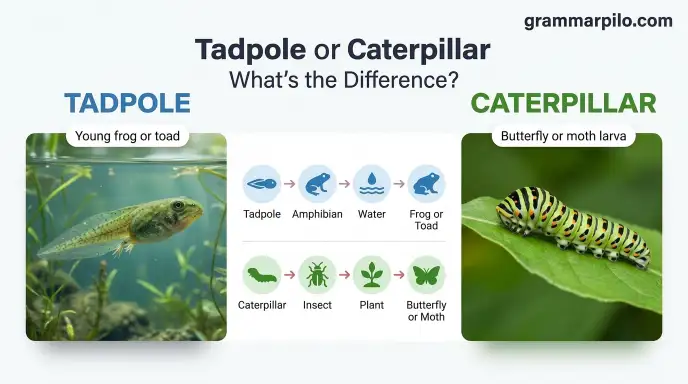
If you are wondering about tadpole or caterpillar, the key difference is simple: a tadpole is the larval stage of a frog or toad, while a caterpillar is the larval stage of a butterfly or moth. They are both young animals that change as they grow, but they belong to very different animal groups.
People often search for “caterpillar or tadpole” because both look like small, developing creatures and both go through major changes during their life cycles. A tadpole lives in water and develops into an amphibian. A caterpillar usually lives on plants and develops into an adult moth or butterfly.
The confusion can also come from the word larva. Both tadpoles and caterpillars are immature stages, but they are not the same type of larva. Their bodies, habitats, diets, and life cycles are different.
In this guide, you will learn what each word means, where the words came from, how their life cycles differ, and when to use each term. You will also see simple examples and a quick comparison table.
Tadpole or Caterpillar: Quick Answer
A tadpole is the aquatic larval stage of a frog or toad. A caterpillar is the larval stage of a butterfly or moth. Tadpoles usually have tails and live in water, while caterpillars have legs, feed mainly on plants, and later form a chrysalis or pupa before becoming adult butterflies or moths.
Tadpole and caterpillar are not two names for the same animal.
The easiest way to remember the difference is:
- Tadpole → frog or toad
- Caterpillar → butterfly or moth
- Tadpole → amphibian
- Caterpillar → insect
- Tadpole → usually aquatic
- Caterpillar → usually lives on land or plants
Example
The frog began life as a tadpole.
The butterfly began life as a caterpillar.
Both words describe an immature stage, but they belong to different life cycles.
A tadpole develops features such as legs and lungs as it changes into an adult frog or toad. A caterpillar grows, sheds its skin several times, and eventually enters the pupal stage before becoming an adult butterfly or moth.
What Does Tadpole or Caterpillar Mean?
What is a tadpole?
A tadpole is the young aquatic stage of a frog or toad.
After hatching from an egg, a young frog or toad usually begins life as a tadpole. It commonly has:
- A rounded body
- A long tail
- Gills for breathing in water
- No fully developed legs at first
As the tadpole grows, its body changes. Hind legs appear first in many species, followed by front legs. The tail becomes smaller, and the animal develops the features needed for life as an adult amphibian.
For example:
We saw dozens of tadpoles swimming in the pond.
The word tadpole therefore refers to a particular stage in the life cycle of frogs and toads.
What is a caterpillar?
A caterpillar is the larval stage of a butterfly or moth.
It hatches from an egg and spends much of this stage eating and growing. Caterpillars usually have:
- A long, soft body
- A head with chewing mouthparts
- Several pairs of legs
- Small structures called prolegs in many species
- A strong appetite for plant material
For example:
The caterpillar was eating a leaf.
After growing enough, a caterpillar enters the pupal stage. A butterfly forms a chrysalis, while a moth usually forms a cocoon or another type of protective structure, depending on the species.
Why are they easy to confuse?
Both animals are young stages of animals that undergo major changes.
This creates an important similarity:
Tadpoles and caterpillars are both immature forms, but they are not the same kind of animal.
A tadpole is an amphibian larva. A caterpillar is an insect larva.
The Origin of Tadpole and Caterpillar
The words tadpole and caterpillar have very different histories.
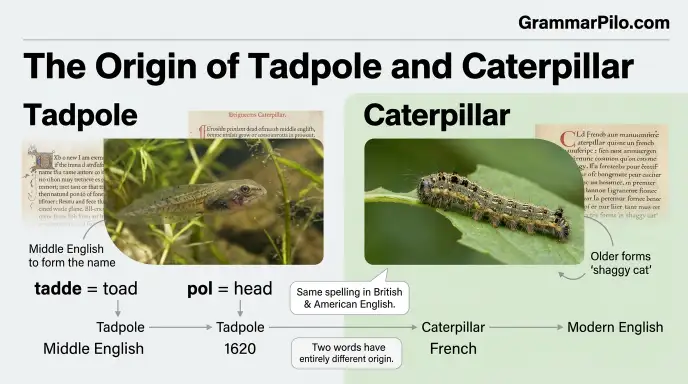
Origin of “tadpole”
The word tadpole dates to the Middle English period. Historical sources record forms such as tadde-pol in the mid-15th century.
The word is generally explained as coming from tadde, meaning “toad,” combined with pol, meaning “head.” The name describes the animal’s appearance, with its large head-like body and tail.
Interestingly, early English uses of related terminology sometimes overlapped with words for other small creatures. Over time, tadpole became the standard English word for the larva of a frog or toad.
Origin of “caterpillar”
Caterpillar also dates from around the mid-15th century.
Its history is more unusual. The modern word developed from older French forms related to caterpilose, associated with the idea of a hairy or shaggy animal. The older expression has been linked to the idea of a “shaggy cat.”
The modern meaning became associated with the larva of butterflies and moths.
So, although tadpole and caterpillar can both describe young stages of animals, their names developed through completely different linguistic histories.
The spelling of either word is not a British-versus-American spelling issue. Both forms are standard in modern English.
British English vs American English
There is no major British and American spelling difference for tadpole or caterpillar.
Both varieties use the same spellings.
| Term | British English | American English | Example |
| Tadpole | tadpole | tadpole | The tadpole lives in water. |
| Caterpillar | caterpillar | caterpillar | The caterpillar is eating a leaf. |
| Plural of tadpole | tadpoles | tadpoles | We saw many tadpoles. |
| Plural of caterpillar | caterpillars | caterpillars | Several caterpillars were on the plant. |
Regional differences
Unlike words such as colour/color or centre/center, these two terms normally do not change spelling between British and American English.
You can therefore write:
The tadpole developed legs.
or:
The caterpillar became a butterfly.
Both sentences are correct in British and American English.
Publishing preferences
For academic, educational, and professional writing, the important point is not regional spelling. It is scientific accuracy.
Do not use caterpillar when you mean a frog larva.
Do not use tadpole when you mean a butterfly or moth larva.
Which Version Should You Use?
You do not need to choose between tadpole and caterpillar based on your country. Choose the word that matches the animal.
United States
Use tadpole for a young frog or toad.
Use caterpillar for the larva of a butterfly or moth.
United Kingdom
The same rule applies. British English uses both words with the same basic meanings.
Canada
Canadian English also uses tadpole and caterpillar in the same general way.
Australia
Australian English follows the same basic distinction. The exact species and life cycle may vary, but the terms remain different.
International writing
For an international audience, use the standard terms:
- tadpole for frog and toad larvae
- caterpillar for butterfly and moth larvae
Academic writing
In academic writing, be precise. If you are discussing biology, identify the animal group and life stage when needed.
For example:
The tadpole is an aquatic stage in the frog’s life cycle.
This is clearer than simply calling it a “baby frog.”
Common Mistakes
Mistake 1: Calling a tadpole a caterpillar
Incorrect:
A frog starts life as a caterpillar.
Correct:
A frog starts life as a tadpole.
Explanation: A caterpillar is the larva of a butterfly or moth. A frog or toad has a tadpole stage.
Memory tip: Think tadpole → toad/frog.
Mistake 2: Calling a caterpillar a tadpole
Incorrect:
The butterfly started as a tadpole.
Correct:
The butterfly started as a caterpillar.
Explanation: Butterflies and moths have a caterpillar stage, not a tadpole stage.
Memory tip: Think caterpillar → butterfly/moth.
Mistake 3: Thinking both are insects
Incorrect idea:
Tadpoles and caterpillars are both insects.
Correct idea:
Caterpillars are insect larvae, while tadpoles are amphibian larvae.
Mistake 4: Thinking a caterpillar becomes a tadpole
A caterpillar does not change into a tadpole.
A caterpillar develops into an adult butterfly or moth.
A tadpole develops into an adult frog or toad.
Mistake 5: Using “baby frog” as the exact scientific term
“Baby frog” is easy to understand, but it is not the same as tadpole.
A tadpole is a particular developmental stage. Once it has developed into a frog, it is no longer a tadpole.
Everyday Examples
In emails
We found several tadpoles in the pond behind the office.
Please avoid touching the caterpillars on the plants.
In business or workplace writing
These words are less common in business writing, but they may appear in environmental, agricultural, educational, or nature-related reports.
The project area contains a small pond with tadpoles.
Staff reported caterpillar damage to several plants.
In news headlines
Local Pond Filled With Tadpoles After Spring Rain
Caterpillar Population Damages Garden Plants
Headlines often use these words because they are short and familiar.
In blogs
How long does it take for a tadpole to become a frog?
What does a caterpillar eat before becoming a butterfly?
On social media
Look at all these tiny tadpoles!
This caterpillar is absolutely covered in bright colors.
In academic writing
Tadpoles undergo significant physical changes during amphibian development.
Caterpillars undergo several growth stages before pupation.
In daily conversation
I saw a tadpole in the pond.
There is a caterpillar on that leaf.
Both are natural uses of the words.
Google Trends & Modern Usage
People who search “tadpole or caterpillar” are usually trying to understand the difference between two animal life stages. The search can come from students, parents, teachers, gardeners, nature enthusiasts, or people who have found an unfamiliar small creature.
Google Trends can show relative search interest by location and time, but it does not provide a simple measure of how often people use these words in everyday speech. Search interest can also change because of school lessons, seasonal wildlife activity, gardening topics, or popular nature content.
For that reason, it would be misleading to give exact country-by-country popularity numbers without a specific Google Trends comparison and date range.
The broader usage pattern is clear:
- Tadpole is strongly linked to frogs, toads, ponds, and amphibian development.
- Caterpillar is strongly linked to butterflies, moths, leaves, gardens, and insect life cycles.
- Both words are common educational terms.
- The phrase “tadpole vs caterpillar” often reflects a comparison of animal development rather than a language or spelling problem.
Google Trends is useful for exploring this interest by country and time, but search volume should not be confused with biological importance or dictionary frequency.
Quick Comparison Table
| Version | Meaning | Correct? | Animal Group | Example |
| Tadpole | Young stage of a frog or toad | Yes | Amphibian | The tadpole swims in the pond. |
| Caterpillar | Larval stage of a butterfly or moth | Yes | Insect | The caterpillar eats leaves. |
| Tadpole for butterfly | Wrong animal stage | No | Insect | A butterfly does not begin as a tadpole. |
| Caterpillar for frog | Wrong animal stage | No | Amphibian | A frog does not begin as a caterpillar. |
Life Cycle Comparison
| Feature | Tadpole | Caterpillar |
| Animal group | Amphibian | Insect |
| Adult form | Frog or toad | Butterfly or moth |
| Typical habitat | Water | Plants or land |
| Main stage after it | Juvenile/adult frog or toad | Pupa |
| Has a tail? | Yes, typically | Not like a tadpole |
| Eats | Varies by species | Mostly plant material |
| Major transformation | Tadpole to frog/toad | Caterpillar to pupa to adult |
| Main association | Ponds and amphibians | Leaves and butterflies/moths |
Key Takeaways
- Tadpole and caterpillar do not mean the same thing.
- A tadpole is the larval stage of a frog or toad.
- A caterpillar is the larval stage of a butterfly or moth.
- Tadpoles are usually associated with aquatic environments.
- Caterpillars usually live on or near plants.
- Tadpoles are amphibians, while caterpillars are insect larvae.
- Neither word has a special British or American spelling.
- Use the word that matches the animal and its life cycle.
FAQs
1. Is a tadpole the same as a caterpillar?
No. A tadpole is the young aquatic stage of a frog or toad. A caterpillar is the larval stage of a butterfly or moth. They belong to different animal groups and follow different life cycles.
2. Does a tadpole become a butterfly?
No. A tadpole develops into a frog or toad. A butterfly develops from a caterpillar after the insect passes through its pupal stage.
3. Does a caterpillar become a frog?
No. A caterpillar becomes an adult butterfly or moth. A frog develops from a tadpole. The two animals have completely different life cycles.
4. Is a tadpole an insect?
No. A tadpole is an amphibian larva. It is an early developmental stage of a frog or toad. A caterpillar, by contrast, is an insect larva.
5. Is a caterpillar an insect?
A caterpillar is the larval stage of an insect, specifically a butterfly or moth. It does not yet look like the adult insect, but it belongs to the insect life cycle.
6. What is the main difference between a tadpole and a caterpillar?
The main difference is the animal they become. A tadpole becomes a frog or toad, while a caterpillar becomes a butterfly or moth. Their bodies, habitats, and development are also different.
7. Can tadpoles live on land?
Tadpoles generally live in water because their early development is adapted to an aquatic environment. As they develop into frogs or toads, they gain features that allow them to spend more time on land.
8. Do caterpillars live in water?
Most caterpillars live on land, often on plants where they find food. There are unusual aquatic insect larvae, but the typical caterpillar associated with butterflies and moths is terrestrial.
9. Why do people confuse tadpoles and caterpillars?
Both are immature stages of animals that undergo major physical changes. People may also see both in nature and describe them simply as “baby animals.” Their life cycles, however, are very different.
10. Which is correct, tadpole or caterpillar?
Both words are correct, but they refer to different animals. Use tadpole for the larval stage of a frog or toad. Use caterpillar for the larval stage of a butterfly or moth.
Conclusion
The difference between a tadpole and a caterpillar is easy to remember once you connect each word to its adult animal. A tadpole is the aquatic larval stage of a frog or toad. A caterpillar is the larval stage of a butterfly or moth.
Their life cycles are also different. Tadpoles develop into amphibians and usually begin life in water. Caterpillars grow on land, often feeding on plants, and later enter a pupal stage before becoming adult butterflies or moths.
There is no British-versus-American spelling problem with these words. Tadpole and caterpillar are spelled the same in both varieties of English. The important issue is choosing the correct biological term.
For students, writers, teachers, and general readers, the simplest rule is also the best one: tadpole means young frog or toad, while caterpillar means butterfly or moth larva.
Use the right word for the right life cycle, and the confusion disappears.
Memorable takeaway: Tadpoles become frogs, caterpillars become butterflies or moths.
Learn the Difference
- Colleague or Coworker: Meaning & When to Use Each
- Someone or Somebody: Which One Should You Use?
- Among or Between: What’s the Real Difference?

I’m Sloane Mercer, a U.S.-based English language writer focused on grammar, spelling, vocabulary, and everyday English usage. Through GrammarPilo, I provide clear and practical explanations to help readers choose the right words and communicate with confidence.








6 thoughts on “Tadpole or Caterpillar: What’s the main Difference?”