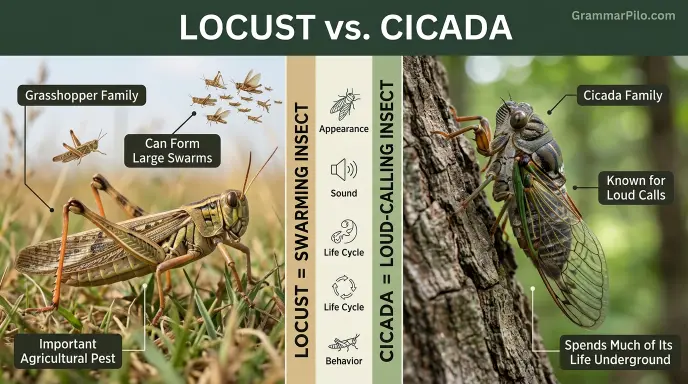
Locust and cicada are not two names for the same insect. A locust is a type of short horned grasshopper that can change its behavior and form large, mobile swarms. A cicada is a different type of insect known for its loud calls, transparent wings, and, in some species, a long period of development underground.
The confusion between cicada or locust often comes from the fact that both insects can appear in large numbers.
Some cicadas, especially periodical cicadas in North America, emerge together by the millions. They are sometimes called “17 year locusts,” but that name is misleading because these insects are cicadas, not true locusts.
Locusts and cicadas also behave very differently. Locusts feed on vegetation and can become serious agricultural pests when they form swarms. Cicadas feed on plant fluids and are best known for their distinctive sounds during their adult stage.
This guide explains locust vs. cicada, including their meanings, biology, appearance, sounds, life cycles, regional usage, common mistakes, and everyday examples. By the end, you will know exactly when to use locust and when cicada is the better word.
Locust or Cicada: Quick Answer
A locust is a type of grasshopper that can form large swarms and damage crops, while a cicada is a different insect known for its loud call and, in some species, years spent underground as a nymph.
Although some cicadas are traditionally called “locusts,” especially 13 year and 17 year cicadas, the two insects are biologically different.
The simplest distinction is this:
- Locust: A swarming type of short horned grasshopper.
- Cicada: A separate insect known for its loud call and distinctive life cycle.
Locusts belong to the order Orthoptera and family Acrididae. Cicadas belong to the order Hemiptera and family Cicadidae. This means they are not closely related in the way their common names might suggest.
| Feature | Locust | Cicada |
| Basic identity | A type of grasshopper | A separate insect group |
| Order | Orthoptera | Hemiptera |
| Main food | Vegetation | Plant fluids |
| Famous for | Large swarms | Loud calls |
| Nymph stage | Develops without the distinctive long underground cicada cycle | Many species spend time underground |
| Agricultural impact | Some species can seriously damage crops | Usually much less destructive |
| Large gatherings | Swarms can travel long distances | Some species emerge together |
| Common nickname issue | True locust | Some are incorrectly called locusts |
Easy memory tip: Think locust = swarm and crops. Think cicada = sound and summer.
What Is a Locust?
A locust is a type of short horned grasshopper. The Food and Agriculture Organization explains that locusts belong to the grasshopper family Acrididae and are unusual because certain species can change their behavior and habits when population density increases.
Under suitable conditions, some locusts change from a relatively solitary phase into a more social or gregarious phase. They can then gather into dense groups called swarms.
This ability makes locusts different from ordinary grasshoppers in everyday usage.
What Do Locusts Eat?
Locusts eat vegetation. Depending on the species, they can feed on leaves, stems, flowers, fruits, seeds, bark, and other plant material. The Desert Locust, for example, is highly adaptable in its diet and can consume many types of crops and vegetation.
This is why locusts can become a major agricultural concern.
A large swarm may contain millions of insects. The FAO reports that a square kilometer of Desert Locust swarm can contain tens of millions of adults under some conditions.
Why Are Locust Swarms Important?
Locusts are especially well known because their swarms can move over large areas and consume substantial quantities of vegetation.
The Desert Locust is considered one of the world’s most destructive migratory pests. When environmental conditions allow populations to increase and become gregarious, dense and highly mobile swarms can develop.
Example:
Farmers watched the locust swarm move across the fields.
Here, locust is the correct word because the sentence describes a swarming grasshopper that feeds on crops.
What Is a Cicada?
A cicada is an insect in the family Cicadidae. Cicadas are especially recognizable because of their loud, continuous calls. Cambridge Dictionary describes the cicada as a large insect found in warm areas that produces a high, continuous sound.
Cicadas have four clear wings and a stout body. Many species spend part of their development as nymphs, feeding on fluids from plants.
Why Are Cicadas So Loud?
Male cicadas produce their characteristic calls as part of their reproductive behavior. The sound can become extremely loud when many males call at the same time.
This is why people often associate cicadas with hot summer days.
Example:
Cicadas filled the trees with their loud calls.
Here, cicadas is the correct word.
What Do Cicadas Eat?
Cicadas feed on plant fluids. Their mouthparts are adapted for piercing plant tissue and drawing out fluids.
The nymphs of periodical cicadas, for example, spend years underground feeding from tree roots before emerging as adults.
This feeding behavior is very different from the chewing and vegetation eating behavior associated with locusts.
Locust vs. Cicada: Appearance and Behavior
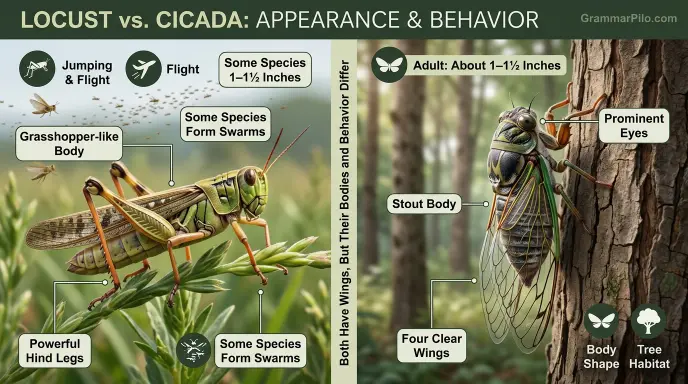
Although both insects have wings and can appear in large numbers, they look and behave differently.
Locusts generally have the familiar grasshopper shape, including powerful hind legs adapted for jumping. Their bodies are built for movement across vegetation and, in swarming species, flight over considerable distances.
Cicadas have a different body shape. Adult cicadas have transparent wings, a stout body, and prominent eyes. University of Minnesota Extension notes that many adult cicadas are roughly 1 to 1½ inches long and have four clear wings.
| Characteristic | Locust | Cicada |
| Body type | Grasshopper like | Broad, stout body |
| Hind legs | Strong jumping legs | Not specialized like a grasshopper’s |
| Wings | Used for flight and migration | Clear, prominent wings |
| Sound | Some species make sounds | Famous for loud calls |
| Feeding | Chews plant material | Pierces plants and feeds on fluids |
| Swarming | Can form mobile swarms | Some emerge in large groups |
| Underground development | Not known for the famous 13 or 17 year cycle | Some species spend years underground |
The differences become particularly obvious when you observe what the insect is doing.
A swarm moving across farmland and feeding heavily on vegetation suggests locusts. A loud chorus coming from trees during warm weather suggests cicadas.
The Origin and History of Locust and Cicada
The words cicada and locust and cicada have separate histories.
The Origin of Locust
The English word locust dates back to the early fourteenth century. It came through Old French from Latin locusta, meaning “locust” and also “lobster.”
The word became strongly associated with grasshopper like insects capable of appearing in large numbers and damaging vegetation.
Because locust outbreaks have affected agriculture for centuries, the word also became associated with destruction, migration, and large swarms.
The Origin of Cicada
Cicada comes into English from Latin cicāda, the name for the insect. The word has remained closely connected with the insect’s distinctive sound and appearance.
The scientific name is much more precise than traditional common names such as “17 year locust.”
Why Is a Cicada Sometimes Called a Locust?
This is one of the most important points in the locust or cicada debate.
Certain North American cicadas are traditionally called 17 year locusts or 13 year locusts because they emerge in large numbers after spending many years underground.
However, they are cicadas, not true locusts.
The Smithsonian specifically notes that periodical cicadas spend most of their lives underground and emerge after 13 or 17 years. Their traditional “17 year locust” name can therefore cause confusion.
For accurate educational and scientific writing, periodical cicada is the clearer term.
British English vs. American English: Locust or Cicada
There is no simple British versus American spelling difference between locust and cicada. Both words are used in British and American English.
However, pronunciation can vary.
Cambridge gives locust as /ˈləʊ.kəst/ in British English and /ˈloʊ.kəst/ in American English. For cicada, British English commonly uses /sɪˈkɑː.də/, while American English has more than one established pronunciation, including /sɪˈkeɪ.də/ and /sɪˈkɑː.də/.
| Variety | Locust | Cicada |
| British English | Locust | Cicada |
| American English | Locust | Cicada |
| Canadian English | Locust | Cicada |
| Australian English | Locust | Cicada |
| International English | Locust | Cicada |
Which Word Should You Use?
Choose locust when you mean a swarming grasshopper.
Choose cicada when you mean the loud, winged insect commonly heard in warm weather.
If you are writing about a periodical cicada, it is better to call it a periodical cicada rather than simply a locust.
Preferred:
Millions of periodical cicadas emerged from the ground.
Less precise:
Millions of locusts emerged from the ground.
The second sentence could make readers think you are describing a crop damaging grasshopper swarm.
Common Mistakes With Locust or Cicada
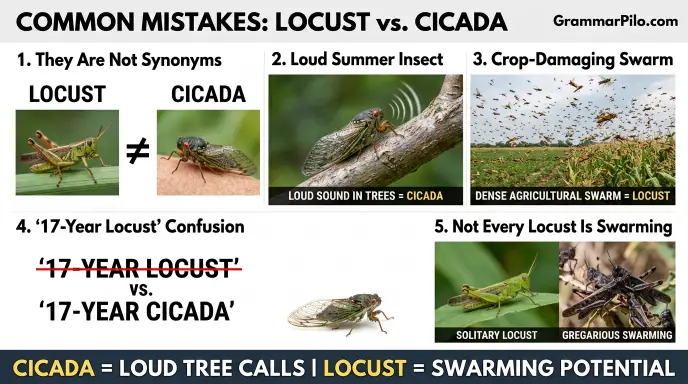
Mistake 1: Thinking Locust and Cicada Are Synonyms
They are not synonyms.
Incorrect: A cicada is a type of locust.
Correct: A cicada is a different type of insect from a locust.
The two insects belong to different orders.
Mistake 2: Calling a Loud Summer Insect a Locust
People sometimes hear a loud buzzing sound in trees and call the insects locusts.
Better:
The cicadas are making a loud noise in the trees.
Cicadas are particularly famous for their calls.
Mistake 3: Calling a Crop Damaging Swarm a Cicada Swarm
A large group of insects does not automatically mean cicadas.
Better:
Locusts formed a dense swarm over the agricultural fields.
Locust swarms can travel and consume vegetation on a large scale.
Mistake 4: Treating “17 Year Locust” as a True Locust
This is one of the most common sources of confusion.
Traditional name: Seventeen year locust
Biologically precise term: Seventeen year cicada
The traditional name refers to a periodical cicada, not a swarming grasshopper.
Mistake 5: Assuming Every Locust Is Always Swarming
Locust species can have different phases. Under low population density, some remain relatively solitary. Under suitable crowded conditions, they can become gregarious and form swarms.
So the ability to swarm is an important characteristic of locusts, but an individual locust is not necessarily part of a swarm at every moment.
Locust or Cicada in Everyday Examples
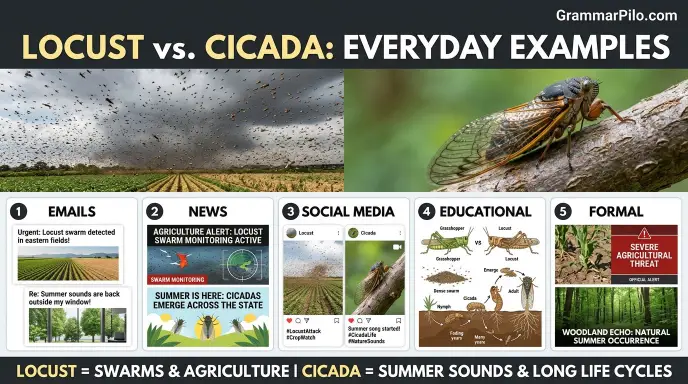
Understanding the context makes choosing the right word much easier.
In Emails
Locust:
The agricultural team is monitoring the locust population near the farms.
Cicada:
The cicadas outside the office have become unusually loud this week.
In News Writing
Locust:
Officials are monitoring the movement of locust swarms across agricultural areas.
Cicada:
Residents have begun hearing cicadas as the weather becomes warmer.
In Social Media
Locust:
A huge locust swarm was spotted over the fields today.
Cicada:
Summer has officially arrived when the cicadas start singing!
In Educational Writing
Locust:
Locusts are grasshoppers capable of changing their behavior and forming swarms.
Cicada:
Some periodical cicadas spend 13 or 17 years underground before emerging as adults.
In Nature Writing
Locust:
The locusts moved across the dry landscape in a dense swarm.
Cicada:
The sound of cicadas echoed through the trees on the hot afternoon.
In Formal Writing
Locust:
Locust swarms can threaten agricultural production and food security.
Cicada:
Periodical cicadas have an unusual life cycle involving prolonged development underground.
Google Trends and Modern Usage: Cicada vs. Locust
The modern usage of locust and cicada is strongly connected to their different meanings.
Locust frequently appears in discussions about agriculture, crop protection, pest control, food security, weather conditions, and insect outbreaks. This is especially true when large swarms affect farming regions.
The FAO continues to monitor locust populations because of their potential effect on crops and livelihoods.
Cicada appears more often in discussions about summer, nature, insect sounds, gardens, trees, and periodical emergences. Search interest can increase when a major periodical cicada emergence is expected.
Search popularity also changes by location. A region affected by locust activity may generate more searches for locust, while a region experiencing a periodical cicada emergence may generate more searches for cicada.
For a current Google Trends comparison, use the live Trends tool rather than relying on a fixed search volume number. Search interest can change over time, so specific figures should not be presented as permanent facts.
The important language point remains unchanged: search popularity does not make locust and cicada interchangeable words.
Locust vs. Cicada: Quick Comparison
| Question | Locust | Cicada |
| What is it? | A type of grasshopper | A distinct insect |
| What is it famous for? | Swarming | Loud calling |
| Does it eat vegetation? | Yes | Feeds mainly on plant fluids |
| Can it form large groups? | Yes, true swarms | Some species emerge together |
| Can it damage crops? | Yes, especially in large swarms | Usually not on the same scale |
| Does it spend years underground? | Not in the famous cicada sense | Some species do |
| What is a 17 year locust? | Not a true locust | A periodical cicada |
| Best memory word | Swarm | Song |
Locust and Cicada: One Sentence Test
Are you still unsure? Try this simple test:
If the sentence is about a crop eating swarm, use locust.
If the sentence is about a loud summer insect or a long underground life cycle, use cicada.
Key Takeaways
- Locusts and cicadas are different insects.
- A locust is a type of short horned grasshopper.
- Locusts can change behavior and form dense, mobile swarms.
- Cicadas belong to a different insect group and are famous for their loud calls.
- Locusts chew and consume vegetation, while cicadas feed on plant fluids.
- Some cicadas spend 13 or 17 years underground before emerging.
- “17 year locust” is a traditional name for a periodical cicada.
- For precise writing, use locust for the swarming grasshopper and cicada for the loud, winged insect.
Frequently Asked Questions
1. What is the difference between a locust and a cicada?
A locust is a type of short horned grasshopper that can form large swarms. A cicada is a different insect known for its loud call and, in some species, a long underground nymph stage.
2. Are locusts and cicadas the same?
No. They belong to different insect groups. Locusts are associated with grasshoppers and swarming, while cicadas are known for their calls and distinctive life cycles.
3. Why are cicadas called 17 year locusts?
Some periodical cicadas emerge every 17 years after spending most of their lives underground. “17 year locust” became a traditional common name, but the insect is actually a cicada.
4. Do cicadas destroy crops like locusts?
Not on the same scale. Locust swarms can consume enormous quantities of vegetation and seriously threaten crops. Cicadas feed on plant fluids and generally have a much smaller agricultural impact.
5. Which insect makes the loud buzzing sound?
Cicadas are famous for their loud calls. Male cicadas produce species specific sounds that can become extremely loud when many insects call together.
6. Can locusts make sounds?
Yes. Locusts and other grasshoppers can produce sounds, but the distinctive continuous summer chorus most people associate with trees and hot weather is characteristic of cicadas.
7. Do all cicadas live underground for 17 years?
No. The 13 year and 17 year cycles belong to periodical cicadas. Many other cicada species have different life cycles and emerge annually or on other schedules.
8. Are all grasshoppers locusts?
No. Locusts are particular grasshopper species with the ability to undergo behavioral and physical changes and, in many cases, form swarms. Most grasshoppers do not behave this way.
9. Is “locust” or “cicada” the correct word for a summer insect?
If you mean the insect that produces the familiar loud summer calls, cicada is usually the correct word. If you mean a swarming grasshopper that feeds heavily on vegetation, use locust.
10. Should I write 17 year locust or 17 year cicada?
For accurate modern writing, 17 year cicada is clearer. 17 year locust is a traditional name for a periodical cicada and can cause biological confusion.
Conclusion: Locust or Cicada?
The difference between locust or cicada is much easier to remember once you focus on what each insect does. A locust is a type of short horned grasshopper that can change its behavior and form dense, mobile swarms.
These swarms can consume large amounts of vegetation and create serious problems for agriculture.
A cicada, on the other hand, is a different insect. It is famous for its loud call, transparent wings, and unusual life cycle. Some periodical cicadas spend 13 or 17 years underground before emerging together in enormous numbers.
The biggest source of confusion is the traditional phrase “17 year locust.” Despite the name, the insect is a cicada. Using periodical cicada or 17 year cicada is therefore clearer in educational and formal writing.
For an easy memory trick, remember: locusts are associated with swarms and crops, while cicadas are associated with sound and summer. Once you connect each word with those characteristics, choosing between locust and cicada becomes straightforward.
Some More Difference
- Flea or Gnat: How to Tell These Tiny Insects Apart
- Tadpole or Caterpillar: What’s the main Difference?
- Crows or Ravens: How to Spot the Difference Easily?

I’m Claire Morgan, the author behind Grammarpilo.com, where I write about English grammar, sentence structure, punctuation, and everyday language. My goal is to make grammar simple, clear, and practical, helping readers understand the rules and apply them with confidence in real-world writing.