
“Someone” and “somebody” are both correct words for referring to an unknown or unspecified person.
They have almost the same meaning, so choosing between them can be confusing. People often search for “someone or somebody” because they want to know if one word is grammatically correct, if one is more formal, or if British and American English use them differently.
The good news is simple: someone and somebody are interchangeable in most sentences. The main difference is tone and frequency.
Cambridge Dictionary notes that someone is used more often in writing, while somebody is more common in speech. It also describes somebody as slightly less formal than someone.
For example:
- Someone left a message for you.
- Somebody left a message for you.
Both sentences are correct. They mean the same thing.
If you are writing an email, report, essay, or other formal text, someone is usually the safer choice. In casual conversation, somebody sounds natural and friendly.
Somebody or Someone: Quick Answer
Someone and somebody are both correct. They mean the same thing: an unknown or unspecified person.
| Word | Meaning | Typical use |
| someone | an unknown or unspecified person | Slightly more common in writing |
| somebody | an unknown or unspecified person | Slightly more common in speech |
Examples
- Someone is waiting outside.
- Somebody is waiting outside.
Both sentences are correct.
Another example:
- I need someone to help me.
- I need somebody to help me.
There is no important difference in meaning. The choice usually depends on style and context. Cambridge specifically says that someone and somebody have no difference in meaning, while somebody is a little less formal.
Definition and Meaning of Someone and Somebody
What does “someone” mean?
Someone is an indefinite pronoun that means some person or a person whose name or identity is not known or not stated.
Examples:
- Someone called you.
- I need someone to help me.
- Someone is standing near the door.
- She wants to meet someone new.
The identity of the person may be unknown, unimportant, or simply not mentioned. Collins defines someone as a person who is not identified by name.
What does “somebody” mean?
Somebody also means some person or an unspecified person.
Examples:
- Somebody called while you were away.
- Somebody left a bag here.
- We need somebody who understands computers.
- Somebody should tell him the news.
Oxford lists somebody as another form of someone when it refers to a person whose name is not known or mentioned.
Can “someone” and “somebody” have another meaning?
Yes. Somebody and someone can also describe an important or well-known person.
For example:
She wants to become somebody in the business world.
Here, somebody means a person who is important or successful.
The same idea can appear with someone:
He hopes to become someone in the music industry.
Collins and Oxford both recognize this additional meaning.
Singular verb agreement
Both someone and somebody are grammatically singular.
Correct:
- Someone is calling.
- Somebody has arrived.
- Someone was here.
- Somebody needs help.
Incorrect:
- Someone are calling.
- Somebody have arrived.
When the person’s gender is unknown, modern English commonly uses they afterward:
Someone left their phone on the table.
Cambridge notes that singular they can refer back to someone or somebody when the person’s gender is unknown.
The Origin of Someone or Somebody
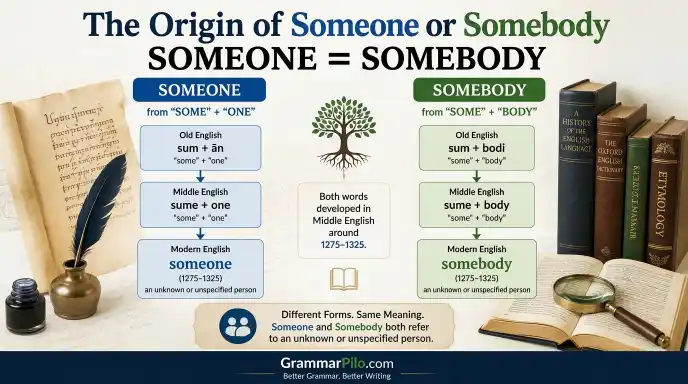
The two words developed from different combinations.
Someone combines some and one. Collins traces the word to Middle English and dates it to approximately 1275–1325.
Somebody combines some and body. Collins also dates this form to approximately 1275–1325, from Middle English.
The difference in form does not mean that the words developed with different meanings. Both came to be used for an unspecified person.
The endings -one and -body also appear in related English words:
- anyone / anybody
- everyone / everybody
- no one / nobody
Over time, these pairs became normal alternatives in English. Today, someone and somebody have essentially the same core meaning.
The spelling difference is therefore not a British-versus-American spelling rule. Someone is not the British spelling and somebody is not the American spelling. Both forms are used in both major varieties of English.
British English vs American English Spelling
There is no spelling difference between British and American English for these two words.
Both varieties use:
- someone
- somebody
The main difference is one of style and frequency, not spelling.
| Feature | British English | American English |
| Someone | Correct | Correct |
| Somebody | Correct | Correct |
| Spelling difference | None | None |
| Meaning | Almost identical | Almost identical |
| Formal writing | Someone often preferred | Someone often preferred |
| Casual speech | Somebody is common | Somebody is common |
Cambridge states that someone is used more in writing, while somebody is more common in speaking.
So you do not need to change the word because of the country you are writing for.
British English examples
Someone has left their umbrella here.
Somebody told me about the meeting.
American English examples
Someone called while you were out.
Somebody left a package at the door.
All four sentences are correct.
Which Spelling Should You Use?
Neither word is a misspelling. Your best choice depends on your audience and the tone of your writing.
For formal writing
Use someone when writing:
- business emails
- academic papers
- reports
- professional documents
- formal notices
For example:
Someone from the finance department will contact you.
Someone tends to sound slightly more neutral and formal.
For casual conversation
Somebody works very well in everyday speech.
For example:
Somebody just called you.
Somebody left the window open.
It can sound relaxed and natural.
For American English
American English accepts both forms. There is no rule saying that Americans must use someone or somebody.
For British English
British English also accepts both forms. The same basic advice applies: someone is often a good choice for writing, while somebody is very natural in speech.
For global English
If you want the safest neutral choice for an international audience, someone is a strong option.
Common Mistakes with Someone or Somebody
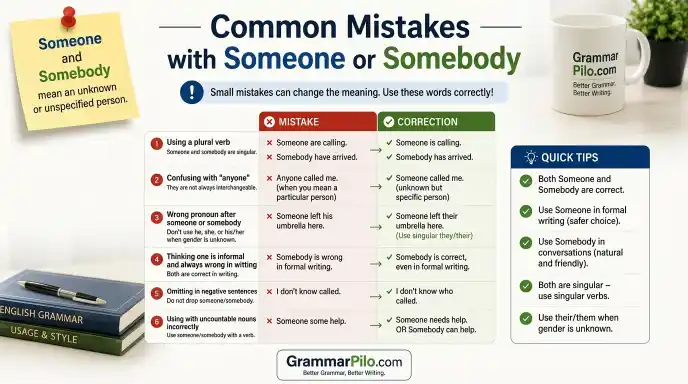
Mistake 1: Thinking one word is incorrect
Incorrect idea:
Somebody is wrong. Someone is correct.
This is not true.
Both are standard English words.
Correct:
Someone called me.
Somebody called me.
Mistake 2: Treating “someone” as plural
Because someone can refer to an unknown number of possible people, learners sometimes use a plural verb.
Incorrect:
Someone are waiting outside.
Correct:
Someone is waiting outside.
Someone is singular.
Mistake 3: Using “their” incorrectly
Modern English commonly uses singular they after someone or somebody.
Correct:
Someone left their keys here.
This avoids guessing the person’s gender.
Mistake 4: Thinking “somebody” is only for casual speech
Somebody can appear in many types of writing. It is not grammatically wrong in formal writing.
However, someone may sound more neutral in professional or academic contexts.
Mistake 5: Confusing “someone” with “anyone”
These words are not always interchangeable.
Compare:
Someone called me.
This suggests that a particular but unidentified person called.
Anyone can join the club.
This means any person is allowed to join.
The some- and any- forms can have different meanings depending on the sentence.
Someone & Somebody in Everyday Examples
In an email
Someone from our support team will contact you shortly.
This sounds professional and neutral.
In casual conversation
Somebody told me that the store is closed.
This sounds natural and conversational.
In news writing
Police said someone entered the building late at night.
Someone is a natural choice for neutral reporting.
On social media
Somebody needs to explain what happened!
Here, somebody sounds casual and expressive.
In formal writing
Someone with relevant experience should review the document.
This is clear and professional.
In everyday questions
Did someone call me?
Did somebody call me?
Both are correct.
With singular “they”
Someone forgot their password.
Somebody left their coat here.
Both sentences use singular they/their naturally.
Somebody vs Someone: Google Trends & Usage Data
Search interest for “someone” and “somebody” can change over time, country, and context. Google Trends measures relative search interest, not the total number of times a word is used in everyday English. Therefore, a Trends graph should not be treated as proof that one word is grammatically better.
For actual language usage, dictionary and corpus evidence is more useful.
Cambridge reports that:
- someone is used more often in writing.
- somebody is more common in speaking.
- The two words have no difference in core meaning.
This helps explain why someone often feels more neutral in articles, reports, and professional writing, while somebody can feel more conversational.
Usage can also differ by context. For example:
| Context | More natural choice |
| Academic writing | Someone |
| Business writing | Someone |
| News writing | Someone |
| Everyday conversation | Someone / Somebody |
| Casual speech | Somebody is common |
| Social media | Someone / Somebody |
| Formal documents | Someone |
Country does not create a simple spelling rule here. Both forms are standard in British and American English.
Someone vs Somebody: Comparison Table
| Point | Someone | Somebody |
| Basic meaning | Some person | Some person |
| Part of speech | Indefinite pronoun | Indefinite pronoun |
| Refers to | Unknown or unspecified person | Unknown or unspecified person |
| Singular? | Yes | Yes |
| Formality | Slightly more neutral | Slightly more casual |
| Writing | More common | Less common |
| Speech | Common | Very common |
| British English | Correct | Correct |
| American English | Correct | Correct |
| Correct spelling | Yes | Yes |
| Can mean an important person? | Yes | Yes |
FAQs About Somebody and Someone
1. Is “someone or somebody” correct?
Yes. Someone and somebody are both correct English words. They usually have the same meaning.
2. Is someone more formal than somebody?
Usually, yes, but only slightly. Someone is often preferred in formal writing, while somebody is common in speech.
3. Is somebody grammatically correct?
Yes. Somebody is a standard English indefinite pronoun.
4. Is someone British or American English?
Neither word belongs exclusively to one variety. Someone is correct in both British and American English.
5. Is somebody singular or plural?
Somebody is singular.
Correct:
Somebody is waiting.
Not:
Somebody are waiting.
6. Can I use “their” after someone?
Yes. Singular their is widely used when the person’s gender is unknown.
Example:
Someone forgot their phone.
7. Which is better: someone or somebody?
For most formal writing, someone is the safer choice. In everyday speech, somebody is completely natural. But neither word is grammatically better in all situations.
Conclusion
Someone and somebody are both correct, and they usually mean exactly the same thing. Both are indefinite pronouns used to refer to a person whose identity is unknown, unstated, or unimportant. The main difference is style rather than grammar.
Someone is often the better choice for formal and professional writing because it sounds neutral and is more common in written English.
Somebody is also correct and is especially natural in everyday conversation. Cambridge confirms that somebody is a little less formal and more common in speech, while someone appears more often in writing.
There is also no British-versus-American spelling rule to remember. Both someone and somebody are standard in British and American English.
Remember that both words are singular, so use a singular verb: “Someone is here” and “Somebody has called.” You can also use singular they when the person’s gender is unknown.
If you are unsure, choose someone for formal writing and somebody when a more conversational tone feels natural. Both are correct.
See More Comparison:

I’m Sloane Mercer, a U.S.-based English language writer focused on grammar, spelling, vocabulary, and everyday English usage. Through GrammarPilo, I provide clear and practical explanations to help readers choose the right words and communicate with confidence.








3 thoughts on “Someone or Somebody: Which One Should You Use?”