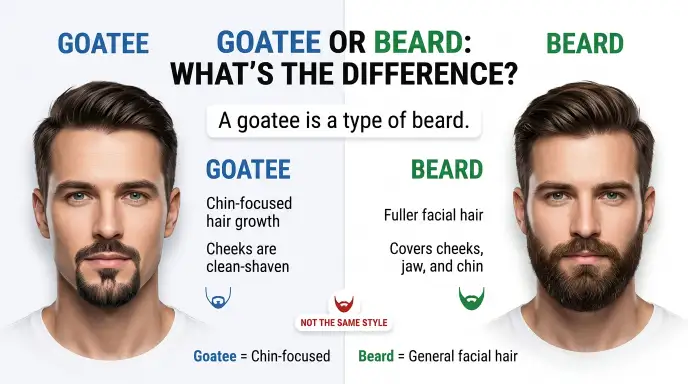
A goatee is a type of beard, but a beard is a broader term for facial hair that grows on the chin, cheeks, and lower face. This is the main difference between goatee or beard. A goatee usually focuses on hair around the chin, while a beard can cover a much larger part of the lower face.
People often search for “goatee or beard” because the two terms are closely related. A person may have facial hair on the chin and wonder if it should be called a goatee, a beard, or both.
The confusion becomes greater because beard styles can vary widely. Some include the cheeks and jaw, while others leave those areas clean-shaven.
A goatee is generally a smaller, more defined style. A traditional goatee is grown mainly on the chin and does not cover the cheeks. A beard can be short, long, full, trimmed, or shaped in many ways.
In this guide, you will learn the difference between a goatee and a beard, where the words came from, how they are used, common mistakes, and which term is best for different situations.
Goatee and Beard: Quick Answer
A goatee is a specific type of beard that is mainly grown on the chin, often with a mustache and little or no hair on the cheeks. A beard is a broader term for facial hair growing on the chin, cheeks, jaw, and lower face. Therefore, a goatee can be called a beard, but not every beard is a goatee.
The simplest answer is:
Goatee = a specific facial-hair style.
Beard = the general term for facial hair.
For example:
- He has a full beard covering his cheeks and jaw.
- He has a goatee on his chin.
- He shaved his beard but kept his goatee.
A goatee usually has a more limited area of growth. Cambridge defines a goatee as a small, usually pointed beard grown only on the chin rather than the cheeks. Oxford similarly defines it as a small pointed beard grown only on the chin.
A beard, by contrast, is a much broader term. Oxford defines a beard as hair growing on the chin and sides of the face. Cambridge also uses beard for hair growing on the chin and lower part of the face.
The key difference
- Goatee: a particular beard style focused on the chin.
- Beard: general facial hair on the lower face.
- Full beard: facial hair covering a large part of the cheeks, chin, jaw, and often the mustache.
- Goatee beard: another way to describe a goatee, especially when emphasizing that it is a beard style.
So, if someone asks, “Does a goatee count as a beard?” the answer is yes, in the broad sense.
What Does Beard or Goatee Mean?
What Does “Goatee” Mean?
A goatee is a small beard that is mainly grown on the chin. The cheeks are usually shaved or kept free of beard growth.
The classic image of a goatee is a small pointed patch of hair below the mouth. Depending on the style, it may be connected to a mustache.
For example:
He decided to grow a goatee instead of a full beard.
This means he chose a smaller facial-hair style focused on his chin.
Another example:
His goatee gives his face a sharper look.
Here, goatee refers to the specific style rather than facial hair in general.
Modern usage can include several variations. Some styles connect the mustache and chin hair, while others focus almost entirely on the chin.
What Does “Beard” Mean?
A beard is the general term for hair that grows on the lower part of the face.
A beard may include hair on:
- the chin
- the cheeks
- the jaw
- the neck
- the area around the mouth
The exact shape depends on the person’s chosen style and grooming.
For example:
He has a long beard.
He trimmed his beard before the interview.
His beard covers most of his jaw.
The word beard is therefore much broader than goatee.
Is a Goatee a Beard?
Yes. A goatee is commonly described as a type of beard.
Think of the relationship like this:
Facial hair → Beard → Goatee
The category becomes more specific as you move from left to right.
Not every beard is a goatee, but a goatee belongs to the larger group of beard styles.
Goatee vs. Full Beard
A full beard normally covers more of the lower face than a goatee.
For example:
He has a full beard that covers his cheeks and chin.
Compared with:
He has a goatee with clean-shaven cheeks.
This is one of the easiest ways to tell the styles apart.
The Origin of Beard and Goatee
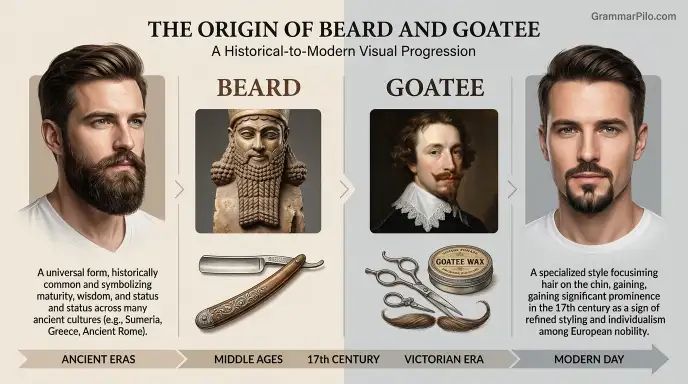
The two words have very different histories.
Origin of “Goatee”
The word goatee comes from the idea that the pointed hair on the chin resembles the hair on a male goat.
The Online Etymology Dictionary dates the noun goatee to the 1840s. It records the word as referring to a pointed tuft of beard on the chin and explains that the name was inspired by its resemblance to a goat’s chin hair.
The form was connected with the adjective goaty, meaning goat-like.
The spelling developed over time. Early forms included goaty, while goatee became the established modern form.
The name is therefore quite literal. A goatee was named for the visual resemblance between a person’s chin hair and a goat’s beard.
Origin of “Beard”
Beard is much older.
Oxford traces the word to Old English and identifies it as a word of West Germanic origin. Related forms appear in other Germanic languages.
The basic meaning has remained connected with facial hair for a very long time.
This gives us an interesting contrast:
- Beard is an old English word with Germanic roots.
- Goatee is a much newer word formed from the idea of a goat-like beard.
The meanings also developed differently. Beard became the general word for facial hair, while goatee became the name for a particular style.
British English vs American English
There is no major British-American spelling difference between goatee and beard. Both words are spelled the same in British and American English.
The main differences are pronunciation and style preferences, not spelling.
| Term | British English | American English | Example |
| goatee | Correct | Correct | He has a goatee. |
| beard | Correct | Correct | He has a beard. |
| goatee beard | Correct | Correct | He wears a goatee beard. |
| full beard | Correct | Correct | He grew a full beard. |
| facial hair | Correct | Correct | His facial hair is neatly trimmed. |
Cambridge gives different pronunciations for British and American English, but the spelling remains goatee in both varieties. The same applies to beard.
British English
In British English, you can say:
He has a beard.
He has a goatee.
American English
In American English, the same terms are used:
He has a beard.
He has a goatee.
There is no rule that requires British speakers to use one word and American speakers to use another.
Which Version Should You Use?
The choice depends on what you are describing. Unlike spelling comparisons such as color and colour, goatee and beard are not competing British and American spellings.
United States
Use goatee when you mean the specific chin-focused style.
Use beard when talking about facial hair more generally.
Example:
He has a short beard.
He has a neatly trimmed goatee.
United Kingdom
The same distinction works in British English.
He grew a beard.
He decided to keep a goatee.
Both words are standard.
Canada
Canadian English also uses beard and goatee in the same basic way.
Choose goatee when the style is specific and beard when the meaning is general.
Australia
Australian English follows the same general distinction.
For example:
He has a full beard.
He wears a goatee.
International Writing
For an international audience, use the most specific word available.
If you mean any facial hair, use beard.
If you mean the chin-focused style, use goatee.
Academic Writing
In academic writing about appearance, fashion, history, or culture, use beard as the broad term and goatee when discussing the specific style.
Example:
The study examined different facial-hair styles, including full beards and goatees.
Business Writing
In most business writing, these words are not common unless appearance is directly relevant.
If you need to describe someone’s appearance, be specific and neutral:
The employee has a short, neatly trimmed beard.
Common Mistakes with Goatee vs. Beard
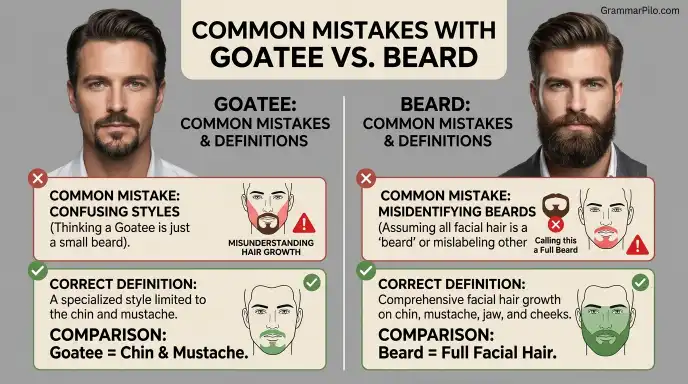
Mistake 1: Thinking every beard is a goatee
Incorrect idea:
He has a beard, so he must have a goatee.
Correct:
He has a beard.
A beard can take many forms. A goatee is only one specific style.
Memory tip: A goatee is a type of beard, not the other way around.
Mistake 2: Using “goatee” for a full beard
Incorrect:
He has a long goatee covering both cheeks.
Better:
He has a long beard covering both cheeks.
A traditional goatee is mainly associated with the chin, while a beard can cover the cheeks and jaw.
Mistake 3: Thinking “goatee” and “beard” are synonyms
They overlap, but they are not exact synonyms.
Beard is the broad category.
Goatee is a more specific style.
Mistake 4: Assuming goatee is a spelling variant of beard
It is not.
Goatee and beard are separate words with different meanings and histories.
Mistake 5: Writing “goaty” instead of “goatee”
Goaty is an adjective meaning goat-like. It is not the modern standard noun for the facial-hair style.
Correct:
He has a goatee.
Not:
He has a goaty.
Beard vs. Goatee in Everyday Examples
In Emails
John will attend the meeting. He is the employee with a short beard.
This is useful when appearance is needed to identify someone.
In Business Writing
The company policy requires employees to keep facial hair neat and well groomed.
Here, facial hair is broader and more neutral than either goatee or beard.
In News Headlines
Actor Debuts New Goatee for Upcoming Film
Here, goatee is more precise because the article refers to a particular facial-hair style.
In Blogs
A short beard can be easier to maintain than a long beard.
A goatee can create a more defined look around the chin.
On Social Media
Thinking about growing a goatee.
Finally shaved my beard!
These are natural uses in casual online writing.
In Academic Writing
The survey included questions about facial-hair styles, including beards, mustaches, and goatees.
This is clear because beards and goatees are treated as related but distinct terms.
In Daily Conversation
Do you have a beard?
No, I have a goatee.
This short exchange shows the distinction clearly.
Google Trends & Modern Usage
People search for “goatee or beard” because the two terms describe related forms of facial hair but do not have the same scope.
A person may search the phrase because they want to know:
- Ifa goatee counts as a beard
- what makes a goatee different from a beard
- If a chin beard is a goatee
- what to call a specific facial-hair style
- If “goatee beard” is correct
- which term is more accurate
Search popularity can vary by country, age group, culture, fashion trends, and the type of information people want.
It is also important to separate search popularity from dictionary meaning. Google Trends can show relative search interest, but it does not decide if a word is grammatically correct or define the word.
There is no reliable reason to claim that one term is universally more popular without checking a specific country, time period, and search category.
Modern English uses beard as the broad everyday term. Goatee remains useful when a speaker wants to describe a particular style.
The rise of grooming, men’s fashion, barbering, and facial-hair content has also created more situations where people need precise names for different styles.
Quick Comparison Table
| Version | Meaning | Correct? | Region | Example |
| Beard | General facial hair | Yes | Worldwide English | He has a beard. |
| Goatee | Chin-focused beard style | Yes | Worldwide English | He has a goatee. |
| Full beard | Beard covering much of the lower face | Yes | Worldwide English | He grew a full beard. |
| Goatee beard | A goatee described as a beard | Yes | Worldwide English | He has a neat goatee beard. |
| Facial hair | General term for hair on the face | Yes | Worldwide English | His facial hair is trimmed. |
| Chin beard | Beard focused on the chin | Yes | General English | He wears a small chin beard. |
Key Takeaways
- Beard is the broad term for facial hair on the lower face.
- Goatee is a specific type of beard.
- A goatee is mainly associated with hair on the chin.
- A full beard usually covers the cheeks, chin, jaw, and often the mustache area.
- A goatee can be called a beard, but not every beard is a goatee.
- Goatee and beard are spelled the same in British and American English.
- Beard is an old English word with Germanic roots.
- Goatee developed later from the idea of a goat-like chin tuft.
- Use goatee when you need to identify the specific style.
- Use beard when talking about facial hair in general.
FAQs About Goatee or Beard
Is a goatee considered a beard?
Yes. A goatee is generally considered a type of beard because it is facial hair grown on the chin. The important difference is that a goatee describes a specific style, while beard is the broader term for facial hair on the lower face.
What is the difference between a goatee and a beard?
A goatee is mainly focused on the chin and usually leaves the cheeks clean-shaven. A beard is a broader term and can include hair on the cheeks, chin, jaw, and other parts of the lower face.
Is a goatee better than a beard?
Neither is automatically better. A goatee and a beard create different looks, and the better choice depends on personal style, grooming preferences, and face shape. If you want a smaller, chin-focused style, a goatee may be suitable. If you want fuller facial coverage, a beard may be better.
Can a goatee include a mustache?
Yes. Many common goatee styles include a mustache connected to the chin hair. However, the exact shape of a goatee can vary. The key feature is that the style centers on the chin rather than covering the cheeks like a full beard.
Is a chin beard the same as a goatee?
Not always. A chin beard is a broad descriptive term for facial hair concentrated on the chin. A goatee is a recognized style that usually involves chin hair and may also include a connected mustache. The terms can overlap, but they are not always identical.
Is “goatee beard” correct English?
Yes. Goatee beard is a valid phrase used to make clear that a goatee is a type of beard. However, goatee alone is usually enough when the context is clear. For example, “He has a goatee” sounds natural and complete.
Is beard a general term?
Yes. Beard is the general term for facial hair growing on the lower face. It can describe many styles, including short beards, long beards, full beards, and other shaped styles. A goatee is one more specific type within the broader category of facial hair.
Is goatee British or American English?
Goatee is used in both British and American English. There is no major spelling difference between the two varieties. The same is true of beard. The words may have different pronunciations, but the spelling and basic meanings remain the same.
Why is it called a goatee?
The name comes from the resemblance between the pointed chin hair of the style and the hair associated with a male goat. Historical etymological records date the word goatee to the 1840s and connect it with the earlier adjective goaty, meaning goat-like.
Which word should I use, goatee or beard?
Use beard when you mean facial hair in general. Use goatee when you mean the specific chin-focused style. If you are describing a person with hair only around the chin, goatee is usually more precise. If the hair covers the cheeks and jaw, beard is the better general term.
Conclusion
Goatee and beard are closely related, but they are not exactly the same thing. A beard is the broad term for facial hair on the lower part of the face, while a goatee is a specific style that mainly focuses on the chin.
This distinction is easy to remember. A goatee is a type of beard, but not every beard is a goatee. A full beard can cover the cheeks, jaw, chin, and mustache area, while a traditional goatee leaves the cheeks mostly clean-shaven.
The words also have different histories. Beard is an old English word with West Germanic roots, while goatee appeared much later and was named because the chin hair resembled that of a male goat.
There is no important British-American spelling difference. Both goatee and beard are standard in British and American English.
When describing facial hair, choose the most precise word. Use beard for the general category and goatee for the specific chin style.
Remember: Every goatee can be called a beard, but not every beard is a goatee.
If you enjoy clear explanations of commonly confused words and phrases, explore more comparisons on GrammarPilo.
Similar Words Explained
- Among or Between: What’s the Real Difference?
- Tadpole or Caterpillar: What’s the main Difference?
- Crows or Ravens: How to Spot the Difference Easily?

I’m Claire Morgan, the author behind Grammarpilo.com, where I write about English grammar, sentence structure, punctuation, and everyday language. My goal is to make grammar simple, clear, and practical, helping readers understand the rules and apply them with confidence in real-world writing.