Philodendron and pothos are two of the most popular indoor plants, but they are easy to confuse because both have trailing vines and heart-shaped leaves.
Philodendron or pothos? The two plants are related, but they are not the same plant. They belong to different genera within the arum family, Araceae.
The confusion is common because some pothos varieties look almost identical to heartleaf philodendrons. Garden centers, plant sellers, and even casual plant owners may use the names loosely.
This makes searches such as pothos or philodendron, philodendron vs. pothos, and pothos vs. philodendron very common.
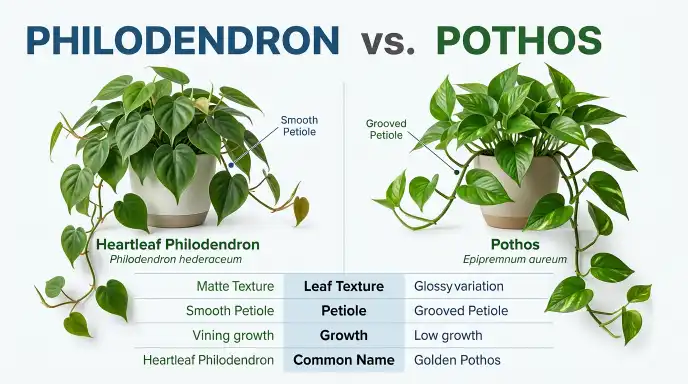
The easiest way to tell them apart is to examine the leaf stems, leaf texture, and new growth. Pothos usually have a noticeable groove in the petiole, while philodendron petioles are generally smooth. Philodendron leaves also tend to feel softer and thinner.
This guide explains the main differences, origins, care needs, common mistakes, and practical ways to identify each plant.
Philodendron or Pothos Quick Answer
Philodendron and pothos are different tropical plants that can look very similar, especially when grown indoors.
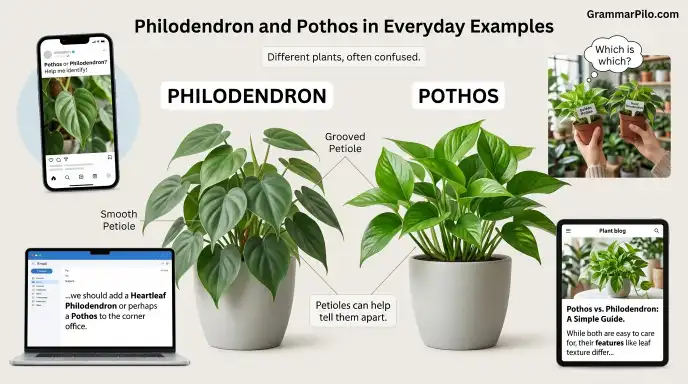
The easiest identification clue is the leaf stem, called the petiole. Pothos generally have a grooved petiole, while heartleaf philodendrons have a smoother petiole.
Quick identification
- Philodendron usually has softer, thinner leaves.
- Pothos usually has thicker, waxier, more glossy leaves.
- Pothos petioles have a noticeable groove.
- Philodendron petioles are generally smooth.
- New philodendron leaves often emerge from a thin protective sheath called a cataphyll.
- New pothos leaves emerge from the existing leaf structure and usually unfurl in a lighter green color.
Example: A plant with a smooth petiole and soft heart-shaped leaves is more likely to be a heartleaf philodendron.
Example: A plant with strong yellow or white variegation is often a pothos, although some philodendron cultivars are also variegated.
What Does Philodendron or Pothos Mean?
What Is a Philodendron?
A philodendron is a member of the genus Philodendron in the Araceae family. The genus includes many tropical plants, including climbing and self-heading forms. Many species are grown as indoor foliage plants.
The heartleaf philodendron is one of the plants most often confused with pothos. It has heart-shaped leaves and a trailing growth habit, making it especially popular in hanging baskets and indoor displays.
Philodendrons are native mainly to tropical areas of Central and South America and the West Indies. In their natural habitats, many species climb trees or grow as epiphytes or hemiepiphytes.
What Is a Pothos?
The plant commonly sold as pothos is usually Epipremnum aureum. It is also known as golden pothos or devil’s ivy.
Although the common name is pothos, the popular houseplant Epipremnum aureum is not currently classified in the genus Pothos. Its history is complicated because it has been placed in several different genera over time.
Pothos is a tropical climbing plant that is widely grown indoors. Common cultivated forms include green, golden, white-variegated, and other patterned varieties.
Philodendron vs. Pothos Leaf Differences
The leaves can provide useful clues.
Heartleaf philodendrons generally have softer, thinner leaves. Pothos leaves tend to be thicker, firmer, and more waxy. Pothos are also commonly sold with strong yellow, white, or green variegation.
However, leaf color alone is not enough for reliable identification. Cultivars can vary greatly, so checking the petiole and new growth gives better results.
Philodendron and Pothos Are Related
Both plants belong to Araceae, commonly called the arum family. This is one reason they can look similar.
They are not the same genus, however. Philodendron belongs to Philodendron, while the plant commonly called pothos is usually Epipremnum aureum.
The Origin of Philodendron or Pothos
The Origin of Philodendron
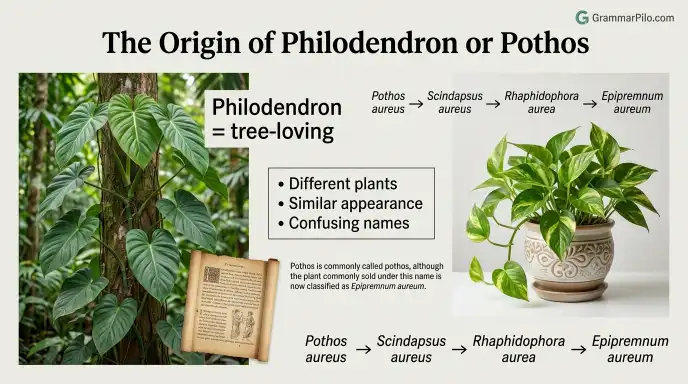
The name Philodendron comes from Greek roots associated with the meaning tree-loving. The name refers to the climbing habit of many philodendron species.
The genus name entered scientific botanical use through New Latin. The name reflects the fact that many philodendrons naturally climb or grow around trees in tropical forests.
The Origin of Pothos
The name pothos has a more complicated history.
The popular houseplant now known as Epipremnum aureum has been classified under different scientific names in the past. It was previously known as Pothos aureus, Scindapsus aureus, and Rhaphidophora aurea. Modern classification places it in the genus Epipremnum.
This history helps explain why the common name pothos remains widely used even though the plant is not currently placed in the genus Pothos.
Why Are the Names So Confusing?
The confusion comes from both appearance and naming history.
Many people learn the name of a plant from a garden center, friend, nursery label, or online listing. Common names can remain in use even after scientific classification changes.
This is why pothos and philodendron can sound like names for two varieties of the same plant. They are actually different plants that happen to share similar features.
British English vs American English
Are the Plant Names Different in British and American English?
The spellings philodendron and pothos are generally the same in British and American English.
The main difference is not spelling. It is more likely to involve common plant names, nursery terminology, or the names used for particular cultivars.
| British English | American English | Example |
| philodendron | philodendron | I bought a philodendron. |
| pothos | pothos | The pothos is growing quickly. |
| heartleaf philodendron | heartleaf philodendron | She grows a heartleaf philodendron indoors. |
| golden pothos | golden pothos | The golden pothos has yellow markings. |
Publishing and Gardening Usage
Plant names are normally written in lowercase when used as common names, such as pothos and philodendron.
Scientific names follow botanical naming conventions. For example, Epipremnum aureum is written with the genus capitalized and the species name lowercase, and the scientific name is italicized.
This distinction is useful in gardening articles, plant labels, academic writing, and horticultural publications.
Which Version Should You Use?
United States
For American readers, use philodendron and pothos as the common names. If exact identification matters, provide the scientific name.
For example, write golden pothos (Epipremnum aureum) when introducing the plant.
United Kingdom
British readers will understand philodendron and pothos in the same basic way. The spelling does not need to change.
Canada
Canadian gardening content can also use the standard forms philodendron and pothos.
Australia
Australian readers commonly encounter these same plant names. The scientific name can help avoid confusion between similar houseplants.
International Writing
For international readers, the clearest approach is to give both the common and scientific name when identification is important.
For example:
Golden pothos, Epipremnum aureum
This makes the information easier to verify and reduces confusion caused by common names.
Academic Writing
Use the scientific name when discussing taxonomy, botany, plant classification, or research.
Business and Gardening Writing
For nursery websites, plant guides, product descriptions, and general articles, use the familiar common name first and add the scientific name when useful.
Common Mistakes About Pothos and Philodendron
Mistake 1: Assuming Every Heart-Shaped Vine Is a Philodendron
Incorrect: Calling every heart-shaped trailing houseplant a philodendron.
Correct: Check the petiole, leaf texture, and new growth before identifying it.
Explanation: Pothos and heartleaf philodendrons can look extremely similar.
Memory tip: Look at the petiole groove. A grooved petiole is a strong clue for pothos.
Mistake 2: Assuming Pothos Is a Type of Philodendron
Incorrect: Pothos is a type of philodendron.
Correct: Pothos and philodendron are separate genera.
Explanation: Both belong to the Araceae family, but they are classified differently.
Mistake 3: Identifying a Plant by Color Alone
Incorrect: It has yellow leaves, so it must be pothos.
Correct: Use several characteristics together.
Explanation: Variegation is common in pothos, but leaf color alone is not enough for reliable identification.
Mistake 4: Ignoring the Petiole
The petiole is the stalk connecting a leaf blade to the stem.
Pothos: The petiole usually has a groove.
Heartleaf philodendron: The petiole is generally smooth.
Mistake 5: Confusing Pothos With Scindapsus
Scindapsus can also resemble pothos. Clemson Extension notes that scindapsus is another group of houseplants commonly confused with pothos.
If accurate identification matters, do not rely on one visual feature.
Everyday Examples
In Emails
Example:
“I moved the philodendron closer to the window because it was not getting enough indirect light.”
In Business Writing
Example:
“The office plant collection includes pothos, philodendrons, and other tropical foliage plants.”
In News Headlines
Example:
“Popular Houseplants Like Pothos and Philodendrons Add Greenery Indoors”
In Blogs
Example:
“Philodendron and pothos are often confused, but their petioles provide a useful identification clue.”
On Social Media
Example:
“Can anyone tell me if this is a pothos or a philodendron?”
In Academic Writing
Example:
“Heartleaf philodendron and Epipremnum aureum are both members of the Araceae family.”
In Daily Conversation
Example:
“Is that a pothos or a philodendron?”
In Plant Shopping
Example:
“I wanted a trailing houseplant, so I compared pothos and philodendron before buying one.”
These examples show why both philodendron and pothos are useful terms in everyday plant discussions, even though they identify different plants.
Google Trends & Modern Usage
Why Do People Search Philodendron or Pothos?
The phrase philodendron or pothos usually reflects a plant-identification question.
People may see a heart-shaped vine and want to know what they have. Searches also come from shoppers comparing houseplants, beginners learning plant care, and owners trying to identify a plant from a photograph.
Common search variations include:
- philodendron or pothos
- pothos or philodendron
- philodendron vs. pothos
- pothos vs. philodendron
- philodendron and pothos
- pothos and philodendron
- pothos plant vs philodendron
- how to tell pothos from philodendron
- philodendron vs pothos leaves
- pothos or heartleaf philodendron
Regional Search Patterns
Exact search popularity can change over time and by country. Search interest may also increase when houseplants become popular on social media, gardening websites, and indoor plant communities.
A search trend does not prove that one plant is more common or easier to grow. It only shows that people are searching for information about a topic.
What Makes the Search So Common?
The main reason is visual similarity.
Both plants can have:
- Heart-shaped leaves
- Trailing stems
- Aerial roots
- Tropical growth habits
- Green foliage
- Similar indoor uses
The most useful way to separate them is to examine several plant features rather than relying on a single characteristic.
Quick Comparison Table
| Version | Meaning | Correct? | Region | Example |
| Philodendron | Genus of tropical aroid plants | Yes | International | This philodendron has heart-shaped leaves. |
| Pothos | Common name usually used for Epipremnum aureum | Yes | International | The pothos is growing over the shelf. |
| Philodendron or pothos | Comparison of two different plants | Yes | International | Is this a philodendron or pothos? |
| Pothos or philodendron | Same comparison in reverse | Yes | International | Should I buy a pothos or philodendron? |
| Philodendron vs. pothos | Comparison phrase | Yes | International | Philodendron vs. pothos can be confusing. |
| Pothos vs. philodendron | Reverse comparison phrase | Yes | International | Pothos vs. philodendron is a common plant question. |
Main Physical Differences
| Feature | Philodendron | Pothos |
| Family | Araceae | Araceae |
| Genus | Philodendron | Common pothos is usually Epipremnum |
| Leaf texture | Often softer and thinner | Often thicker and waxier |
| Petiole | Generally smooth | Usually grooved |
| Growth | Many climbing and self-heading forms | Commonly trailing or climbing |
| Variegation | Depends on cultivar | Common in cultivated varieties |
| New leaves | Often emerge from a cataphyll | Usually unfurl from the existing growth |
| Common indoor use | Houseplant | Houseplant |
The physical clues above are especially useful for identifying a heartleaf philodendron and common pothos, because the broader groups contain many different species and cultivars.
Key Takeaways
- Philodendron and pothos are different plants.
- Both belong to the Araceae family.
- Common pothos is usually Epipremnum aureum.
- A pothos petiole is generally grooved.
- A heartleaf philodendron petiole is generally smooth.
- Pothos leaves are often thicker and waxier.
- Heartleaf philodendron leaves are often softer and thinner.
- Common names can create confusion, so scientific names are useful for exact identification.
- Both plants are commonly grown as indoor tropical foliage plants.
- If pets are present, keep both plants out of reach because pothos and philodendron contain insoluble calcium oxalates that can cause oral and digestive irritation when chewed.
FAQs About Pothos or Philodendron
1. Is a philodendron the same as a pothos?
No. Philodendron and pothos are different plants. They belong to the same plant family, Araceae, but they belong to different genera. The common pothos sold as a houseplant is usually Epipremnum aureum, while philodendrons belong to the genus Philodendron.
2. How can I tell a pothos from a philodendron?
The petiole is one of the easiest clues. Pothos usually have a grooved petiole, while heartleaf philodendrons generally have smooth petioles. Leaf texture can also help. Philodendron leaves are often softer and thinner, while pothos leaves tend to be thicker and waxier.
3. Is pothos easier to grow than philodendron?
Both can be successful indoor plants, but care needs vary by species and cultivar. Illinois Extension notes that philodendrons tolerate low light well, while pothos generally need somewhat more light to maintain strong variegation. Avoid assuming that every variety has exactly the same requirements.
4. Why is pothos not called Epipremnum?
Pothos is a common name that remained in everyday use even after botanical classification changed. The popular houseplant was previously placed in several genera, including Pothos, but it is now generally known botanically as Epipremnum aureum.
5. Can pothos and philodendron grow together?
They can be kept in the same indoor environment if their basic growing conditions are suitable. Both prefer warm conditions and indirect light, but individual species and cultivars can have different needs. It is best to check the requirements of each specific plant instead of treating every pothos or philodendron as identical.
6. Are pothos and philodendron safe for cats and dogs?
Both can be harmful if chewed or swallowed. ASPCA lists pothos and philodendron among plants containing insoluble calcium oxalates, which can cause oral irritation, drooling, vomiting, and difficulty swallowing. Keep these plants away from pets and contact a veterinarian if an animal has a significant exposure.
7. Does a philodendron have heart-shaped leaves?
Some philodendrons do. The heartleaf philodendron is especially well known for its heart-shaped leaves. However, not all philodendrons have the same leaf shape because the genus contains many different species and forms. This is why leaf shape alone should not be used to identify a plant.
8. Why do pothos and philodendron look so similar?
Both are tropical aroids and many are climbing or trailing plants. Their indoor juvenile leaves can also look alike. The petiole, leaf texture, new growth, and other structural features provide better clues than a quick look at the leaves alone.
9. Which plant has a grooved stem or leaf stalk?
The pothos usually has a grooved petiole. The heartleaf philodendron generally has a smoother petiole. This is one of the most useful visual tests when comparing these two commonly confused houseplants.
10. Can a plant be called pothos even if it is Epipremnum?
Yes. Pothos is the familiar common name for the popular houseplant Epipremnum aureum. Common names do not always match current scientific classification. In plant writing, giving the scientific name alongside the common name can make identification much clearer.
Conclusion
Philodendron and pothos are easy to confuse, but they are not the same plant. Both belong to the Araceae family, and both are popular tropical houseplants with attractive foliage. The common pothos sold indoors is usually Epipremnum aureum, while philodendrons belong to the genus Philodendron.
When comparing philodendron or pothos, start with the petiole. Pothos usually have a noticeable groove, while heartleaf philodendrons generally have smooth petioles. Leaf texture and new growth can provide additional clues.
The names can also be confusing because common plant names often remain in everyday use after scientific classifications change. That is why Epipremnum aureum can still be widely called pothos.
For gardening articles, plant shopping, or casual conversation, the common names are fine. For exact identification, add the scientific name.
Remember this simple clue: a grooved petiole points toward pothos, while a smooth petiole points toward heartleaf philodendron.
If you enjoy comparing commonly confused plants, explore more plant guides and identification articles on GrammarPilo.
Check This Out!

I’m Claire Morgan, the author behind Grammarpilo.com, where I write about English grammar, sentence structure, punctuation, and everyday language. My goal is to make grammar simple, clear, and practical, helping readers understand the rules and apply them with confidence in real-world writing.








1 thought on “Philodendron or Pothos: How to Tell Them Apart”