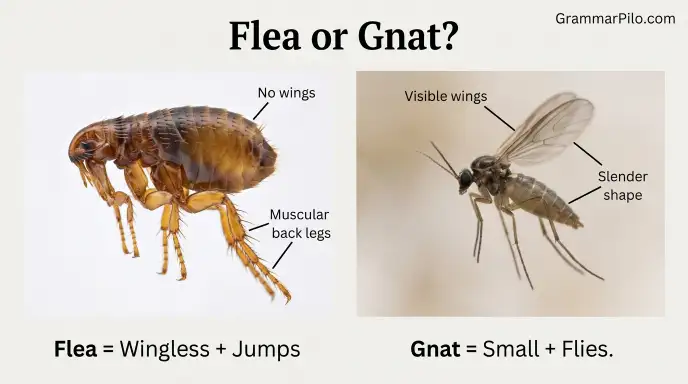
A flea is a tiny, wingless, jumping insect that feeds on blood, while a gnat is a general name used for several types of small flying insects.
Although both can be tiny and annoying, flea and gnat describe very different kinds of insects.
The confusion around flea or gnat usually happens because both insects are small enough to be difficult to identify at a glance.
They can also bite people or animals, depending on the species. However, their bodies, movement, habitats, and life cycles are quite different.
Fleas are especially associated with mammals and pets. They have flattened bodies and powerful legs that allow them to jump. The CDC notes that fleas are small insects that survive by feeding on animal or human blood.
Gnats are different. The word gnat is a broad common name rather than the name of one single insect group. Some gnats bite people and animals, while others do not.
University of Minnesota Extension notes that some insects called gnats are small flying insects that can bite humans and animals.
Understanding the difference between flea vs. gnat becomes much easier when you look at if the insect jumps or flies, where it is found, and what it looks like.
Flea or Gnat: Quick Answer
Flea: A small, wingless, blood feeding insect that usually jumps rather than flies.
Gnat: A small flying insect name used for several different types of insects, including some biting species.
Simple rule: If the tiny insect jumps and has no wings, it may be a flea. If it flies around in the air, it may be a gnat or another small flying insect.
Definition and Meaning of Flea or Gnat
What Does Flea Mean?
A flea is a small parasitic insect that feeds on blood. Fleas are wingless and have bodies adapted for moving through the fur or hair of their hosts.
The CDC reports that there are more than 2,500 flea species worldwide, with more than 300 species occurring in the United States. Common species include cat fleas, dog fleas, ground squirrel fleas, and Asian rat fleas.
Fleas are particularly well known because they can infest pets and homes.
Their bodies are flattened from side to side, which helps them move through animal fur. Their strong legs allow them to jump considerable distances relative to their small body size.
What Does Gnat Mean?
A gnat is a common name used for several kinds of small flying insects.
Unlike the word flea, gnat does not refer to one single biological group. Different insects may be called gnats in everyday English.
Some gnats bite people and animals. For example, University of Minnesota Extension describes black flies or buffalo gnats as small biting flying insects.
Other insects commonly called gnats may be harmless and simply become a nuisance around plants, soil, or damp areas.
Flea and Gnat Are Not the Same Insect
Although flea and gnat are both names for tiny insects, they differ in important ways.
A flea is wingless and adapted for jumping and feeding on blood.
A gnat is generally a small flying insect, and the term can refer to several different insects with different habits.
How Fleas and Gnats Look Different
Appearance is one of the easiest ways to compare flea vs. gnat.
| Feature | Flea | Gnat |
| Wings | No | Usually yes |
| Movement | Jumps and crawls | Flies |
| Body | Small and flattened | Usually slender or compact |
| Size | Very small | Very small |
| Blood feeding | Yes for adult fleas | Some species bite and feed on blood |
| Common location | Animals, bedding, carpets, surroundings | Air, plants, soil, water, vegetation |
| Visibility | Often difficult to see | Often seen flying |
| Main association | Pets and mammals | Small flying insects |
Fleas are particularly distinctive because they are wingless and laterally flattened. University of Minnesota Extension also notes that fleas can be flattened from side to side and have hard bodies.
The Origin of Flea and Gnat
The Origin of Flea
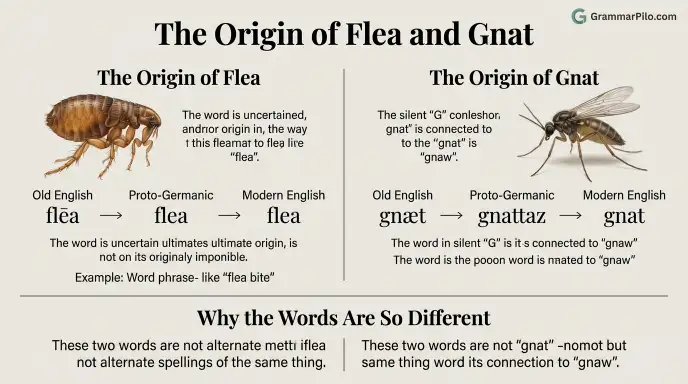
The word flea comes from Old English flēa and can be traced through Proto Germanic forms. Its deeper origin is uncertain, although Etymonline connects it with a possible Indo European root associated with the flea.
The word has been part of English for centuries.
Related expressions developed over time, including flea bite, flea bitten, flea collar, and flea circus.
The Origin of Gnat
The word gnat comes from Old English gnæt, meaning a gnat, midge, or small flying insect.
Etymonline traces it to Proto Germanic gnattaz and notes a possible connection with the idea of a biting insect and the verb gnaw.
The silent g in gnat is a historical feature of the spelling. Modern English pronunciation does not pronounce the initial g.
Why the Words Are So Different
The words flea and gnat developed from completely different linguistic histories.
Flea: An old Germanic word connected with the name of the parasite.
Gnat: An Old English word for a small flying or biting insect.
Neither word is simply another spelling of the other.
British English vs American English Spelling
The spelling of flea and gnat does not normally change between British and American English.
| Word | British English | American English |
| Flea | Flea | Flea |
| Gnat | Gnat | Gnat |
| Fleas | Fleas | Fleas |
| Gnats | Gnats | Gnats |
The main differences are related to which insects people call gnats, rather than to spelling.
The word gnat can refer to different small flies in different regions and contexts. This is one reason the term can sometimes be less precise than a scientific insect name.
Which Word Should You Use?
Choose flea when you are talking about a small, wingless, jumping parasite that feeds on blood.
Choose gnat when you are talking about a small flying insect that is commonly called a gnat.
Use Flea for Pets and Jumping Insects
Examples:
- The dog has fleas.
- I found a flea on the carpet.
- Flea bites can make pets uncomfortable.
Use Gnat for Small Flying Insects
Examples:
- Gnats were flying around the garden.
- A gnat landed on my arm.
- The outdoor area was full of tiny gnats.
Context Makes the Difference
If an insect is jumping from a pet’s fur, flea is a much better description.
If tiny insects are flying around your face, plants, or outdoor space, gnat may be the appropriate everyday term.
However, visual identification can be difficult because many tiny insects look similar.
Common Mistakes with Flea or Gnat
Mistake 1: Calling Every Tiny Insect a Flea
Incorrect assumption: Every tiny insect found indoors is a flea.
Better: Look for the insect’s movement and body shape.
Fleas are wingless and typically jump, while many insects called gnats fly.
Mistake 2: Assuming Every Gnat Bites
Incorrect assumption: All gnats bite people.
Better: Some insects called gnats bite, while others are mainly nuisance insects.
University of Minnesota Extension specifically describes some gnat groups as biting insects, showing that biting behavior depends on the particular type of gnat.
Mistake 3: Confusing Flying Insects With Fleas
Incorrect: There are fleas flying around the kitchen.
Better: There may be gnats or another type of small flying insect.
Adult fleas do not have wings. They move by jumping and crawling.
Mistake 4: Assuming Fleas Only Live on Animals
Fleas depend on hosts for blood meals, but different life stages can occur in the environment.
The CDC explains that flea eggs, larvae, pupae, and adults can be found during the flea life cycle, with immature stages developing in the host’s surroundings.
Flea or Gnat in Everyday Examples
In Emails
Example: We noticed fleas on the dog and are arranging treatment.
Example: The patio has been attracting gnats in the evening.
In News Writing
Example: Health officials warned residents about flea borne disease risks in the affected area.
Example: Large numbers of biting gnats were reported near livestock.
In Social Media
Example: My dog somehow picked up fleas again!
Example: There are so many gnats around my plants today.
In Formal Writing
Example: Fleas are parasitic insects that feed on the blood of their hosts.
Example: Certain gnats can cause irritation through their bites.
In Everyday Conversation
Example: Is that a flea jumping on the blanket?
Example: Why are these gnats flying around my face?
Flea vs. Gnat: How They Move
Movement is one of the simplest clues when identifying flea or gnat.
Fleas Jump
Fleas are wingless. Their powerful legs allow them to jump and move quickly.
If a tiny dark insect suddenly disappears from a pet or piece of fabric and seems to jump rather than fly, a flea is one possibility.
Gnats Fly
Gnats are flying insects. Some can appear in groups or swarms, especially around suitable environmental conditions.
University of Minnesota Extension notes that certain gnats can form large groups and become a nuisance around livestock and outdoor areas.
Flea and Gnat Life Cycles
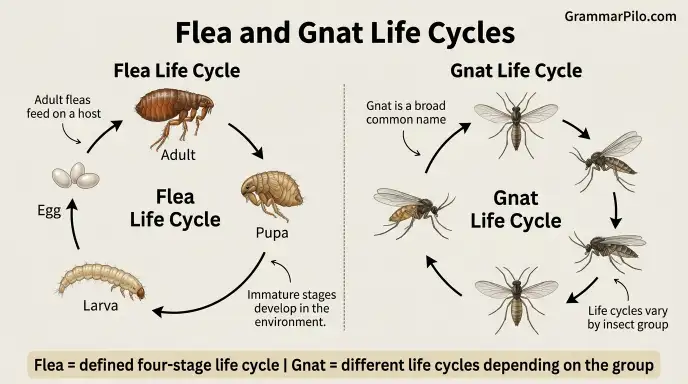
Fleas have a clearly defined four stage life cycle.
The CDC identifies these stages as:
- Egg
- Larva
- Pupa
- Adult
Adult fleas feed on a host, while immature stages develop in the surrounding environment.
Gnats are more complicated because gnat is a broad common name covering different insects. Their life cycles vary according to the specific group.
This is another important difference between flea and gnat.
Flea or Gnat: Google Trends & Usage Data
Google Trends shows relative search interest rather than the total number of insects, words, or articles using a term.
For flea or gnat, search interest can be influenced by several factors, including pet problems, seasonal insect activity, gardening questions, outdoor activities, and searches about insect bites.
The terms also have different levels of specificity. Flea normally refers to a particular type of parasitic insect, while gnat is a broad common term used for several kinds of small flying insects.
For accurate current Google Trends comparisons, the country, time period, and search category should be selected before interpreting the results. A single worldwide number would not accurately represent every English speaking region.
Flea or Gnat: Side by Side Comparison
| Feature | Flea | Gnat |
| Basic description | Small parasitic insect | Common name for several small flying insects |
| Wings | Wingless | Usually winged |
| Movement | Jumps and crawls | Flies |
| Blood feeding | Adult fleas feed on blood | Some gnats feed on blood |
| Body | Flattened and hard | Often slender or compact |
| Common hosts | Mammals and sometimes birds | Humans, animals, plants, or environments depending on species |
| Common setting | Pets, bedding, carpets, animal environments | Gardens, outdoor areas, soil, water, vegetation |
| Bites | Yes | Some types do |
| Life cycle | Egg, larva, pupa, adult | Varies by insect group |
| Spelling | Same in UK and US | Same in UK and US |
How to Remember Flea vs. Gnat
Use this simple memory trick:
Flea = Flies? No. Fleas jump.
Gnat = Goes through the air.
This is not a scientific rule for every insect identification, but it is a useful everyday way to remember the basic distinction.
If the insect is tiny, wingless, and jumping, think flea.
If it is tiny and flying, think gnat or another small flying insect.
Key Takeaways
- Flea and gnat are not two names for the same insect.
- A flea is a small, wingless, blood feeding insect.
- Fleas usually move by jumping and crawling.
- A gnat is a broad common name for several types of small flying insects.
- Some gnats bite humans and animals, while others do not.
- Fleas have four main life stages: egg, larva, pupa, and adult.
- Fleas are often associated with pets and other animal hosts.
- Gnats are commonly associated with flying insects found around plants, soil, water, animals, and outdoor environments.
- Flea vs. gnat is mainly a difference in insect type, body structure, and behavior.
- The spelling is the same in British and American English.
Frequently Asked Questions About Flea or Gnat
1. Is a flea or gnat more likely to jump?
Answer: A flea is much more likely to jump. Fleas are wingless and use their powerful legs to jump, while gnats are flying insects.
2. What is the main difference between a flea and a gnat?
Answer: A flea is a wingless parasitic insect that feeds on blood, while a gnat is a common name for various small flying insects.
3. Can gnats bite humans?
Answer: Yes, some types of gnats bite humans. University of Minnesota Extension notes that certain black flies, also called buffalo gnats, bite people and animals.
4. Do fleas fly?
Answer: No. Adult fleas are wingless. They move by jumping and crawling.
5. Are fleas and gnats the same size?
Answer: Both can be very small, but their body structures are different. Fleas are flattened and wingless, while gnats are generally small flying insects.
6. Can fleas live in a house?
Answer: Yes. Flea life stages can occur in the environment around an animal host. Eggs, larvae, and pupae may develop in places such as bedding and other areas where a host spends time.
7. Are all gnats harmful?
Answer: No. The term gnat covers several types of small flying insects. Some are biting pests, while others are mainly nuisance insects.
8. Why do I see tiny flying insects but no fleas?
Answer: If the insects are clearly flying, they may be gnats or another type of small fly rather than fleas. Adult fleas do not have wings.
9. Is flea or gnat the correct spelling?
Answer: Both flea and gnat are correctly spelled English words. They describe different types of insects.
10. How can I remember flea vs. gnat?
Answer: Remember flea = jumps and gnat = flies. This simple distinction can help you remember the basic difference.
Conclusion
The difference between flea or gnat is mainly about the type of insect, its body structure, and how it moves. A flea is a tiny, wingless parasite that feeds on blood and uses its powerful legs to jump.
Fleas are commonly associated with pets and other animal hosts, and their life cycle includes eggs, larvae, pupae, and adults.
A gnat, on the other hand, is a broad everyday term for several kinds of small flying insects. Some gnats bite people or animals, while others are mainly nuisance insects found around plants, soil, water, or outdoor areas.
The easiest way to remember flea vs. gnat is simple: fleas jump, while gnats fly. That basic difference can help you narrow down what you are seeing, although identifying a particular insect may require a closer look.
So, when writing flea or gnat, use flea for the small wingless blood feeding parasite and gnat for the appropriate small flying insect.
Compare More Words

I’m Sloane Mercer, a U.S.-based English language writer focused on grammar, spelling, vocabulary, and everyday English usage. Through GrammarPilo, I provide clear and practical explanations to help readers choose the right words and communicate with confidence.






3 thoughts on “Flea or Gnat: How to Tell These Tiny Insects Apart”