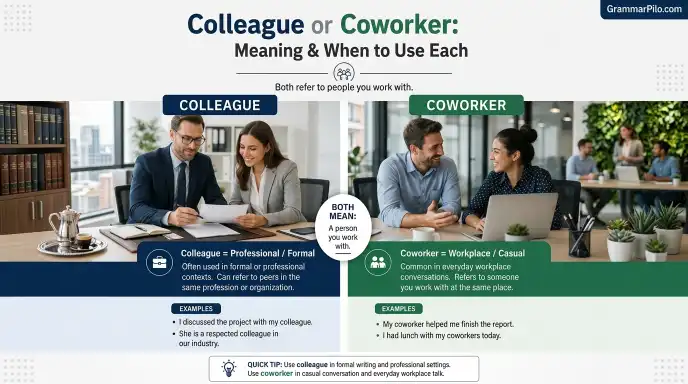
Colleague and coworker both mean a person you work with, so both words are correct. The main difference is that colleague can sound slightly more formal, while coworker is especially common in American English and everyday speech.
People often search for “colleague or coworker” because they want to know if the words have different meanings, which one sounds more professional, and which term they should use at work.
The two words are very close in meaning, but context can affect which one sounds more natural. A colleague can be someone you work with, especially in a profession or organization. A coworker usually means someone who works at the same company, workplace, or organization as you.
For example:
- My colleague helped me with the report.
- My coworker helped me with the report.
Both sentences are correct.
If you are writing a formal email, report, or professional document, colleague is often a good choice. In casual American English, coworker is very common. Understanding this small difference helps you choose the word that best fits your audience and situation.
Coworker vs Colleague: Quick Answer
Colleague and coworker both refer to someone you work with. They are often interchangeable, but colleague can sound more formal and can sometimes refer to a professional peer outside your immediate workplace.
Examples
- My colleague is helping me prepare the presentation.
- My coworker is helping me prepare the presentation.
Both are correct.
Another example:
- I spoke with a colleague from our London office.
- I spoke with a coworker from our London office.
Again, both can work if the person works within the same organization.
The Simple Difference
Colleague = a person you work with or a professional peer.
Coworker = a person who works with you, especially at the same workplace.
The words overlap heavily, but colleague often has a more professional or formal tone.
Definition and Meaning of Colleague or Coworker
What Does “Colleague” Mean?
A colleague is a person you work with, especially someone in the same profession, organization, or field.
For example:
Sarah is my colleague at the law firm.
This means Sarah works with the speaker.
The word can also describe a professional peer.
I discussed the research with my academic colleagues.
Here, colleagues are other people working in the same professional or academic field.
What Does “Coworker” Mean?
A coworker is a person who works with you, usually at the same company, workplace, or organization.
For example:
My coworker sits next to me.
This clearly means the person works at the same workplace.
Another example:
I asked my coworker to check the file.
The person is someone the speaker works with.
Is There a Difference in Meaning?
There is some overlap, but the words can have slightly different ranges.
Coworker usually focuses on sharing a workplace.
Colleague can focus more on sharing a profession, organization, or professional field.
For example:
The doctor spoke with her colleagues.
The colleagues could be other doctors or medical professionals.
I had lunch with my coworkers.
This usually means people who work at the same workplace.
However, these distinctions are not strict. Native speakers often use the words interchangeably.
The Origin of Colleague or Coworker

The words colleague and coworker have different origins.
Origin of “Colleague”
Colleague comes from French collègue and ultimately from Latin collega, meaning a partner or associate in office or employment.
The Latin word is related to the idea of people being chosen or appointed together.
Over time, colleague developed its modern English meaning of a person with whom someone works or a professional associate.
The word has been used in English for centuries and is now common in professional, academic, business, and workplace writing.
Origin of “Coworker”
Coworker is formed from co- + worker.
The prefix co- means “together,” “jointly,” or “with.”
So, a coworker is literally a person who works together with you.
The spelling is straightforward:
co + worker = coworker
The word became especially common in modern workplace English, particularly in American English.
Unlike colleague, coworker is a transparent compound word. Its meaning can be understood directly from its two parts.
British English vs American English Spelling
There is no major spelling difference between British and American English for colleague.
Coworker, however, is especially common in American English. In British English, colleague is often the more natural general term.
| Word | British English | American English |
| colleague | Very common | Very common |
| coworker | Correct, but less common | Very common |
| Meaning | Person you work with | Person you work with |
| Formal tone | Common | Common |
| Casual workplace use | Colleague is common | Coworker is common |
British English Examples
I spoke to my colleague about the project.
Several colleagues attended the meeting.
American English Examples
I spoke to my coworker about the project.
My coworkers are having a meeting.
American English also commonly uses colleague, especially in professional and formal settings.
So, this is mainly a difference in usage and preference, not a spelling rule.
Which Spelling Should You Use?
The best choice depends on your audience and the context.
For Formal Writing
Colleague is often the safest choice in:
- business emails
- professional reports
- academic writing
- workplace announcements
- formal correspondence
Example:
I discussed the matter with my colleague.
It sounds neutral and professional.
For American English
Coworker is very natural in everyday American workplace English.
Example:
One of my coworkers helped me finish the project.
It sounds normal and conversational.
For British English
Colleague is usually the more natural choice.
Example:
I spoke with my colleague this morning.
For International English
If you are writing for a global professional audience, colleague is a strong choice because it is widely understood and has a neutral professional tone.
Common Mistakes with Colleague or Coworker
Mistake 1: Thinking “coworker” is incorrect
This is incorrect.
Coworker is a standard English word.
Correct:
My coworker helped me.
Mistake 2: Thinking “colleague” only means a friend
A colleague does not have to be your friend.
For example:
I have several colleagues at the company.
This simply means people you work with.
Mistake 3: Using “coworker” for every professional peer
Sometimes colleague is more precise.
For example:
Doctors from different hospitals met to discuss the case with their colleagues.
Here, colleague can describe professional peers even when they do not share the exact same workplace.
Mistake 4: Assuming British English uses “coworker” more
In British English, colleague is generally the more familiar choice for someone you work with.
Mistake 5: Writing “co-worker” when “coworker” is preferred
Coworker is the common modern spelling, especially in American English.
Example:
My coworker sent me the document.
The hyphenated form co-worker can be found in some writing, but coworker is the standard form in many modern dictionaries and style guides.
Coworker or Colleague or in Everyday Examples
In an Email
Hi James,
I spoke with my colleague about the schedule, and we agreed on the new meeting time.
Colleague works well in professional email writing.
In Casual Conversation
My coworker is taking a vacation next week.
This sounds natural in everyday American English.
In News Writing
The employee’s colleagues described her as hardworking and reliable.
Colleagues is a natural choice in formal news writing.
On Social Media
My coworkers surprised me with a birthday cake today!
Coworkers fits a casual social-media tone.
In Academic Writing
The researcher discussed the findings with her colleagues.
Colleagues is common in academic and professional writing.
In a Workplace Conversation
Can you ask your coworker to send me the file?
This is natural when talking about someone at the same workplace.
Colleague and Coworker: Google Trends & Usage Data
Search interest for “colleague” and “coworker” can vary by country and context. Google Trends shows relative search interest rather than total word usage, so a Trends graph should not be treated as a direct measure of which word is grammatically correct.
Actual usage shows an important pattern: colleague is widely used across international English, while coworker is strongly associated with American workplace English.
The difference is also affected by context. Professional and academic writing often favors colleague, while everyday American conversation frequently uses coworker.
| Context | Common Choice |
| Academic writing | Colleague |
| Professional reports | Colleague |
| Formal emails | Colleague |
| British workplace English | Colleague |
| American workplace English | Coworker / Colleague |
| Casual American speech | Coworker |
| Social media | Coworker / Colleague |
| International business English | Colleague |
Google Trends data can also change over time, so if you are comparing search popularity for, check the target country and date range rather than assuming one word is universally more popular.
Colleague vs Coworker: Comparison Table
| Feature | Colleague | Coworker |
| Basic meaning | Person you work with | Person you work with |
| Professional peer | Yes | Sometimes |
| Same workplace | Usually | Usually |
| Same profession | Yes | Not required |
| Formality | Slightly more formal | More casual |
| British English | Very common | Less common |
| American English | Common | Very common |
| Academic use | Very common | Less common |
| Business writing | Very common | Common |
| Casual speech | Common | Very common |
| Correct spelling | Yes | Yes |
FAQs About Coworker and Colleague
1. Is “colleague” the same as “coworker”?
Usually, yes. Both words can mean a person you work with. Colleague can sometimes have a broader professional meaning.
2. Is colleague more formal than coworker?
Generally, yes. Colleague often sounds slightly more formal or professional, while coworker is common in casual American English.
3. Is “coworker” correct English?
Yes. Coworker is a standard English word, especially common in American English.
4. Is “colleague” British or American?
Colleague is used in both British and American English. It is also common in international English.
5. Which is better for a professional email?
Colleague is usually a good choice for a professional email because it sounds neutral and polished.
Example:
I discussed this with my colleague.
6. Do Americans say “coworker”?
Yes. Coworker is very common in American English, especially when referring to someone at the same workplace.
7. Can a colleague work at another company?
Yes, depending on the context. Colleague can refer to a professional peer or someone working in the same organization. It can sometimes be used more broadly for people in the same profession or field.
Conclusion
Colleague & coworker are both correct English words, and in many situations they mean the same thing. Both can describe a person you work with. The main difference is tone and common usage.
Colleague has a slightly more formal and professional feel. It is especially common in British English, academic writing, business communication, and international professional English. Coworker is particularly common in American English and everyday workplace conversations.
For example, both “My colleague helped me with the report” and “My coworker helped me with the report” are correct. Your choice depends mainly on your audience and the tone you want.
If you are writing a formal email, report, or professional document, colleague is often the safest option. If you are speaking casually about someone who works at the same company, especially in American English, coworker sounds natural.
The key point is that neither word is a spelling mistake. Colleague is not simply the British version of coworker, and coworker is not the American spelling of colleague. They are separate words with overlapping meanings. Choose the one that best fits your context, audience, and level of formality.
Discover More Articles!

I’m Claire Morgan, the author behind Grammarpilo.com, where I write about English grammar, sentence structure, punctuation, and everyday language. My goal is to make grammar simple, clear, and practical, helping readers understand the rules and apply them with confidence in real-world writing.








3 thoughts on “Colleague or Coworker: Meaning & When to Use Each”