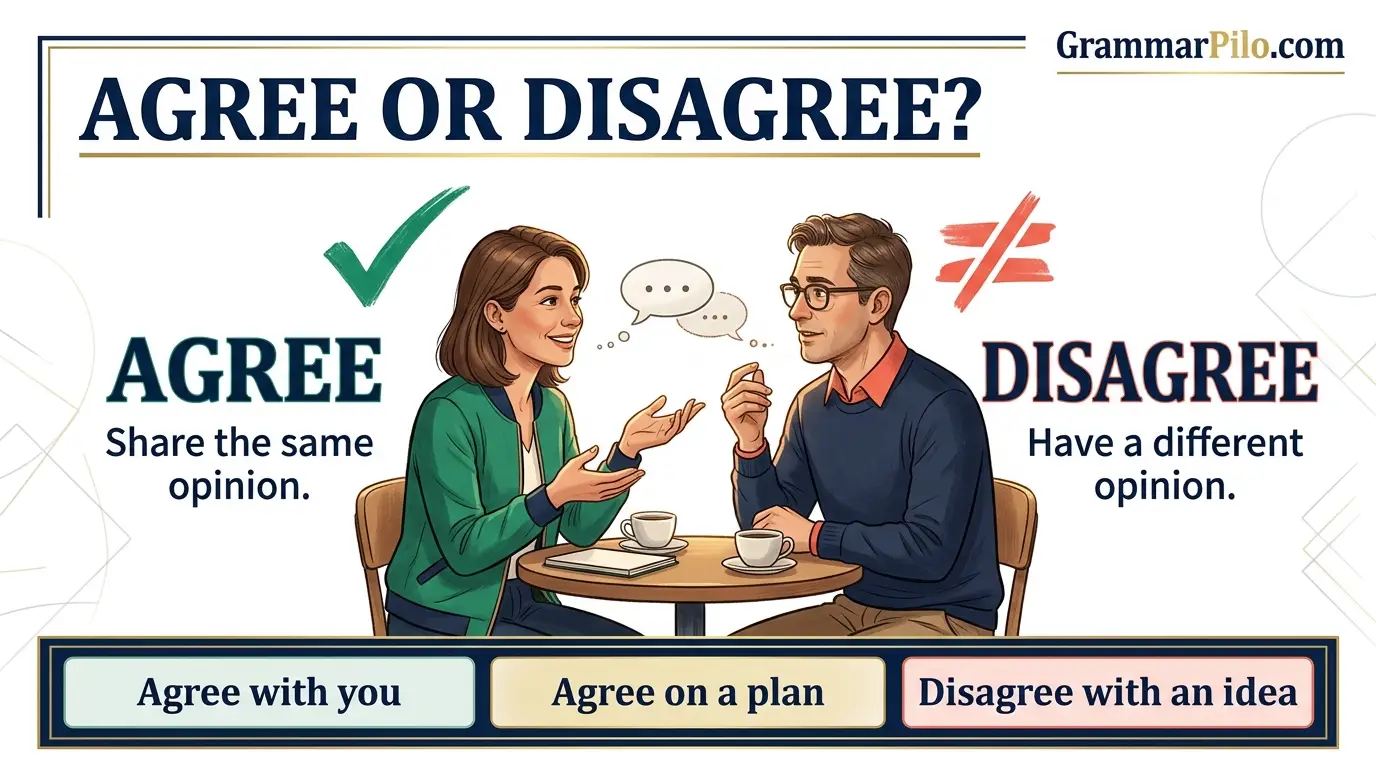
Agree and disagree express opposite responses to an idea, opinion, statement, or proposal. Agree means to share the same opinion, accept a point as reasonable, or have the same view as another person.
Disagree means to hold a different opinion, reject a suggestion, or believe that a statement is incorrect. For example, “I agree with your decision” shows support, while “I disagree with your decision” expresses a different view.
These words appear frequently in classroom discussions, workplace meetings, online debates, academic writing, surveys, and everyday conversations. People also use them when responding to advice, expressing personal beliefs, or discussing important decisions.
Although the meanings are straightforward, learners sometimes make mistakes with the prepositions and sentence structures that follow each verb.
Understanding agree or disagree is not just about choosing the opposite word. It also involves knowing when to say “agree with,” “agree on,” “agree to,” or “disagree with.”
This guide explains the meanings, grammar rules, common mistakes, and practical examples of both words so you can use them confidently in everyday and formal English.
Quick Answer
Agree means to share someone’s opinion, accept a suggestion, or reach the same conclusion. Disagree means to have a different opinion or reject an idea.
For example, “I agree with your proposal” expresses support, while “I disagree with your proposal” expresses opposition.
Both words are correct, and the appropriate choice depends on the opinion or position you want to communicate.
Agree vs. Disagree at a Glance
Agree and disagree are opposites in meaning, but both are used to express a person’s position on a topic.
| Feature | Agree | Disagree |
| Basic meaning | Share the same opinion | Have a different opinion |
| Word type | Verb | Verb |
| Opposite | Disagree | Agree |
| Common preposition | With, on, to | With |
| Example | I agree with your idea. | I disagree with your idea. |
| Tone | Supportive or accepting | Opposing or questioning |
| Workplace use | I agree with the recommendation. | I disagree with the recommendation. |
| Discussion use | We agree on the main point. | We disagree on the main point. |
Easy memory trick: Agree means “I share your view.” Disagree means “I see it differently.”
What Does Agree Mean?
Agree is a verb that means to share an opinion, accept a proposal, express the same view, or reach a mutual understanding. It can describe agreement between individuals, groups, organizations, or countries.
Agree as Sharing an Opinion
When you agree with someone, you believe that their statement, opinion, or argument is correct or reasonable.
Examples include the following:
- I agree with your explanation.
- She agrees with her teacher about the assignment.
- We agree that students need more practice.
- They agreed with the manager’s recommendation.
- My friends and I agree on the importance of honesty.
In these examples, agree expresses a shared opinion or belief.
Agree as Accepting a Proposal
Agree can also mean accepting a suggestion, request, or arrangement.
Examples include the following:
- He agreed to help me with the project.
- The company agreed to extend the deadline.
- She agreed to attend the meeting.
- They agreed to the proposed changes.
- We agreed to meet after lunch.
The grammatical structure depends on the situation. For instance, “agree to help” introduces an action, while “agree to the changes” refers to accepting a proposal or arrangement.
Agree as Reaching a Mutual Decision
People may agree after discussing a problem, negotiating, or considering different options.
Examples include the following:
- The two teams agreed on a schedule.
- We finally agreed on a price.
- The committee agreed that the plan was practical.
- Both parties agreed to settle the dispute.
In these sentences, agree describes a shared decision or conclusion.
Common Expressions With Agree
Several common expressions use agree:
- Agree with someone: Share a person’s opinion.
- Agree on something: Reach a shared decision about a subject.
- Agree to something: Accept a proposal, condition, or arrangement.
- Agree to do something: Accept or promise to perform an action.
- Agree that: Express a shared belief about a statement.
- Agree in principle: Accept the general idea but possibly disagree about the details.
The preposition often changes the precise meaning, so learning these expressions together is helpful.
What Does Disagree Mean?
Disagree is a verb that means to hold a different opinion, reject a statement, or fail to share another person’s view. It does not necessarily mean that someone is angry or disrespectful. People can disagree politely while maintaining a productive conversation.
Disagree as Having a Different Opinion
Disagree commonly appears when two people interpret information differently or reach different conclusions.
Examples include the following:
- I disagree with your conclusion.
- She disagrees with the proposed solution.
- We disagree about the best way to solve the problem.
- The researchers disagreed with the original interpretation.
- My colleagues and I disagree on this issue.
Each example expresses a difference of opinion.
Disagree as Rejecting an Argument
People also use disagree when they believe that a claim, argument, or decision is incorrect.
Examples include the following:
- I disagree with the claim that practice is unnecessary.
- The editor disagreed with the author’s interpretation.
- He disagreed with the committee’s final decision.
- Several students disagreed with the answer presented in class.
In these situations, disagree indicates that someone does not accept another person’s position.
Disagree Without Being Disrespectful
Disagree does not have to sound confrontational. The wording around it can make a response more diplomatic.
Examples include the following:
- I respectfully disagree with that interpretation.
- I see your point, but I disagree with the conclusion.
- I understand your concern, although I have a different opinion.
- I appreciate your suggestion, but I disagree with the proposed approach.
These expressions are useful in workplaces, academic discussions, and professional correspondence.
Common Expressions With Disagree
- Disagree with someone: Have a different opinion from a person.
- Disagree with something: Reject or question an idea, statement, or decision.
- Disagree about something: Hold different opinions concerning a subject.
- Disagree on an issue: Have different views about a particular matter.
- Respectfully disagree: Express opposition in a polite manner.
- Agree to disagree: Accept that people have different opinions without continuing the argument.
The Difference Between Agree and Disagree in Grammar
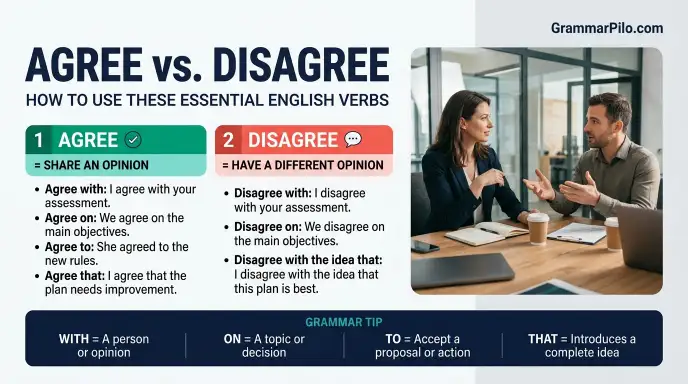
Agree and disagree are closely related verbs. The prefix dis– reverses the positive meaning of agree, giving disagree the opposite sense.
Both verbs can take different grammatical structures depending on the intended meaning.
Agree With vs. Disagree With
Use with when referring to a person, opinion, argument, or position.
Examples include the following:
- I agree with your assessment.
- I disagree with your assessment.
- She agrees with her supervisor.
- She disagrees with her supervisor.
The preposition with is generally the safest choice when you are expressing agreement or disagreement with a person’s view.
Agree On vs. Disagree On
Use on when discussing a subject, decision, plan, or point about which people may share or differ in opinion.
Examples include the following:
- We agree on the main objectives.
- We disagree on the main objectives.
- The partners agreed on a price.
- The partners disagreed on the final price.
Both verbs can be used with on, although the precise meaning depends on the context.
Agree To vs. Disagree With
Agree to is often used when accepting a proposal, condition, or action.
Examples include the following:
- She agreed to the new rules.
- He agreed to attend the conference.
- The company agreed to the revised terms.
For disagreement, disagree with is often the natural choice:
- She disagreed with the new rules.
- He disagreed with the proposed arrangement.
- The company disagreed with the revised terms.
You can also say “refused to agree to the proposal” when you want to emphasize rejection.
Agree That vs. Disagree That
Both verbs can introduce a clause beginning with that.
Examples include the following:
- I agree that the plan needs improvement.
- I disagree that the plan is the best option.
- They agreed that the evidence was convincing.
- She disagreed that the evidence proved the claim.
In everyday English, “I disagree that…” is grammatical, but “I disagree with the idea that…” or “I do not agree that…” may sound more natural in some contexts.
Agree or Disagree in American and British English
There is no spelling difference between disagree and agree in American and British English. Both forms are standard in the United States, the United Kingdom, Canada, Australia, and other English speaking regions.
| Feature | American English | British English |
| Correct spelling | Agree / Disagree | Agree / Disagree |
| Common expression | I agree with you. | I agree with you. |
| Common expression | I disagree with that view. | I disagree with that view. |
| Formal usage | I respectfully disagree. | I respectfully disagree. |
| Spelling variation | None | None |
Differences may appear in tone, formality, or conversational preference, but the words themselves are spelled the same way.
Which spelling should you use? Use agree and disagree in all standard varieties of English. There is no need to change their spelling for a British, American, or international audience.
Common Mistakes When Using Agree or Disagree
Although the words are easy to understand, the prepositions and sentence structures can be confusing.
Mistake 1: Saying Agree to Someone
Incorrect: I agree to you.
Correct: I agree with you.
Use agree with someone when sharing that person’s opinion. Use agree to something when accepting a proposal, condition, or arrangement.
Mistake 2: Using the Wrong Form After Agree
Incorrect: She agreed helping me.
Correct: She agreed to help me.
When agree means accepting or promising an action, use the structure agree to + base verb.
More examples include the following:
- He agreed to participate.
- They agreed to cooperate.
- We agreed to wait.
Mistake 3: Confusing Agree With Agree On
Incorrect in the intended context: We agree the price.
Better: We agree on the price.
When describing a shared decision about a price, plan, or topic, agree on is usually appropriate. Another correct structure is “We agreed that the price was fair.”
Mistake 4: Assuming Disagree Is Always Rude
Incorrect assumption: Disagreeing with a colleague is automatically disrespectful.
Better understanding: Disagreeing is a normal part of discussion. The tone and wording determine how respectful the response sounds.
For example, “I disagree with your conclusion because the data suggests something different” is direct but professional.
Mistake 5: Writing Disagree With No Matter the Structure
Awkward: I disagree with that the plan will work.
Better: I disagree with the idea that the plan will work.
Also correct: I disagree that the plan will work.
Use disagree with + noun or noun phrase, or use disagree that + clause. Avoid placing with immediately before a that clause in this structure.
Agree or Disagree in Everyday Examples
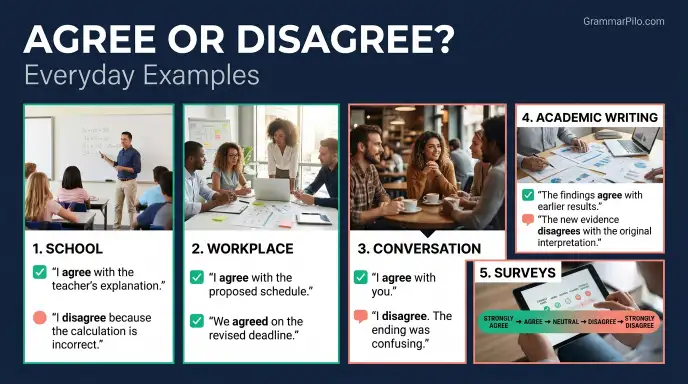
The following examples demonstrate how both words work in common situations.
In School
Agree: I agree with the teacher’s explanation of the poem.
Disagree: I disagree with the answer because the calculation is incorrect.
Agree: The students agreed that the experiment was successful.
Disagree: Two students disagreed about the meaning of the passage.
In Emails and Workplace Communication
Agree: I agree with the proposed schedule and will follow it.
Disagree: I respectfully disagree with the suggested approach.
Agree: We agreed on the revised project deadline.
Disagree: The departments disagreed on how the budget should be allocated.
In Everyday Conversation
Agree: I agree with you. That movie was excellent.
Disagree: I disagree. I thought the ending was confusing.
Agree: We agree on where to eat tonight.
Disagree: My brother and I disagree about which team will win.
In Academic and Formal Writing
Agree: The findings agree with the results of the earlier study.
Disagree: The new evidence disagrees with the original interpretation.
Agree: Several researchers agree that additional testing is necessary.
Disagree: Other researchers disagree with the proposed explanation.
In academic writing, evidence and results are often described as supporting, contradicting, or being consistent with other findings. These alternatives can be more precise than simply saying agree or disagree.
In Surveys and Questionnaires
Agree: I agree with the statement that public libraries are important.
Disagree: I disagree with the statement that homework should be eliminated.
Surveys often use a scale ranging from strongly agree to strongly disagree. These options allow respondents to show how strongly they support or oppose a statement.
Agree vs. Disagree: A Quick Comparison Table
| Situation | Use Agree | Use Disagree |
| Sharing an opinion | I agree with your opinion. | I disagree with your opinion. |
| Discussing a plan | We agree on the plan. | We disagree on the plan. |
| Accepting a request | She agreed to help. | She refused to agree to help. |
| Discussing a conclusion | They agree that the evidence is strong. | They disagree that the evidence is strong. |
| Professional discussion | I agree with your recommendation. | I respectfully disagree with your recommendation. |
| Ending an argument | We agreed to move forward. | We agreed to disagree. |
The key distinction is simple: Agree communicates a shared view or acceptance, while disagree communicates a different view or opposition.
Disagree vs. Agree: Google Trends and Modern Usage
Agree and disagree are widely used in everyday English, education, business communication, public discussions, and online surveys. They also appear in search queries about grammar, opinion writing, debate preparation, and polite ways to express opposing views.
The phrase disagree or agree is especially common in educational contexts, including essay prompts that ask students to state and defend a position.
For example, a writing task may ask, “Do you agree or disagree with the statement?” In these cases, students are expected to choose a position and support it with reasons and evidence.
The expression also appears in surveys and feedback forms, where options such as strongly agree, agree, neither agree nor disagree, disagree, and strongly disagree help measure attitudes.
Exact search interest changes by location, time, and topic. No verified live Google Trends figures are included here, so specific search volumes or rankings should not be assumed.
To compare current interest, enter “agree,” “disagree,” and “agree or disagree” into Google Trends and select your preferred region and time period.
A Simple Trick to Remember Agree and Disagree
The easiest way to remember these words is to focus on the prefix dis–.
- Agree: You share an opinion or accept an idea.
- Disagree: You hold a different opinion or reject an idea.
Think about a simple classroom discussion.
Student A: I agree that reading every day improves vocabulary.
Student B: I disagree. I think conversation practice is just as important.
Both students are expressing their positions. Neither word is automatically right or wrong, and the difference lies in the opinion being communicated.
For polite communication, remember that you can disagree with an idea without criticizing the person who expressed it.
Phrases such as “I see your point, but I disagree” and “I respectfully disagree with that conclusion” make discussions more constructive.
Frequently Asked Questions
1. Is agree or disagree correct?
Both words are correct. Agree means to share an opinion or accept an idea, while disagree means to hold a different opinion or reject an idea. Choose the word that matches your intended meaning.
2. What is the difference between disagree and agree?
Agree expresses a shared view, acceptance, or mutual decision. Disagree expresses a difference of opinion or opposition. For example, “I agree with your plan” shows support, while “I disagree with your plan” shows opposition.
3. Should I say agree with or agree to?
Use agree with when sharing someone’s opinion or position. Use agree to when accepting a proposal, condition, or arrangement, or when agreeing to perform an action. For example, “I agree with you” and “I agree to help” are both correct.
4. Is disagree with grammatically correct?
Yes. Disagree with is the standard structure when expressing a different opinion from a person, statement, or idea. For example, “I disagree with your conclusion” is correct.
5. Can I say I disagree that?
Yes. “I disagree that the decision was fair” is grammatically acceptable. You can also say “I disagree with the idea that the decision was fair” or “I do not agree that the decision was fair.”
6. What does agree to disagree mean?
Agree to disagree means accepting that two people have different opinions without continuing to argue or trying to persuade each other. For example, “We could not settle the debate, so we agreed to disagree.”
7. Are agree and disagree spelled differently in British and American English?
No. Agree and disagree have the same spelling in both varieties of English. The words are used internationally with the same basic meanings and grammatical patterns.
8. Is disagree a negative word?
Disagree expresses opposition or a difference of opinion, but it is not necessarily rude or hostile. You can disagree politely by explaining your reasoning and respecting the other person’s point of view.
9. What is the noun form of agree and disagree?
The noun form is agreement for agree and disagreement for disagree. For example, “We reached an agreement” means the parties accepted the same terms, while “Their disagreement continued” means they maintained different views.
10. How do I use disagree or agree in an essay?
Start by clearly stating your position. You can write “I agree with the statement because…” or “I disagree with the statement because…” Then support your position with reasons, examples, and relevant evidence.
A strong essay explains the reasoning behind the position rather than relying on the opinion alone.
Conclusion
Agree and disagree are essential English verbs for expressing opinions, responding to suggestions, and participating in discussions. Agree means sharing a view, accepting a proposal, or reaching a common decision.
Disagree means holding a different view or rejecting an idea. Both words are correct, and neither is automatically more appropriate than the other.The most important grammatical point is understanding the expressions that follow each verb.
Use agree with when sharing someone’s opinion, agree on when reaching a shared decision about a subject, and agree to when accepting a proposal or undertaking an action. For disagreement, disagree with and disagree on are common and useful structures.
These words are spelled the same way in American and British English. They also appear in academic essays, workplace communication, everyday conversations, surveys, and formal debates.
When discussing a difference of opinion, remember that disagreeing does not require being disrespectful. Clear explanations and polite wording can make opposing views productive.
Remember this simple rule: Agree means sharing a position, while disagree means having a different position. Once you understand the difference and learn the common grammatical patterns, you can use both words accurately and confidently.
Explore More Articles

I’m Sloane Mercer, a U.S.-based English language writer focused on grammar, spelling, vocabulary, and everyday English usage. Through GrammarPilo, I provide clear and practical explanations to help readers choose the right words and communicate with confidence.








1 thought on “Agree or Disagree: The Easy Way to Choose the Right Word”