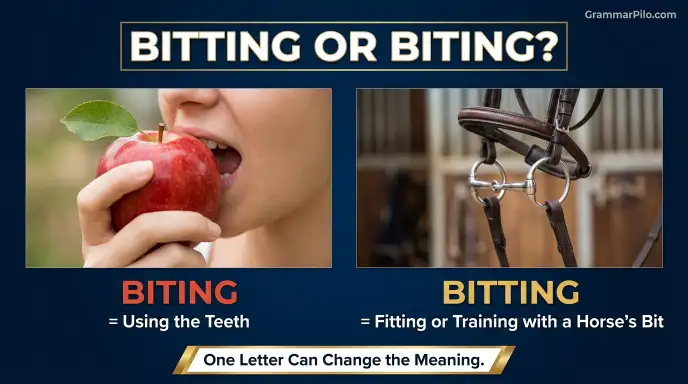
Biting is the correct spelling when you mean using your teeth to cut, grip, or chew something, or when describing something sharp, harsh, or cold.
Bitting is also a real word, but it has a specialized meaning in certain contexts, particularly in horse tack and locksmithing. The two words are not interchangeable in ordinary writing.
For example, you would write, “The dog is biting its toy,” because the action of using teeth is spelled biting. Similarly, “The biting wind made everyone reach for their coats” uses biting to describe an intense, unpleasant cold.
Bitting, on the other hand, can refer to the part of a bridle or bit that contacts a horse’s mouth, or to the process of preparing a key or lock in locksmithing. These technical uses are much less common in everyday conversation.
Understanding the difference between bitting or biting helps you avoid spelling mistakes in school assignments, emails, stories, and professional writing.
This guide explains both words, shows how to use them correctly, and provides practical examples to help you remember which spelling fits your sentence.
Quick Answer: Bitting or Biting?
Biting is the usual word for using teeth to bite something, describing a sharp or cold sensation, or expressing a harsh or cutting tone. Bitting is a specialized term used in fields such as equestrian equipment and locksmithing.
If you mean that a person or animal is using its teeth, choose biting. For example, “The puppy is biting the slipper” is correct, not “The puppy is bitting the slipper.”
Biting Definition and Meaning
Biting is the present participle of the verb bite. It can describe the action of using teeth to cut, grip, or hold something. It can also function as an adjective that describes something sharp, severe, or intense.
The verb bite is irregular. Its principal forms are bite, bit, and bitten. When adding -ing, the final silent e is dropped, producing biting.
Examples of Biting as a Verb
- The baby is biting the teething ring.
- The dog keeps biting its leash.
- Stop biting your nails during the meeting.
- The mosquito was biting everyone near the lake.
- She caught herself biting her lower lip nervously.
In these examples, biting describes an action involving teeth or a similar pinching or piercing effect.
Examples of Biting as an Adjective
Biting can also describe something sharp, severe, or unpleasant:
- The biting wind made the walk uncomfortable.
- He responded with a biting remark.
- Her article offered a biting criticism of the policy.
- The hikers struggled against the biting cold.
- The comedian delivered a biting joke about office politics.
In these sentences, biting does not refer to literally using teeth. It describes intensity, sharpness, or criticism.
How to Use Biting in a Sentence
Use biting when the sentence refers to the action of biting or an adjective meaning sharp, harsh, or intense.
Correct: The cat is biting the string.
Correct: His biting comments upset the audience.
Incorrect for the ordinary meaning: The cat is bitting the string.
The final example should use biting because it describes an animal using its teeth.
Bitting Definition and Meaning
Bitting is a valid English word, but it is uncommon outside specialized contexts. Its meaning depends on the field in which it appears.
Bitting in Equestrian Terminology
In horse-related terminology, bitting can refer to fitting, selecting, or assessing a bit for a horse, as well as aspects of the bit’s fit and contact with the horse’s mouth. A bit is a piece of equipment used with a bridle.
Example: The trainer discussed bitting options to improve the horse’s comfort.
Example: Proper bitting requires attention to the horse’s individual needs and equipment fit.
The exact meaning can vary with the equestrian context, so specialist sources are useful when discussing technical details.
Bitting in Locksmithing
In locksmithing, bitting refers to the arrangement of cuts or depths on a key that correspond to the configuration of a lock. These cuts help determine which key can operate the lock.
Example: The locksmith checked the key’s bitting before making a replacement.
Example: The technician recorded the bitting information for the key.
This use is technical rather than conversational. Most people would not encounter it unless they were reading about keys, locks, or locksmith work.
How to Use Bitting in a Sentence
Use bitting only when the intended meaning fits a specialized context:
- The locksmith recorded the bitting code for the replacement key.
- The horse’s bitting equipment was reviewed by an experienced professional.
- The technician checked the key bitting before cutting a new key.
If you are describing a person or animal using its teeth, these technical meanings do not apply. The correct word is biting.
Bitting vs. Biting: Main Differences
Although the two words differ by only one letter, their everyday usage is quite different.
| Feature | Biting | Bitting |
| Commonness | Common in everyday English | Uncommon and specialized |
| Main meaning | Using teeth or describing something sharp or harsh | A technical term in fields such as locksmithing and equestrian equipment |
| Part of speech | Verb form or adjective | Noun or verb form in specialized usage |
| Everyday example | The puppy is biting the toy. | Usually not used in everyday conversation |
| Technical example | The biting wind was uncomfortable. | The locksmith checked the key’s bitting. |
| Best choice for teeth related actions | Correct | Incorrect |
| Typical audience | General readers | Readers in specialist fields |
The key difference is context. Biting is the standard spelling for the familiar action and related descriptive meanings. Bitting is appropriate when the specialized technical meaning is intended.
Why Do People Confuse Bitting and Biting?
The words look and sound similar, so it is easy to type one when you intend the other. The confusion is especially common when writers are unsure how to form the -ing version of an English verb.
The Silent E Rule
Many English verbs ending in a silent e drop that letter before adding -ing.
| Base verb | Correct -ing form |
| Bite | Biting |
| Write | Writing |
| Make | Making |
| Drive | Driving |
| Smile | Smiling |
| Hope | Hoping |
The same spelling rule explains why bite becomes biting, not bitting, when referring to the action of using teeth.
Why Bitting Is Not the Standard Form of Bite
Doubling the final consonant is a spelling pattern used with certain short verbs, such as sit becoming sitting and run becoming running. However, bite already ends in a silent e, so the correct form is biting.
Compare these examples.
Correct: The child is biting the apple.
Correct: The child is sitting on the chair.
Incorrect for the ordinary meaning: The child is bitting the apple.
Remember that English spelling patterns depend on the structure of the base word. You cannot apply the consonant doubling rule to every verb.
Biting or Bitting in American and British English
The standard spelling of biting is the same in American and British English. Neither variety uses bitting as the ordinary spelling for the action of using teeth.
| Usage | American English | British English |
| Using teeth | Biting | Biting |
| Harsh or sharp criticism | Biting | Biting |
| Extremely cold wind | Biting | Biting |
| Specialized locksmithing term | Bitting | Bitting |
| Specialized equestrian term | Bitting | Bitting |
There is no major regional spelling difference between these words. The choice depends on meaning, not nationality.
Which Spelling Should You Use?
For general writing, choose biting when referring to an animal, person, insect, or other source of a bite. Use it for figurative meanings such as biting criticism or biting cold as well.
Choose bitting only when you are discussing a recognized technical use, such as key bitting in locksmithing or bitting in an equestrian context.
Common Mistakes With Bitting or Biting
Writers may accidentally use bitting when they mean biting. The following examples show how to correct the mistake.
Mistake 1: Writing Bitting Instead of Biting
Incorrect: The puppy is bitting my shoes.
Correct: The puppy is biting my shoes.
Why: The sentence describes the puppy using its teeth. The correct form of bite with -ing is biting.
Mistake 2: Using Bitting for a Painful Bite
Incorrect: The mosquito is bitting my arm.
Correct: The mosquito is biting my arm.
Why: The verb refers to the mosquito piercing the skin to feed. The ordinary word is biting.
Mistake 3: Misspelling Biting Cold
Incorrect: We walked through the bitting cold.
Correct: We walked through the biting cold.
Why: The adjective biting describes cold that feels extremely sharp or intense.
Mistake 4: Assuming Bitting Is Always Wrong
Incorrect claim: Bitting is not a real English word.
Correct explanation: Bitting is a valid word in specialized contexts, including locksmithing and equestrian terminology.
Why: A word can be uncommon in everyday English while remaining correct in a technical field.
Mistake 5: Doubling the Final T
Incorrect: She was bitting her lip while waiting.
Correct: She was biting her lip while waiting.
Why: The silent e in bite is removed before -ing is added. The letter t is not doubled.
Bitting and Biting in Everyday Examples
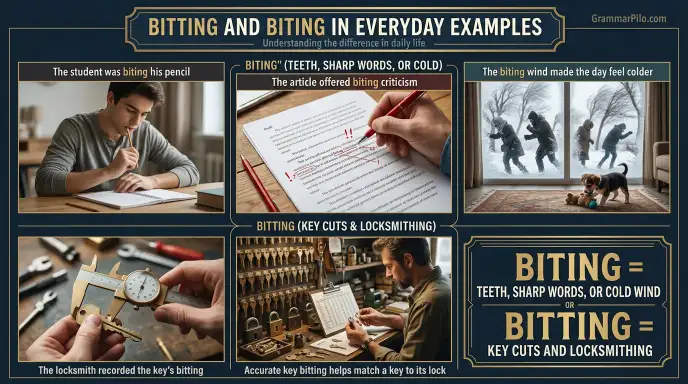
The following examples show how to use the words naturally in school, workplace communication, conversations, and technical writing.
In School
Biting: The student was biting the end of his pencil while solving the problem.
Biting: The teacher described the review as a biting criticism of the novel.
Bitting: The class studied key bitting as part of a lesson on locksmithing.
In Emails and Workplace Communication
Biting: Please revise the biting language in the report so the feedback sounds more constructive.
Biting: The biting wind delayed the outdoor inspection.
Bitting: The locksmith documented the key’s bitting for the maintenance records.
In Everyday Conversation
Biting: Why is the puppy biting the furniture?
Biting: That biting wind makes it feel much colder outside.
Bitting: The technician explained how key bitting affects the lock.
In News and Media
Biting: The columnist published a biting response to the politician’s statement.
Biting: Residents complained about the biting cold during the winter storm.
Bitting: A specialist article explained the importance of accurate key bitting in locksmithing.
In Formal Writing
Biting: The report contains a biting assessment of the proposed policy.
Biting: The animal was observed biting the fence repeatedly.
Bitting: The locksmith reviewed the bitting specifications before producing a replacement key.
Bitting or Biting: Google Trends and Modern Usage
Biting is the familiar term used in everyday conversation, education, health related discussions, animal behavior, weather descriptions, and commentary. Expressions such as nail-biting, biting cold, and biting criticism are widely recognizable.
Bitting is much more specialized. It may appear in material about key cutting, lock design, horse equipment, and related professional subjects. Its appearance in technical writing does not make it an alternative spelling of biting in ordinary sentences.
Search popularity can vary by region, time period, and topic. No verified, current Google Trends figures are included here, so exact search volumes or percentage comparisons should not be inferred.
If you want to compare the terms using Google Trends, enter both words and examine the same geographic region and time period. Because bitting has technical meanings, its search interest may reflect specialist subjects rather than people misspelling biting.
For general readers and writers, the practical lesson is straightforward. Use biting for the action of using teeth and for familiar descriptive meanings. Reserve bitting for contexts in which its specialized meaning is relevant.
Biting vs. Bitting: Quick Reference Table
| Sentence or context | Correct choice | Reason |
| The dog is ___ the ball. | Biting | Describes using teeth |
| The baby keeps ___ its toy. | Biting | Correct form of bite |
| The wind was ___ cold. | Biting | Describes intense cold |
| Her article offered a ___ critique. | Biting | Describes sharp criticism |
| The locksmith checked the key’s ___. | Bitting | Technical locksmithing term |
| The trainer reviewed the horse’s ___. | Bitting | Specialized equestrian context |
| He was ___ his nails. | Biting | Describes a common habit |
| The mosquito was ___ me. | Biting | Describes an insect feeding |
A Simple Trick to Remember Bitting vs. Biting
Use this memory trick to choose the correct spelling.
Biting has one T before the ending: Think of the word bite. Remove the silent e and add -ing to get biting.
Bitting has a specialized meaning: Remember that bitting belongs mainly to technical contexts, such as the cuts on a key or horse related equipment.
You can also remember the rule with a simple sentence.
“I bite, I am biting.”
The base verb is bite, and its -ing form is biting. This pattern is similar to write/writing, drive/driving, and make/making.
If your sentence is about teeth, a cold wind, or sharp criticism, biting is almost certainly the word you need.
Frequently Asked Questions
1. Is bitting or biting correct?
Both spellings are correct words, but they have different meanings. Biting is the ordinary form of bite used for actions involving teeth and for descriptions such as biting cold. Bitting is used in specialized contexts, including locksmithing and equestrian terminology.
2. Is bitting a real word?
Yes. Bitting is a real English word used in technical contexts. In locksmithing, it can refer to the pattern of cuts on a key. In equestrian contexts, it relates to the selection, fitting, or use of a horse’s bit.
3. Why is biting spelled with one T?
The base verb bite ends in a silent e. When you add -ing, the e is dropped, giving biting. The final t is not doubled.
4. Is “the dog is bitting me” correct?
No, not when you mean the dog is using its teeth. The correct sentence is “The dog is biting me.” Bitting does not serve as the ordinary -ing form of bite.
5. What does biting mean in figurative language?
Figuratively, biting describes something sharp, severe, or cutting. For example, a biting comment is a harsh or pointed remark, and biting criticism is strong, direct criticism.
6. What does bitting mean in locksmithing?
In locksmithing, bitting refers to the arrangement of cuts or depths on a key that correspond to the lock’s mechanism. It is a technical term used when discussing key patterns and lock operation.
7. Is biting the same in American and British English?
Yes. The spelling biting is standard in both American and British English. Bitting also retains its specialized meanings across these varieties.
8. How can I remember the difference between biting and bitting?
Remember the phrase “I bite, I am biting.” Because bite ends in a silent e, remove the e before adding -ing. Use bitting only when you intend a specialized technical meaning.
Conclusion: Bitting or Biting?
The difference between biting and bitting comes down to spelling and context. Biting is the correct everyday word when someone or something uses its teeth, and it can also describe sharp criticism, intense cold, or a harsh tone.
Bitting is a legitimate but uncommon term associated with specialist subjects such as locksmithing and equestrian equipment.
The most useful rule is simple. Start with the verb bite, remove the silent e, and add -ing. The result is biting, not bitting. This same pattern appears in words such as writing, driving, and making.
For school assignments, emails, articles, and everyday conversation, choose biting whenever you are describing an action involving teeth or something figuratively sharp. If you are writing about key cutting or horse equipment, bitting may be appropriate.
Keeping this distinction in mind will help you avoid a common spelling mistake and make your writing more accurate and natural.
Explore Here More Articles

I’m Claire Morgan, the author behind Grammarpilo.com, where I write about English grammar, sentence structure, punctuation, and everyday language. My goal is to make grammar simple, clear, and practical, helping readers understand the rules and apply them with confidence in real-world writing.







1 thought on “Bitting or Biting: The Easy to Miss Difference Explained in 2026”