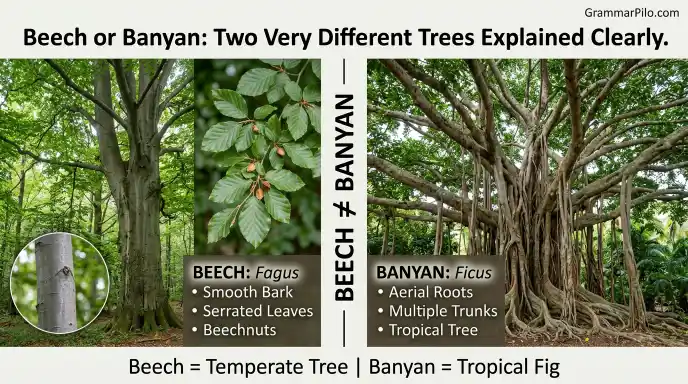
Beech and banyan are two different kinds of trees with very different appearances, habitats, and growth patterns.
A beech is a deciduous tree in the genus Fagus, while the banyan commonly refers to Ficus benghalensis, a tropical strangling fig known for its aerial roots that can develop into additional trunks.
The confusion around beech or banyan usually comes from comparing tree names without knowing what each tree looks like or where it naturally grows. Both are large, woody trees, but they belong to different plant families and have very different structures.
Beech trees are associated with temperate forests. American beech, Fagus grandifolia, has smooth gray bark, oval leaves with serrated edges, and distinctive nuts. It is native to eastern North America.
Banyan trees are associated with tropical and subtropical environments. Ficus benghalensis is native to the Indian subcontinent, including India and Pakistan. Its branches produce aerial roots that can reach the ground and develop into new trunks, allowing one tree to spread across a very large area.
This guide explains beech and banyan, their meanings, origins, physical differences, habitats, uses, common mistakes, and the easiest way to tell beech vs. banyan apart.
Beech or Banyan: Quick Answer
Beech: A temperate deciduous tree belonging to the genus Fagus and family Fagaceae.
Banyan: A tropical fig tree, commonly Ficus benghalensis, belonging to the genus Ficus and family Moraceae.
The two trees are not varieties of the same plant.
| Feature | Beech | Banyan |
| Botanical group | Fagus | Ficus |
| Family | Fagaceae | Moraceae |
| Typical climate | Temperate | Tropical |
| Bark | Often smooth and gray | Usually rougher and distinctive in mature trees |
| Leaves | Oval, serrated | Large, leathery, entire |
| Special feature | Beechnuts | Aerial roots that can become trunks |
| Common range | Europe, Asia, North America depending on species | Indian subcontinent and other tropical regions |
| Growth pattern | Conventional single or multiple trunk tree | Can spread laterally through aerial roots |
Kew recognizes Fagus as an accepted genus containing multiple beech species, while Ficus benghalensis is an accepted species commonly known as banyan.
Definition and Meaning of Beech or Banyan
What Does Beech Mean?
Beech is the common English name for trees in the genus Fagus.
Beeches are deciduous hardwood trees. Different species occur across parts of Europe, Asia, and North America. Kew lists 15 accepted species within the genus Fagus.
American beech, Fagus grandifolia, is one well known species. The U.S. Forest Service describes it as a large, slow growing deciduous tree with smooth gray or blue gray bark.
A typical beech may be recognized by:
- Smooth gray bark
- Oval leaves
- Serrated leaf edges
- Dense crown
- Slender pointed buds
- Small nuts enclosed in a bur like covering
The exact appearance varies by species.
What Does Banyan Mean?
Banyan commonly refers to Ficus benghalensis, a species of fig native to the Indian subcontinent.
Kew describes banyan as a type of strangling fig. The plant can begin life growing on another tree, then produce aerial roots from its branches. When those roots reach the ground, they can develop into additional trunks.
This unusual growth pattern allows a banyan to spread outward over a very large area.
A banyan is often recognized by:
- Large leathery leaves
- A broad spreading crown
- Numerous aerial roots
- Multiple trunk like structures
- Small fig fruits
- Tropical growth conditions
Kew notes that Ficus benghalensis can grow up to about 30 meters tall, with aerial roots that develop into new trunks.
The Origin of Beech and Banyan
The Origin of Beech
The word beech has a very old Germanic history.
Etymonline traces beech through Middle English beche and Old English bece to a Proto Germanic word connected with related words in Germanic languages. It is also connected historically with the word book.
The connection between beech and book is especially interesting.
Etymonline explains that the Old English word for book, boc, is connected to an older Germanic word associated with beech. One explanation is that beechwood tablets were used for writing or carving runes.
So the history of beech reaches beyond botany and into the history of writing.
The Origin of Banyan
The word banyan has a very different history.
Etymonline dates the English noun to the 1630s and explains that it was connected with Indian merchants known as banians. These merchants were associated with a particular tree near Gombroon, now Bandar Abbas, where they had built a pagoda.
The word ultimately traces to Gujarati vaniyo, meaning a man of the trading caste, from Sanskrit vanija, meaning merchant.
The tree’s broad shade and aerial roots also made banyans useful gathering places and natural market locations, which helped connect the tree with the merchants whose name became associated with it.
Beech vs. Banyan: Botanical Differences
The clearest way to understand beech or banyan is to compare their botanical characteristics.
Beech
Beeches belong to the genus Fagus in the family Fagaceae. Kew currently recognizes the genus as an accepted group with multiple species.
American beech is classified as Fagus grandifolia and belongs to the beech family, Fagaceae.
Banyan
The banyan commonly discussed in South Asia is Ficus benghalensis.
It belongs to:
Genus: Ficus
Family: Moraceae
Kew lists Ficus benghalensis as an accepted species and gives its native range as the Indian subcontinent.
Side by Side Botanical Comparison
| Botanical feature | Beech | Banyan |
| Genus | Fagus | Ficus |
| Family | Fagaceae | Moraceae |
| Plant type | Deciduous hardwood tree | Tropical fig tree |
| Main visual feature | Smooth bark and serrated leaves | Aerial roots and spreading crown |
| Fruit | Nuts | Figs |
| Root behavior | Typical tree root system | Aerial roots can become additional trunks |
| Climate | Mainly temperate | Mainly tropical |
The botanical differences make it clear that beech vs. banyan is a comparison between two distinct tree groups, not two names for the same tree.
How to Identify a Beech Tree
A beech tree can often be identified from several visible characteristics.
Smooth Gray Bark
American beech is particularly recognizable because its bark remains smooth and gray as the tree matures. The U.S. Forest Service describes the bark as smooth and gray to blue gray.
The National Park Service also highlights smooth gray bark as one of the distinctive characteristics of American beech.
Oval Leaves
Beech leaves are generally oval and have toothed or serrated margins. The U.S. National Park Service lists oval shaped leaves with serrated edges among the key identification features.
Beechnuts
Beech trees produce nuts. American beech produces small triangular nuts enclosed in a bur like covering.
These nuts are important food for many kinds of wildlife.
Dense Crown
Beech trees can develop a broad, dense crown. Their branches and leaves can create substantial shade in forests.
How to Identify a Banyan Tree
Banyans have some of the most distinctive growth patterns among tropical trees.
Aerial Roots
The most recognizable feature is the production of aerial roots.
These roots grow down from branches toward the ground. Once established, they can become trunk like supports.
Multiple Trunks
A mature banyan can appear to have many separate trunks, even though they may all belong to one connected tree.
Kew notes that a single banyan can spread laterally through these additional roots and trunks and reach an enormous size.
Large Leathery Leaves
The banyan has large, leathery leaves. Kew describes them as entire, ovate or elliptic, with prominent lateral veins.
Figs
Banyans produce fig fruits rather than the nut like fruit associated with beech.
Kew describes the figs of Ficus benghalensis as small and paired in the leaf axils, becoming bright red when ripe.
Where Do Beech and Banyan Trees Grow?
Beech Habitat
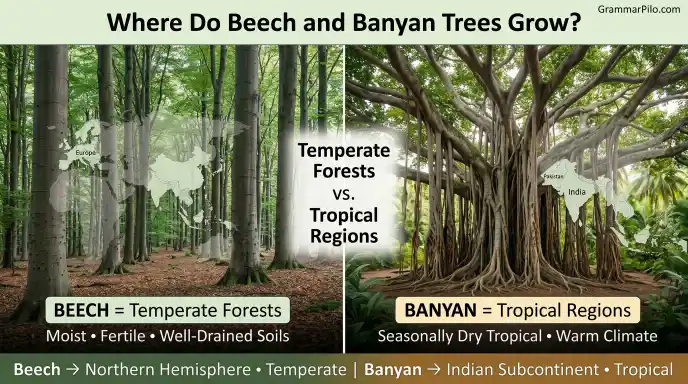
Beech species are mainly associated with temperate regions.
Kew lists the native range of the genus Fagus across parts of the Northern Hemisphere, including Europe, Asia, North America, and Mexico.
American beech naturally occurs across much of eastern North America, from parts of Canada through the eastern United States.
The species generally grows in forest environments and can thrive in moist, fertile, well drained soils.
Banyan Habitat
Banyan has a much stronger association with tropical environments.
Kew gives the native range of Ficus benghalensis as the Indian subcontinent and describes its primary biome as seasonally dry tropical.
The species is native to India, Pakistan, Nepal, Bangladesh, Sri Lanka, and other parts of the region.
It is also cultivated in other tropical and subtropical areas.
Beech or Banyan in Everyday Examples
In Gardening
Example: The garden has a young beech tree near the northern boundary.
Example: The tropical garden contains a large banyan with many aerial roots.
In Nature Writing
Example: The smooth gray bark helped us identify the beech.
Example: The banyan’s aerial roots created a network of trunk like supports.
In News Writing
Example: The park is protecting several mature beech trees.
Example: The historic banyan attracts visitors throughout the year.
In Social Media
Example: I photographed a beautiful beech tree during my autumn hike.
Example: This banyan tree looks like an entire forest growing from one plant.
In Formal Writing
Example: American beech is an important deciduous tree in eastern North American forests.
Example: Banyan trees can develop aerial roots that become additional trunks.
In Educational Writing
Example: Beech and banyan belong to different plant families and have different growth patterns.
Common Mistakes with Beech or Banyan
Mistake 1: Thinking Beech and Banyan Are Similar Tree Types
Beech and banyan are not closely related tree names for the same type of plant.
Beech belongs to Fagus and Fagaceae, while banyan belongs to Ficus and Moraceae.
Mistake 2: Calling Any Tree With Multiple Roots a Banyan
A banyan is specifically associated with the characteristic growth of aerial roots that can become additional trunks.
Simply seeing exposed roots does not automatically make a tree a banyan.
Mistake 3: Confusing Beech With Birch
The names beech and birch sound somewhat similar, but they are different trees.
Beech belongs to Fagaceae, while birches belong to Betulaceae.
Mistake 4: Assuming Banyan Is Only a Single Species
The word banyan is commonly associated with Ficus benghalensis, but the broader use of the term can refer to certain related figs with similar growth habits.
For a precise botanical reference, Ficus benghalensis is the classic banyan species. Kew accepts this species under that scientific name.
Mistake 5: Thinking Beech Trees Have Aerial Trunks
Beech trees do not have the characteristic banyan growth pattern of aerial roots turning into additional trunks.
That feature is one of the easiest ways to distinguish the two.
Beech or Banyan: Google Trends & Usage Data
Google Trends can be useful for exploring how often people search for terms such as:
Beech or banyan
Banyan or beech
Beech and banyan
Banyan and beech
Beech vs. banyan
Banyan vs. beech
Search interest can also be influenced by broader searches about tree identification, gardening, forests, tropical plants, and regional tree names.
Search frequency does not determine botanical classification. A term may receive more searches simply because it is associated with a common question, a popular location, a famous tree, or a seasonal topic.
For accurate identification, botanical references are more useful than search volume. Kew identifies Fagus as the accepted genus containing beech species and Ficus benghalensis as the accepted species commonly known as banyan.
Beech vs. Banyan: Quick Comparison Table
| Feature | Beech | Banyan |
| Common scientific example | Fagus grandifolia | Ficus benghalensis |
| Family | Fagaceae | Moraceae |
| Climate | Temperate | Tropical |
| Leaves | Oval and serrated | Large, leathery, usually entire |
| Bark | Smooth gray in American beech | Distinctive mature bark with spreading structure |
| Fruit | Beechnuts | Figs |
| Roots | Typical root system | Aerial roots can become trunks |
| Crown | Dense and broad | Extremely broad and spreading |
| Typical setting | Temperate forests | Tropical forests, parks, gardens |
| Major identification clue | Smooth gray bark | Aerial roots and multiple trunks |
| Native range | Parts of Europe, Asia, North America | Indian subcontinent for F. benghalensis |
Beech and Banyan: Uses and Importance
Uses of Beech
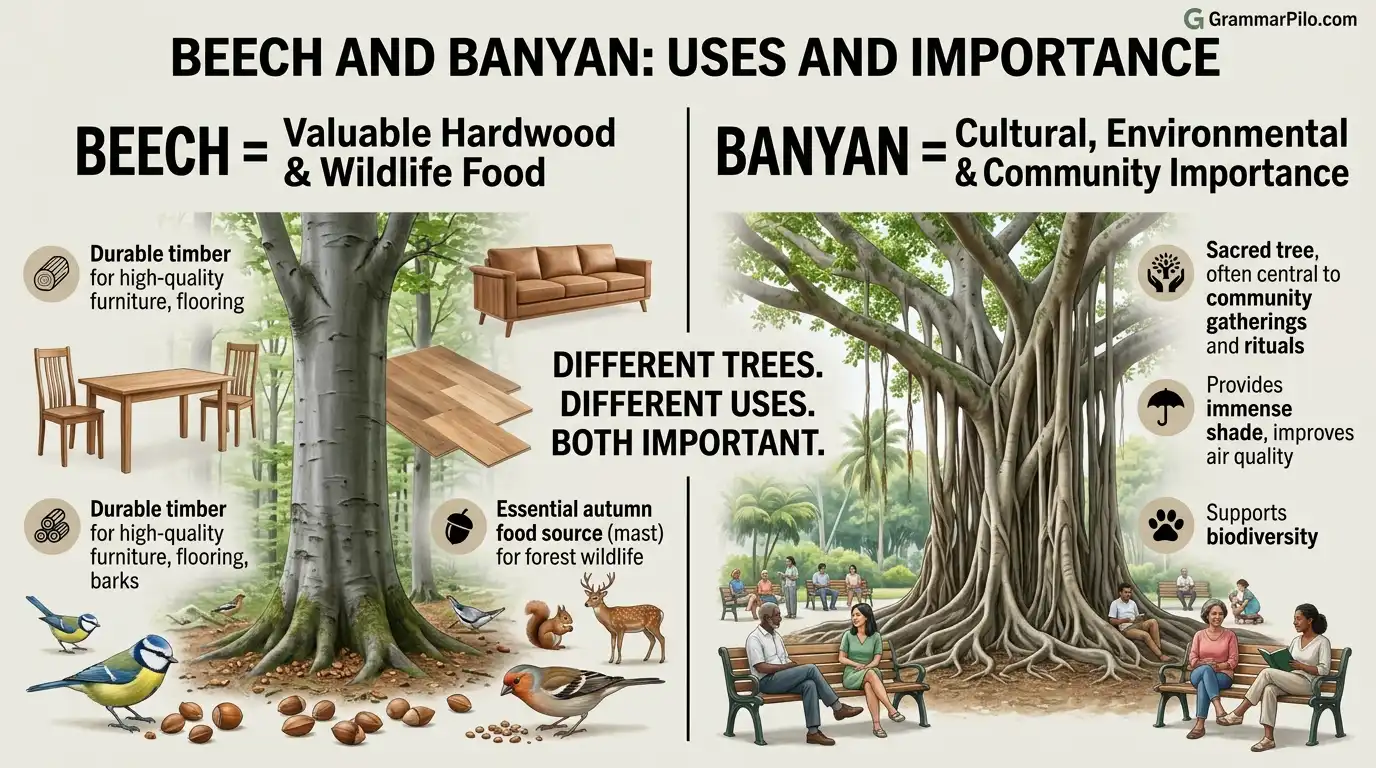
Beech wood is valued as a hardwood.
The U.S. Forest Service notes that American beech wood is suitable for turning and steam bending and has been used for flooring, furniture, veneer, and containers.
Beech trees are also ecologically important because their nuts provide food for wildlife.
The National Park Service notes that beech nuts support wildlife ranging from black bears and white tailed deer to small mammals and birds.
Uses of Banyan
Banyan has cultural, environmental, ornamental, and practical importance.
Kew notes that banyan is frequently planted around temples and is also used in parks and along streets in tropical regions.
The tree also has traditional uses, and its wood, bark, fruits, and other parts have been used in different ways. Kew documents uses involving food, fibers, construction, medicine, and cultural traditions.
Its broad shade also makes it an important gathering tree in many tropical communities.
How to Remember Beech or Banyan
A simple visual memory trick can help.
Beech = Smooth Bark and Nuts
Think:
Beech → Smooth gray bark → Serrated leaves → Beechnuts
American beech is especially recognizable because of its smooth gray bark.
Banyan = Aerial Roots and Many Trunks
Think:
Banyan → Aerial roots → New trunks → Huge spreading crown
This is the easiest visual distinction.
If a tree looks as though many trunks are supporting one enormous crown, it may be a banyan.
If you see smooth gray bark and serrated oval leaves on a temperate forest tree, beech is a strong possibility.
Key Takeaways
- Beech and banyan are different trees.
- Beech belongs to the genus Fagus and family Fagaceae.
- Banyan commonly refers to Ficus benghalensis, in the family Moraceae.
- American beech has smooth gray bark and serrated oval leaves.
- Beech produces nuts that are important food for wildlife.
- Banyan produces aerial roots that can become additional trunks.
- Beech is mainly associated with temperate forests.
- Banyan is mainly associated with tropical environments.
- The word beech has an ancient Germanic history and is historically connected with book.
- The word banyan comes through Indian trading terminology and was associated with merchants.
Frequently Asked Questions
1. What is the difference between beech and banyan?
Beech is a group of temperate deciduous trees in the genus Fagus. Banyan commonly refers to the tropical fig Ficus benghalensis. They belong to different plant families.
2. Is a banyan tree a beech tree?
No. A banyan is not a beech. The classic banyan, Ficus benghalensis, belongs to Moraceae, while beech trees belong to Fagaceae.
3. What does a beech tree look like?
A beech tree often has smooth gray bark, oval leaves with serrated edges, and a dense crown. American beech is particularly recognizable by its smooth gray bark.
4. What does a banyan tree look like?
A banyan usually has a broad crown, large leaves, and aerial roots that can grow downward and become additional trunks.
5. Where do beech trees grow?
Beech species occur across temperate parts of the Northern Hemisphere. The genus Fagus includes species native to parts of Europe, Asia, North America, and Mexico.
6. Where do banyan trees grow?
The classic banyan, Ficus benghalensis, is native to the Indian subcontinent. Kew lists India, Pakistan, Nepal, Bangladesh, Sri Lanka, and other regional areas within its native distribution.
7. Why does a banyan have so many trunks?
Its aerial roots can grow down from branches and develop into new trunk like supports. This allows a single tree to spread over a large area.
8. Does beech produce fruit?
Beech produces nuts rather than fleshy fruits like many common fruit trees. American beech produces small triangular nuts enclosed in a bur like structure.
9. Is beech wood useful?
Yes. American beech wood has been used for flooring, furniture, veneer, containers, turning, and steam bending.
10. What is the easiest way to tell a beech and banyan apart?
Look at the roots and bark. Smooth gray bark is a strong clue for American beech, while aerial roots developing into multiple trunks are a strong clue for banyan.
Conclusion
The comparison beech or banyan involves two very different trees. Beech trees belong to the genus Fagus and are mainly associated with temperate forests. American beech, for example, is recognized by its smooth gray bark, oval serrated leaves, dense crown, and small nuts.
Banyan is commonly associated with Ficus benghalensis, a tropical fig native to the Indian subcontinent. Its most remarkable feature is its aerial roots. T
hese roots can descend from branches, reach the soil, and develop into additional trunks, allowing one tree to spread across a remarkably large area.
The names also have completely different histories. Beech has deep Germanic roots and has a historical connection with the word book, while banyan entered English through terminology associated with Indian merchants.
So, when comparing beech and banyan, remember the easiest visual distinction: beech is known for smooth bark and beechnuts, while banyan is known for aerial roots and multiple trunk like structures.
Compare More Words

I’m Sloane Mercer, a U.S.-based English language writer focused on grammar, spelling, vocabulary, and everyday English usage. Through GrammarPilo, I provide clear and practical explanations to help readers choose the right words and communicate with confidence.








1 thought on “Beech or Banyan: Two Very Different Trees Explained Clearly”