
Prioritise and prioritize are both correct spellings of the same verb, but the preferred form depends on the variety of English you use.
Prioritize is the standard spelling in American English, while prioritise is the standard spelling in British English and is also used in Australian and other Commonwealth varieties. Both words mean to arrange tasks, goals, or responsibilities according to their importance.
For example, an American manager might write, “We need to prioritize customer satisfaction,” while a British manager would typically write, “We need to prioritise customer satisfaction.” The meaning remains exactly the same, even though the spelling changes.
This difference can be confusing for students, English learners, writers, editors, and professionals who communicate with international audiences. T
he good news is that the rule is straightforward once you understand how American and British spelling conventions differ. The same pattern appears in words such as organize/organise, recognize/recognise, and realize/realise.
In this guide, you will learn the definitions of prioritise and prioritize, their origins, regional spelling rules, common mistakes, and practical examples for everyday writing.
You will also discover how to choose the right form for school assignments, professional emails, websites, and international communication.
Quick Answer: Prioritise or Prioritize?
Prioritize is the preferred American English spelling, while prioritise is the preferred British English spelling. Both words are correct and have the same meaning.
| Word | Preferred variety | Meaning |
| Prioritize | American English | Arrange tasks or goals by importance |
| Prioritise | British English | Arrange tasks or goals by importance |
Examples:
- American English: The team will prioritize the most urgent requests.
- British English: The team will prioritise the most urgent requests.
Neither spelling is universally better. Choose the version that matches your intended audience or the style guide you follow.
Easy memory trick: The spelling with -ize is standard in American English for this word, while the spelling with -ise is standard in British English.
Prioritise vs. Prioritize: Definition and Meaning
Prioritize and prioritise are alternative regional spellings of the same verb. They describe the process of deciding which tasks, needs, objectives, or responsibilities deserve attention first.
What Does Prioritize Mean?
Prioritize means to identify what is most important and give it attention before less urgent or less significant matters. It is the standard spelling in American English.
The word is commonly used in workplaces, education, project management, personal planning, and business communication.
Examples include the following:
- We must prioritize customer needs before launching the new service.
- Students should prioritize their assignments before the examination.
- The manager asked the team to prioritize urgent support requests.
- I need to prioritize my health and daily responsibilities.
- The company will prioritize projects with the greatest potential impact.
In each example, prioritize describes deciding what deserves attention first.
The word does not necessarily mean ignoring everything else. Instead, it involves arranging responsibilities according to importance, urgency, available resources, or expected results.
What Does Prioritise Mean?
Prioritise has exactly the same meaning as prioritize. It is the standard spelling in British English and is common in British-influenced varieties of English.
Examples include the following:
- We need to prioritise customer feedback before changing the product.
- The school will prioritise student safety.
- Please prioritise the most urgent tasks first.
- Our department must prioritise essential spending.
- She decided to prioritise her professional development.
The meaning in these examples is identical to the meaning of the American spelling. Only the spelling convention changes.
Are Prioritise and Prioritize Different Words?
No. They are not separate words with different definitions. They are regional spelling variants of the same verb.
A sentence written with prioritise can generally be changed to prioritize without changing its meaning. The important consideration is consistency.
For example:
- British style: We should prioritise the most urgent repairs.
- American style: We should prioritize the most urgent repairs.
Both sentences are grammatically correct.
The Origin of Prioritise and Prioritize
The spelling difference between prioritize and prioritise reflects a broader pattern in the development of British and American English.
Where Did Prioritize Come From?
The verb prioritize developed from priority, a word associated with being first in order, importance, or consideration. The noun ultimately comes from Latin prioritas, formed from prior, meaning earlier or first.
The verb gained wider use as organizations and individuals increasingly needed to describe the process of ranking tasks and objectives. It became especially useful in business, administration, planning, and management.
The spelling with -ize is standard in American English and follows a common pattern in American vocabulary, including organize, recognize, and realize.
Where Did Prioritise Come From?
Prioritise is the spelling commonly used in British English. It represents the same verb and follows a familiar British spelling pattern in which -ise appears in words such as organise, recognise, and realise.
This pattern is widespread, although British English does not require -ise in every word that can end in -ize. Some British dictionaries and style guides accept or prefer -ize for many words, including organize and recognize.
That distinction is important. The spelling convention for prioritise is strongly associated with British usage, but it is more accurate to describe -ise as the usual British preference for this word rather than an absolute rule for every British publication.
Why Are There Two Spellings?
English spelling developed differently across regions. American English generally favors -ize in this group of words, while British usage commonly favors -ise.
Both forms remain established, and neither spelling changes the word’s pronunciation or meaning in ordinary use.
Prioritise or Prioritize in British English vs. American English
The main difference is regional preference. American English normally uses prioritize, while British English typically uses prioritise.
| Feature | American English | British English |
| Preferred spelling | Prioritize | Prioritise |
| Meaning | Arrange by importance | Arrange by importance |
| Pronunciation | Essentially the same | Essentially the same |
| Past tense | Prioritized | Prioritised |
| Present participle | Prioritizing | Prioritising |
| Noun form | Prioritization | Prioritisation |
| Related spelling | Organize | Organise |
| Related spelling | Recognize | Recognise |
Which Spelling Is Used in American English?
Prioritize is the usual form in the United States. It is the appropriate choice for American publications, US business correspondence, school assignments following American conventions, and websites aimed primarily at US readers.
Examples:
- We need to prioritize the highest value projects.
- The department prioritized employee training.
- The team is prioritizing urgent customer requests.
Notice that the spelling remains consistent across different verb forms: prioritize, prioritized, and prioritizing.
Which Spelling Is Used in British English?
Prioritise is the usual form in the United Kingdom. It is commonly used in British newspapers, professional communication, educational writing, and organizations following British spelling conventions.
Examples:
- We need to prioritise the highest-value projects.
- The department prioritised employee training.
- The team is prioritising urgent customer requests.
The same spelling pattern applies to the related forms prioritised and prioritising.
What About Australian, Canadian, and Other English Varieties?
Australian English generally follows the British preference and commonly uses prioritise. Other countries influenced by British English may also prefer this form.
Canadian English has a mixture of British and American spelling conventions. Many Canadian publications use prioritize, though individual organizations and style guides may differ.
For international writing, the best approach is to check the publication’s style guide and apply one spelling consistently.
Which Spelling Should You Use: Prioritise or Prioritize?
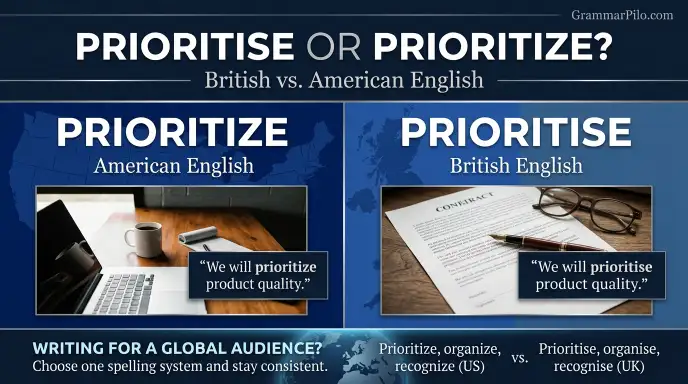
The right choice depends on your audience, the type of document you are preparing, and any style requirements you must follow.
Use Prioritize for American Audiences
Choose prioritize when writing for readers in the United States or following a US-based style guide.
It is appropriate for:
- American business reports
- US school and university assignments
- Websites targeting American readers
- Professional emails to US colleagues
- Marketing content written in American English
Example: We will prioritize product quality and customer satisfaction.
Use Prioritise for British Audiences
Choose prioritise when writing for a British audience or following a style guide that uses British spelling.
It is suitable for:
- British publications
- UK workplace communication
- School assignments following British conventions
- Websites aimed at UK readers
- Reports written in British English
Example: We will prioritise product quality and customer satisfaction.
What If You Write for an International Audience?
If your audience includes readers from several English-speaking countries, choose a consistent spelling system and apply it throughout the document.
For example, if your website primarily serves American readers, use prioritize, organize, and recognize. If it follows British conventions, use prioritise, organise, and recognise where those forms are preferred.
Consistency makes writing look professional and prevents unnecessary spelling changes within the same article.
Common Mistakes With Prioritise and Prioritize
Although both spellings are correct, writers can still make mistakes by using the wrong regional form for their intended style or by mixing spelling conventions unnecessarily.
Mistake 1: Treating One Spelling as Universally Incorrect
Incorrect claim: Prioritise is always wrong.
Correct explanation: Prioritise is a standard spelling in British English and is used in other varieties as well. Prioritize is the standard American form.
A spelling may be less appropriate for a particular audience without being incorrect in English generally.
Mistake 2: Mixing American and British Spellings
Inconsistent: We need to prioritize the project and organise the team.
This sentence mixes the common American spelling of prioritize with the common British spelling of organise.
Consistent American style: We need to prioritize the project and organize the team.
Consistent British style: We need to prioritise the project and organise the team.
Mixing regional conventions is not always a grammatical error, but it can make professional writing appear inconsistent. Follow one style unless a specific word or house style requires otherwise.
Mistake 3: Changing the Meaning While Correcting the Spelling
Some writers replace prioritize with a different verb because they assume the spelling changes the meaning.
Original: We should prioritize urgent repairs.
British spelling: We should prioritise urgent repairs.
The meaning remains the same. There is no need to rewrite the sentence merely because the spelling convention changes.
Mistake 4: Forgetting Related Word Forms
The spelling pattern should generally remain consistent across the word family.
| American English | British English |
| Prioritize | Prioritise |
| Prioritized | Prioritised |
| Prioritizing | Prioritising |
| Prioritization | Prioritisation |
For example, if you use prioritize in American English, the corresponding forms are prioritized and prioritizing. If you use prioritise in British English, the usual forms are prioritised and prioritising.
Mistake 5: Assuming the -ize Ending Is Never British
Although -ise is common in British English, British spelling does not universally reject -ize. Some respected British dictionaries and editorial standards use or accept forms such as organize and recognize.
For this specific word, prioritise is a familiar British form. However, writers should follow the relevant dictionary or style guide rather than assume that every word must follow one universal rule.
Prioritize or Prioritise in Everyday Examples
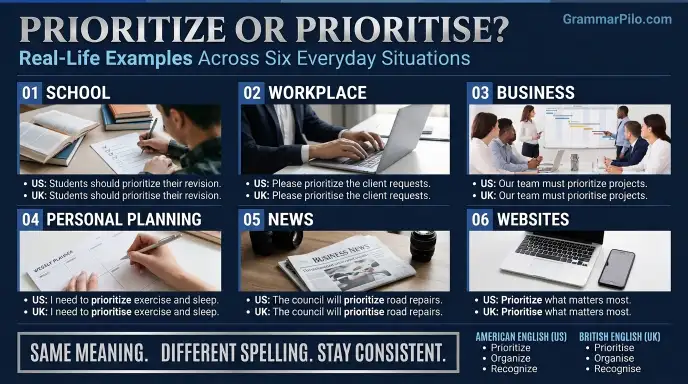
The following examples show how both spellings work in school, professional communication, daily planning, and other common situations.
In School and Education
Prioritize: Students should prioritize their revision before the final examination.
Prioritise: Students should prioritise their revision before the final examination.
Prioritize: The teacher advised us to prioritize the most difficult questions.
Prioritise: The teacher advised us to prioritise the most difficult questions.
The sentences have the same meaning. Choose the spelling that matches the English variety used by your school or institution.
In Emails and Workplace Communication
Prioritize: Please prioritize the client requests that require an immediate response.
Prioritise: Please prioritise the client requests that require an immediate response.
Prioritize: I will prioritize the report and send it before the deadline.
Prioritise: I will prioritise the report and send it before the deadline.
Both versions are appropriate. The choice depends on the spelling conventions used in the workplace.
In Business and Project Management
Prioritize: The company plans to prioritize customer retention this quarter.
Prioritise: The company plans to prioritise customer retention this quarter.
Prioritize: Our team must prioritize projects with measurable benefits.
Prioritise: Our team must prioritise projects with measurable benefits.
In business writing, the word often describes decisions about time, resources, budgets, and organizational goals.
In Personal Planning
Prioritize: I need to prioritize exercise and sleep this week.
Prioritise: I need to prioritise exercise and sleep this week.
Prioritize: She learned to prioritize her responsibilities more effectively.
Prioritise: She learned to prioritise her responsibilities more effectively.
These examples show that the word is useful beyond formal workplace settings. It also describes everyday decisions about how to use time and energy.
In News and Reports
Prioritize: The council will prioritize road repairs in areas with the greatest need.
Prioritise: The council will prioritise road repairs in areas with the greatest need.
Prioritize: The report recommends prioritizing public transport improvements.
Prioritise: The report recommends prioritising public transport improvements.
The spelling changes according to the publication’s style, but the underlying message remains unchanged.
In Websites and Social Media
Prioritize: Prioritize what matters most and make steady progress.
Prioritise: Prioritise what matters most and make steady progress.
Prioritize: Our latest guide explains how to prioritize tasks more effectively.
Prioritise: Our latest guide explains how to prioritise tasks more effectively.
For websites, choose the spelling that suits the intended audience and use it consistently in headings, body text, image descriptions, and related pages.
Prioritise or Prioritize: Google Trends and Modern Usage
Prioritise and prioritize remain useful words in contemporary English, especially in discussions about productivity, time management, workplace responsibilities, education, and planning.
Which Spelling Is More Common?
The answer depends largely on the region being examined. Prioritize is the expected form in standard American English, while prioritise is common in British English and other varieties that favor British spelling conventions.
A comparison that combines all English-speaking regions may obscure this regional distinction. A meaningful analysis should compare similar locations or language markets.
What Can Google Trends Tell You?
Google Trends can help readers explore the relative search interest for “prioritise” and “prioritize” over a selected period and in a chosen region. For example, a US-focused comparison can be examined separately from a UK-focused comparison.
However, Google Trends reports relative interest rather than providing a direct count of every search. Results can also vary with location, time range, and search settings.
Exact current trend values should be checked directly before publishing numerical claims. Without verified live data, it would be misleading to state that one spelling receives a specific number or percentage of searches more than the other.
Which Form Should Writers Choose Today?
The best spelling is the one that fits the target audience and editorial standard. Writers should not choose a spelling simply because they believe it is more popular worldwide.
For a US audience, prioritize is the natural choice. For a UK audience, prioritise is generally more suitable. And for a global publication, a consistent house style is more useful than switching between the forms.
Prioritize vs. Prioritise: Side by Side Comparison
This table summarizes the essential differences between the two spellings.
| Comparison | Prioritise | Prioritize |
| Main meaning | Arrange by importance | Arrange by importance |
| Typical regional preference | British English | American English |
| Pronunciation | Essentially the same | Essentially the same |
| Past tense | Prioritised | Prioritized |
| Present participle | Prioritising | Prioritizing |
| Noun form | Prioritisation | Prioritization |
| Common context | UK-oriented writing | US-oriented writing |
| Is it correct? | Yes | Yes |
| Does the meaning change? | No | No |
Prioritise and Prioritize in Different Tenses
Both spellings can be used across common verb forms.
Present tense:
- American: I prioritize urgent tasks.
- British: I prioritise urgent tasks.
Past tense:
- American: I prioritized urgent tasks yesterday.
- British: I prioritised urgent tasks yesterday.
Present participle:
- American: I am prioritizing urgent tasks.
- British: I am prioritising urgent tasks.
The difference remains a spelling convention, not a grammatical or semantic distinction.
Frequently Asked Questions About Prioritise or Prioritize
1. Is Prioritize or Prioritise Correct?
Both are correct. Prioritize is the standard American English spelling, while prioritise is the common British English spelling. Both mean to arrange tasks or goals according to importance.
2. Is Prioritise British or American English?
Prioritise is primarily associated with British English and is also common in Australian and other English varieties influenced by British spelling conventions.
3. Is Prioritize American or British English?
Prioritize is the standard American English spelling. It is widely used in US business writing, education, journalism, and everyday communication.
4. Do Prioritise and Prioritize Mean the Same Thing?
Yes. Both words mean to decide which tasks, goals, or responsibilities should receive attention first. The spelling difference does not change the definition.
5. Should I Write Prioritise or Prioritize on My Website?
Choose the spelling that matches your main audience. Use prioritize for a US-focused website and prioritise for a UK-focused website. If the website serves an international audience, choose a consistent spelling standard and apply it throughout the site.
6. What Is the Past Tense of Prioritise and Prioritize?
The past tense is prioritised in the usual British spelling and prioritized in American English.
Examples:
- American: The team prioritized customer requests.
- British: The team prioritised customer requests.
Both forms are grammatically correct.
7. Is Prioritisation or Prioritization Correct?
Both are correct regional spellings of the noun. Prioritization is the usual American form, while prioritisation is commonly used in British English.
Conclusion: Choose the Spelling That Fits Your Audience
Prioritise and prioritize are two accepted spellings of the same English verb. Both describe the process of deciding which tasks, goals, or responsibilities deserve attention first. The difference lies in regional spelling preferences rather than meaning, pronunciation, or grammar.
Prioritize is the standard choice for American English, while prioritise is the common choice for British English and several other varieties influenced by British conventions. Their related forms follow the same general pattern, including prioritized/prioritised, prioritizing/prioritising, and prioritization/prioritisation.
When deciding which form to use, consider your readers and any style guide you need to follow. A US-focused report should normally use American spelling, while a UK publication will generally favor British spelling. For international content, consistency is the key to professional writing.
Neither form is universally superior, and changing the spelling does not change the word’s meaning. Once you understand the regional preference, choosing between prioritise and prioritize becomes simple.
Apply the same spelling convention throughout your document, and your writing will remain clear, consistent, and appropriate for its intended audience.
What to Read Next

I’m Sloane Mercer, a U.S.-based English language writer focused on grammar, spelling, vocabulary, and everyday English usage. Through GrammarPilo, I provide clear and practical explanations to help readers choose the right words and communicate with confidence.