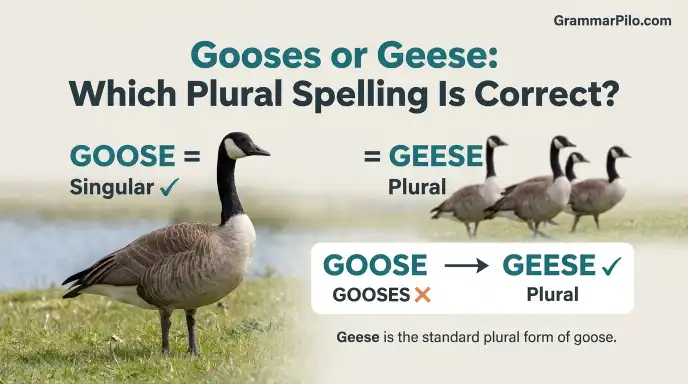
Gooses or geese? The correct plural of “goose” is “geese,” while “gooses” is generally incorrect in standard English.
This is a common search because goose is an irregular noun, so its plural does not follow the usual rule of simply adding -s. Instead, the vowel changes from oo to ee: goose → geese.
People often search for gooses or geese, geese or gooses, or gooses vs. geese when writing about more than one goose. The confusion is understandable because many English nouns form plurals with -s or -es, such as duck → ducks and box → boxes. However, English has many older irregular plurals that follow different patterns.
Knowing the correct form helps you write clearly in school assignments, emails, articles, social media posts, news stories, and formal writing. The simple rule is easy to remember: one goose, two geese.
Gooses or Geese: Quick Answer
The correct plural of “goose” is “geese.”
Correct Form
- Singular: goose
- Plural: geese
Example:
- I saw one goose near the lake.
- I saw several geese near the lake.
Is “Gooses” Correct?
“Gooses” is not the standard plural form of “goose.” In normal English writing, use geese when referring to more than one goose.
Gooses or Geese: Simple Rule
Remember:
One goose → two geese
Not:
One goose → two gooses
So, when deciding between gooses or geese, choose geese.
Definition and Meaning of Gooses and Geese
What Does “Goose” Mean?
A goose is a large waterbird belonging to the family Anatidae. Geese are commonly found near lakes, rivers, wetlands, farms, and other areas with water and vegetation.
Example:
- A goose was standing beside the pond.
What Does “Geese” Mean?
Geese is the plural form of goose. It means two or more birds of this type.
Example:
- The geese were swimming across the lake.
Goose vs. Geese
The difference is based on number:
| Form | Meaning | Example |
| Goose | One bird | A goose is near the pond. |
| Geese | More than one bird | The geese are near the pond. |
Geese or Gooses in Context
In standard English, geese is the normal plural form.
Correct: The geese flew south.
Incorrect: The gooses flew south.
This is why the question geese or gooses has a simple answer: geese is the standard plural.
The Origin of Geese or Gooses
Where Does “Goose” Come From?
The word goose is very old. It comes from Old English gōs, with related forms found in other Germanic languages.
The word has remained in English for centuries, although its spelling and pronunciation changed over time.
Why Is the Plural “Geese”?
Geese is an example of an irregular plural.
Older forms of English sometimes changed the vowel inside a word to show that there was more than one. This pattern is known as vowel mutation or i-mutation.
A similar historical pattern can be seen in other English words:
- foot → feet
- tooth → teeth
- mouse → mice
- goose → geese
The vowel change in goose → geese comes from this older Germanic plural pattern.
Why Not “Gooses”?
Modern English often forms plurals by adding -s, but not every noun follows that rule. Words such as goose, mouse, and tooth have older irregular plural forms.
Therefore, gooses vs. geese is not a choice between two standard plural spellings. Geese is the standard plural.
British English vs American English Spelling
Is “Geese” Used in British English?
Yes. Geese is the standard plural of goose in British English.
Example:
- The geese are walking across the field.
Is “Geese” Used in American English?
Yes. American English also uses geese as the plural form.
Example:
- We watched the geese near the lake.
There is no standard British-American spelling difference for this word.
British English vs. American English
| English Variety | Singular | Plural | Example |
| British English | goose | geese | The geese are flying. |
| American English | goose | geese | The geese are flying. |
| International English | goose | geese | The geese are flying. |
The answer remains the same in both major varieties: goose → geese.
Which Spelling Should You Use?
For American English
If you are writing for a U.S. audience, use geese.
Example:
- The geese gathered near the park.
For British English
If you are writing for a British audience, use geese as well.
Example:
- Several geese were resting beside the river.
For International English
For international readers, geese is also the correct standard form.
Professional Advice
When writing about more than one goose, use geese in:
- School assignments
- Business writing
- Emails
- Websites
- News articles
- Academic writing
- Social media
- Formal documents
You generally should not use gooses as the plural of goose.
Common Mistakes with Gooses or Geese
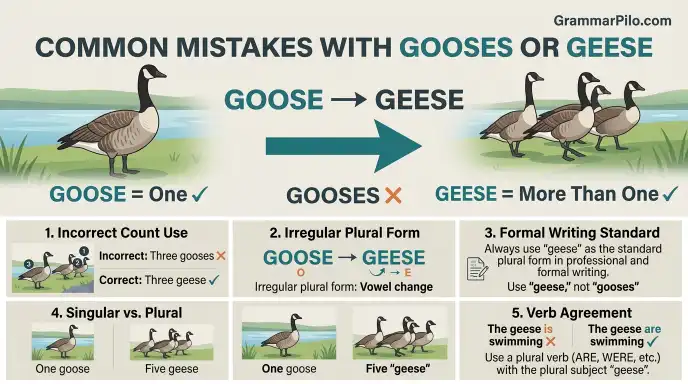
Mistake 1: Adding “-s” to Goose
Incorrect:
- There are three gooses in the park.
Correct:
- There are three geese in the park.
Mistake 2: Treating Goose Like a Regular Noun
Many nouns form plurals by adding -s:
- bird → birds
- duck → ducks
- dog → dogs
But goose is irregular.
Goose → geese
Mistake 3: Using “Gooses” in Formal Writing
The form gooses may appear when someone is learning English or applying a regular plural rule, but it is not the standard plural of the bird.
Use: geese
Mistake 4: Confusing “Geese” With “Goose”
Goose refers to one.
Geese refers to more than one.
Correct: One goose is eating.
Correct: Five geese are eating.
Mistake 5: Using a Singular Verb With “Geese”
Because geese is plural, it normally takes a plural verb.
Incorrect: The geese is swimming.
Correct: The geese are swimming.
Geese and Gooses in Everyday Examples
In Emails
Correct:
“We noticed several geese near the entrance this morning.”
In News Writing
Correct:
“Local officials warned residents about a group of geese near the road.”
On Social Media
Correct:
“Look at these geese enjoying the lake!”
In Formal Writing
Correct:
“Several geese were observed in the wetland area.”
In Everyday Conversation
Correct:
“There are geese in the backyard.”
In School Writing
Correct:
“The geese migrate to warmer areas during certain seasons.”
These examples show why geese or gooses is usually an easy choice once you remember that goose has an irregular plural.
Gooses or Geese: Google Trends & Usage Data
Which Form Do People Search For?
People may search for both gooses or geese and geese or gooses because they are unsure if goose follows the regular English plural rule.
Searches may also appear as:
- gooses vs. geese
- geese vs. gooses
- gooses and geese
- geese and gooses
- plural of goose
- plural goose
- goose plural
The important point is that search interest does not mean both forms are grammatically standard.
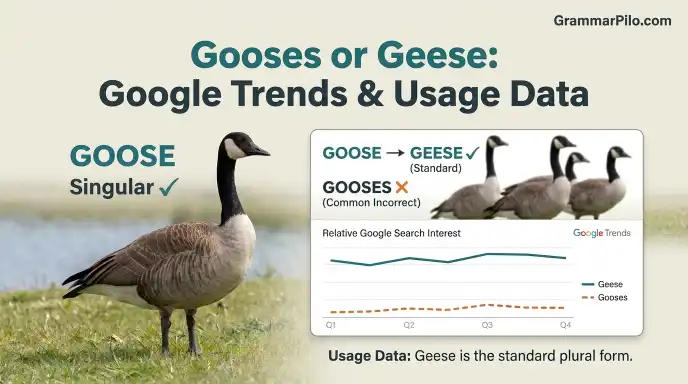
What Does Google Trends Show?
Google Trends measures relative search interest, not if a word is grammatically correct. Search volume can vary by country, season, school-related searches, wildlife interest, and general language questions.
For a grammar website such as GrammarPilo, the useful search intent behind gooses or geese is mainly spelling and plural-form clarification.
Rather than treating search popularity as proof of correctness, writers should use established English grammar and dictionary conventions to determine the standard form.
Gooses vs. Geese: Comparison Table
| Variation | Standard English? | Meaning/Use |
| goose | Yes | One goose |
| geese | Yes | More than one goose |
| gooses | No, not as the normal plural | Usually an incorrect regular plural |
| gooses or geese | Search phrase | Asks which plural is correct |
| geese or gooses | Search phrase | Same comparison in reverse |
| gooses vs. geese | Search phrase | Compares the two forms |
| geese vs. gooses | Search phrase | Reverse comparison |
| gooses and geese | Phrase | Can mention both forms when discussing the confusion |
| geese and gooses | Phrase | Reverse order of the comparison |
The Key Rule
Goose → geese
That is the form to use when you mean more than one goose.
FAQs About Geese vs. Gooses
1. What is the plural of goose?
Answer: The plural of goose is geese.
Example: One goose, two geese.
2. Is “gooses” a correct word?
Answer: Gooses is not the standard plural of goose. In normal English, use geese.
3. Is it geese or gooses?
Answer: Geese is correct when referring to more than one goose.
4. Why is the plural of goose geese?
Answer: Goose → geese comes from an older Germanic pattern in which the vowel changed to mark the plural.
5. Is “geese” singular or plural?
Answer: Geese is plural. The singular form is goose.
6. Do British and American English use “geese”?
Answer: Yes. Both British and American English use geese as the standard plural of goose.
7. How can I remember goose vs. geese?
Answer: Remember the pattern goose → geese, just as foot → feet and tooth → teeth use vowel changes for their plural forms.
Conclusion: Gooses or Geese?
Goose or geese? The standard English forms are simple: “goose” is singular, and “geese” is plural. The form gooses is not the normal plural form used in standard English.
The confusion comes from the fact that many English nouns form their plurals by adding -s, but goose is an irregular noun. Its plural developed through an older Germanic vowel-change pattern, giving us goose → geese.
This rule is the same in American English, British English, and general international English. If you are writing an email, school assignment, news article, social media post, or formal document, use geese when talking about two or more of these birds.
If you search for gooses or geese, geese or gooses, gooses vs. geese, or geese vs. gooses, the answer remains the same: geese is the standard plural of goose. The easiest memory trick is simply: one goose, two geese.
Similar Words Explained

I’m Sloane Mercer, a U.S.-based English language writer focused on grammar, spelling, vocabulary, and everyday English usage. Through GrammarPilo, I provide clear and practical explanations to help readers choose the right words and communicate with confidence.








3 thoughts on “Gooses or Geese: Which Plural Spelling Is Correct?”