
Remodel or move? The right choice depends on your budget, your home’s condition, your space needs, and how well your current location fits your lifestyle.
Remodeling allows you to improve the home you already own, while moving gives you the opportunity to find a property that better matches your needs. Both options can solve common housing problems, but they involve different costs, risks, and long term benefits.
Some homeowners consider remodeling because they love their neighborhood but need a larger kitchen, an extra bedroom, or a more functional layout. Others find that renovations cannot solve their main problems, such as a long commute, limited outdoor space, or a home that has become too small for their family.
The remodel or move decision is not simply about comparing renovation costs with the price of another house. You also need to consider selling expenses, moving costs, temporary housing, future maintenance, and the emotional value of staying in a familiar place.
This guide explains the difference between remodeling and moving, compares their advantages and disadvantages, and provides practical examples to help you evaluate both options. By understanding the costs, benefits, and trade offs, you can make a more confident decision for your home and your future.
Remodel or Move: Quick Answer
Quick answer: Remodel if your current home and location meet your long term needs and the renovation is financially practical. Move if your home has fundamental limitations that remodeling cannot reasonably solve.
Remodeling is often attractive when you want to update specific rooms, improve functionality, increase comfort, or make better use of existing space.
Moving may be the better choice when you need a different location, substantially more space, a different property type, or a layout that would be too expensive to create through renovations.
Neither option is automatically cheaper. A major renovation can cost more than expected, while buying another home involves transaction costs, moving expenses, and potentially higher mortgage payments.
The best choice depends on the complete financial picture and the improvements you want to make.
Definition and Meaning of Remodel and Move
What Does Remodel Mean?
To remodel means to change or improve the structure, design, layout, or appearance of an existing property. Home remodeling can involve minor updates or extensive construction.
Examples include renovating a kitchen, redesigning a bathroom, removing a non load bearing wall, finishing a basement, or converting an unused room into a home office.
Example: We decided to remodel our house instead of moving because we loved the neighborhood and only needed a larger kitchen.
What Does Move Mean?
In this context, to move means to leave your current home and relocate to another property. This usually involves selling or renting out your existing home, finding a new property, and arranging the move.
Moving can provide a fresh start, more suitable space, improved access to work or school, or a different neighborhood.
Example: The family chose to move because their current house could not comfortably accommodate their growing needs.
Remodel vs. Move at a Glance
| Factor | Remodel | Move |
| Main purpose | Improve the current home | Find a more suitable home |
| Location | Usually stays the same | Usually changes |
| Construction | May involve contractors and permits | Usually involves buying or renting another property |
| Upfront expenses | Renovation costs and possible temporary accommodation | Closing costs, moving expenses, and other transaction costs |
| Lifestyle disruption | Noise, dust, and construction | Packing, relocation, and adjustment to a new area |
| Best suited for | Homes with fixable limitations | Homes or locations that no longer meet major needs |
The Origin of Remodel and Move
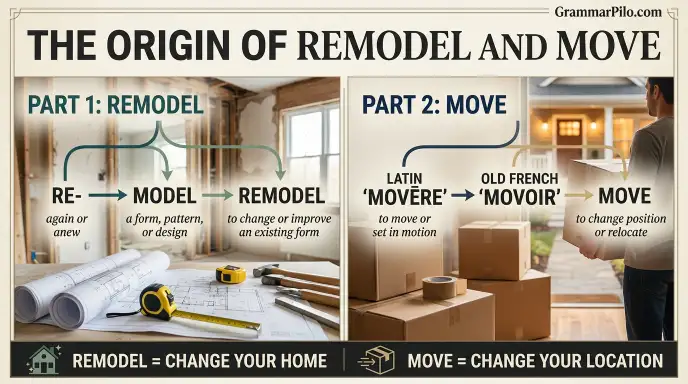
Where Does Remodel Come From?
The word remodel combines the prefix re , meaning again or anew, with model, referring to a form, pattern, or design. It describes the act of shaping something again or changing its existing form.
The word became especially familiar in construction, architecture, and home improvement, where it refers to changing an existing building or room.
Related words include remodeling, remodeled, and remodeler. American English commonly uses the spelling remodeling, while British English often uses remodelling.
Where Does Move Come From?
Move comes from Old French movoir and Latin movēre, meaning to move or set in motion. The word has long been used for physical movement, changes in position, and relocation.
In housing, move commonly means transferring your household from one residence to another.
Related expressions include moving house, moving out, moving in, and moving day.
Although move and remodel can both describe ways to improve a living situation, they refer to different actions. Remodeling changes the property, while moving changes where you live.
British English vs American English Spelling
The words move and remodel are spelled the same in standard American and British English. However, some related forms of remodel differ.
| Form | American English | British English |
| Base verb | Remodel | Remodel |
| Present participle | Remodeling | Remodelling |
| Past tense | Remodeled | Remodelled |
| Noun for the activity | Remodeling | Remodelling |
| Relocation verb | Move | Move |
| Present participle | Moving | Moving |
| Past tense | Moved | Moved |
The difference comes from a common spelling pattern. American English generally favors a single final consonant in remodeling and remodeled, while British English often doubles the final l in remodelling and remodelled.
The spelling of move does not change between the two varieties.
Which Option Should You Choose?
Choosing between remodeling and moving requires more than looking at one estimate or browsing available homes. Consider your priorities, financial position, and plans for the next several years.
Choose Remodeling If You Love Your Location
Staying may make sense if you value your neighborhood, commute, schools, nearby family, or community connections.
A renovation can help you enjoy your existing location without the disruption of relocating. It may also allow you to personalize your space instead of adapting to a new property’s limitations.
Choose Moving If Your Needs Have Changed
Moving may be more practical if your household needs an extra bedroom, a different floor plan, a more accessible home, or a shorter commute.
Some limitations are difficult or expensive to fix. A small lot, restrictive building rules, a poor location, or an unsuitable property layout may make another home a better long term fit.
Compare the Full Cost of Both Options
Do not compare only the renovation estimate with the purchase price of another home. Include the costs that are easy to overlook.
| Remodeling costs | Moving costs |
| Contractor labor and materials | Selling and closing expenses |
| Architectural or engineering fees | Purchase closing costs |
| Permits and inspections | Moving company or rental truck |
| Temporary accommodation, if needed | Repairs or updates to the new home |
| Unexpected construction problems | Mortgage, tax, and insurance changes |
| Possible storage and cleanup | Utility transfers and other setup expenses |
Get written estimates where possible. Real estate transaction costs, contractor pricing, and local rules vary by location, so use figures that reflect your own circumstances.
Think About Your Long Term Plans
A home improvement that suits you today may not fit your plans in five years. Consider your expected household size, work arrangements, accessibility needs, and the time you plan to remain in the property.
If you expect to stay for many years, a carefully planned renovation may provide lasting value. If you anticipate relocating soon, a costly personalized remodel may not be the most practical use of your money.
Common Mistakes When Deciding to Remodel or Move
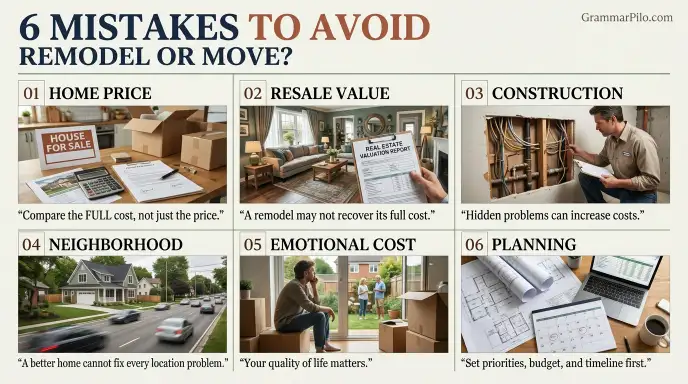
1. Comparing Renovation Costs With Only the New Home’s Price
The purchase price is only one part of moving. Selling fees, closing costs, moving services, repairs, and changes to monthly housing expenses can substantially affect the total.
Compare the full estimated cost of both options before deciding.
2. Assuming Every Remodel Increases Home Value
Some improvements make a home more appealing, but the amount recovered at resale varies. A project that is highly personalized or expensive for the neighborhood may not return its full cost.
Consider your own comfort as well as potential resale value.
3. Underestimating Construction Problems
Older homes may contain hidden plumbing, electrical, structural, or moisture problems. These issues can increase the budget and extend the timeline.
Arrange appropriate inspections and keep a contingency reserve instead of assuming the first estimate is final.
4. Ignoring the Neighborhood
A beautiful renovation cannot fix every location problem. Traffic, long commutes, limited access to services, or an unsuitable school commute may remain after the work is complete.
Think about if your dissatisfaction comes from the building itself or from the area around it.
5. Forgetting the Emotional Cost of Moving
Leaving friends, familiar routines, and a community can be difficult. On the other hand, staying in a home that no longer works can create daily frustration.
Include quality of life in your decision rather than treating the choice as a purely financial calculation.
6. Starting a Remodel Without a Clear Plan
Changing the scope of a project after construction begins can add costs and delays. Decide which improvements are essential, which are optional, and what your maximum budget will be.
Obtain required permits and confirm contractor responsibilities before work starts.
Remodel or Move in Everyday Situations
The following examples show how different needs can influence the decision.
In a Growing Family
Remodel: A family loves its neighborhood but needs a second bathroom. If the property has enough suitable space and the project is feasible, adding a bathroom may be a practical solution.
Move: If the family needs several extra bedrooms and the property cannot accommodate them, finding a larger home may make more sense.
In a Work From Home Situation
Remodel: Someone who enjoys their current home might convert an underused room into a dedicated office.
Move: A person who needs separate office space but has no room to create it may benefit from moving to a home with a suitable layout.
In an Older Home
Remodel: A homeowner may update outdated wiring, improve insulation, replace worn flooring, or modernize a kitchen while preserving the property’s character.
Move: If the home requires extensive structural work and several expensive systems need replacement, another property may be worth comparing.
Safety and repair needs should be assessed by qualified professionals before making a financial decision.
In a Changing Lifestyle
Remodel: Someone planning to age in place may improve lighting, widen suitable doorways, or install accessible bathroom features where practical.
Move: A person who needs a single level layout or easier access may find that another property meets those needs more efficiently.
In a Financial Decision
Remodel: A homeowner with a manageable renovation budget may improve the existing property without taking on the costs of purchasing another home.
Move: Someone with sufficient resources and a strong reason to change location may decide that buying a more suitable property is worth the transaction expenses.
These examples show that move or remodel is a personal decision shaped by the home’s limitations, the available budget, and the homeowner’s priorities.
Move vs. Remodel: Google Trends and Modern Usage
People searching for remodel or move are often comparing the practical and financial trade offs of renovating their current home with relocating. Related searches may include should I move or remodel, renovate or buy a new house, cost to remodel a house, and is it cheaper to move or renovate.
These phrases reflect different stages of the decision. Some searchers are still deciding what they want, while others are comparing costs or looking for specific renovation ideas.
Google Trends can help you compare the relative search interest of terms such as remodel, home renovation, moving house, and buy a new home. To make the comparison meaningful, select the intended country, time period, and search category. You can also compare related phrases separately to understand more specific interests.
Google Trends reports relative interest rather than exact search volume. A trend chart alone cannot establish the total number of people planning to renovate or relocate, and interest can vary by season and location.
For a homeowner, the most useful research is local. Compare renovation quotes, current property listings, transaction expenses, and the likely monthly cost of each option. Broad search trends can provide context, but local numbers should guide the final decision.
Key Takeaways: Remodel or Move
- Remodel when your home and location still suit your needs and the required improvements are practical.
- Move when the location, layout, size, or condition of your current property creates problems that renovations cannot reasonably solve.
- Compare total costs, including hidden expenses, rather than focusing on a single estimate.
- Consider disruption, neighborhood connections, future plans, and quality of life.
- Obtain professional assessments for major structural, electrical, plumbing, or safety concerns.
- Do not assume that every renovation will recover its full cost at resale.
- Use local property and contractor information to make a realistic comparison.
The strongest decision is the one that fits your finances and daily life, not simply the one that sounds cheaper at first.
Frequently Asked Questions
1. Is it cheaper to remodel or move?
It depends on the size of the renovation, the price of a suitable replacement home, local property values, and transaction costs. Small or moderate renovations may cost less than moving, but major structural changes can be expensive. Compare detailed estimates for both options.
2. When should I remodel instead of moving?
Remodeling may be the better choice when you like your neighborhood, your home’s basic structure works, and the improvements you need are affordable and feasible. It can also make sense if moving would significantly increase your housing expenses.
3. When is moving better than remodeling?
Moving may be preferable when you need a different location, much more space, a different layout, or a property that better meets accessibility needs. It may also be worth considering when the existing home requires extensive repairs that would be costly to complete.
4. Does remodeling always increase home value?
No. The effect depends on the project, local market, workmanship, and buyer preferences. Necessary repairs and well planned improvements may help a property appeal to buyers, but highly personalized or expensive projects may not return their full cost.
5. Should I remodel before selling my house?
Not necessarily. Minor repairs, cleaning, and simple cosmetic improvements may help present the home well. Major renovations should be evaluated carefully because the cost may exceed the value they add. Ask a local real estate professional which improvements buyers in your market tend to value.
6. How do I compare the cost of remodeling with buying another home?
Create two budgets. For remodeling, include labor, materials, permits, inspections, temporary housing, and a contingency reserve. For moving, include selling expenses, purchase closing costs, moving services, immediate repairs, and changes to mortgage payments, taxes, and insurance.
7. Can I remodel my house while living in it?
Yes, depending on the scale and location of the work. Smaller projects may allow you to stay, while major kitchen, bathroom, structural, or whole house renovations can make daily life difficult. Discuss dust control, access, utilities, safety, and temporary accommodation with your contractor.
8. Is remodeling a good investment before moving later?
It can be, but it depends on the improvement and how soon you plan to sell. Focus first on necessary repairs and practical updates. Before investing in a major project, compare the estimated cost with local buyer expectations and likely resale benefits.
9. What should I do first when deciding to remodel or move?
Write down the problems you want to solve, separate essential needs from preferences, and estimate the total cost of both choices. Then review local property options and obtain professional advice for major renovation work. This creates a clearer basis for comparison.
10. Can remodeling solve a home’s layout problems?
Sometimes. Opening up suitable spaces, improving storage, or reconfiguring rooms may make a home more functional. However, load bearing walls, plumbing locations, building codes, lot restrictions, and the home’s overall design can limit what is practical.
Conclusion: Making the Right Choice for Your Future
The decision to remodel or move comes down to what you need from your home and what makes the most sense financially. Remodeling can help you preserve a familiar neighborhood, improve comfort, and create a space that fits your lifestyle.
Moving can provide a fresh start when your current property or location no longer meets your needs.Neither option is always better.
A renovation may be worthwhile when the house has a sound structure and the changes are achievable within your budget. Relocating may be more practical when you need substantially more space, a different layout, or a location that better supports your work and family life.
Before making a final decision, compare the complete costs, consider the disruption involved, and think about your plans for the coming years. Gather reliable contractor estimates and current local housing information rather than relying on general assumptions about what is cheaper.
Ultimately, the best choice is the one that supports your long term comfort, financial stability, and quality of life. A thoughtful comparison can help you decide if your next chapter should begin with improving the home you have or finding a new place to call home.
More Articles to Explore

I’m Claire Morgan, the author behind Grammarpilo.com, where I write about English grammar, sentence structure, punctuation, and everyday language. My goal is to make grammar simple, clear, and practical, helping readers understand the rules and apply them with confidence in real-world writing.