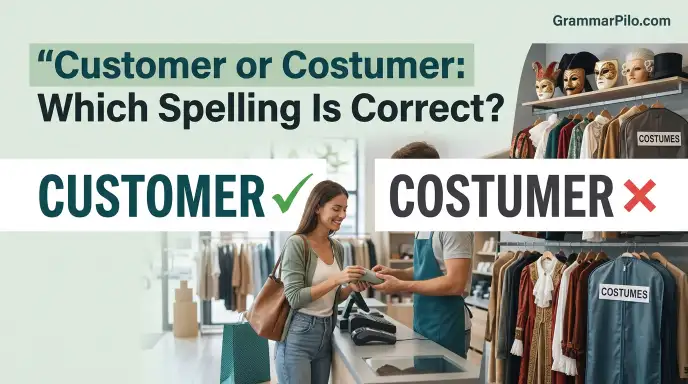
“Customer” is the correct spelling when you mean a person who buys goods or services, while “costumer” is a different word for a person who makes or wears costumes. If you are wondering if to write costumer or customer, the correct choice depends on what you mean.
The two words look very similar, but they have different meanings. Customer is the common word used in business, shopping, restaurants, stores, and online services. A customer buys something or uses a service.
For example:
The customer ordered a new laptop.
Costumer, on the other hand, is a much less common word. It refers to someone involved with costumes, such as a person who makes, supplies, or works with costumes.
For example:
The theater hired a professional costumer for the production.
This makes customer vs. costumer different from a simple spelling mistake. While costumer is sometimes used as a misspelling of customer, it is also a legitimate English word with a separate meaning.
Understanding the difference between costumer and customer can help you avoid mistakes in emails, business writing, articles, product descriptions, and everyday communication.
Costumer or Customer : Quick Answer
Customer is the correct word when you mean someone who buys a product or service.
Costumer is a real but uncommon word related to costumes.
| Word | Meaning | Example |
| Customer | A person who buys goods or services | The customer paid for the meal. |
| Costumer | A person who makes, supplies, or works with costumes | The costumer prepared the outfits. |
Easy Rule
Remember:
Customer = buys something
Costumer = works with costumes
Examples
The customer asked for a refund.
The theater hired a costumer.
The store has many regular customers.
The costumer designed costumes for the actors.
Definition and Meaning of Customer
What Does “Customer” Mean?
A customer is a person or organization that buys goods or services from a business.
For example:
The customer bought a new phone.
Here, the person buying the phone is the customer.
The word is commonly used in stores, restaurants, banks, websites, businesses, and service industries.
Everyday Examples
The customer ordered coffee.
The customer paid with a credit card.
We value every customer.
The company contacted its customers.
The restaurant has many regular customers.
A customer does not necessarily buy a physical product. Someone who pays for a service can also be a customer.
For example:
She is a customer of the bank.
He became a customer of the streaming service.
Definition and Meaning of Costumer
What Does “Costumer” Mean?
A costumer is a person who works with costumes. Depending on the context, this can mean someone who designs, makes, supplies, selects, or manages costumes, especially for theater, film, television, or other performances.
For example:
The film’s costumer prepared clothing for the actors.
The word is much less common than customer.
It is important to understand that costumer is not simply an alternative spelling of customer. It is a separate word with a different meaning.
Costumer Example
The theater hired a professional costumer to create the performers’ outfits.
Here, costumer relates to costume, not to buying something.
Customer vs. Costumer: What Is the Difference?
The main difference is their meaning.
Customer refers to someone who buys goods or services.
Costumer refers to someone who works with costumes.
Compare:
The customer bought a costume.
The person buying the costume is the customer.
The costumer designed the costume.
The person working on the costume is the costumer.
The words differ by only one letter, but that letter changes the meaning.
| Customer | Costumer |
| Buys products or services | Works with costumes |
| Common word | Less common word |
| Used in business and shopping | Used mainly in costume-related contexts |
| Related to commerce | Related to costumes |
Why Do People Confuse Customer and Costumer?

The confusion happens because customer and costumer look and sound very similar.
The word costumer contains the complete word costume, which makes its meaning easier to connect once you know it.
costume → costumer
By contrast:
custom → customer
Historically, customer developed from custom, which originally had a sense connected with habitual buying or dealing.
The similarity between the two words makes costumer a common misspelling when someone actually means customer.
The Origin of Customer
The word customer comes from custom.
The history of the word is connected with the idea of a person who regularly uses or purchases from a particular business.
The word custom ultimately comes through Old French and Latin roots associated with established practice or habit.
Over time, customer developed into the English noun used for someone who regularly deals with a business or purchases its goods or services.
This connection gives us a useful memory clue:
custom → customer
The Origin of Costumer
Costumer is formed from costume with the suffix -er, referring to a person associated with the activity.
The word costume comes through French and ultimately has Latin roots. In modern English, a costume is a particular style of clothing, especially clothing worn for a particular period, character, performance, or occasion.
Therefore:
costume → costumer
A costumer is someone who works with costumes.
This gives us an easy way to distinguish the two words:
Customer → custom
Costumer → costume
British English vs. American English Spelling
There is no British vs. American spelling difference between customer and costumer.
Both British and American English use:
customer
for a person who buys goods or services.
Both also recognize:
costumer
as a word relating to costumes, although it is much less common.
| Meaning | British English | American English |
| Person who buys goods/services | customer | customer |
| Person working with costumes | costumer | costumer |
So, this is not a British vs. American spelling issue.
The important difference is meaning.
Which Word Should You Use?
Use customer when talking about someone who purchases something or uses a business service.
Use Customer For:
- shoppers
- buyers
- restaurant guests who purchase meals
- people using paid services
- business clients in appropriate contexts
Examples:
The customer placed an order.
We need to help the customer.
The company gained 500 new customers.
Use costumer when referring to someone who works with costumes.
Examples:
The theater hired a costumer.
The costumer created outfits for the production.
The film’s costumer organized the actors’ clothing.
Costumer or Customer in Everyday Examples
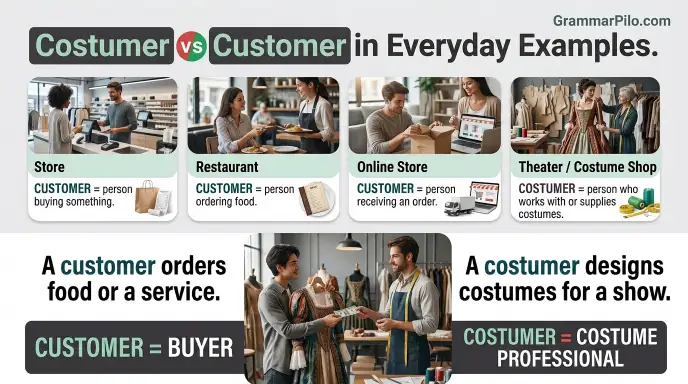
In a Store
The customer asked about the price.
Correct.
The costumer asked about the price.
Usually incorrect if you mean a shopper.
In a Restaurant
The customer ordered a burger.
Correct.
In an Online Store
The customer received an order confirmation.
Correct.
In a Theater
The costumer prepared costumes for the actors.
Correct.
At a Costume Shop
Both words can appear in the same situation:
The customer bought a costume from the costumer.
Here:
- customer = person buying the costume
- costumer = person working with or supplying costumes
This is an excellent example of why the difference matters.
Common Mistakes With Costumer or Customer
Mistake 1: Using Costumer for a Shopper
Incorrect:
The costumer complained about the service.
If you mean someone who bought something, use customer.
Correct:
The customer complained about the service.
Mistake 2: Thinking Costumer Is Always Wrong
It is not always wrong.
Costumer is a legitimate word when you mean someone associated with costumes.
The theater’s costumer designed the outfits.
So, costumer is not simply an incorrect spelling.
Mistake 3: Forgetting the Connection Between Customer and Custom
A useful way to remember customer is:
custom → customer
The word does not come from costume.
Mistake 4: Confusing Costume and Customer
These words are related to completely different ideas:
Costume = clothing or outfit
Customer = person who buys something
Costumer = person who works with costumes
Customer vs. Costumer: Side-by-Side Examples
| Customer | Costumer |
| The customer bought a shirt. | The costumer designed the outfit. |
| The customer asked for help. | The costumer prepared the costumes. |
| We have many customers. | The theater employs a costumer. |
| The customer placed an order. | The costumer selected clothing for the actors. |
| The customer requested a refund. | The costumer repaired the costume. |
Customer and Costumer in Professional Writing
Choosing the correct word is important in professional communication.
Business
Our customers expect excellent service.
Marketing
We want to understand our customers’ needs.
Customer Service
The customer contacted support about the problem.
Theater or Film
The costumer worked closely with the director.
Fashion and Performance
The costumer prepared clothing for the performers.
The context usually makes the correct word clear.
How to Remember Customer vs. Costumer
Use this simple memory trick:
CUSTOMER = CUSTOM
Think:
custom → customer
A customer is someone who regularly deals with a business or buys something.
COSTUMER = COSTUME
Think:
costume → costumer
A costumer works with costumes.
One-Letter Memory Trick
Customer has no extra “o” after the t.
customer ✓
Costumer has the “o” because it comes from costume.
costume → costumer ✓
This is one of the easiest ways to remember the difference.
Google Trends & Usage Data
Searches for “costumer or customer” usually reflect spelling confusion between two very similar-looking words.
The search phrase can be misleading because costumer is not simply an incorrect form of customer. It is also a legitimate, less common English noun connected with costumes.
Google Trends measures relative search interest, not the total number of times a word appears in everyday English. Search interest can vary by location, time period, education, and the context in which people encounter the words.
For most business, shopping, and service-related writing, customer is the word you need.
For theater, film, costume design, and performance contexts, costumer may be appropriate.
Costumer or Customer : Quick Comparison
| Question | Answer |
| Which word means a buyer? | Customer |
| Which word relates to costumes? | Costumer |
| Is customer correct? | Yes |
| Is costumer always wrong? | No |
| Is costumer a misspelling of customer? | It can be, but it is also a legitimate word |
| Which word is more common? | Customer |
| Is the spelling different in British English? | No |
| Is the spelling different in American English? | No |
Frequently Asked Questions
Is it costumer or customer?
Both are real English words, but they have different meanings. Customer means a person who buys goods or services. Costumer refers to someone who works with costumes.
Is “costumer” a correct word?
Yes. Costumer is a legitimate but less common word for someone who makes, supplies, designs, or works with costumes.
Is “costumer” the same as “customer”?
No. Customer and costumer have different meanings.
Customer = buyer or client.
Costumer = person who works with costumes.
Why do people spell customer as costumer?
The words look and sound very similar. People may associate customer with costume and accidentally add the extra o.
How do I remember the difference between customer and costumer?
Remember:
Customer → custom
Costumer → costume
If the person is buying something, use customer. If the person works with costumes, use costumer.
Which is more common: customer or costumer?
Customer is much more common in everyday English because people frequently talk about buyers and clients. Costumer is more specialized and is mainly used in costume-related contexts.
Is customer spelled differently in British English?
No. Customer has the same spelling in British and American English.
Conclusion
Customer and costumer are both correct words, but they have different meanings. If you are asking costumer or customer because you want to describe someone who buys a product or service, the correct word is customer.
Customer is widely used in business, shopping, restaurants, online stores, banking, and customer service.
Costumer is a less common word connected with costumes. It can describe someone who designs, makes, supplies, selects, or manages costumes, especially for theater, film, or other performances.
The easiest way to remember the difference is:
Customer → custom → buyer
Costumer → costume → costume professional
There is no British or American spelling difference between the two words. The important point is their meaning and context.
So, if you mean someone who buys something, write customer. If you mean someone who works with costumes, costumer can be the correct word.
You May Also Like!

I’m Claire Morgan, the author behind Grammarpilo.com, where I write about English grammar, sentence structure, punctuation, and everyday language. My goal is to make grammar simple, clear, and practical, helping readers understand the rules and apply them with confidence in real-world writing.





3 thoughts on “Customer or Costumer: Which Spelling Is Correct?”