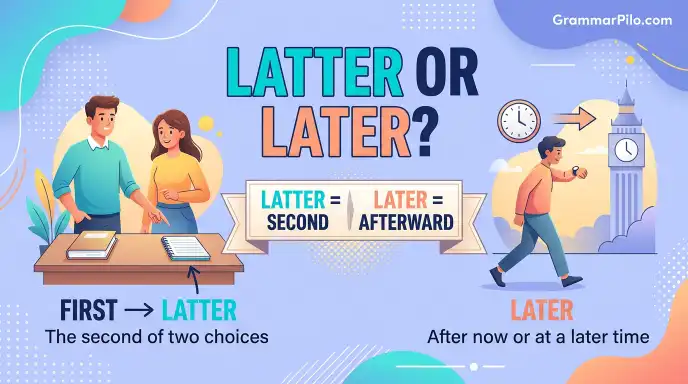
Latter and later are both correct English words, but they have different meanings and cannot usually replace each other. Latter refers to the second of two people, things, or options mentioned earlier, while later refers to a time after the present or after another event.
For example, in “I prefer tea and coffee, but I like the latter more,” latter means coffee. In “I will call you later,” the word later refers to a future time.
The confusion between latter and later is understandable because the words look almost identical and differ by only one letter. However, remembering their basic meanings makes the distinction straightforward.
One word helps readers identify the second item in a pair, while the other tells them when something will happen.
This guide explains the meaning of later and latter, their origins, common mistakes, and how to use each word naturally in everyday writing. You will also find practical examples, a comparison table, and answers to frequently asked questions.
By the end, you will know which word fits your sentence and how to avoid mixing them up in emails, school assignments, professional documents, and casual conversations.
Quick Answer
Latter means the second of two people or things mentioned previously. Later means at a time in the future or after a particular event.
| Word | Meaning | Example |
| Latter | The second of two items mentioned | I considered tea and coffee, and I chose the latter. |
| Later | At a future time or after something else | I will choose my drink later. |
Easy memory trick:
- Latter = the second option.
- Later = a future time.
For example, “I can study now or later” uses later because it refers to time. However, “I can study mathematics or history, and I prefer the latter” uses latter because it identifies the second subject, history.
Both words are standard in American and British English. The correct choice depends on what you want to communicate, not on which variety of English you use.
Latter vs. Later: Definition and Meaning
Although they share similar spelling but perform different jobs in a sentence. Understanding their definitions is the easiest way to choose the correct word.
What Does Latter Mean?
Latter refers to the second of two people, things, choices, or ideas mentioned earlier in a sentence or passage. It helps writers avoid repeating the name of the second item.
For example, consider this sentence.
“I enjoy reading novels and biographies, but I prefer the latter.”
The two items are novels and biographies. Because biographies appear second, the latter means biographies.
Here are more examples:
- I can travel by train or bus, but I prefer the latter.
- Sarah considered teaching and nursing before choosing the latter.
- The report discusses cost and quality, with the latter receiving more attention.
- We visited Rome and Florence, and the latter was my favorite.
In each example, latter points back to the second member of a pair.
The word is especially useful in formal writing, academic discussions, reports, and explanations. However, readers must be able to identify the two items being compared. If the reference is unclear or several items appear in between, repeating the noun may make the sentence easier to understand.
Important rule: Latter generally refers to the second of two items, not the final item in a long list of several unrelated options.
What Does Later Mean?
Later refers to a time after the present moment or after another event. It can function as an adverb and, in some contexts, an adjective.
For example, “I will finish the assignment later” means the assignment will be completed at a future time.
Common examples include the following:
- I will send you the details later.
- We arrived later than expected.
- She decided to discuss the issue at a later meeting.
- The later chapters explain the main argument.
- He called me two hours later.
The exact time does not always need to be specified. In “I will speak to you later,” the listener understands that the conversation will happen sometime in the future.
Unlike latter, later does not identify the second of two previously mentioned items. It focuses on time, sequence, or something occurring after another point.
Latter and Later in One Sentence
Using both words together can make their differences especially clear.
“I considered studying medicine or engineering, but I decided to think about it later because the latter option seemed more appealing.”
In this example:
- Latter refers to engineering, the second subject mentioned.
- Later refers to a future time when the speaker will think about the decision.
Both words are correct because they communicate different ideas.
The Origin of Later and Latter
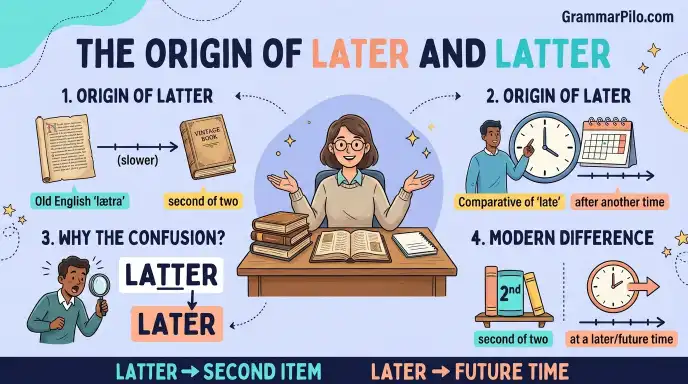
The historical development of these words helps explain why they look so similar despite having different meanings.
Where Did Latter Come From?
Latter developed from Old English lætra, a comparative form associated with late. Historically, it was connected with the idea of being later in time or coming after something.
Over time, latter acquired its familiar modern use as a reference to the second of two things previously mentioned. It is now particularly common in expressions such as “the former and the latter.”
For example, “The manager compared two proposals and approved the latter” means the manager approved the second proposal.
Although the word has historical links to time and sequence, its modern reference function distinguishes it from the more time-focused later.
Where Did Later Come From?
Later developed as the comparative form of late. It means occurring after another time or event.
For example, “The train arrived later than scheduled” indicates that the train arrived after its expected time.
The word continues to appear in everyday speech and writing because people frequently discuss schedules, plans, deadlines, and future events.
Why Are they Confused?
The words are visually similar, share historical connections, and differ by just one letter. Their relationship to the idea of sequence can also make their meanings seem interchangeable.
Nevertheless, modern usage has established a practical distinction.
- Use latter to identify the second of two previously mentioned items.
- Use later to describe a future time or something that happens afterward.
Learning this distinction is more useful than trying to memorize their spellings in isolation.
British English vs. American English
The distinction between latter and later is consistent across major English varieties. American and British writers use the same spellings and follow the same basic grammatical rules.
| Feature | American English | British English |
| Second of two items | Latter | Latter |
| Future time | Later | Later |
| Spelling difference | None | None |
| Formal usage | Both words are standard | Both words are standard |
| Example | I preferred the latter choice. | I preferred the latter choice. |
| Example | We can discuss it later. | We can discuss it later. |
Is Latter American or British English?
Neither. Latter is used in both American and British English. It is not an American-only or British-only spelling.
Is Later American or British English?
Later is also standard in both varieties. Writers in the United States, the United Kingdom, Canada, Australia, and other English-speaking regions use the same spelling.
Which Word Should You Use?
Choose the word according to its meaning rather than the country in which you are writing.
Use latter when referring to the second of two previously mentioned items. Use later when referring to a future time or something that happens afterward.
Which Spelling Should You Use
The best choice depends on the sentence you are writing. These words are not alternative spellings of the same word, so replacing one with the other can change the meaning or make the sentence incorrect.
Use Latter When Referring to the Second Item
Choose latter when you have already introduced two options and want to refer to the second one without repeating its name.
Correct: I can work remotely or in the office, but I prefer the latter.
Here, the latter means working in the office.
Correct: The article examines grammar and vocabulary, with the latter receiving more attention.
In this sentence, the latter means vocabulary.
Use Later When Referring to Time
Choose later when discussing something that will happen after now or after another event.
Correct: I will review your document later.
Correct: The meeting started later than planned.
Correct: We can discuss the proposal at a later date.
Each sentence refers to time rather than the second item in a pair.
Can Latter and Later Be Used Interchangeably?
No. Their meanings are different.
Consider these examples.
- “I prefer the latter.” This identifies the second of two items.
- “I prefer it later.” This suggests that the preference or action applies at a later time, though the sentence needs context to sound natural.
Changing one word to the other can make the sentence communicate a different idea. Always check whether your sentence refers to an option or a time.
Common Mistakes With Later and Latter
Even confident writers sometimes confuse because of their similar appearance. The following mistakes show how to use each word correctly.
Mistake 1: Using Later to Identify the Second Option
Incorrect: I compared tea and coffee, and I chose the later.
Correct: I compared tea and coffee, and I chose the latter.
The sentence identifies coffee as the second option, so latter is the appropriate word.
Mistake 2: Using Latter to Describe a Future Time
Incorrect: I will finish my homework latter.
Correct: I will finish my homework later.
The sentence refers to a future time, making later the correct choice.
Mistake 3: Confusing Latter With the Last Item in a Long List
Unclear: We considered tea, coffee, juice, and water, and I chose the latter.
Because four items appear in the list, readers may not know which item the latter identifies. The word traditionally refers to the second of two items.
Clearer: We considered tea, coffee, juice, and water, and I chose water.
Repeating the name of the chosen item avoids ambiguity.
Mistake 4: Using Latter Without Naming Two Items
Incorrect: The latter was an excellent idea.
This sentence may be correct if the previous context clearly identifies two ideas. Without that context, readers do not know what the latter refers to.
Clearer: The second proposal was an excellent idea.
When the earlier items are not obvious, name the item directly.
Mistake 5: Assuming Latter Means the Most Recent Event
Incorrect: I arrived at 9 a.m. and left at noon. The latter was when I met my friend.
Correct: I arrived at 9 a.m. and left at noon. The latter event was when I met my friend.
The corrected sentence clarifies that the latter refers to the second event, leaving time for a clear reference. In ordinary writing, “The second event was when I met my friend” may sound more natural.
Remember that latter identifies the second of two items, while later refers to time.
Later or Latter in Everyday Examples
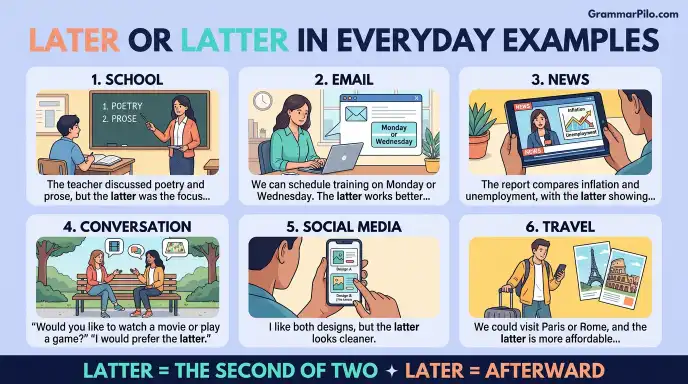
Seeing both words in everyday situations makes the distinction easier to remember.
In School and Academic Writing
Latter: The teacher discussed poetry and prose, but the latter was the focus of the lesson.
Later: I will complete the research paper later this evening.
The first sentence identifies prose. The second describes when the student plans to finish the paper.
In Emails and Professional Communication
Latter: We can schedule the training on Monday or Wednesday. The latter works better for our team.
Later: I will send the revised document later today.
The first sentence refers to Wednesday, while the second refers to a future time.
In News and Reports
Latter: The report compares inflation and unemployment, with the latter showing a significant change.
Later: Officials released a statement later that afternoon.
In the report example, the latter means unemployment. In the news example, later identifies when the statement was released.
In Everyday Conversations
Latter: “Would you like to watch a movie or play a game?” “I would prefer the latter.”
Later: “Can we talk about this later?”
The first speaker chooses the second activity. The second asks to have a conversation at another time.
In Social Media and Online Messages
Latter: I like both designs, but the latter looks cleaner.
Later: I will post the second photo later.
The first sentence identifies a design. The second describes when a photo will be posted.
In Travel and Planning
Latter: We could visit Paris or Rome, and the latter is more affordable for this trip.
Later: Our flight was delayed, so we arrived later than expected.
The first sentence refers to Rome. The second describes a delay in arrival time.
Google Trends and Modern Usage
Latter and later are both established English words, but their practical usage differs because they serve different purposes.
Which Word Is More Common?
Later is generally more common in everyday English because people regularly discuss future plans, schedules, appointments, deadlines, and events that happen afterward.
Latter appears more often in contexts that compare two items, particularly in formal writing, academic explanations, reports, and discussions.
This difference in everyday use does not mean that latter is incorrect or outdated. It remains useful when a writer needs to refer concisely to the second of two previously mentioned items.
What Do Search Trends Tell Us?
People may search for “latter or later” when they are uncertain about spelling or meaning. These searches reflect a common vocabulary question: the words look similar, but their functions differ.
Exact Google Trends figures, search volumes, and changes over time should be checked using current data rather than estimated. A live comparison can help establish how often people search for the pair, but search interest alone does not determine which word is grammatically correct.
Which Word Is Better for Modern Writing?
Both words remain appropriate, but clarity should guide your decision.
Use latter when the two items are obvious and the reference makes your sentence shorter without creating confusion. In casual writing, repeating the noun may be clearer.
Use later whenever you mean at a future time or after another event.
For example, “I prefer the latter” works well when the reader has just seen two choices. “I prefer the second option” may be clearer in a longer explanation.
Later vs. Latter: Side by Side Comparison
The following table summarizes the main differences between latter and later.
| Comparison | Latter | Later |
| Main meaning | The second of two items mentioned | After the present or another time |
| Refers to | People, things, choices, or ideas | Time, events, or sequence |
| Common phrase | The former and the latter | Sooner or later |
| Example | I prefer the latter option. | I will decide later. |
| Formal writing | Useful for referring to a second item | Useful for discussing timing |
| Everyday conversation | Less common | Very common |
| American spelling | Latter | Later |
| British spelling | Latter | Later |
| Can they replace each other? | No | No |
Latter vs. Former
Another word worth learning alongside latter is former.
Former refers to the first of two items mentioned, while latter refers to the second.
For example, “I studied French and German, but I prefer the former” means French. “I studied French and German, but I prefer the latter” means German.
This pair is particularly useful in formal writing, but both words require clear context. When a sentence contains several options, naming the specific item may be more effective.
Later vs. Afterward
Later and afterward can sometimes express similar ideas, but they are not identical in every sentence.
For example, “I will call you later” sounds natural when referring to an unspecified future time. “We ate dinner and went for a walk afterward” indicates that the walk happened after dinner.
Both words can express sequence, but later is especially common for future plans and comparisons of time.
Frequently Asked Questions
1. Is Latter or Later Correct?
Both are correct English words, but they have different meanings. Latter refers to the second of two previously mentioned items, while later refers to a future time or something that happens afterward.
2. What Is the Difference Between Latter and Later?
The main difference is their function. Use latter to identify the second item in a pair. Use later to describe time.
Example: “I chose the latter” identifies the second option, while “I chose later” would suggest making a choice at a later time and would usually need more context.
3. Does Latter Mean the Last One?
Not necessarily. Latter usually refers to the second of two items mentioned earlier, rather than the final item in a longer list.
For a list containing three or more choices, naming the specific item is often clearer.
4. Can I Use Latter in Casual Conversation?
Yes. However, latter can sound formal in everyday conversation. When speaking casually, people often say “the second one” instead.
For example, “I like tea and coffee, but I prefer the second one” is a natural alternative to “I prefer the latter.”
5. Is Latter or Later Different in American and British English?
No. Both words are spelled the same way and have the same basic meanings in American and British English. The choice depends on the intended meaning, not the variety of English.
6. How Can I Remember the Difference Between Latter and Later?
Remember this simple rule: Latter means the second option, and later means a future time.
For example, “I prefer the latter” identifies a choice, while “I will do it later” describes when an action will happen.
7. Can Latter and Later Appear in the Same Sentence?
Yes. They can appear together when a sentence discusses both a choice and a future time.
Example: “I prefer the latter option, but I will make my final decision later.”
Here, latter identifies the second option, and later refers to the time when the decision will be made.
Conclusion: Remember When to Use Latter or Later
Choosing between latter and later becomes easy once you understand what each word communicates. Latter refers to the second of two people, things, choices, or ideas mentioned earlier.
Later refers to a future time or something that happens after another event. Although their spellings are similar, they are not interchangeable.
Use latter when you want to avoid repeating the name of the second item in a clear pair. For example, “I considered tea and coffee, but I preferred the latter” means coffee. Choose later when discussing schedules, plans, deadlines, or future actions, as in “I will finish the task later.”
The same distinction applies in American and British English, so there is no regional spelling rule to memorize. Simply identify what your sentence needs to express: the second option or a point in time.
If you remember only one thing, keep this rule in mind: Latter is about the second choice; later is about time. Applying that simple distinction will help you write more clearly in emails, assignments, reports, social media posts, and everyday conversations.
Explore More

I’m Sloane Mercer, a U.S.-based English language writer focused on grammar, spelling, vocabulary, and everyday English usage. Through GrammarPilo, I provide clear and practical explanations to help readers choose the right words and communicate with confidence.








2 thoughts on “Latter or Later: The Simple Way to Tell These Similar Words Apart”