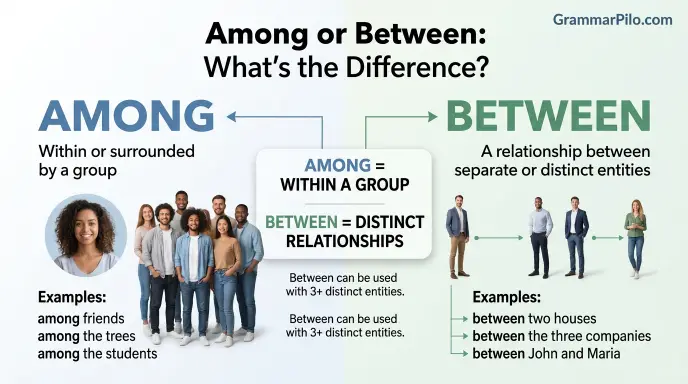
Have you ever wondered if to use among or between when talking about people, places, or things?
The basic difference is simple:
Between is traditionally used for separate, distinct people or things, while among is generally used for someone or something within a group or surrounded by several people or things.
However, modern English allows between with more than two clearly distinct items when they are considered separately.
For example, you might say, “The money was divided between the two brothers,” but “She felt comfortable among her friends.” In the first sentence, the relationship is between two distinct people. In the second, the person is within a group.
The choice can sometimes be confusing because both words describe relationships or positions involving multiple people or things. The old rule that between is only for two and among is only for more than two is too simple for modern English.
In this guide, you will learn the difference between among and between, when to use each word, common mistakes, British and American usage, and practical examples for everyday writing.
Among or Between: Quick Answer
Between is commonly used for separate or clearly defined people or things, while among is generally used when someone or something is part of or surrounded by a group. “Among the trees” uses among, while “Between the two houses” uses between. Between can also be used with more than two distinct items when they are considered individually.
Use between when referring to separate, distinct people or things, especially when describing a relationship or choice involving clearly identified individuals or items.
Use among when referring to someone or something within a group or surrounded by a number of people or things.
Examples
- The agreement was between three companies.
- She sat between John and Maria.
- He was walking among the trees.
- The teacher distributed the books among the students.
- There was disagreement between the three departments.
Easy Memory Tip
Between = separate or distinct relationships.
Among = within a group.
The number of people or things alone does not always determine if you should use between or among.
What Does Between or Among Mean?
What Does “Between” Mean?
Between is a preposition used to describe a position, relationship, choice, or connection involving separate people or things.
Examples:
The shop is between the bank and the post office.
She divided her time between work and family.
The negotiations were between three countries.
The important point is that the people or things can be viewed as separate and distinct.
What Does “Among” Mean?
Among is a preposition generally used when someone or something is within a group or surrounded by several people or things.
Examples:
She was standing among the crowd.
The house was hidden among the trees.
He felt comfortable among his friends.
Here, the emphasis is on being within a group or collection rather than on individual relationships.
The Difference in One Example
Compare these sentences:
The teacher divided the students between the two teams.
The teacher distributed the worksheets among the students.
In the first sentence, between describes a division involving two distinct teams.
In the second, among describes distribution throughout a group.
Is “Between” Only for Two?
No.
This is one of the most common grammar myths.
You can use between with more than two people or things when they are considered as separate, individual entities.
For example:
The negotiations took place between the United States, Canada, and Mexico.
The countries are individual, distinct parties in the relationship.
Similarly:
The money was divided between Alice, Ben, and Sarah.
The three people are being treated as separate individuals.
So the modern distinction is not simply:
Two = between
Three or more = among
A better rule is:
Separate and identifiable relationships → between
Within a group → among
The Origin of Among and Between
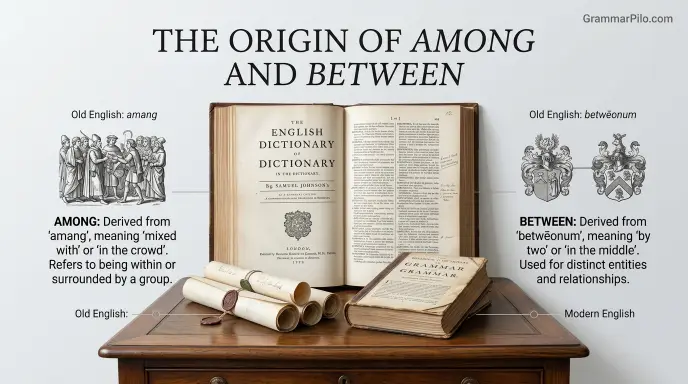
The words among and between are both old English prepositions.
Origin of “Among”
Among developed from Old English forms related to the idea of being in or mixed with a group. Its historical development is connected with words expressing being in the midst of or surrounded by others.
The modern meaning still reflects this basic idea: being in the middle of, within, or surrounded by a group.
For example:
A small house stood among the trees.
The house is located within the group of trees.
Origin of “Between”
Between comes from Old English betweonum, related to the idea of being in two or more separate positions or relationships.
Its meaning developed around the concept of something existing in the space or relationship separating distinct people or things.
For example:
The river runs between the two towns.
The modern word retains this idea of separation or relationship between identifiable entities.
Why the Old “Two vs. More Than Two” Rule Exists
Traditional grammar teaching often simplified the distinction:
- Between → two
- Among → three or more
This is easy for beginners to remember, but it does not describe all modern English usage.
Modern English allows between with more than two entities when the entities are individually identified or involved in separate relationships.
British English vs American English
There is no major British-American spelling difference between among and between. Both varieties use the same words and follow essentially the same grammatical principles.
| Feature | British English | American English |
| Among | among | among |
| Between | between | between |
| Among spelling | Same | Same |
| Between spelling | Same | Same |
| Between two people | Common | Common |
| Among a group | Common | Common |
| Between three or more distinct parties | Common | Common |
For example:
British English:
She shared the information among her colleagues.
American English:
She shared the information among her colleagues.
Both are correct.
Likewise:
The agreement was between the three companies.
This construction is acceptable in both British and American English when the companies are treated as separate parties.
Which Version Should You Use?
For US English
Use between when you are describing separate or clearly defined relationships.
The choice is between three options.
Use among when referring to something within a group.
She was popular among her classmates.
For UK English
The same basic distinction applies.
The disagreement was between the three departments.
He was standing among the crowd.
For Canadian English
Canadian English generally follows the same modern distinction.
Use between for distinct relationships and among when emphasizing a group.
For Australian English
Australian English also uses both words according to the relationship being described.
There was an agreement between the four companies.
She felt at home among the local residents.
For International English
For international readers, the easiest approach is to focus on the relationship, not simply the number of items.
Ask:
Are the people or things clearly separate and individually identified?
If yes, between may be appropriate.
Ask:
Is the person or thing being viewed as part of a group?
If yes, among is usually appropriate.
For Academic Writing
Both words are common in formal and academic writing.
The relationship between the variables was significant.
The survey was conducted among university students.
For Business Writing
Use between for agreements, negotiations, partnerships, or relationships involving distinct parties.
The agreement between the two companies was finalized.
Negotiations between the three departments continued.
Use among when discussing a group collectively.
The policy was widely discussed among employees.
Common Mistakes With Between and Among
Mistake 1: Thinking “Between” Is Only for Two
This is the most common mistake.
Incorrect rule:
Between must always be used for exactly two things.
Better rule:
Use between when separate, identifiable people or things are involved in a relationship.
Correct:
The agreement was between the three companies.
The three companies are distinct parties.
Memory tip:
Think between = separate relationships, not simply “two.”
Mistake 2: Using “Among” for Clearly Separate Parties
Consider:
The negotiations were among the three countries.
This may be acceptable depending on the intended meaning, but between is often more precise when the countries are being treated as distinct negotiating parties.
Better:
The negotiations were between the three countries.
Mistake 3: Using “Between” for a Group
Consider:
She was hiding between the crowd.
This is incorrect in standard usage.
Better:
She was hiding among the crowd.
The person is within a group.
Mistake 4: Confusing “Among” With “Amid”
Among and amid can sometimes be similar, but they are not always interchangeable.
He stood among the students.
Here, among refers naturally to a group of people.
He remained calm amid the confusion.
Here, amid means in the middle of a situation or condition.
Mistake 5: Using “Between” Simply Because There Are Fewer Items
The number of items is not the only factor.
For example:
The difference between the three products is easy to see.
This can be correct because the three products are individually identifiable.
Among & Between in Everyday Examples
In Emails
Between:
Please keep the information between you and me.
Among:
Please share the document among the team members.
In Business Writing
Between:
The contract between the two companies was renewed.
Among:
The announcement was discussed among employees.
In News Headlines
Between:
Trade Talks Between Three Nations Continue
Among:
Concern Grows Among Local Residents
The first focuses on distinct parties. The second focuses on a group.
In Blogs
Between:
There is an important difference between these three options.
Among:
The product became popular among younger users.
In Social Media
Between:
I can’t decide between these two outfits.
Among:
I found my keys among all these bags.
In Academic Writing
Between:
Researchers examined the relationship between three variables.
Among:
The study surveyed differences among students from different backgrounds.
In Daily Conversation
I had to choose between pizza and pasta.
She was sitting among her friends.
Both sound natural because the words describe different relationships.
Google Trends & Modern Usage: Between vs. Among
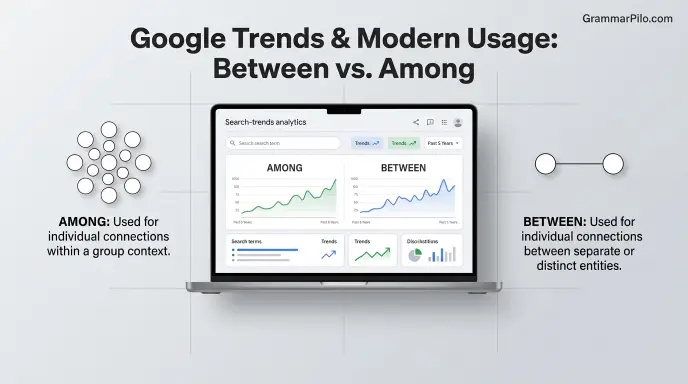
Among and between are both established, frequently used English prepositions. They appear across everyday conversation, formal writing, academic texts, journalism, and business communication.
One reason people search for among or between is the traditional rule that between should be used only with two items. Modern English usage shows that this rule is too restrictive.
The more useful distinction is based on how the relationship is understood:
- Between emphasizes separate or identifiable entities and their relationships.
- Among emphasizes membership within or surroundings by a group.
Search interest can change over time, particularly during school and exam periods, but specific Google Trends figures should only be reported when current, verifiable data is available.
For practical writing, learning the meaning and structure of each word is more useful than memorizing a simple number-based rule.
Quick Comparison Table: Between vs. Among
| Feature | Among | Between |
| Main idea | Within a group | Relationship between distinct entities |
| Common use | Groups or collections | Separate or identifiable people/things |
| Usually used with two? | Sometimes, depending on meaning | Yes |
| Can be used with 3+? | Yes | Yes |
| Example | among friends | between friends |
| Group emphasis | Strong | Less central |
| Individual relationships | Less emphasis | Strong emphasis |
| Example with 3+ | among the students | between the three departments |
Compare These Examples
Among:
She was standing among the trees.
The trees are viewed as a surrounding group.
Between:
The cabin stood between three mountains.
The mountains are treated as distinct geographical points around the cabin.
Both constructions can be correct because the intended relationship is different.
Key Takeaways
- Among generally means within or surrounded by a group.
- Between generally describes a relationship involving separate or identifiable people or things.
- Do not assume between = two and among = three or more in every situation.
- Between can be used with three or more distinct parties.
- Among emphasizes group membership or being surrounded by a group.
- Between emphasizes separation, connection, comparison, or relationship.
- Both words have the same spelling in British and American English.
- “Among the crowd” is correct when someone is within a group.
- “Between the three companies” can be correct when the companies are distinct parties.
- Focus on the meaning of the relationship, not just the number of items.
FAQs About Among or Between
What is the main difference between among and between?
The main difference is that between usually describes a relationship involving separate or clearly identifiable people or things, while among generally describes someone or something within a group. For example, “between the two buildings” focuses on distinct buildings, while “among the trees” describes something surrounded by a group of trees.
Is between only used for two things?
No. This is a common grammar myth. Between can be used with three or more people or things when they are considered separately or as distinct parties. For example, “The agreement was between the three companies” is standard English because each company is an identifiable party in the relationship.
Is among used only for more than two people?
Not necessarily. Among is mainly about being within a group, so the meaning matters more than simply counting the people or things. If the emphasis is on being part of a group or surrounded by others, “among” may be appropriate.
Should I say between the three or among the three?
Both can be correct, depending on meaning. Use between the three when the three people or things are distinct parties in a relationship, comparison, or division. Use among the three when the emphasis is on the group collectively. The context determines the better choice.
Is it correct to say “among friends”?
Yes. “Among friends” is a common and natural expression. It means within a group of friends or in the company of friends. For example: “She felt comfortable among friends.” The emphasis is on the person being part of or surrounded by the group.
Is “between you and me” correct?
Yes. “Between you and me” is the standard expression. “Between” is a preposition, so the objective pronoun me is used rather than I. The phrase means that something is private or confidential between the two people.
Can between be used with more than two countries?
Yes. When countries are treated as separate, identifiable parties, between can be used with three or more countries. For example: “Trade negotiations between the United States, Canada, and Mexico.” The countries are distinct participants in the relationship.
What is the easiest way to remember among and between?
Think of between as focusing on distinct relationships and among as focusing on being within a group. For example, “between the houses” highlights separate houses, while “among the trees” describes something located within a group of trees.
Is among more formal than between?
No. Neither word is simply a more formal version of the other. Among and between have different meanings and grammatical uses. Both are appropriate in formal writing, academic writing, business communication, and everyday conversation when used correctly.
Are among and between different in British and American English?
The basic distinction is essentially the same in British and American English. Both varieties use among for being within a group and between for relationships involving distinct entities. Neither word has a different British or American spelling.
Conclusion
Knowing when to use among or between becomes much easier once you stop relying on the old “two versus three” rule.
Between is generally used when people or things are viewed as separate, identifiable entities in a relationship. Among is generally used when someone or something is within a group or surrounded by several people or things.
For example, you can say:
The agreement was between the three companies.
And:
She was standing among the employees.
The number of people or things does not automatically determine the correct word. Three companies can have an agreement between them because they are distinct parties. On the other hand, a person can be among three or more people when the group is the main focus.
The same basic usage applies in American, British, Canadian, and Australian English. There is no spelling difference between the two words.
When you are unsure, ask yourself one simple question: Am I talking about a relationship between separate entities, or am I describing something within a group? If you are emphasizing separate relationships, choose between. If you are emphasizing membership in or surroundings by a group, choose among.
Explore more Comparisons

I’m Sloane Mercer, a U.S.-based English language writer focused on grammar, spelling, vocabulary, and everyday English usage. Through GrammarPilo, I provide clear and practical explanations to help readers choose the right words and communicate with confidence.








3 thoughts on “Among or Between: What’s the Real Difference?”