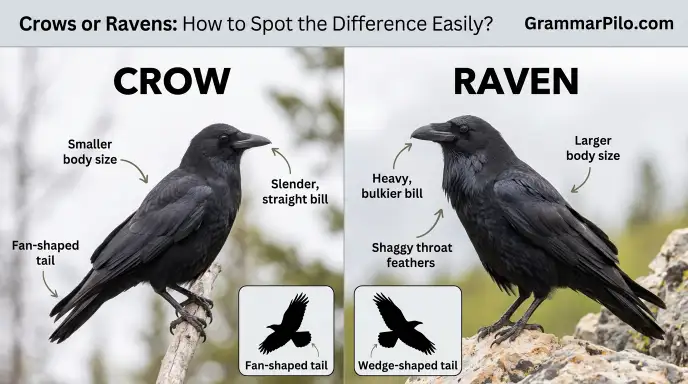
Crows and ravens are both black birds in the crow family, but ravens are usually larger, heavier, and have a thicker bill and a wedge-shaped tail.
People often search for “crows or ravens” because these birds look very similar, especially from a distance. Both belong to the family Corvidae, and both are intelligent, adaptable birds that can live near people.
The confusion is easy to understand. A crow and a raven can both have black feathers, dark eyes, and strong bills. They can also live in similar habitats and eat many of the same foods. However, several clues can help you tell them apart.
The easiest clues are size, bill shape, tail shape, flight, and sound. A Common Raven is much larger than an American Crow. A raven also has a heavier bill, shaggy throat feathers, and a long, wedge-shaped tail.
Crows are smaller and usually have a shorter, more rounded or squared tail. Their calls are different too: crows usually make a familiar caw, while ravens often make a deeper, throaty sound.
Crows or Ravens : Quick Answer
Crows and ravens are related birds, but ravens are generally larger and have heavier bills, longer wings, and wedge-shaped tails.
The easiest way to remember the difference is:
- Crow = smaller, shorter tail, lighter bill
- Raven = larger, heavier bill, wedge-shaped tail
For example, an American Crow is usually much smaller than a Common Raven. Cornell Lab gives the American Crow an average length of about 20 inches, while the Common Raven is about 27 inches long. Their average wingspans are also different: about 36 inches for the crow and 46 inches for the raven.
Quick examples
A small black bird with a rounded tail is likely a crow.
A much larger black bird with a diamond-shaped tail is likely a raven.
Sound can also help:
Crow: “caw”
Raven: deep, throaty “croak”
These are useful clues, but size and sound can vary between species.
Definition and Meaning of Crows and Ravens
What Is a Crow?
A crow is a black bird belonging to the genus Corvus. The term can refer to several species, including the American Crow and Fish Crow.
The American Crow is a familiar bird across much of North America. It is an all-black bird with a strong bill and a hoarse cawing voice. Crows are often seen in towns, fields, roadsides, parks, and other places where people live.
Crows are omnivores. They can eat insects, small animals, seeds, fruit, carrion, and human food waste.
What Is a Raven?
A raven is also a member of the genus Corvus, but the word usually refers to larger species such as the Common Raven.
The Common Raven is a large black bird found across much of the Northern Hemisphere. It has a large bill, shaggy throat feathers, long wings, and a wedge-shaped tail.
Ravens are highly intelligent birds. They can explore objects, solve problems, and adapt to many different environments.
Are Crows and Ravens the Same Bird?
No.
They are closely related, but they are not the same bird.
Think of the relationship this way:
Crows and ravens → same family → different birds
Both belong to the family Corvidae, but there are different crow and raven species.
Crows vs. Ravens at a Glance
| Feature | Crow | Raven |
| Family | Corvidae | Corvidae |
| Typical size | Smaller | Larger |
| Bill | Moderate | Large and heavy |
| Tail | Rounded or squared | Wedge-shaped |
| Wings | Shorter and broader | Longer and narrower |
| Throat | Smoother | Often shaggy |
| Common call | Caw | Deep croak |
| Flight | More steady flapping | More gliding and soaring |
| Social behavior | Often more social | Often seen alone or in pairs |
Cornell’s identification guides emphasize size, bill shape, tail shape, wings, and sound as useful ways to separate the two.
The Origin of Ravens and Crows
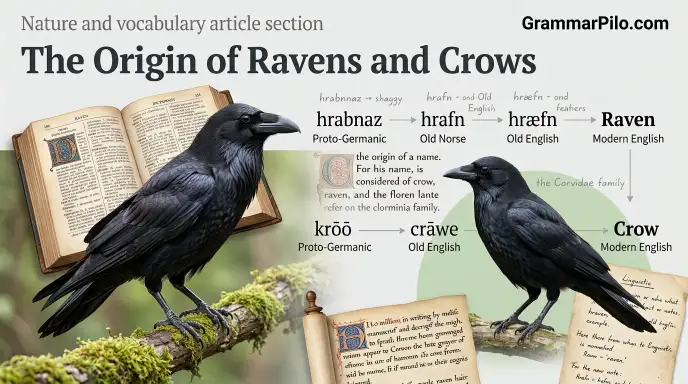
The words crow and raven have different histories.
Origin of “Crow”
The English word crow comes from Old English crāwe. Its history is connected with words for similar birds in other Germanic languages.
The name is thought to be linked to the bird’s harsh call. In other words, the word likely developed partly from the sound the bird makes.
The word has also produced familiar English expressions.
For example:
As the crow flies
This means the shortest distance between two places, measured in a straight line.
Another expression is:
Eat crow
In North American English, this means accepting that you were wrong or doing something you strongly disliked after previously opposing it.
Origin of “Raven”
Raven also has a very old history. It comes from Old English hræfn and is related to words in other Germanic languages, including German Rabe and Dutch raaf.
The word is connected to ancient terms associated with the bird’s harsh or croaking sound.
Unlike a spelling variation, the difference between crow and raven comes from the fact that English developed separate names for related birds.
Why Are They Sometimes Confused?
The confusion is not caused by British and American spelling.
Instead, it happens because both birds:
- are members of the same family
- have black feathers
- belong to the genus Corvus
- can live near people
- eat similar foods
- have similar body shapes
So, the words describe related but different birds, not two spellings of the same bird.
British English vs American English Spelling
There is no major British-versus-American spelling difference between crow and raven.
Both words are spelled the same in British and American English.
| Word | British English | American English |
| crow | Correct | Correct |
| raven | Correct | Correct |
| Spelling difference | None | None |
| Meaning | Same basic meaning | Same basic meaning |
| Plural of crow | crows | crows |
| Plural of raven | ravens | ravens |
British English
We saw several crows in the field.
A raven was flying over the mountain.
American English
There were several crows near the road.
A raven landed on the fence.
The spelling stays the same.
The bigger difference is which species are common in a particular region, not how the words are spelled.
For example, the Common Raven occurs across much of the Northern Hemisphere, while the American Crow is widespread across North America.
Which Spelling Should You Use?
If you are talking about these birds, there is no need to choose a British or American spelling.
Use crow when you mean a crow.
Use raven when you mean a raven.
The important thing is choosing the correct bird.
For American English
If you are writing about North American birds, American Crow and Common Raven are useful specific names.
For example:
The American Crow is smaller than the Common Raven.
For British English
The same words are used:
The crow flew across the field.
The raven circled above the cliffs.
For International English
Use the specific bird name when accuracy matters.
Instead of simply writing:
I saw a black bird.
You can write:
I saw a crow.
Or:
I saw a raven.
If you are unsure, describe the bird’s size and shape before deciding. A very large bird with a heavy bill and wedge-shaped tail is more likely to be a raven.
Common Mistakes with Crows or Ravens
Mistake 1: Thinking every black bird is a crow
Not every black bird is a crow.
Other birds can also have dark or black feathers. Identification should consider size, shape, bill, tail, sound, and location.
Mistake 2: Thinking crows and ravens are the same bird
They are closely related, but they are different birds.
Correct:
A raven is larger than an American Crow.
Mistake 3: Using size alone
Size is helpful, but it should not be the only clue.
A bird seen far away can be difficult to judge accurately. Use several clues together.
Mistake 4: Ignoring the tail
Tail shape is one of the most useful clues.
A crow usually has a rounded or squared tail in flight.
A raven has a more wedge-shaped or diamond-shaped tail.
Mistake 5: Ignoring the sound
The voice can be very useful.
American Crows have a strong, harsh caw, while Common Ravens have a deeper, throaty call.
Mistake 6: Assuming ravens are always alone
Ravens are often seen alone or in pairs, but they can gather at food sources such as carcasses or landfills.
Crows or Ravens in Everyday Examples
Although crow and raven are bird names, people use them in many types of writing.
In an Email
I noticed a group of crows near the office parking lot this morning.
This is a normal descriptive use.
In News Writing
Wildlife experts identified the bird as a Common Raven.
A news report may use the specific species name when identification is important.
On Social Media
I saw two huge ravens flying over the mountains today!
The word ravens works naturally in casual posts.
In Formal Writing
The study examined the behavior of crows and ravens in urban environments.
This is suitable for an academic or scientific context.
In Everyday Conversation
Was that a crow or a raven?
This is one of the most natural questions to ask when the bird is difficult to identify.
In a Nature Article
Ravens have longer wings and larger bills than American Crows.
This sentence gives a simple identification clue.
Ravens vs. Crows: Google Trends & Usage Data
People search for “crows or ravens” mainly because the birds are easy to confuse. Search interest can also rise when people see these birds in their local area, encounter them in wildlife content, or want help identifying a bird.
Google Trends measures relative search interest, not the number of birds or the total number of times a word is spoken. It also does not prove that one term is scientifically better than another.
For this topic, location matters. The American Crow is widespread across North America, while the Common Raven occurs across much of the Northern Hemisphere.
Cornell notes that Common Ravens occur across western and northern North America and much of Eurasia, while American Crows are familiar across much of North America.
This means search interest can depend on local wildlife and the species people commonly see.
| Search context | Likely reason for interest |
| United States | Identifying American Crows and Common Ravens |
| Canada | Comparing local crow and raven species |
| United Kingdom | Learning about crows, ravens, and related corvids |
| Nature searches | Bird identification |
| Photography | Telling similar black birds apart |
| Birdwatching | Size, sound, and behavior |
| General searches | Understanding the difference |
Crows vs. Ravens: Comparison Table
| Feature | Crows | Ravens |
| General size | Smaller | Larger |
| Example species | American Crow | Common Raven |
| Body | Large but compact | Larger and more massive |
| Bill | Moderate | Thick and heavy |
| Tail in flight | Rounded or squared | Wedge-shaped or diamond-shaped |
| Wings | Broader and shorter | Longer and narrower |
| Throat feathers | Less shaggy | Shaggier |
| Call | Harsh caw | Deep croak |
| Flight | More steady flapping | More gliding and soaring |
| Social behavior | Often more social | Often alone or in pairs |
| Diet | Omnivorous | Omnivorous |
| Intelligence | Highly intelligent | Highly intelligent |
| Family | Corvidae | Corvidae |
| Genus | Corvus | Corvus |
Cornell Lab’s bird guides support these major identification differences, especially size, bill, tail, wings, sound, and social behavior.
FAQs About Crows or Ravens
1. What is the main difference between crows and ravens?
The main differences are size, bill shape, tail shape, wings, and sound. Ravens are usually larger and have heavier bills and wedge-shaped tails.
2. Are crows and ravens the same bird?
No. They are closely related birds in the same family and genus, but they are different species.
3. Which is bigger, a crow or a raven?
A raven is usually bigger. For example, Cornell lists the American Crow at about 20 inches long and the Common Raven at about 27 inches.
4. How can you tell a crow from a raven?
Look at the bird’s size, bill, tail, wings, and sound. A raven usually has a heavier bill, shaggy throat feathers, longer wings, and a wedge-shaped tail.
5. Do crows and ravens have different calls?
Yes. American Crows usually make a strong, harsh caw, while Common Ravens often make a deep, throaty croak.
6. Are ravens smarter than crows?
Both are highly intelligent birds. Common Ravens are known for solving novel problems and exploring objects, while crows also show complex behavior and strong adaptability. It is better to avoid treating intelligence as a simple contest between the two groups.
7. Are crows and ravens both black?
Many commonly known crows and ravens are black. American Crows and Common Ravens, for example, have entirely black plumage. However, not every species in the broader crow family looks exactly the same.
Conclusion
Crows and ravens are closely related black birds, but they are not the same bird. The easiest way to tell them apart is to look at several features rather than relying on color alone.
Ravens are generally larger, with heavier bills, longer wings, shaggy throat feathers, and wedge-shaped tails. Crows are smaller and usually have shorter, broader wings and rounded or squared tails.
Their sounds also differ, with crows making a familiar harsh caw and ravens producing a deeper, throaty call.
There is no British-versus-American spelling issue with crow or raven. Both words are spelled the same in both varieties of English. The real question is which bird you are describing.
If you are writing a professional, academic, or educational article, use the specific species name when possible, such as American Crow or Common Raven. For everyday conversation, simply saying crow or raven is usually enough.
The key rule is simple: smaller and rounder usually suggests a crow; larger, heavier, and wedge-tailed usually suggests a raven.
Similar Words Explained

I’m Sloane Mercer, a U.S.-based English language writer focused on grammar, spelling, vocabulary, and everyday English usage. Through GrammarPilo, I provide clear and practical explanations to help readers choose the right words and communicate with confidence.







3 thoughts on “Crows or Ravens: How to Spot the Difference Easily?”