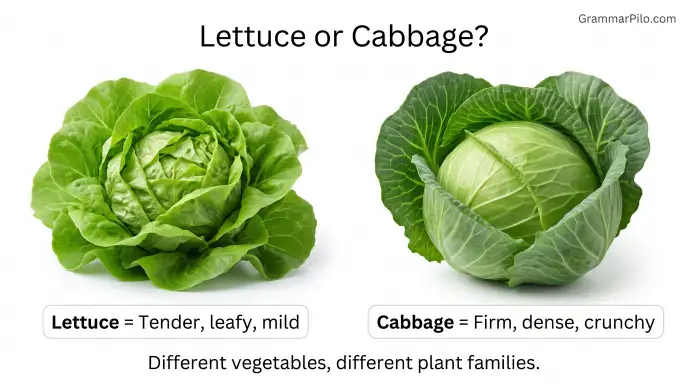
Lettuce and cabbage are both leafy vegetables, but they are different plants with different textures, appearances, families, and common uses.
Lettuce is generally known for its tender leaves and is widely used in salads, sandwiches, wraps, and burgers. Cabbage usually has thicker, firmer leaves and often grows into a dense head that can be eaten raw, cooked, fermented, or used in dishes such as coleslaw.
The confusion around lettuce or cabbage often comes from their similar appearance in grocery stores. Both can be green, round, leafy, and sold as whole heads. Some varieties can also look surprisingly similar at first glance.
However, lettuce and cabbage are not simply two names for the same vegetable. They belong to different plant families. Lettuce belongs to the sunflower family, Asteraceae, while cabbage belongs to the mustard or cabbage family, Brassicaceae.
Their texture and flavor also help distinguish them. Lettuce is generally more delicate and watery, while cabbage tends to be crisp, dense, and more substantial.
This guide explains lettuce vs. cabbage, their meanings, origins, differences, common uses, examples, and the easiest ways to tell them apart.
Lettuce or Cabbage: Quick Answer
Lettuce: A leafy vegetable from the Asteraceae family, commonly eaten raw in salads, sandwiches, burgers, and wraps.
Cabbage: A leafy vegetable from the Brassicaceae family that usually forms a dense head and can be eaten raw, cooked, fermented, or pickled.
Simple rule: Lettuce is generally softer and more delicate, while cabbage is usually firmer, denser, and crunchier.
Definition and Meaning of Lettuce or Cabbage
What Does Lettuce Mean?
Lettuce is a leafy vegetable commonly grown for its edible leaves.
The scientific name of cultivated lettuce is Lactuca sativa. It belongs to the Asteraceae family, which is also known as the sunflower family. The University of Minnesota Extension identifies lettuce as a member of this family.
Common types include:
- Iceberg lettuce
- Romaine lettuce
- Butterhead lettuce
- Leaf lettuce
Lettuce is often eaten raw because many varieties have tender leaves and a mild flavor.
Example: I added fresh lettuce to my sandwich.
What Does Cabbage Mean?
Cabbage is a leafy vegetable belonging to the Brassicaceae family.
Common cabbage varieties include green cabbage, red cabbage, savoy cabbage, and other forms of cultivated cabbage. Cabbage is related to vegetables such as broccoli, cauliflower, kale, Brussels sprouts, and kohlrabi.
Cabbage usually develops a compact head made of overlapping leaves.
Example: We used shredded cabbage to make coleslaw.
Lettuce and Cabbage Are Different Plants
Although lettuce and cabbage can both appear as round leafy heads, they belong to different plant families.
| Vegetable | Plant family | Common characteristic |
| Lettuce | Asteraceae | Tender leafy greens |
| Cabbage | Brassicaceae | Dense head with firm leaves |
This botanical difference is one of the clearest answers to the question lettuce or cabbage.
The Origin of Lettuce and Cabbage
The Origin of Lettuce
The English word lettuce dates to the late 13th century.
Etymonline traces it to Middle English letuse, probably from Old French laitues, from Latin lactuca. The Latin word is connected with lac, meaning “milk,” apparently referring to the milky juice of the plant.
Lettuce has a long history as a cultivated salad vegetable. Modern lettuce includes many varieties that differ in shape, color, texture, and growing characteristics.
The University of Minnesota Extension describes lettuce as a leafy green from the Asteraceae family and notes that these salad crops originated in the Mediterranean region and surrounding areas.
The Origin of Cabbage
The word cabbage has a different history.
Etymonline dates the English noun to the mid 15th century, from forms such as caboge, ultimately related to Old North French caboche, meaning “head.” The word was connected with the rounded head of the vegetable.
Cabbage has a long history as a cultivated vegetable and belongs to the Brassicaceae family.
The word’s history helps explain why cabbage is associated with a head, while lettuce has a separate linguistic and botanical history.
British English vs American English Spelling
There is no spelling difference between British and American English for either vegetable.
| Word | British English | American English |
| Lettuce | Lettuce | Lettuce |
| Cabbage | Cabbage | Cabbage |
| Iceberg lettuce | Correct | Correct |
| Romaine lettuce | Correct | Correct |
| Red cabbage | Correct | Correct |
| Green cabbage | Correct | Correct |
Both lettuce and cabbage are standard spellings in British and American English.
There can be regional differences in vegetable names. For example, romaine lettuce is the common American term for a type of lettuce that British speakers may call cos lettuce. Etymonline records romaine as the American term for this long leaved lettuce variety.
The basic words lettuce and cabbage, however, remain unchanged.
Which One Should You Use?
Choosing between lettuce and cabbage depends on the vegetable you actually mean.
Use Lettuce for Soft Salad Greens
Use lettuce when referring to tender leafy greens commonly used in salads, sandwiches, wraps, and burgers.
Example: She added lettuce and tomato to the sandwich.
Lettuce is especially useful when you want a mild, fresh, crisp, or tender leafy ingredient.
Use Cabbage for Dense, Firm Leaves
Use cabbage when referring to a vegetable that usually forms a compact head with firmer leaves.
Example: The recipe calls for half a head of cabbage.
Cabbage can be eaten raw or cooked and is commonly used in salads, slaws, soups, stir fries, and fermented foods.
Use the Specific Variety When Necessary
Sometimes simply saying lettuce or cabbage is not precise enough.
For example:
- Romaine lettuce
- Iceberg lettuce
- Butterhead lettuce
- Green cabbage
- Red cabbage
- Savoy cabbage
Using the specific variety makes the description clearer.
Common Mistakes with Cabbage and Lettuce
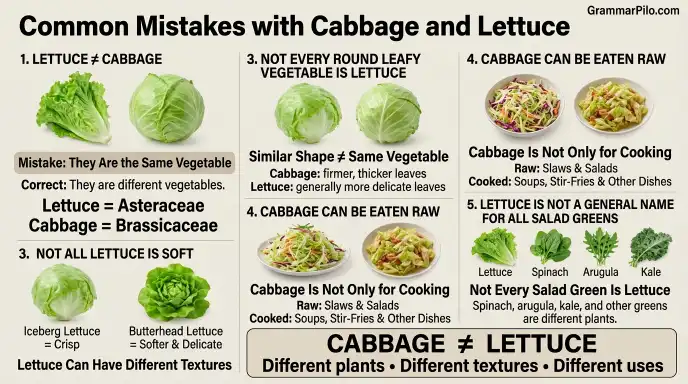
Mistake 1: Assuming Lettuce and Cabbage Are the Same Vegetable
Incorrect idea: Lettuce and cabbage are simply two varieties of the same plant.
Correct: They are different vegetables belonging to different plant families. Lettuce belongs to Asteraceae, while cabbage belongs to Brassicaceae.
Mistake 2: Calling Every Round Leafy Vegetable Lettuce
Some cabbage varieties form round heads that may look similar to iceberg lettuce.
Better: Check the leaves and texture.
Cabbage generally has firmer, thicker leaves, while lettuce tends to have more delicate leaves.
Mistake 3: Assuming All Lettuce Is Soft
Not every lettuce variety has exactly the same texture.
Iceberg lettuce can be particularly crisp, while butterhead lettuce tends to be softer and more delicate.
Mistake 4: Assuming Cabbage Must Be Cooked
Cabbage can be eaten raw.
Raw cabbage is commonly shredded for slaws and salads. It can also be cooked in soups, stir fries, and other dishes.
Mistake 5: Using Lettuce as a General Name for All Salad Greens
Lettuce is one type of leafy green, but not every leafy salad ingredient is lettuce.
Spinach, arugula, kale, and other greens are different plants.
Cabbage or Lettuce in Everyday Examples
In Emails
Example: Please buy two heads of lettuce and one cabbage for the event.
In News Writing
Example: Farmers reported strong demand for lettuce and cabbage during the cool growing season.
In Social Media
Example: This homemade salad has romaine lettuce, cabbage, carrots, and cucumbers.
In Formal Writing
Example: Lettuce and cabbage are both cool season vegetable crops, but they belong to different botanical families.
In Recipes
Example: Finely shred the cabbage before adding it to the slaw.
Example: Wash the lettuce leaves before assembling the salad.
In Grocery Shopping
Example: I need a head of lettuce for the sandwiches.
Example: Pick up a small green cabbage for tonight’s recipe.
Lettuce vs. Cabbage: Taste and Texture
Taste and texture are among the easiest ways to distinguish lettuce vs. cabbage.
| Feature | Lettuce | Cabbage |
| Texture | Usually tender and crisp | Usually firm and crunchy |
| Flavor | Mild and fresh | Mild to slightly stronger |
| Leaves | Often delicate | Generally thicker and firmer |
| Head | Some varieties form heads | Commonly forms a dense head |
| Raw use | Very common | Very common |
| Cooking | Some varieties are cooked | Frequently cooked |
| Salads | Very common | Common |
| Slaw | Less typical | Very common |
The exact texture varies among varieties, so these descriptions are general rather than absolute.
Cabbage vs. Lettuce: Appearance
A whole head of iceberg lettuce and a green cabbage can look similar, especially from a distance.
There are still useful clues.
Lettuce
Lettuce leaves are often thinner and more delicate. Depending on the variety, they can be loose, soft, ruffled, or tightly arranged.
Romaine develops a tall, elongated head, while iceberg forms a compact round head.
Cabbage
Cabbage generally has thicker, firmer leaves that overlap to create a dense head.
Savoy cabbage has distinctly crinkled leaves, while red cabbage has purple red leaves that make it easy to identify.
The University of Minnesota Extension lists iceberg, romaine, and butterhead among common traditional lettuce varieties.
Lettuce and Cabbage: Growing Conditions
Both lettuce and cabbage are commonly considered cool season vegetables.
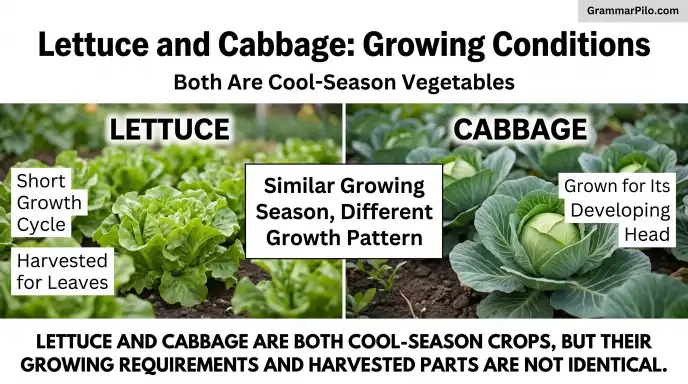
The University of Minnesota Extension lists lettuce and cabbage among cool season crops and explains that these vegetables generally perform best under cool, moderate conditions during early growth.
However, their growing requirements are not identical.
Lettuce has a relatively short growth cycle and is often harvested for its leaves. The University of Minnesota Extension notes that frequent harvesting of lettuce leaves can provide fresh salad greens.
Cabbage is generally grown for its developing head.
This difference is useful when understanding why lettuce or cabbage can look similar at the store but behave differently in a garden.
Lettuce or Cabbage: Google Trends & Usage Data
Google Trends can help compare public search interest for lettuce or cabbage, but it measures relative search interest rather than the number of vegetables sold or the total number of times a word appears in writing.
Search interest can also vary by country, season, recipes, gardening trends, health topics, and grocery searches.
For a reliable comparison, the same location, time period, and search type should be selected for both terms. Exact percentages or numerical Trends values should not be presented without a current, directly verified Trends comparison.
Dictionary and horticultural sources provide a more useful basic distinction: lettuce and cabbage are both established vegetable names, but they refer to different plants and different botanical families.
Lettuce and Cabbage: Nutritional and Culinary Differences
Both vegetables can be part of a balanced diet, but their culinary characteristics differ.
Lettuce is commonly used as a fresh ingredient. Its tender leaves work well in salads, sandwiches, burgers, and wraps.
Cabbage is more versatile in cooking because its firm leaves can hold up well to heat. It can be steamed, boiled, roasted, stir fried, fermented, or eaten raw.
Neither vegetable should be described as universally better. The better choice depends on the recipe and the texture you want.
Choose Lettuce When You Want
- Tender salad leaves
- A mild flavor
- A sandwich or burger topping
- A wrap ingredient
- Fresh leafy greens
Choose Cabbage When You Want
- Firm shredded vegetables
- A crunchy slaw
- A cooked vegetable
- A fermented ingredient
- A denser leafy texture
Lettuce or Cabbage: Easy Memory Trick
Think of lettuce as the classic salad leaf.
Think of cabbage as the firm headed vegetable.
Lettuce = tender leafy greens.
Cabbage = firm, dense leaves.
Remembering their plant families provides an even stronger distinction:
Lettuce = Asteraceae.
Cabbage = Brassicaceae.
Key Takeaways
- Lettuce and cabbage are both correct vegetable names.
- They are different plants, not alternative spellings.
- Lettuce belongs to the Asteraceae family.
- Cabbage belongs to the Brassicaceae family.
- Lettuce is commonly used raw in salads, sandwiches, wraps, and burgers.
- Cabbage is commonly used raw or cooked.
- Lettuce generally has more delicate leaves.
- Cabbage generally has thicker and firmer leaves.
- Both can be cool season crops.
- British and American English use the same spellings.
- Lettuce vs. cabbage is a comparison of two different vegetables, not a spelling question.
Frequently Asked Questions About Lettuce or Cabbage
1. What is the difference between lettuce and cabbage?
Answer: Lettuce and cabbage are different vegetables. Lettuce belongs to the Asteraceae family and generally has tender leaves, while cabbage belongs to the Brassicaceae family and generally has firmer leaves.
2. Is lettuce or cabbage better for salads?
Answer: Both can be used in salads. Lettuce is especially common because of its tender leaves, while cabbage provides a firmer, crunchier texture.
3. Is cabbage a type of lettuce?
Answer: No. Cabbage and lettuce belong to different plant families and are different vegetables.
4. Is lettuce healthier than cabbage?
Answer: Both can provide useful nutrients as part of a varied diet. The nutritional profile depends on the specific variety and serving size, so one should not automatically be considered better in every situation.
5. Can you eat cabbage raw like lettuce?
Answer: Yes. Cabbage can be eaten raw and is commonly shredded for salads and coleslaw.
6. Can lettuce be cooked like cabbage?
Answer: Some lettuce varieties can be cooked, but lettuce is more commonly eaten fresh. Cabbage generally holds its texture better during cooking.
7. Are lettuce and cabbage from the same family?
Answer: No. Lettuce belongs to Asteraceae, while cabbage belongs to Brassicaceae.
8. What is the difference between lettuce and cabbage leaves?
Answer: Lettuce leaves are generally thinner and more tender, while cabbage leaves are usually thicker, firmer, and more tightly packed.
9. Is iceberg lettuce cabbage?
Answer: No. Iceberg is a type of lettuce. The University of Minnesota Extension lists iceberg among common lettuce varieties.
10. Are lettuce and cabbage spelled differently in British and American English?
Answer: No. Lettuce and cabbage have the same spellings in British and American English.
Conclusion
The difference between lettuce or cabbage is easy to understand once you look beyond their similar appearance. They are two different vegetables from two different plant families. Lettuce belongs to the Asteraceae family, while cabbage belongs to the Brassicaceae family.
Lettuce is generally recognized by its tender leaves and mild flavor. It is especially common in salads, sandwiches, burgers, and wraps. Cabbage usually has thicker, firmer leaves and forms a dense head. It can be eaten raw, cooked, or fermented.
The words lettuce and cabbage also have different histories. Lettuce comes through Old French from Latin lactuca, while cabbage developed from French forms related to the word for “head.”
So, when choosing between lettuce vs. cabbage, think about the plant and the texture you need. Choose lettuce for tender salad greens and cabbage for a firmer, crunchier vegetable that works especially well in slaws and cooked dishes.
Discover More Differences
- Masculine or Feminine: Understanding the Difference in English
- Hero or Villain: Understanding the Roles That Drive a Story
- Flea or Gnat: How to Tell These Tiny Insects Apart

I’m Claire Morgan, the author behind Grammarpilo.com, where I write about English grammar, sentence structure, punctuation, and everyday language. My goal is to make grammar simple, clear, and practical, helping readers understand the rules and apply them with confidence in real-world writing.








3 thoughts on “Lettuce or Cabbage: What Is the Real Difference?”