
Frolic is the standard modern English spelling, while frolick is an uncommon historical variant that is not normally used in modern writing.
The confusion becomes understandable when you see words such as frolicked and frolicking, which are both correct forms of the verb frolic. Although these words contain a second k, the base word does not.
The word frolic means to play, move around, or behave in a lively and cheerful way. Children may frolic on a beach, puppies may frolic in a garden, and lambs may frolic in a field. It can also be used as a noun to describe playful activity or cheerful fun.
When comparing frolick or frolic, the main point is to remember the difference between a base word and its inflected forms.
Frolic is the spelling you should normally choose in essays, emails, school assignments, articles, and everyday writing. Frolicked and frolicking, on the other hand, follow the spelling rule that doubles the final consonant before certain endings.
This guide explains the meanings, origins, spelling rules, common mistakes, and everyday uses of frolic and frolick. You will also learn why frolicked is correct even though frolick is not the usual modern spelling of the base word.
Frolic or Frolick: Quick Answer
Quick answer: Use frolic as the standard modern English word. Frolick is an uncommon historical or alternative spelling and is not the normal choice in contemporary writing.
- Frolic: The standard spelling of the base word.
- Frolick: An uncommon historical or alternative form.
- Frolicked: The correct past tense of frolic.
- Frolicking: The correct present participle of frolic.
- Frolics: The correct third person singular present form and plural noun.
Examples:
- Correct: The children love to frolic in the park.
- Unusual in modern writing: The children love to frolick in the park.
- Correct: The puppies frolicked in the grass.
- Correct: The lambs are frolicking in the field.
The important distinction is that the extra k appears in certain forms created by adding an ending. It does not normally belong in the base word.
Definition and Meaning of Frolic or Frolick
What Does Frolic Mean?
Frolic is a verb and a noun. As a verb, it means to play, run, jump, or move around in a cheerful and carefree manner. As a noun, it refers to playful activity, fun, or lively enjoyment.
Examples of frolic as a verb:
- The children frolic on the beach during their summer vacation.
- Two puppies frolic together in the garden.
- The lambs frolic in the meadow on a sunny morning.
- Tourists frolic in the shallow water near the shore.
Examples of frolic as a noun:
- The afternoon was filled with fun and frolic.
- The children enjoyed a playful frolic in the snow.
- Their outdoor frolic ended when it started to rain.
The word usually suggests happiness, energy, and playful movement. It is often used for children, animals, outdoor activities, and lighthearted occasions.
What Does Frolick Mean?
Frolick is an uncommon alternative or historical spelling associated with frolic. It is not the standard spelling most modern readers expect when the word is used as a verb or noun.
You may encounter frolick in older texts, historical spelling records, or unusual writing. However, modern dictionaries generally present frolic as the standard headword.
For everyday communication, use frolic rather than frolick. This choice is clearer and more consistent with current English usage.
Frolick and Frolic: Are They Different Words?
The two spellings are connected, but they are not equally common in modern English.
| Word | Meaning or role | Modern usage |
| Frolic | Play or move around happily; playful activity | Standard |
| Frolick | Historical or alternative spelling | Uncommon |
| Frolicked | Past tense of frolic | Standard |
| Frolicking | Present participle of frolic | Standard |
| Frolics | Present tense verb or plural noun | Standard |
The spelling difference can be confusing because frolicked and frolicking contain the same final letters as the uncommon spelling frolick. The reason is a spelling rule, not a change in the base word.
The Origin of Frolic and Frolick
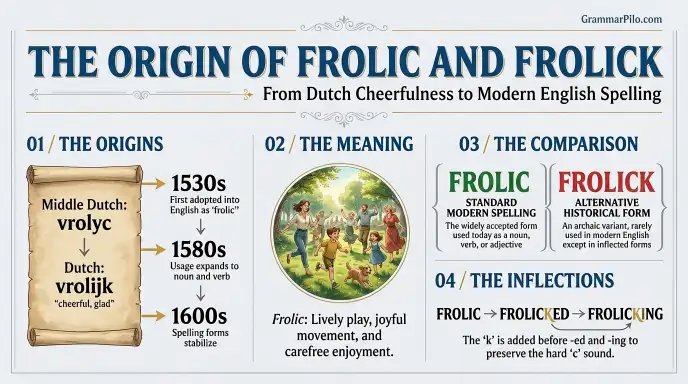
The history of frolic helps explain why the word has its present spelling.
Where Did Frolic Come From?
The word frolic entered English from Dutch vrolijk, meaning cheerful or merry, through the related Middle Dutch form vrolyc. English records show the adjective in the 1530s and the verb in the 1580s. The noun use appeared in the early 1600s.
Over time, frolic became associated with lively play, joyful movement, and carefree enjoyment. Its meaning remains similar today.
How Did Frolick Become an Alternative Form?
Frolick is recorded as an alternative form, but it is not the standard spelling used in most modern English writing. Historical spelling variation was more common before spelling conventions became as stable as they are today.
The existence of an alternative form does not mean both spellings are equally suitable for contemporary writing. Current dictionaries identify frolic as the main form and give its standard inflections as frolicked and frolicking.
The useful lesson is simple. Learn the standard base spelling first, then learn how it changes when endings are added.
British English vs American English Spelling
Frolic is spelled the same way in standard British and American English. There is no regional spelling difference that makes frolick the preferred modern form in either variety.
| Usage | British English | American English |
| Base form | Frolic | Frolic |
| Past tense | Frolicked | Frolicked |
| Present participle | Frolicking | Frolicking |
| Third person singular | Frolics | Frolics |
| Uncommon alternative | Frolick | Frolick |
The pronunciation differs slightly between many British and American accents, but the standard spelling remains the same. Cambridge lists the British pronunciation as /ˈfrɒl.ɪk/ and the American pronunciation as /ˈfrɑː.lɪk/.
Remember: British writers and American writers should both use frolic as the standard base form.
Which Spelling Should You Use?
Use Frolic in Everyday Writing
Choose frolic when you need the base verb or noun. It is appropriate for schoolwork, professional writing, stories, blogs, captions, and everyday conversation.
Correct examples:
- The children will frolic outside after lunch.
- The dogs frolic in the park every morning.
- We watched the horses frolic in the field.
- The festival was full of music, laughter, and frolic.
Use Frolicked for the Past Tense
When describing an action that happened in the past, write frolicked. The spelling doubles the final k before adding -ed.
Examples:
- The children frolicked in the waves yesterday.
- The puppies frolicked around the living room.
- The young goats frolicked in the pasture all afternoon.
Use Frolicking for an Ongoing Action
Use frolicking when describing an action in progress or when the word functions as a participle.
Examples:
- The children are frolicking in the garden.
- We saw dolphins frolicking near the boat.
- Frolicking in the snow made the dogs excited.
Why Does Frolic Gain an Extra K?
English spelling often doubles a final consonant when a short word ends in a single vowel followed by a consonant and takes a suffix beginning with a vowel. In frolic, the final consonant is c, which keeps its hard sound when the word takes endings such as -ed or -ing by using ck.
The forms are therefore:
- Frolic + -ed = frolicked
- Frolic + -ing = frolicking
This pattern is also seen in words such as panic, panicked, and panicking. The base spelling stays the same, but the added k helps preserve the hard /k/ sound before the ending.
Common Mistakes With Frolic or Frolick
Mistake 1: Using Frolick as the Standard Base Word
Incorrect for standard modern writing: The children frolick in the garden.
Correct: The children frolic in the garden.
Frolick may appear as a historical or alternative spelling, but frolic is the usual modern form.
Mistake 2: Removing the K From Frolicked
Incorrect: The puppies froliced in the grass.
Correct: The puppies frolicked in the grass.
The past-tense spelling needs ck before -ed to preserve the hard /k/ sound.
Mistake 3: Writing Frolicing Instead of Frolicking
Incorrect: The lambs are frolicing in the field.
Correct: The lambs are frolicking in the field.
The correct present participle includes ck before -ing.
Mistake 4: Assuming Frolicked Makes Frolick Correct
Seeing frolicked and frolicking may lead writers to assume that frolick is the standard base word. However, the extra k is part of the spelling change before these endings.
Remember the pattern: Frolic, frolicked, frolicking.
Mistake 5: Confusing Frolic With Formal or Serious Activity
Frolic usually describes playful, lively, or carefree behavior. It is not normally the best word for a serious business meeting, a formal examination, or a routine task.
Less natural: The accountants frolicked through the financial report.
More natural: The accountants reviewed the financial report.
Frolic can be used humorously or figuratively, but its playful meaning should fit the context.
Frolic or Frolick in Everyday Examples
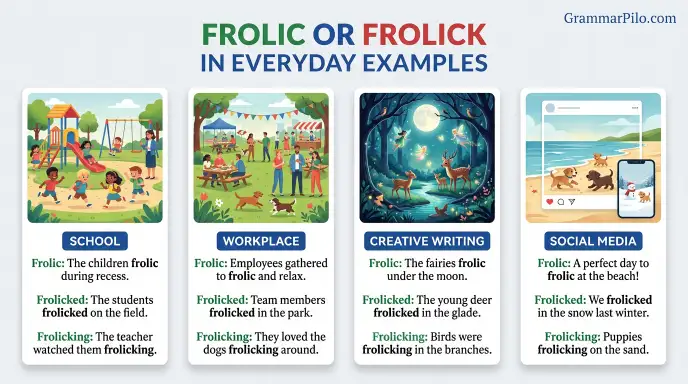
The following examples show how the word can be used in different situations.
In School
Frolic: The children frolic on the playground during recess.
Frolicked: The students frolicked in the snow after their final lesson.
Frolicking: The teacher watched the younger children frolicking outside.
In Emails and Workplace Communication
Frolic: The family event will give employees a chance to frolic and relax outdoors.
Frolicked: The team members frolicked on the beach after the conference.
Frolicking: The report includes photographs of dogs frolicking at the company picnic.
In formal workplace writing, frolic may sound playful or literary. Use it when that tone suits the message.
In Stories and Creative Writing
Frolic: The fairies frolic beneath the moonlight.
Frolicked: The young deer frolicked through the forest.
Frolicking: Birds were frolicking near the garden fountain.
The word is especially useful in descriptive writing because it creates a lively image of movement and happiness.
In Social Media Captions
Frolic: A perfect day to frolic by the sea.
Frolicked: We frolicked in the snow all afternoon.
Frolicking: Puppies frolicking in the sunshine make every day better.
These examples use the standard base word and its correct inflected forms.
Frolic vs. Frolick: Google Trends and Modern Usage
The main point in the frolic vs. frolick comparison is the difference between standard modern spelling and an uncommon alternative form.
Modern dictionaries list frolic as the main spelling and document frolicked and frolicking as its regular verb forms. Cambridge and Oxford both provide the standard base spelling and the forms used for past tense and continuous actions.
What Should You Know About Search Trends?
Search interest can vary by time, region, and context. Without checking a specific Google Trends comparison, it would be misleading to claim exact search volumes or percentages for frolick and frolic.
For an accurate comparison, enter both spellings into Google Trends and select the country and period you want to study. You can compare search interest over time and by region, but remember that Trends reports relative interest rather than the total number of searches.
For practical writing, dictionary evidence is enough to guide your spelling choice. Use frolic as the base word and frolicked or frolicking when the sentence requires those forms.
Frolick vs. Frolic: Side by Side Comparison
| Feature | Frolic | Frolick |
| Standard modern spelling | Yes | No, not normally |
| Meaning | Play or move about happily; playful activity | Historical or alternative spelling of the same word |
| Best for modern writing | Yes | Generally avoid |
| Past tense | Frolicked | Not the standard base form |
| Present participle | Frolicking | Not the standard base form |
| British English | Standard | Uncommon |
| American English | Standard | Uncommon |
Easy Memory Trick
Think of frolic as the base word and frolicked and frolicking as forms that need ck before their endings.
- Frolic = the base form.
- Frolicked = happened in the past.
- Frolicking = happening now or described as ongoing.
- Frolick = an uncommon alternative, not the usual modern base spelling.
Key Takeaways
- Frolic is the standard modern English spelling.
- Frolick is an uncommon historical or alternative form.
- Frolic can be a verb meaning to play happily or a noun meaning playful activity.
- Frolicked is the correct past tense.
- Frolicking is the correct present participle.
- British and American English use the same standard spellings.
- The extra k in frolicked and frolicking helps preserve the hard /k/ sound before the endings.
- For essays, articles, emails, and everyday writing, choose frolic as the base form.
Frequently Asked Questions
1. Is frolick or frolic correct?
Frolic is the standard modern spelling. Frolick is an uncommon historical or alternative form, so frolic is the safer choice in contemporary writing.
2. Is frolick a real word?
Frolick is recorded as an alternative spelling, but it is not the normal modern form. Use frolic unless you are quoting a historical text or discussing spelling history.
3. What does frolic mean?
Frolic means to play or move around in a lively, happy, and carefree way. As a noun, it can mean playful activity or fun.
4. Is frolicked spelled correctly?
Yes. Frolicked is the standard past tense form of frolic. The spelling adds k before -ed to preserve the hard /k/ sound.
5. Is frolicking correct English?
Yes. Frolicking is the standard present participle of frolic. For example, “The children are frolicking in the park.”
6. Why does frolic become frolicked?
The final c changes to ck before the vowel-starting ending -ed so the word keeps its hard /k/ sound. The same pattern appears in frolicking.
7. Is frolic spelled differently in British and American English?
No. Frolic, frolicked, and frolicking are spelled the same in standard British and American English.
8. What is the noun form of frolic?
Frolic can itself be a noun. It can describe a playful activity, a lively occasion, or a period of cheerful fun. Its plural form is frolics.
9. What are some synonyms for frolic?
Depending on the context, synonyms include play, romp, frisk, cavort, gambol, and caper. Some are more informal or literary than others.
10. How can I remember frolic or frolick?
Remember that the base word is frolic. The extra k appears in the standard forms frolicked and frolicking, not in the usual modern base spelling.
Conclusion
Choosing between frolic or frolick is easier once you understand the difference between a base word and its inflected forms. Frolic is the standard modern spelling and means to play or move around in a happy, lively, and carefree way. It can also be used as a noun to describe playful activity or cheerful fun.
Frolick is an uncommon historical or alternative spelling, so it is not the best choice for most modern writing. However, the extra k in frolicked and frolicking is correct. Those forms follow an English spelling pattern that preserves the hard /k/ sound before the endings -ed and -ing.
The rule is the same in British and American English. Use frolic in school assignments, articles, emails, stories, and everyday communication. When describing something that happened in the past, write frolicked. When describing an ongoing action, write frolicking.
Once you remember this simple pattern, you can use all three forms confidently and avoid the common mistake of treating frolick as the standard base word.
Explore Some More Rticles
- Product or Service: The Key Difference Every Writer Should Know
- Incidents or Incidences: The Meaning Difference Most Writers Miss
- Past or Pass: The Simple Trick That Makes the Difference Clear

I’m Sloane Mercer, a U.S.-based English language writer focused on grammar, spelling, vocabulary, and everyday English usage. Through GrammarPilo, I provide clear and practical explanations to help readers choose the right words and communicate with confidence.





1 thought on “Frolic or Frolick: Small Spelling Mistake That Can Change Writing”