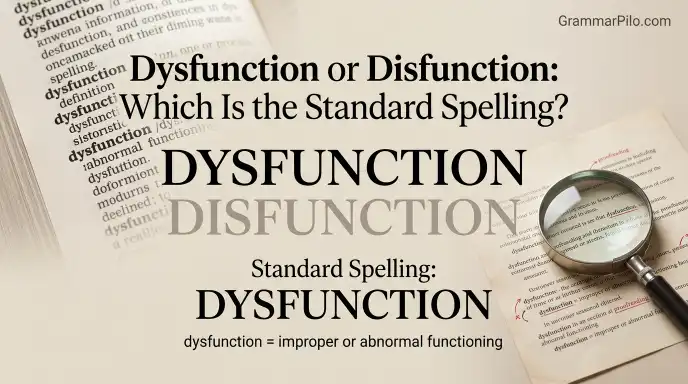
Dysfunction is the standard modern spelling for a problem, abnormality, or impairment in the way a body part, system, machine, or organization functions.
Disfunction has appeared historically as a variant, but dysfunction is the spelling you should normally use in modern edited English.
Cambridge defines dysfunction as a problem or fault in part of the body or a machine, and also as failure to operate or work well.
The confusion between dysfunction or disfunction is understandable because both forms contain the familiar word function. The main difference is the prefix.
Dysfunction uses dys , a prefix associated with something bad, abnormal, difficult, or impaired. Etymonline traces dysfunction to dys + function and dates the noun to 1914.
You may see dysfunction in medical writing, psychology, sociology, technology, workplace discussions, and everyday descriptions of systems that do not work normally.
Examples include muscle dysfunction, brain dysfunction, organizational dysfunction, and family dysfunction. Cambridge lists several of these common combinations.
This guide explains dysfunction and disfunction, their meanings, origins, spelling differences, common mistakes, everyday examples, and the easiest way to remember the standard form.
Dysfunction or Disfunction: Quick Answer
Standard modern spelling: Dysfunction
Historical variant: Disfunction
Dysfunction meaning: A failure, abnormality, problem, or impairment in normal functioning.
Disfunction meaning: A historical variant spelling of dysfunction that is not the usual modern standard choice.
Cambridge uses dysfunction as the standard dictionary entry for a problem or fault in a body part or machine and for failure to operate or work well.
Etymonline records disfunction from 1914 as a variant of dysfunction, showing that the spelling has existed historically.
For modern writing, the safest choice is:
Correct standard form: dysfunction
Usually avoid: disfunction
The easiest memory rule is:
Dysfunction = dys + function
Definition and Meaning of Dysfunction or Disfunction
What Does Dysfunction Mean?
Dysfunction is a noun that describes a failure or abnormality in normal functioning.
It can refer to a physical body system, an organ, a machine, a group, an organization, or another system.
Cambridge gives the basic meaning as a problem or fault in part of the body or a machine. Its American definition also describes dysfunction as failure to operate or work well.
For example:
Example: The test showed some dysfunction in the respiratory system.
Example: The organization experienced serious internal dysfunction.
The word can therefore be used in both technical and broader contexts.
What Does Disfunction Mean?
Disfunction is recorded as a historical variant of dysfunction.
Etymonline specifically lists disfunction as a variant from 1914.
That means disfunction is not simply a word that was invented by modern writers. It has appeared in English, but it is not the standard form you should normally choose in contemporary edited writing.
If you are writing an article, report, academic paper, workplace document, or general English sentence, use dysfunction.
Dysfunction and Disfunction at a Glance
| Word | Status | Meaning / Use |
| Dysfunction | Standard modern form | Abnormal or impaired functioning |
| Disfunction | Historical variant | Variant form of dysfunction |
The difference is mainly about modern standard usage, not the existence of the second spelling.
The Origin of Dysfunction and Disfunction
The Origin of Dysfunction
The word dysfunction is built from two parts:
Dys : Bad, abnormal, difficult, or impaired
Function: The way something works or operates
Etymonline dates dysfunction to 1914 and explains it as dys + function. The word was originally used in anatomy and medicine and later gained use in sociology.
The word function itself has a much older history. Etymonline traces it through French to Latin functio, meaning a performance or execution, from a verb meaning to perform, execute, or discharge.
This gives us a useful word building pattern:
Dys + function = dysfunction
The prefix changes the meaning from normal functioning to impaired or abnormal functioning.
The Origin of Disfunction
Disfunction appeared as a variant spelling of dysfunction.
Etymonline records the noun disfunction from 1914 and directly identifies it as a variant of dysfunction.
The spelling may look logical because English has many words beginning with dis , but that does not make disfunction the standard spelling.
The established modern form is dysfunction.
British English vs American English Spelling
There is no standard British and American spelling difference between dysfunction and dysfunction.
Both British and American English use:
British English: dysfunction
American English: dysfunction
The same spelling is used in medical, academic, technical, workplace, and general contexts.
Comparison Table
| Variety | Standard Spelling | Common Meaning |
| American English | dysfunction | Abnormal or impaired functioning |
| British English | dysfunction | Abnormal or impaired functioning |
| Canadian English | dysfunction | Abnormal or impaired functioning |
| Australian English | dysfunction | Abnormal or impaired functioning |
| International English | dysfunction | Abnormal or impaired functioning |
So, dysfunction or disfunction is not a British versus American spelling issue.
The distinction is mainly between the standard modern spelling and a historical variant.
Which Spelling Should You Use?
Use dysfunction in modern standard English.
This applies to general writing, professional communication, academic writing, technical writing, and most formal contexts.
Use Dysfunction for Physical Functioning
Example: The condition may affect muscle function and cause dysfunction.
Use Dysfunction for Body Systems
Example: The report described respiratory dysfunction.
Use Dysfunction for Technology or Machines
Example: The system experienced a temporary dysfunction.
For a machine that simply stops working, malfunction may sometimes be the more natural word. Cambridge defines malfunction as a failure to work or operate correctly.
Use Dysfunction for Organizations
Example: The company struggled with internal dysfunction.
Use Dysfunction for Social or Family Situations
Example: The novel explores dysfunction within the family.
Cambridge lists examples of dysfunction involving family, social, cognitive, brain, and cardiac contexts.
What About Disfunction?
Disfunction can be encountered in historical or variant usage, but it is not the spelling you should normally select for modern standard writing.
If a spelling checker or dictionary search brings up disfunction, do not automatically assume it is the preferred modern form.
For a practical spelling question, the answer is:
Use: dysfunction
Avoid in normal modern writing: disfunction
Common Mistakes with Dysfunction or Disfunction
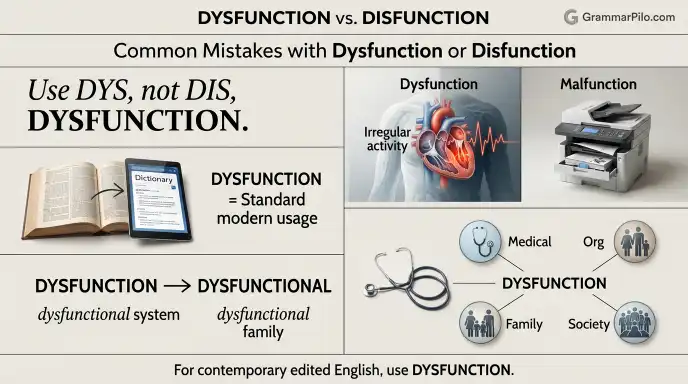
Mistake 1: Writing Disfunction Because “Dis ” Looks Familiar
English has many common words beginning with dis , so writers may naturally create disfunction.
Incorrect in standard modern usage: disfunction
Correct: dysfunction
The standard word uses dys .
Mistake 2: Treating Disfunction as the Preferred Spelling
Because disfunction appears in historical records, some writers assume it is equally standard today.
The historical record is more complicated. Etymonline identifies it as a variant, while modern dictionary usage centers on dysfunction.
For contemporary edited English, dysfunction is the better choice.
Mistake 3: Confusing Dysfunction With Malfunction
These words overlap, but they are not always interchangeable.
Dysfunction: Abnormal or impaired functioning, often used for biological, social, psychological, or organizational systems.
Malfunction: Failure to work or operate correctly, especially for machines or equipment.
For example:
Example: The patient has cardiac dysfunction.
Example: The printer has a malfunction.
Mistake 4: Forgetting the Related Adjective
The adjective is dysfunctional, not disfunctional in standard modern usage.
Cambridge defines dysfunctional as not behaving or working normally.
Correct: a dysfunctional system
Correct: a dysfunctional family
Mistake 5: Assuming Dysfunction Only Applies to Medicine
The word originally had strong medical and anatomical use, but it is now used in broader contexts.
It can describe:
Medical systems: organ dysfunction
Technology: system dysfunction
Organizations: organizational dysfunction
Families: family dysfunction
Society: social dysfunction
Etymonline notes that the word began in anatomy and medicine and later gained sociological use.
Dysfunction or Disfunction in Everyday Examples
In Emails
Correct: The software issue appears to be related to system dysfunction.
Correct: We are investigating the source of the equipment dysfunction.
In News Writing
Correct: Officials described the agency’s internal dysfunction as a major challenge.
In Social Media
Correct: The team’s communication dysfunction is making everything harder.
In Formal Writing
Correct: The report identified several causes of organizational dysfunction.
In Academic Writing
Correct: The study examined cognitive dysfunction and its effects on performance.
In Workplace Communication
Correct: The department needs to address the communication dysfunction between teams.
In Medical Writing
Correct: The examination revealed evidence of organ dysfunction.
In Technical Writing
Correct: The engineers investigated the system dysfunction before restarting the equipment.
These examples show how widely dysfunction can be used while keeping the same basic idea of impaired or abnormal functioning.
Dysfunction vs. Disfunction: Side by Side Comparison
| Feature | Dysfunction | Disfunction |
| Modern standard choice | Yes | No |
| Historical usage | Yes | Yes |
| Main meaning | Abnormal or impaired functioning | Variant of dysfunction |
| Common in modern dictionaries | Yes | Limited/variant |
| Medical writing | Common | Not preferred |
| Academic writing | Preferred | Avoid |
| Workplace writing | Preferred | Avoid |
| British spelling | dysfunction | disfunction as variant |
| American spelling | dysfunction | disfunction as variant |
| Related adjective | dysfunctional | disfunctional as historical variant |
The key point is that dysfunction is the established modern form.
Dysfunction or Disfunction: Google Trends & Usage Data
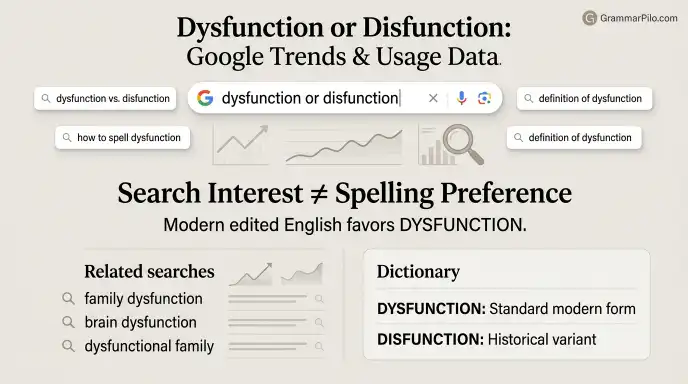
Google Trends can help show search interest around dysfunction or disfunction, but search interest should not be treated as a direct measurement of correct spelling.
People may search the two forms because they are unsure which spelling to use. They may also search related phrases such as:
Dysfunction or disfunction
Disfunction or dysfunction
Dysfunction and disfunction
Disfunction and dysfunction
Dysfunction vs. disfunction
Disfunction vs. dysfunction
Search interest can also be influenced by specific phrases such as family dysfunction, organizational dysfunction, brain dysfunction, cognitive dysfunction, and dysfunctional family.
For modern English usage, the dictionary evidence points toward dysfunction as the standard form. Cambridge uses dysfunction as the main dictionary entry, while Etymonline records disfunction as a historical variant.
This distinction is important because a search result for disfunction does not automatically mean that the spelling is preferred in modern edited English.
Dysfunction and Its Related Words
Understanding the word family makes the spelling easier to remember.
Function
Function: The normal purpose or operation of something.
Example: The heart has an important function in the body.
Dysfunction
Dysfunction: Abnormal or impaired functioning.
Example: The patient experienced organ dysfunction.
Dysfunctional
Dysfunctional: Not behaving or working normally.
Example: The organization has a dysfunctional communication system.
Cambridge defines dysfunctional as not behaving or working normally.
Functioning
Functioning: Working or operating.
Example: The equipment is functioning normally.
The pattern is simple:
Function → Dysfunction → Dysfunctional
This makes the spelling of dysfunction easier to remember.
How to Remember Dysfunction
The easiest memory trick is to focus on the prefix.
Remember “Dys ”
The prefix dys can indicate something abnormal, difficult, or impaired.
Dysfunction = abnormal function
That gives you the correct spelling:
Dys + function = dysfunction
Connect It With Dysfunctional
If you know the common word dysfunctional, the noun becomes easier.
Dysfunctional family
Dysfunctional system
Dysfunction in the system
Both forms use dys .
Do Not Build It From “Dis ”
Although dis appears in many English words, disfunction is not the standard modern spelling of the noun.
Remember:
Dysfunction = standard modern form
Disfunction = historical variant
Key Takeaways
- Dysfunction is the standard modern spelling.
- Disfunction has historical usage as a variant.
- Dysfunction means abnormal, impaired, or failed functioning.
- Cambridge defines dysfunction as a problem or fault in a body part or machine and as failure to work well.
- The word is formed from dys + function.
- Dysfunctional is the related adjective.
- British and American English use dysfunction.
- Do not use disfunction as your normal modern spelling.
- Malfunction can be a better word for a machine that fails to operate correctly.
- A useful memory rule is dys + function = dysfunction.
Frequently Asked Questions
1. Is dysfunction or disfunction correct?
Dysfunction is the standard modern spelling. Disfunction has been recorded as a historical variant, but it is not the preferred form in modern edited English.
2. Is disfunction a real word?
It has historical dictionary and etymological evidence as a variant of dysfunction. Etymonline dates the variant to 1914. However, dysfunction is the standard modern form.
3. What does dysfunction mean?
Dysfunction means abnormal, impaired, or unsuccessful functioning. It can describe a body system, machine, organization, family, or other system.
4. Why is dysfunction spelled with “dys”?
The word is formed from dys , meaning bad, abnormal, or difficult, and function, referring to operation or functioning.
5. Is dysfunction used in British and American English?
Yes. Dysfunction is used in both British and American English with the same spelling.
6. What is the adjective form of dysfunction?
The adjective is dysfunctional.
Example: The organization has a dysfunctional communication system.
Cambridge defines dysfunctional as not behaving or working normally.
7. Is dysfunctional or disfunctional correct?
Dysfunctional is the standard modern spelling. Etymonline also records disfunctional as a historical variant, but it is not the preferred modern form.
8. What is the difference between dysfunction and malfunction?
Dysfunction refers broadly to abnormal or impaired functioning, including biological, social, psychological, and organizational contexts. Malfunction generally refers to failure to work or operate correctly, especially for a machine or piece of equipment.
9. Can dysfunction describe a machine?
Yes. Dysfunction can describe a problem or fault in a machine or system. However, malfunction may be the more natural choice when specifically describing equipment that fails to operate correctly.
10. What is an easy way to remember dysfunction?
Think of dys + function. The prefix dys indicates something abnormal or impaired, giving you dysfunction.
Conclusion
The difference between dysfunction or disfunction is mainly a question of modern standard usage. Dysfunction is the established spelling used in contemporary English for abnormal, impaired, or unsuccessful functioning.
It appears in medical, academic, technical, workplace, social, and everyday contexts. Cambridge defines it as a problem or fault in part of the body or a machine and also as failure to operate or work well.
Disfunction is not completely without historical evidence. Etymonline records it as a variant of dysfunction from 1914. That historical usage explains why some readers may encounter the spelling, but it does not make it the preferred choice for modern edited writing.
The easiest way to remember the standard form is to break it into two parts: dys + function. The prefix dys carries the idea of something abnormal or impaired, while function refers to the way something works. So, when you mean abnormal functioning, choose dysfunction.
For modern articles, reports, emails, academic work, and professional communication, dysfunction is the spelling to use.
Solve the Confusion
- Fluorescent or Florescent: The Extra “U” Changes the Meaning
- Sking or Skiing: Fix Your Spelling in 30 Seconds
- Spiky or Spikey: The Correct Spelling Explained

I’m Sloane Mercer, a U.S.-based English language writer focused on grammar, spelling, vocabulary, and everyday English usage. Through GrammarPilo, I provide clear and practical explanations to help readers choose the right words and communicate with confidence.








4 thoughts on “Dysfunction or Disfunction: Which Is the Standard Spelling?”