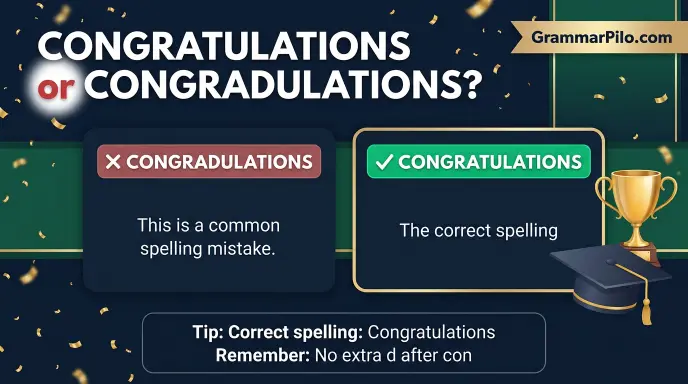
Congratulations is the correct spelling, while congradulations is a common misspelling. Use congratulations when you want to praise someone for an achievement, celebrate good news, or express happiness about an important event.
The confusion often happens because the middle sound in the word can be difficult to spell. Some people mistakenly write “d” after “congra” because they associate the word with the sound of “grade.” However, the correct spelling contains a t, not a d: con-gra-tu-la-tions.
You may use congratulations in a card, email, social media post, speech, or everyday conversation. It is commonly used for events such as graduations, weddings, promotions, new jobs, awards, and personal achievements.
This guide explains the difference between congratulations or congradulations, the word’s meaning and origin, its correct usage, and common spelling mistakes. You will also find practical examples to help you use the word confidently in everyday and formal writing.
Congratulations or Congradulations: Quick Answer
Congratulations is the correct spelling. Congradulations is incorrect in standard English.
Use congratulations to express praise, approval, or happiness about someone’s success or good news.
Correct: Congratulations on your new job!
Incorrect: Congradulations on your new job!
The correct spelling contains a t after “gra”: c-o-n-g-r-a-t-u-l-a-t-i-o-n-s.
Memory tip: Think of congratulate. The noun congratulations keeps the same “t” found in the verb.
Definition and Meaning of Congratulations
Congratulations is a noun used to express praise, approval, or happiness for someone’s achievement or good fortune. It is commonly used when someone reaches a goal, receives an award, or experiences an important life event.
What Does Congratulations Mean?
When you say congratulations, you show that you are pleased about something positive that has happened to another person.
Examples:
- Congratulations on passing your exam!
- Congratulations on your promotion.
- Congratulations to the happy couple.
- Congratulations on completing your degree.
The word can be used in both personal and professional situations.
Is Congratulations Singular or Plural?
Congratulations is normally used in the plural form. People commonly say or write “congratulations” rather than “congratulation” when praising someone.
Natural: Congratulations on your achievement!
The singular word congratulation exists, but it is much less common in everyday English.
Is Congratulations a Noun or a Verb?
Congratulations is a noun. The related verb is congratulate.
| Word | Part of Speech | Meaning |
| Congratulate | Verb | To praise someone for an achievement |
| Congratulation | Singular noun | An expression of praise |
| Congratulations | Plural noun / expression | Words used to praise or celebrate someone |
Example with the verb: I congratulate you on your success.
Example with the noun: Congratulations on your success!
When Should You Say Congratulations?
Use congratulations when someone has achieved something or received good news.
Common occasions include:
- Graduation
- Marriage or engagement
- A new job
- A promotion
- Winning a competition
- Passing an exam
- Completing a major project
- Receiving an award
- Having a baby
The word is suitable for friendly, professional, and formal messages.
The Origin and History of Congratulations
The word congratulations comes from the verb congratulate, which developed from Latin roots. It is connected to the Latin congratulari, meaning to wish joy or express happiness with someone.
The word entered English through forms influenced by Latin and French. Over time, congratulate became the common verb for expressing praise or happiness about another person’s success.
The noun congratulation developed from the same word family. Its plural form, congratulations, became a familiar expression used in conversation, letters, cards, and public celebrations.
Why Do People Spell It Congradulations?
The misspelling congradulations may happen because the word sounds similar to other familiar words, especially grade and graduation.
People may connect the word with academic achievements and accidentally use a “d” in the spelling. However, congratulations comes from congratulate, not from “grade.”
How Can You Remember the Correct Spelling?
Connect the noun to its verb:
- Congratulate
- Congratulations
Both contain the letter t after “gra.”
Remember: You congratulate someone, and you offer congratulations. The spelling uses t, not d.
British English vs American English Spelling
There is no spelling difference between British and American English for congratulations. Both varieties use the same standard spelling.
| Form | American English | British English | Status |
| Congratulations | Correct | Correct | Standard spelling |
| Congradulations | Incorrect | Incorrect | Common misspelling |
Does Congratulations Have Different Spellings in Other English Varieties?
No. The standard spelling is congratulations in American, British, Canadian, Australian, and other major varieties of English.
American English: Congratulations on your graduation!
British English: Congratulations on your graduation!
The spelling remains the same across these examples.
Is There a Difference in How the Word Is Used?
The word is used in similar ways across English varieties. Differences are more likely to appear in the surrounding message or level of formality, not in the spelling itself.
For example, both “Congratulations on your new job” and “Many congratulations on your new job” are understandable in standard English.
Which Spelling Should You Use?
Use congratulations in all standard English writing. It is correct for American, British, and international audiences.
For American Readers
Use congratulations in emails, cards, social media posts, speeches, and professional messages.
Example: Congratulations on earning your degree!
For British and Commonwealth Readers
The correct spelling is also congratulations in British English and other Commonwealth varieties.
Example: Many congratulations on your new position.
For International Readers
Choose congratulations for international communication. It is widely recognized and understood.
For Formal Writing
Congratulations is appropriate in formal messages, business communication, and public announcements.
Example: Please accept our congratulations on your recent achievement.
For a more personal tone, you can use a shorter expression such as “Well done!” or “I’m delighted for you.”
Common Mistakes with Congratulations or Congradulations
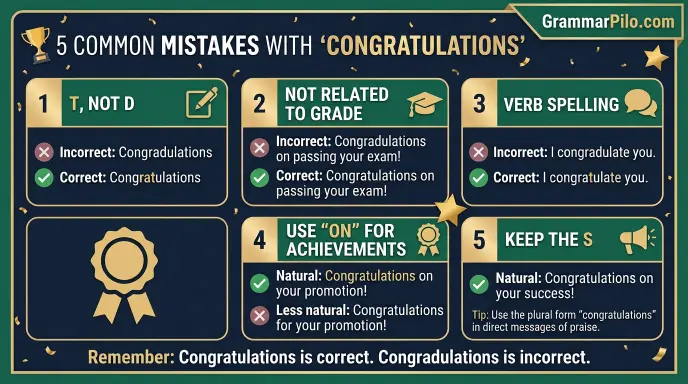
Mistake 1: Replacing T With D
A common error is writing congradulations instead of congratulations.
Incorrect: Congradulations on your wedding!
Correct: Congratulations on your wedding!
The correct word contains a “t,” not a “d.”
Mistake 2: Connecting the Word to Grade
Some people assume that congratulations is related to the word “grade,” especially when using it for school achievements.
However, the correct spelling comes from congratulate.
Incorrect: Congradulations on passing your exam!
Correct: Congratulations on passing your exam!
Mistake 3: Misspelling the Verb Congratulate
The related verb is also sometimes misspelled.
Incorrect: I congradulate you on your success.
Correct: I congratulate you on your success.
Remember that both congratulate and congratulations use “t.”
Mistake 4: Using the Wrong Preposition
The word congratulations is often followed by on when referring to an achievement or event.
Natural: Congratulations on your promotion!
Less natural: Congratulations for your promotion!
“Congratulations for” can occur in some contexts, but congratulations on is the usual choice for achievements.
Mistake 5: Forgetting the Plural Form
In everyday English, the usual expression is congratulations, with “s” at the end.
Natural: Congratulations on your success!
The singular congratulation is possible in limited contexts, but it is not the usual form for a direct message of praise.
Congratulations in Everyday Examples
Seeing congratulations in different situations can help you remember its spelling and use.
In Emails
Example: Congratulations on your promotion! Your hard work and dedication have truly paid off.
This message is friendly and suitable for a colleague.
In News Writing
Example: The university shared its congratulations with the graduating students.
The sentence uses the word in a public announcement.
In Social Media
Example: Congratulations to my best friend on getting her dream job!
This is a natural way to celebrate someone’s good news online.
In Formal Writing
Example: Please accept our sincere congratulations on receiving the award.
This wording is suitable for a formal letter or professional message.
In Business Communication
Example: Congratulations on the successful launch of your new product.
The expression recognizes a professional achievement.
In Everyday Conversation
Example: “I passed my driving test!”
“Congratulations! That’s wonderful news.”
This is a simple and natural conversational use.
In Greeting Cards
Example: Congratulations on your wedding! Wishing you both a lifetime of happiness.
The word is commonly used in cards for important life events.
Congratulations vs Congradulations: Side by Side Comparison
The difference between congratulations and congradulations is spelling. Only congratulations is correct in standard English.
| Feature | Congratulations | Congradulations |
| Spelling | C-O-N-G-R-A-T-U-L-A-T-I-O-N-S | C-O-N-G-R-A-D-U-L-A-T-I-O-N-S |
| Standard English | Correct | Incorrect |
| Meaning | Expression of praise or happiness | No standard meaning as this spelling |
| Related verb | Congratulate | Incorrect form: congradulate |
| American English | Correct | Incorrect |
| British English | Correct | Incorrect |
| Example | Congratulations on your success! | Congradulations on your success! |
Congratulations or Congradulations: Which One Is Correct?
Congratulations is the correct form. Remember the related verb congratulate to keep the “t” in the right place.
The correct spelling is:
C-O-N-G-R-A-T-U-L-A-T-I-O-N-S
Google Trends and Usage Data for Congratulations
People search for congratulations or congradulations because the word is frequently used in messages, cards, announcements, and social media posts. Its spelling can be confusing because some people associate it with “grade” or “graduation.”
Search interest may also rise around common celebration periods, such as graduation seasons or major public events. However, search activity does not determine which spelling is correct.
Google Trends can compare relative interest in congratulations and congradulations for selected locations and time periods. It does not provide exact search totals, and a popular search term is not automatically a correct spelling.
For reliable spelling guidance, use established dictionaries and grammar references. They recognize congratulations as the standard form.
Practical takeaway: Use congratulations in every standard English context. Avoid congradulations.
Frequently Asked Questions
1. Is it congratulations or congradulations?
Congratulations is correct. Congradulations is a common misspelling. The correct form uses a “t,” not a “d.”
2. Why is congratulations spelled with a T?
The word comes from congratulate, which also contains a “t.” The noun congratulations keeps the same spelling pattern.
3. Is congradulations ever correct?
No. Congradulations is not a standard English spelling. Use congratulations in formal, academic, professional, and everyday writing.
4. Is congratulations British or American?
Congratulations is correct in both British and American English. There is no regional spelling difference.
5. Is congratulations singular or plural?
Congratulations is normally used in the plural form when praising someone. The singular noun congratulation exists, but it is less common in everyday messages.
6. What is the difference between congratulate and congratulations?
Congratulate is a verb, while congratulations is a noun or expression.
Verb: I congratulate you on your achievement.
Noun: Congratulations on your achievement!
7. Should I say congratulations on or congratulations for?
Congratulations on is the usual expression when referring to an achievement or event.
Example: Congratulations on your graduation!
Conclusion: Remember the T in Congratulations
When choosing between congratulations or congradulations, always use congratulations. It is the correct spelling in standard English, while congradulations is a common mistake.
The easiest way to remember the spelling is to connect it with the verb congratulate. Both words contain a “t” after “gra.” The word is not formed from “grade,” so adding a “d” is incorrect.
Use congratulations when praising someone for passing an exam, getting a new job, earning a promotion, getting married, or reaching another important goal. It works in friendly conversations, greeting cards, social media posts, business emails, and formal announcements.
There is no difference between British and American spelling. Writers in both varieties should use congratulations.
Remember: You congratulate someone, and you offer congratulations. Keep the “t,” and you will spell the word correctly.
Discover More Articles

I’m Sloane Mercer, a U.S.-based English language writer focused on grammar, spelling, vocabulary, and everyday English usage. Through GrammarPilo, I provide clear and practical explanations to help readers choose the right words and communicate with confidence.







3 thoughts on “Is It Congradulations or Congratulations? The Definitive Guide”