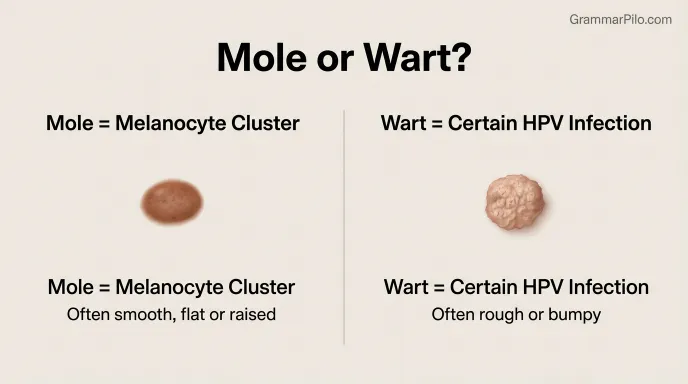
A mole and a wart are different types of skin growths, even though they can sometimes look similar.
A mole develops when pigment producing cells called melanocytes grow in clusters, while a wart develops because certain types of human papillomavirus, or HPV, infect the skin.
The confusion around mole or wart often comes from their appearance. Both can appear as raised spots or bumps, and both can vary in color and size.
Some warts can even be smooth or relatively flat, while some moles can be raised and have an uneven looking surface.
There are, however, several useful differences. Moles are often brown, tan, pink, black, or close to the natural skin tone, and many are round or oval.
Warts are often rough or bumpy and can develop on the hands, feet, face, elbows, knees, and other areas. Some warts have tiny dark dots that are actually blood vessels.
This guide explains mole vs. wart, how they differ, their meanings, origins, common mistakes, everyday examples, and when a skin growth should be checked by a healthcare professional.
Mole or Wart: Quick Answer
Mole: A common skin growth formed by clusters of melanocytes, the pigment producing cells in the skin. Moles are also called nevi or nevus.
Wart: A usually benign skin growth caused by certain types of human papillomavirus, or HPV.
Simple rule: Moles are associated with clusters of pigment producing cells, while warts are caused by certain HPV infections.
Definition and Meaning of Wart or Mole
What Does Mole Mean?
A mole is a growth on the skin caused by melanocytes growing in clusters.
The medical term for a mole is nevus, while the plural is nevi. Moles are very common, and MedlinePlus reports that most people have between 10 and 40 moles.
Moles can be:
- Flat
- Slightly raised
- Brown
- Tan
- Pink
- Black
- Skin colored
- Round or oval
Not every mole looks exactly the same. The American Academy of Dermatology notes that moles can vary in size, shape, and color, even on the same person.
Example: She noticed a small brown mole on her arm.
What Does Wart Mean?
A wart is a skin growth caused by certain types of HPV.
Warts can occur on different parts of the body, including the hands, feet, face, elbows, knees, and areas of shaved skin.
Common warts can feel rough and raised. Other types can be flat, smooth, dome shaped, or cauliflower like. Plantar warts develop on the soles of the feet and may grow inward because of pressure from walking.
Example: He developed a small wart on his finger.
Mole and Wart Are Not the Same Thing
Although mole and wart can both describe visible skin growths, they have different causes.
| Feature | Mole | Wart |
| Medical term | Nevus | Wart |
| Main cause | Cluster of melanocytes | Certain HPV infections |
| Common appearance | Flat or raised spot | Often raised or rough |
| Common colors | Brown, tan, pink, black, skin colored | Skin colored, brown, gray, black, pink, or other shades |
| Contagious | No | Yes, warts can spread |
| Common locations | Anywhere on the skin | Hands, feet, face, elbows, knees, genitals, and other areas |
| Surface | Often smooth | Often rough, but can vary |
The exact appearance varies, so visual comparison alone cannot always identify a skin growth.
The Origin of Mole and Wart
The Origin of Mole
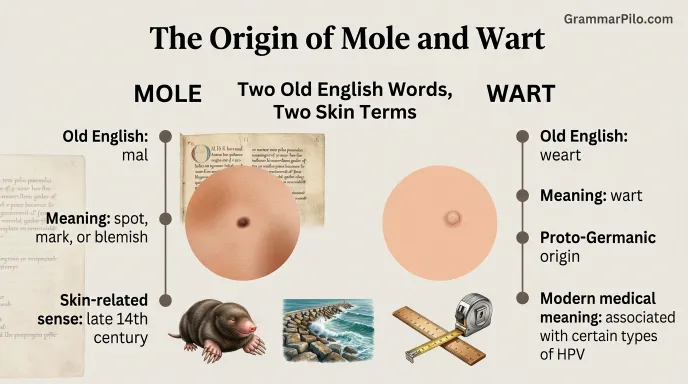
The word mole, when referring to a spot on the skin, has a long history in English.
Etymonline traces this sense to Old English mal, meaning a spot, mark, or blemish. The word was originally used for marks or spots more generally before becoming associated specifically with small permanent dark marks on human skin.
The skin related sense is recorded from the late 14th century.
It is important to remember that mole has several unrelated meanings in English. It can also refer to a small burrowing mammal, a massive breakwater, or a scientific unit of molecular quantity. The skin related meaning is only one sense of the word.
The Origin of Wart
The word wart is even older.
Etymonline traces wart to Old English weart, meaning a wart, from a Proto Germanic form related to similar words in other Germanic languages.
The word has remained associated with a small fleshy growth on the skin for centuries.
Its medical meaning today is more specific because modern medicine identifies common warts as growths associated with certain types of HPV.
British English vs American English Spelling
There is no British American spelling difference between wart and mole.
| Word | British English | American English |
| Mole | Mole | Mole |
| Wart | Wart | Wart |
| Moles | Moles | Moles |
| Warts | Warts | Warts |
| Mole removal | Correct | Correct |
| Wart treatment | Correct | Correct |
Both terms are standard in British and American English.
The medical terminology may sometimes differ in style, but the everyday spellings remain the same.
Which Word Should You Use?
The correct word depends on the type of skin growth you are describing.
Use Mole for a Mole
Use mole when referring to a skin growth associated with a cluster of melanocytes.
Example: The doctor examined the mole on her shoulder.
Example: He has several small moles on his arms.
The word nevus is the medical term often used for a mole.
Use Wart for a Wart
Use wart when referring to a skin growth caused by certain types of HPV.
Example: The child developed a wart on his hand.
Example: The dermatologist treated the wart on her foot.
Warts can have several appearances depending on their type.
Do Not Diagnose a Skin Growth From a Word Comparison
A grammar or vocabulary article can explain the difference between mole and wart, but appearance alone is not always enough to identify a skin growth.
The American Academy of Dermatology notes that conditions such as seborrheic keratoses and skin cancer can sometimes look like warts. It recommends seeing a dermatologist if you are not certain a growth is a wart.
Common Mistakes with Mole or Wart
Mistake 1: Assuming Every Raised Spot Is a Wart
Incorrect idea: Any raised bump on the skin must be a wart.
Correct: Skin growths can have many causes. Moles, warts, skin tags, seborrheic keratoses, and other conditions can look different from one another, and some can resemble each other.
Mistake 2: Assuming Every Dark Spot Is a Mole
Incorrect idea: Every dark spot on the skin is a mole.
Correct: A dark or changing spot can have different causes. The American Academy of Dermatology recommends professional evaluation for a mole or skin lesion showing concerning changes.
Mistake 3: Treating a Suspected Mole Like a Wart
Incorrect: Applying wart remover to an unidentified skin growth.
Better: Get an uncertain growth evaluated before attempting treatment.
The American Academy of Dermatology specifically warns that some conditions that resemble warts can be damaged by at home wart treatments.
Mistake 4: Thinking Warts and Moles Are Contagious in the Same Way
Warts are associated with HPV and can spread from person to person or between areas of the body. Moles are not contagious.
Mistake 5: Assuming Every Mole Is Dangerous
Most moles are harmless. However, changes in a mole can sometimes be a reason to seek professional evaluation.
Mole or Wart in Everyday Examples
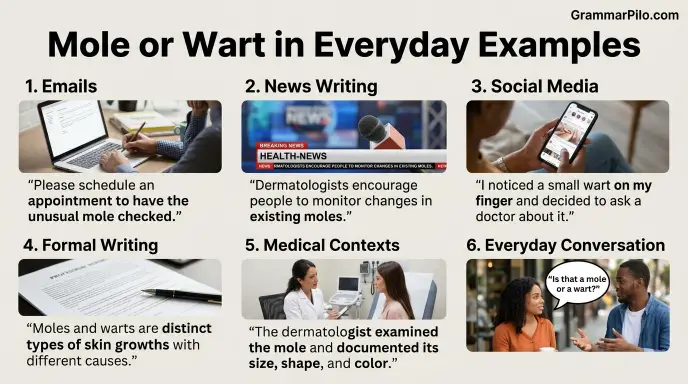
In Emails
Example: Please schedule an appointment to have the unusual mole checked.
In News Writing
Example: Dermatologists encourage people to monitor changes in existing moles.
In Social Media
Example: I noticed a small wart on my finger and decided to ask a doctor about it.
In Formal Writing
Example: Moles and warts are distinct types of skin growths with different causes.
In Medical Contexts
Example: The dermatologist examined the mole and documented its size, shape, and color.
In Everyday Conversation
Example: Is that a mole or a wart?
This question is common when a person notices a new or unfamiliar skin growth.
Mole vs. Wart: Appearance and Texture
The visual differences between wart vs. mole can be useful, but they are not a substitute for professional diagnosis.
| Characteristic | Mole | Wart |
| Typical texture | Often smooth | Often rough |
| Typical shape | Round or oval | Round, flat, dome shaped, or irregular |
| Color | Often brown or tan | Often skin colored or grayish, but can vary |
| Can be raised? | Yes | Yes |
| Can be flat? | Yes | Yes |
| Tiny dark dots | Not the typical feature | Can occur in some warts |
| Can spread? | No | Yes |
| Caused by HPV? | No | Yes |
The American Academy of Dermatology describes warts as potentially round, flat, rough, smooth, cauliflower shaped, or thread like. It also notes that some warts contain small dark dots that are blood vessels.
Moles, meanwhile, can be flat or slightly raised and can appear in several colors.
Mole and Wart: Where They Commonly Appear
Moles
Moles can appear almost anywhere on the skin.
The American Academy of Dermatology notes that moles can occur on areas including the scalp, between fingers and toes, palms, soles, and under the nails.
Warts
Warts can also occur in many locations.
Common locations include:
- Hands
- Fingers
- Around the nails
- Feet
- Elbows
- Knees
- Face
- Genitals
The location can provide a clue, but it does not by itself establish a diagnosis.
When Should a Mole Be Checked?
Most moles are harmless, but changes deserve attention.
The American Academy of Dermatology describes the ABCDE warning signs used when evaluating a mole for possible melanoma:
- A: Asymmetry
- B: Border irregularity
- C: Color variation
- D: Diameter
- E: Evolving
A mole or skin lesion that changes in size, shape, or color should be evaluated by a dermatologist.
MedlinePlus similarly recommends having unusual moles checked if they grow larger, change color or outline, or otherwise change.
This does not mean that every changing mole is cancerous. It means that a healthcare professional should evaluate concerning changes.
When Should a Wart Be Checked?
Many warts are harmless, but an uncertain skin growth should not automatically be treated as a wart.
The American Academy of Dermatology recommends professional evaluation if you are unsure that a growth is a wart because other skin conditions can resemble one.
A healthcare professional can determine what the growth is and recommend an appropriate treatment if necessary.
Mole or Wart: Google Trends & Usage Data
Google Trends can compare relative search interest for mole or wart, but search interest is not the same as the number of people who have moles or warts.
Search behavior can be affected by health concerns, seasonal searches, medical information, skincare trends, and people trying to identify an unfamiliar skin growth.
For an accurate Trends comparison, the same country, date range, and search category should be used for both terms. Exact numerical search interest values should not be stated without a current direct Trends check.
Dictionary and medical sources establish a much clearer distinction: mole refers to a skin growth associated with clusters of melanocytes, while wart refers to a growth caused by certain HPV types.
Mole or Wart: Simple Memory Trick
A simple way to remember the difference is:
Mole = melanocytes.
Both words begin with M, which can help connect mole with melanocytes, the pigment producing cells involved in mole formation.
Wart = HPV.
Think of a wart as a skin growth associated with certain types of HPV.
This is only a memory aid, not a way to diagnose a skin growth.
Key Takeaways
- Mole and wart are different types of skin growths.
- A mole forms from clusters of melanocytes.
- A wart is caused by certain types of HPV.
- Moles can be flat or raised.
- Warts can be rough, smooth, flat, raised, or cauliflower like.
- Moles are not contagious.
- Warts can spread because they are associated with HPV infection.
- Most moles are harmless, but changing or unusual moles should be checked.
- An unfamiliar skin growth should not automatically be treated as a wart.
- British and American English use the same spellings.
- Mole vs. wart is a difference in meaning and medical classification, not a spelling difference.
Frequently Asked Questions About Mole or Wart
1. What is the difference between a mole and a wart?
Answer: A mole is a skin growth formed from clusters of melanocytes, while a wart is a growth caused by certain types of HPV.
2. Is a mole the same as a wart?
Answer: No. A mole and a wart have different causes and characteristics. Moles are associated with melanocyte clusters, while warts are associated with HPV.
3. Can a wart look like a mole?
Answer: Some warts can be brown, gray, black, or skin colored, so appearance can sometimes cause confusion. The American Academy of Dermatology notes that warts can have several different appearances.
4. Can a mole look like a wart?
Answer: Yes. Some moles can be raised and may have a surface that looks somewhat wart like. A dermatologist can determine what a suspicious or uncertain growth is.
5. Are warts contagious?
Answer: Yes. Warts are caused by certain types of HPV and can spread through contact.
6. Are moles contagious?
Answer: No. Ordinary moles are not contagious.
7. Can you remove a mole with wart remover?
Answer: You should not assume an unidentified growth is a wart and treat it with wart remover. Some conditions that resemble warts can be irritated or damaged by wart treatments.
8. When should I have a mole checked?
Answer: A mole should be professionally evaluated if it changes in size, shape, or color or shows other concerning features. The ABCDE warning signs can help identify changes that deserve attention.
9. Where do warts usually appear?
Answer: Warts commonly appear on the hands, feet, elbows, knees, face, around the nails, and other areas of the skin.
10. What is the medical name for a mole?
Answer: A mole is also called a nevus, and the plural form is nevi.
Conclusion
The difference between mole or wart is easier to understand once you look at their causes rather than simply their appearance.
A mole is a common skin growth associated with clusters of melanocytes, the cells that produce pigment in the skin. A wart, in contrast, develops because certain types of human papillomavirus infect the skin.
Moles can be flat or raised and may appear brown, tan, pink, black, or close to the skin’s natural color. Warts can also vary in appearance, but many have a rough or bumpy surface. Some warts have tiny dark dots caused by blood vessels.
The terms mole and wart therefore should not be used interchangeably. A mole is not simply a different name for a wart, and a wart is not another type of mole.
If you are unsure about a new or changing skin growth, appearance alone may not provide a reliable diagnosis. Dermatology sources recommend professional evaluation for uncertain or changing lesions, especially when a mole develops concerning changes.
The easiest memory trick is simple: mole = melanocyte related growth, while wart = HPV related growth.
More Differences to Explore

I’m Sloane Mercer, a U.S.-based English language writer focused on grammar, spelling, vocabulary, and everyday English usage. Through GrammarPilo, I provide clear and practical explanations to help readers choose the right words and communicate with confidence.







2 thoughts on “Mole or Wart: How Can You Tell the Difference?”