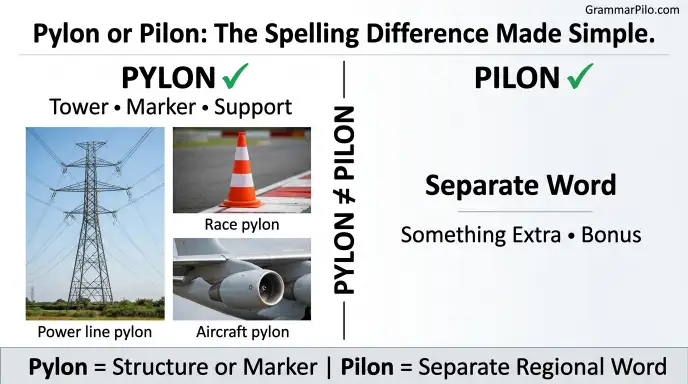
Pylon is the standard English word for structures such as tall towers that carry electrical cables, markers used in racing or aviation, and certain architectural or aircraft structures.
Pilon is also a real English word, but it has a much narrower use and is especially associated with a regional Southwestern U.S. meaning for something extra or a small bonus.
The confusion between pylon or pilon usually comes from their similar spelling and pronunciation. The two words differ by only one letter, but they do not normally have the same meaning.
If you are talking about an electricity tower, race marker, entrance structure, or aircraft component, pylon is the word you need.At the same time, pilon should not simply be treated as a spelling mistake.
Dictionaries record it as a genuine word, particularly in Southwestern U.S. English. In that regional use, a pilon can mean something extra given to a customer, similar to a bonus or small gift.
This guide explains pylon vs. pilon, their meanings, origins, spelling, pronunciation, common mistakes, and everyday usage so you can choose the right word confidently.
Pilon and Pylon: Quick Answer
Pylon: The standard word for a tall tower, marker, gateway structure, or aircraft support structure.
Pilon: A less common regional word, especially in Southwestern U.S. English, meaning something extra or a small bonus.
Simple rule: Use pylon for a structure or marker. Use pilon only when the context specifically refers to its regional or specialized meaning.
Definition and Meaning of Pylon or Pilon
What Does Pylon Mean?
A pylon is a tall structure used for several different purposes.
One of the most familiar meanings is an electrical tower that supports high voltage cables. In British English, this is one of the most common meanings of the word.
In American English, the same word can describe structures used for electrical lines, aviation, racing, entrances, and other purposes.
Examples include:
- an electricity pylon
- a racing pylon
- an aviation pylon
- an Egyptian temple pylon
- an aircraft engine pylon
The word can therefore appear in engineering, transportation, architecture, aviation, sports, and historical writing.
What Does Pilon Mean?
Pilon is a real word, but it is much less common.
Dictionary sources record pilon as a Southwestern U.S. term, especially associated with Texas, meaning something extra or a small bonus. It can describe an additional item given to a customer as a gesture of generosity.
For example:
Example: The shopkeeper gave the customer a pilon with the purchase.
This meaning is regional, so many English speakers may never encounter pilon in ordinary writing.
Pylon and Pilon Are Not Interchangeable
Although pylon and pilon look similar, they normally refer to different things.
If you are describing a tall electrical structure, pylon is correct.
If you are describing a regional Southwestern U.S. term for an extra gift or bonus, pilon may be correct.
The Origin of Pylon and Pilon
The Origin of Pylon
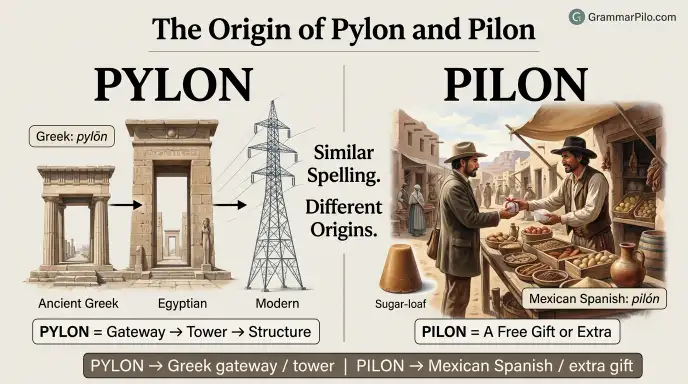
The word pylon comes from Greek pylōn, meaning a gateway or gate tower. The word entered English in the 19th century and originally referred to monumental gateway structures, especially those associated with ancient Egyptian temples.
Over time, the meaning expanded.
The word was used for structures connected with aviation in the early 20th century. Later, it became associated with steel towers carrying high tension electrical wires. Etymonline dates the aviation related meaning to 1909 and the electrical tower meaning to 1923.
This explains why pylon can describe several different kinds of structures today.
The Origin of Pilon
The history of pilon is different.
Dictionary.com traces the Southwestern U.S. word to Mexican Spanish pilón, while Etymonline records its American English use in the late 19th century as a free gift given by merchants to customers.
Dictionary.com explains that the Spanish source originally referred to a sugar loaf and is connected with Spanish words for a basin or trough.
So, despite their similar appearance, pylon and pilon have different histories and meanings.
British English vs American English Spelling
The spelling pylon is used in both British and American English.
The biggest difference is often not spelling but meaning preference and pronunciation.
| Word | British English | American English |
| Pylon | Correct | Correct |
| Pilon | Rare and specialized | Regional, especially Southwestern U.S. |
| Electrical tower | Often called a pylon | Often called an electrical tower or power tower |
| Racing marker | Pylon | Pylon |
| Aircraft support | Pylon | Pylon |
Collins lists pylon as a standard British and American English word, with several meanings in both varieties. In British English, an electrical pylon is especially associated with the large steel structures carrying high voltage cables.
The spelling does not change to pilon in British English.
Which Spelling Should You Use?
For most general English writing, use pylon when you mean a tower, marker, gateway structure, or aircraft support.
Use Pylon for Structures
Choose pylon when writing about:
- electricity towers
- high voltage power lines
- aircraft structures
- racing markers
- aviation markers
- Egyptian temple gateways
- certain bridge or entrance structures
Example: The engineers inspected the damaged electricity pylon.
Use Pilon for Its Regional Meaning
Use pilon when the context specifically refers to the Southwestern U.S. meaning of an extra or bonus item.
Example: The store owner included a pilon with the customer’s purchase.
Because this meaning is uncommon, readers unfamiliar with Southwestern U.S. English may not recognize the word immediately.
A Simple Writing Tip
If you are unsure and your sentence describes a physical tower or support structure, pylon is almost certainly the word you need.
Common Mistakes with Pylon or Pilon
Mistake 1: Writing Pilon for an Electricity Tower
Incorrect: The workers climbed the pilon to repair the power line.
Correct: The workers climbed the pylon to repair the power line.
An electrical tower is normally called a pylon, especially in British English.
Mistake 2: Assuming Pilon Is Always a Misspelling
Incorrect assumption: Pilon is never a real English word.
Correct: Pilon is a real but uncommon regional word.
Dictionary sources record pilon as a Southwestern U.S. term meaning something extra or a bonus.
Mistake 3: Treating Pylon and Pilon as Exact Synonyms
Incorrect idea: Pylon and pilon are two spellings for the same thing.
Correct: They have different meanings and different historical origins.
Mistake 4: Using Pilon in General Technical Writing
Technical writing about electrical infrastructure, aviation, or architecture normally uses pylon.
Example: The new pylon supports several high voltage cables.
Using pilon in this sentence would create confusion.
Pilon Vs. Pylon in Everyday Examples
In Emails
Example: The maintenance team will inspect the pylon near the north entrance.
In News Writing
Example: Engineers replaced an aging electricity pylon after the inspection.
In Social Media
Example: I finally saw the famous temple pylons in person.
In Formal Writing
Example: The bridge design includes reinforced pylons to support the structure.
In Aviation
Example: The engine is attached to the aircraft wing by a pylon.
In Sports
Example: The runner passed the final pylon during the race.
In Regional U.S. Usage
Example: The vendor added a small pilon to the customer’s order.
These examples show why context matters when choosing pylon or pilon.
Pylon vs. Pilon: Pronunciation
The pronunciation can also contribute to confusion.
Pylon: Often pronounced approximately like “pie-lon” or “pie-lən,” depending on the variety of English.
Pilon: In its Southwestern U.S. regional use, Dictionary.com gives a pronunciation approximately like “pee-lohn.”
The words therefore differ not only in spelling but also in their commonly recorded pronunciation.
Pylon or Pilon: Google Trends & Usage Data
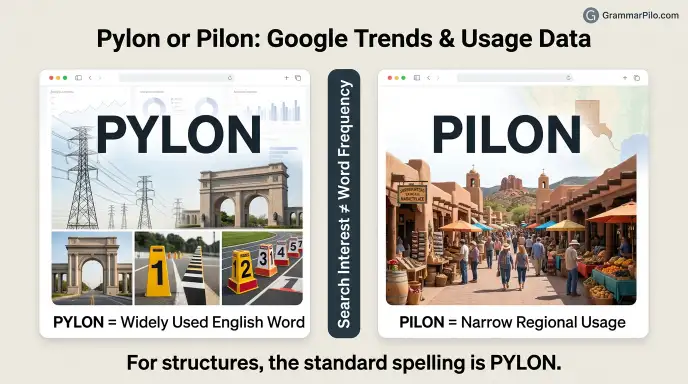
Google Trends measures relative search interest rather than the total number of times a word appears in published English. For a comparison such as pylon or pilon, search interest can also be affected by regional usage and by people searching to check a spelling.
The important usage pattern is clear from dictionary coverage: pylon is a widely established English word with meanings across engineering, architecture, aviation, and sports, while pilon has a much narrower regional meaning in Southwestern U.S. English.
This means that a search for pylon vs. pilon is often really a spelling question. In most general contexts involving a structure, the expected form is pylon.
For accurate current Google Trends figures, the comparison should be checked directly for the selected country, date range, and search type rather than presenting unsupported numerical values.
Pylon and Pilon Side by Side Comparison
| Feature | Pylon | Pilon |
| Standard spelling | Yes | Yes, but uncommon |
| Main use | Structures and markers | Regional term for something extra |
| Electrical tower | Yes | No |
| Aviation structure | Yes | No |
| Racing marker | Yes | No |
| Egyptian gateway | Yes | No |
| Southwestern U.S. bonus/gift | No | Yes |
| Common in general English | Yes | No |
| British English | Standard | Rare/specialized |
| American English | Standard | Regional use |
| Origin | Greek | Mexican Spanish |
Pilon or Pylon: Easy Memory Trick
Think of pylon as a physical structure.
Pylon = tower, marker, gateway, or support.
Think of pilon as a regional extra.
Pilon = something extra or a small bonus.
If you are talking about power lines, an airplane, a race course, or an Egyptian temple, remember pylon.
Key Takeaways
- Pylon is the standard word for several types of tall structures and markers.
- Pylon can refer to an electricity tower, racing marker, aviation structure, or architectural gateway.
- Pilon is a genuine but uncommon word.
- Pilon is especially recorded in Southwestern U.S. English with the meaning “something extra” or “bonus.”
- Pylon comes from Greek and originally referred to a gateway or gate tower.
- Pilon has a different history connected to Mexican Spanish.
- For an electrical tower, pylon is the correct choice.
- Pylon and pilon are not interchangeable spellings.
Frequently Asked Questions
1. Is pylon or pilon correct?
Answer: Both are real words, but they have different meanings. Pylon is the standard word for structures and markers, while pilon has a much narrower regional meaning.
2. Is pylon the correct spelling for an electricity tower?
Answer: Yes. Pylon is the standard term, especially in British English, for a large steel structure supporting high voltage electrical cables.
3. Is pilon a misspelling of pylon?
Answer: Not always. Pilon is a legitimate regional word recorded in Southwestern U.S. English, where it can mean something extra or a small bonus.
4. What is the difference between pylon and pilon?
Answer: Pylon generally refers to a physical structure or marker. Pilon can refer to something extra given as a bonus in a regional Southwestern U.S. usage.
5. Is pylon British or American English?
Answer: Pylon is used in both British and American English. Its meanings can vary slightly by context and regional usage.
6. What does pilon mean in American English?
Answer: In Southwestern U.S. English, especially Texas, pilon can mean something extra or a small bonus given to a customer.
7. What is a pylon in aviation?
Answer: In aviation, a pylon can be a structure attached to an aircraft that supports an engine, fuel tank, or other equipment.
8. What is a pylon in sports?
Answer: A pylon can be a marker used to define a course or turning point in racing. In American football, pylons also mark the corners of the end zone.
9. Does pylon have the same spelling in the UK and US?
Answer: Yes. The spelling is pylon in both British and American English.
10. How can I remember pylon vs. pilon?
Answer: Remember pylon = physical structure. Pilon = regional extra or bonus. This simple distinction helps prevent most spelling mistakes.
Conclusion
The difference between pylon or pilon becomes much easier once you separate their meanings.
Pylon is the standard and widely used English word for structures such as electricity towers, aviation supports, race markers, and monumental gateways. Its history goes back to Greek, where the original word referred to a gateway or gate tower.
Pilon is also a legitimate word, but it is far less common. In Southwestern U.S. English, especially in Texas, it can mean something extra or a small bonus given to a customer. Its history is connected to Mexican Spanish rather than the Greek origin of pylon.
So, when you are writing about power lines, aircraft, racing, bridges, or ancient Egyptian architecture, choose pylon. Reserve pilon for contexts where its specific regional meaning is intended.
The simplest rule is easy to remember: pylon is usually a structure or marker, while pilon is a specialized regional word for something extra.
Read Next:

I’m Claire Morgan, the author behind Grammarpilo.com, where I write about English grammar, sentence structure, punctuation, and everyday language. My goal is to make grammar simple, clear, and practical, helping readers understand the rules and apply them with confidence in real-world writing.








2 thoughts on “Pylon or Pilon: The Spelling Difference Made Simple”