Have you ever paused while writing independent or independant and wondered which spelling is correct? The correct spelling is independent, with an ent ending. Independant is a common spelling mistake and is not the standard form in English.
The confusion often happens because the ending sounds similar to other words, and writers may expect it to follow a familiar spelling pattern.
However, the accepted spelling is consistent in American English, British English, Canadian English, and Australian English.The word independent describes someone who can make decisions or do things without relying on others.
It can also describe a country, organization, study, or process that is free from outside control or influence. For example, an independent student may complete assignments without help, while an independent organization operates separately from a larger institution.
This guide explains the difference between independent and independant, explores the word’s meaning and origin, and provides practical examples to help you remember the correct spelling.
Independent or Independant: Quick Answer
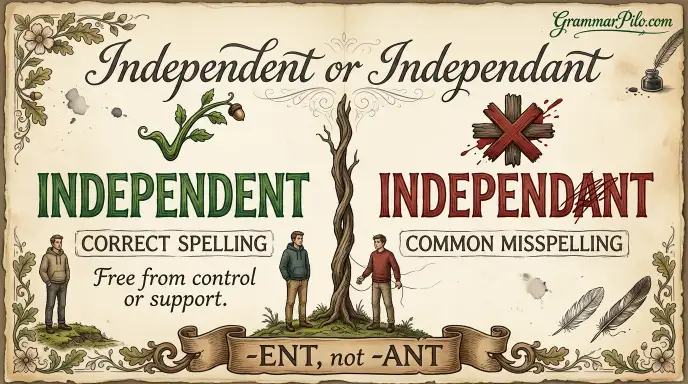
Independent is the correct spelling in standard English. Independant is a misspelling. Use independent when describing a person, organization, country, or decision that is free from outside control, influence, or support.
Correct: She is an independent thinker.
Incorrect: She is an independant thinker.
Remember the ending: independent is spelled with -ent, not -ant.
What Does Independent or Independant Mean?
Only independent is the standard spelling. It is commonly used as an adjective, but it can also function as a noun.
Independent: Definition and Meaning
Independent means free from another person’s control, influence, or support. It can describe a person who makes decisions alone, an organization that operates separately, or a country that governs itself.
According to Cambridge Dictionary, the word can describe something that is not controlled or influenced by others. It can also refer to someone who does not need help from other people.
Examples:
- My sister became financially independent after getting a full time job.
- The company hired an independent consultant.
- The country became independent many years ago.
- Students should learn to work independently.
- We need an independent review of the results.
Independant: Definition and Meaning
Independant is not the accepted spelling of the word. It is usually a spelling error caused by confusion over the final letters.
Incorrect: He wants to become independant.
Correct: He wants to become independent.
The intended meaning is clear, but the spelling should be corrected in schoolwork, professional documents, emails, and published content.
Independent vs. Independant: Main Difference
The difference is spelling, not meaning. Independent is the recognized English word, while independant is a nonstandard spelling.
| Word | Status | Meaning |
| Independent | Correct | Free from control, influence, or support |
| Independant | Incorrect spelling | No standard meaning in this context |
The Origin and History of Independent
The word independent entered English in the early 17th century. Oxford Learner’s Dictionaries identifies its origin as partly following the pattern of the French word indépendant.
The word developed from the idea of not depending on someone or something. Its parts connect to the prefix in , meaning “not,” and dependent, meaning relying on or being controlled by something else.
Over time, independent gained several related uses. It came to describe people who can act without help, countries that govern themselves, organizations that are not controlled by larger bodies, and research that is conducted separately from outside influence.
The spelling independent became the established form in English. The alternative spelling independant may appear in informal writing or as a typing error, but it is not the standard spelling.
How the Word Is Used Today
Modern English uses independent in many settings.
Personal independence: She is an independent person who enjoys making her own decisions.
Financial independence: He hopes to become financially independent.
Business independence: They run an independent bookstore.
Academic independence: The researchers conducted an independent study.
Political independence: The nation celebrated its independence.
These uses share one central idea: freedom from outside control, influence, or reliance.
British English vs. American English Spelling
Unlike some English words that have different American and British spellings, independent is spelled the same way in both varieties.
| English variety | Correct spelling | Incorrect spelling |
| American English | Independent | Independant |
| British English | Independent | Independant |
| Canadian English | Independent | Independant |
| Australian English | Independent | Independant |
| International English | Independent | Independant |
There is no regional spelling difference between independent and independant. The correct form remains independent across standard English varieties.
Is Independent Spelled Differently in the UK and US?
No. Both American and British writers use independent.
American English: The student completed the project independently.
British English: The student completed the project independently.
The spelling does not change based on the country or writing style.
Which Spelling Should You Use?
Use independent in all standard English writing. The word does not have a separate British or American spelling, so you do not need to change it for a particular audience.
For American English
Use independent in school assignments, business emails, reports, and everyday writing.
Example: Our team needs an independent assessment.
For British English
The spelling is also independent in British English.
Example: The organization operates as an independent body.
For Canadian and Australian English
Writers in Canada and Australia also use independent.
Example: She works as an independent designer.
For Academic Writing
Use independent when discussing variables, studies, researchers, or people who work without outside influence.
Example: The researchers collected data from three independent studies.
For Business and Professional Writing
Choose independent when describing a consultant, contractor, company, review, or decision that is separate from another organization.
Example: We asked an independent adviser to review the proposal.
Common Mistakes with Independant or Independent
Writers often make spelling errors when they rely on how a word sounds instead of checking its standard form. Here are common mistakes involving independent and independant.
Mistake 1: Using Independant Instead of Independent
Incorrect: She wants to become independant.
Correct: She wants to become independent.
The correct word ends in ent. The spelling independant is not accepted in standard English.
Memory tip: Think of the ending in dependent. Independent keeps the same ent ending.
Mistake 2: Assuming the Word Ends in Ant
Some writers use ant because it appears in familiar English words such as important and assistant.
Incorrect: The organization is independant.
Correct: The organization is independent.
English spelling does not follow one ending pattern for every word. Remember the established spelling rather than choosing an ending based only on sound.
Mistake 3: Misspelling Independent in Professional Documents
A spelling mistake can distract readers from an otherwise clear message.
Incorrect: We need an independant review before making a decision.
Correct: We need an independent review before making a decision.
Use a spelling checker, but also learn the correct form so you can recognize the error yourself.
Mistake 4: Confusing Independent With Independence
Independent is usually an adjective. Independence is a noun.
Incorrect: She values being independence.
Correct: She values being independent.
Also correct: She values her independence.
Use independent to describe a person or thing. Use independence to name the state of being free from control or support.
Everyday Examples of Independent or Independant
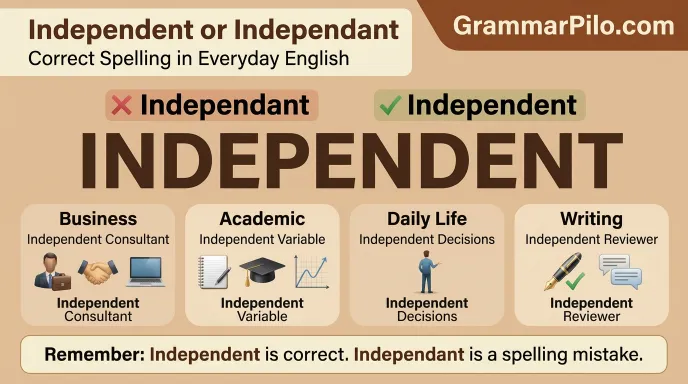
Seeing the correct spelling in different contexts makes it easier to remember. The following examples show how independent is used in everyday English.
In Emails
Correct: I have attached the report from the independent reviewer.
Correct: Please contact the independent contractor about the project.
In Business Writing
Correct: The company hired an independent consultant to review its operations.
Correct: We need an independent assessment before approving the plan.
In News Headlines
Correct: Independent Review Examines the New Policy
Correct: Local Independent Bookstore Celebrates Its Anniversary
In Blog Posts
Correct: Learning to manage your time can help you become more independent.
Correct: An independent business may have different needs from a large corporation.
On Social Media
Correct: Feeling proud of how independent I have become!
Correct: Independent travel taught me to plan ahead.
In Academic Writing
Correct: The study used an independent variable to examine the results.
Correct: Each group completed the task independently.
In Daily Conversation
Correct: My younger brother is becoming more independent.
Correct: She prefers to make independent decisions.
In Formal Writing
Correct: The committee requested an independent investigation.
Correct: The findings were reviewed by an independent expert.
In every example, independent is the correct form. Replacing it with independant would introduce a spelling error.
Google Trends and Modern Usage
The spelling difference between independent and independant is mainly a matter of standard spelling. Independent is the form used in established dictionaries, educational materials, and edited English writing.
Google Trends can help readers explore search interest for the two spellings over a selected period and region. However, search interest is not the same as proof of correct spelling. A misspelling may receive searches because people are checking it, correcting it, or trying to understand the difference.
For reliable writing, use dictionary entries and established spelling references rather than treating search frequency as a spelling rule. Cambridge and Oxford list independent as the standard form.
Practical takeaway: Search data can show what people look for, but standard dictionaries help establish which spelling to use.
Independent vs. Independant: Quick Comparison Table
| Feature | Independent | Independant |
| Spelling status | Correct | Misspelling |
| Standard dictionary form | Yes | No |
| Meaning | Free from control, influence, or support | No standard meaning as a spelling variant |
| American English | Accepted | Not standard |
| British English | Accepted | Not standard |
| Academic writing | Use this form | Avoid |
| Professional writing | Use this form | Avoid |
| Example | She is independent. | She is independant. |
Key Takeaways
- Independent is the correct spelling.
- Independant is a common misspelling.
- The correct word ends in ent, not ant.
- American and British English use the same spelling.
- Independent can describe people, countries, organizations, studies, and decisions.
- Independence is the related noun.
- Use independent in academic, business, formal, and everyday writing.
- Remember the spelling of dependent to help you spell independent correctly.
Frequently Asked Questions
1. Is independent or independant correct?
Independent is correct. Independant is a common misspelling and is not the standard form in English. Use independent when describing someone or something that is free from control, influence, or support.
2. How do you spell independent correctly?
Spell it i-n-d-e-p-e-n-d-e-n-t. The word ends in -ent, just like dependent. A useful way to remember it is to connect independent with dependent, since both share the same ending.
3. Is independant a real word?
Independant is not the standard spelling of the English word. It may appear in errors, informal text, or names, but it should not replace independent in ordinary writing.
4. Why do people spell independent as independant?
The two endings can sound similar in everyday speech. Some writers may choose ant because they recognize that ending in other English words. However, the accepted spelling is independent, with ent.
5. Is independent the same in American and British English?
Yes. American and British English both use independent. There is no standard regional spelling difference between these varieties.
6. What does independent mean?
Independent means free from another person’s control, influence, or support. For example, an independent person can make decisions without relying on others, while an independent organization operates separately from a larger body.
7. What is the difference between independent and independence?
Independent is generally an adjective that describes someone or something. Independence is a noun that refers to the state of being free from control or reliance.
Example: She is independent and values her independence.
8. What is the opposite of independent?
The common opposite of independent is dependent. Dependent describes someone or something that relies on another person or thing for support, control, or help.
Example: The child is still dependent on their parents.
9. Is independently spelled with ant or ent?
The correct spelling is independently, with ently at the end. It is the adverb form of independent.
Example: The students completed the assignment independently.
10. Can I use independent in formal writing?
Yes. Independent is appropriate in formal, academic, business, and everyday writing. It is commonly used to describe independent research, an independent review, an independent organization, or a person who can act without help.
Conclusion: Choose Independent Every Time
When comparing independent or independant, remember that only independent is the standard spelling. The word ends in ent, and this form is used in American, British, Canadian, Australian, and international English.
Independent describes a person who can make decisions without relying on others. It can also refer to a country, organization, study, or review that operates without outside control or influence. The related noun is independence, while independently is the adverb form.
Although independant may look reasonable because of its sound, it is not the accepted spelling. Use independent in essays, emails, reports, articles, and professional documents.
A simple way to remember it is to connect independent with dependent. Both words end in ent. Keep that spelling in mind, and you can avoid this common mistake with confidence.
For more clear explanations of confusing English words, explore other word comparisons on GrammarPilo.com.
Similar Words Explained
- Pylon or Pilon: The Spelling Difference Made Simple
- Dysfunction or Disfunction: Which Is the Standard Spelling?
- Sking or Skiing: Fix Your Spelling in 30 Seconds

I’m Claire Morgan, the author behind Grammarpilo.com, where I write about English grammar, sentence structure, punctuation, and everyday language. My goal is to make grammar simple, clear, and practical, helping readers understand the rules and apply them with confidence in real-world writing.