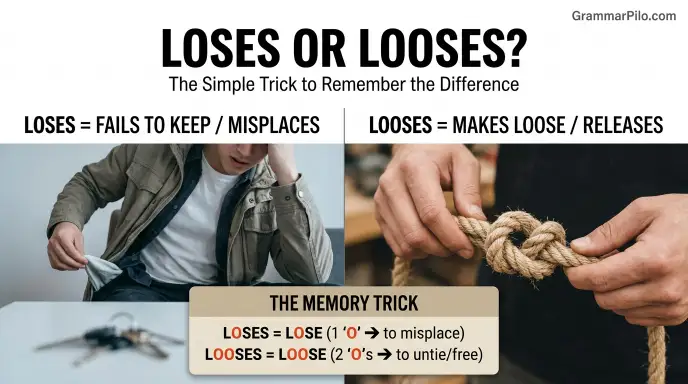
Loses is the correct spelling when you mean fails to keep, misplaces, or is defeated, while looses is a less common verb meaning releases or sets free.
The confusion between loses or looses is extremely common because the words look and sound similar, but they have different meanings and grammatical uses.
The most common word is loses, which is the third person singular form of lose. You use it when someone does not win, no longer has something, wastes something, or fails to maintain something. For example, “She loses her keys” and “The team loses the match.”
Looses, on the other hand, comes from the verb loose, meaning to release, free, or let something go. It is much less common in modern everyday English. For example, “The warrior looses an arrow” means that the warrior releases the arrow.
This distinction matters because lose and loose are already commonly confused. Adding the third person ending -s creates loses and looses, making the difference even easier to miss.
If you are writing an email, article, school assignment, business document, or social media post, loses will usually be the word you need.
Looses or Loses: Quick Answer
Loses and looses are both real words, but they have completely different meanings.
- Loses = fails to keep, misplaces, wastes, or is defeated.
- Looses = releases, frees, or lets loose.
Examples
She loses her phone frequently.
Here, loses means she no longer has or cannot find her phone.
The team loses the game.
Here, loses means the team is defeated.
The archer looses an arrow.
Here, looses means releases the arrow.
Quick Comparison
| Word | Meaning | Example |
| Loses | Fails to keep or is defeated | He loses the game. |
| Looses | Releases or sets free | She looses the arrow. |
| Lose | Base form of loses | I do not want to lose. |
| Loose | Not tight or securely fixed | My shirt is loose. |
The easiest rule
If you mean “not win,” “misplace,” or “no longer have,” use loses.
If you mean “release” or “set free,” use looses.
Definition and Meaning of Loses and Looses
What Does Loses Mean?
Loses is the third person singular present tense form of lose.
It can have several meanings.
1. To Be Defeated
Our team loses every time we play them.
Here, loses means does not win.
2. To Misplace Something
She often loses her keys.
This means she cannot find her keys.
3. To No Longer Have Something
He loses his job after the company closes.
Here, loses means he no longer has his job.
4. To Waste or Miss Something
The company loses valuable time because of delays.
5. To Reduce or Decrease
She loses weight through regular exercise.
In this context, loses means experiences a reduction.
What Does Looses Mean?
Looses is the third person singular present tense form of loose when loose is used as a verb.
As a verb, loose means to release, free, or let go.
For example:
The hunter looses an arrow.
This means the hunter releases the arrow.
Another example:
The prisoner escapes after someone looses the chains.
Here, looses means releases or frees.
However, this verb is relatively uncommon in modern everyday English.
Most people are much more likely to encounter loose as an adjective:
The screw is loose.
She wore a loose jacket.
The Origin of Looses and Loses
The words lose and loose have different histories even though their modern forms look similar.
Origin of Lose
Lose has roots in Old English and is related to the idea of being deprived of something, failing to retain something, or suffering defeat.
Over time, the word developed many meanings, including:
- fail to win
- misplace
- no longer possess
- waste
- fail to understand
- experience a reduction
The form loses is simply the third person singular present tense:
lose → loses
For example:
I lose my keys.
She loses her keys.
Origin of Loose
Loose has a different history and is associated with the idea of being free, unrestrained, or not tightly fixed.
As an adjective, it describes something that is not tight:
The rope is loose.
As a verb, loose means to release:
The soldier loosed the rope.
The form looses means:
He looses the rope.
Why Are They So Easily Confused?
The words are visually similar:
lose → loses
loose → looses
The extra o in looses can make the distinction difficult to remember.
A useful way to remember them is:
Lose = fail to keep or win.
Loose = not tight or release.
British English vs American English Spelling
There is no meaningful British versus American spelling difference between loses and looses.
Both British English and American English use the same forms.
| Word | American English | British English | Meaning |
| lose | Correct | Correct | Fail to keep or win |
| loses | Correct | Correct | Third person form of lose |
| loose | Correct | Correct | Not tight; release as a verb |
| looses | Correct but uncommon | Correct but uncommon | Third person form of loose as a verb |
American English
He loses his wallet frequently.
The dog looses itself from the chain.
The second construction is grammatical but uncommon.
British English
He loses his wallet frequently.
The archer looses an arrow.
Again, the spelling remains the same.
The important distinction is not geography. It is meaning.
Which Spelling Should You Use?
The right choice depends on what you want to say.
Use Loses for Losing Something
She loses her keys.
Use Loses for Defeat
Our team loses the final.
Use Loses for Reduction
He loses weight gradually.
Use Looses for Releasing Something
The archer looses an arrow.
Use Loose as an Adjective
The button is loose.
This is important because many people accidentally use looses when they actually mean loose.
For example:
Incorrect: The screw is looses.
Correct: The screw is loose.
Here, loose describes the screw. It is not a verb.
For Modern Professional Writing
In most everyday situations, loses is the form you will need.
Looses is grammatically valid but relatively rare. If you are writing about archery, historical literature, hunting, military action, or something being released, it may be appropriate.
Common Mistakes With Loses or Looses
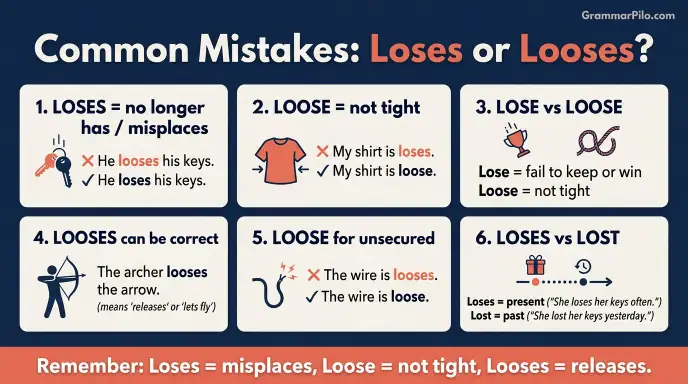
Mistake 1: Writing Looses When You Mean Loses
Incorrect: He looses his keys every day.
Correct: He loses his keys every day.
The person is misplacing the keys, so loses is correct.
Mistake 2: Writing Loses When You Mean Loose
Incorrect: My shirt is loses.
Correct: My shirt is loose.
Here, loose is an adjective meaning not tight.
Mistake 3: Confusing Loose With Lose
This is one of the most common spelling mistakes in English.
Lose means to no longer have something or fail to win.
Don’t lose your passport.
Loose means not tight.
The handle is loose.
Mistake 4: Assuming Looses Is Always Wrong
Looses is a legitimate word when loose functions as a verb.
The archer looses the arrow.
However, it is uncommon, so it should not replace loses in ordinary sentences.
Mistake 5: Using Looses for a Loose Object
If you want to describe something that is not securely attached, use loose, not looses.
Incorrect: The wire is looses.
Correct: The wire is loose.
Mistake 6: Confusing Loses With Lost
Loses is present tense.
She loses her keys often.
Lost is the past tense.
She lost her keys yesterday.
Loses or Looses in Everyday Examples
Emails
The company loses money every month because of the problem.
Please make sure the package does not come loose during shipping.
Notice that loose is used as an adjective in the second sentence.
Business Writing
The company loses customers when delivery times become too long.
The technician noticed that one of the cables was loose.
News Writing
The team loses its final match of the season.
A historical article might use looses:
The archer looses an arrow toward the target.
This is grammatically correct but has a more literary or historical feel.
Social Media
I always lose my keys!
Our team loses again!
These everyday examples use lose and loses, not loose or looses.
Formal Writing
The organization loses significant revenue because of inefficient processes.
The study examines why the company loses customers.
Sports Writing
The team loses its third consecutive game.
The defending champion loses the final.
In sports writing, loses is extremely common.
Loses vs. Looses: Google Trends & Usage Data
Searches for loses or looses are usually connected to one of two common English learning problems.
The first is confusion between lose and loose.
The second is deciding how to form the third person singular:
lose → loses
loose → looses
Searches may include:
- loses or looses
- lose or loose
- loses meaning
- looses meaning
- is looses a word
- lose vs loose
- loose or lose
- loses or loose
- how to spell loses
The word loses has much broader everyday usage because lose is an extremely common verb.
People use it when discussing:
- sports
- money
- possessions
- jobs
- relationships
- weight
- opportunities
- time
- games
- arguments
By contrast, looses is uncommon because the verb loose meaning “release” is itself relatively rare in ordinary modern conversation.
Usage Context Comparison
| Context | Most likely word |
| Losing a game | loses |
| Misplacing keys | loses |
| Losing money | loses |
| Losing weight | loses |
| Losing an opportunity | loses |
| Releasing an arrow | looses |
| Releasing something | looses |
| Something not tight | loose |
This makes loses the overwhelmingly more useful form for everyday writing.
Looses vs. Loses: Side by Side Comparison
| Feature | Loses | Looses |
| Base word | Lose | Loose |
| Part of speech | Verb | Verb |
| Meaning | Fails to keep, win, or retain | Releases or sets free |
| Common in everyday English | Yes | No |
| Used for sports | Yes | No |
| Used for misplaced objects | Yes | No |
| Used for weight reduction | Yes | No |
| Used for releasing an arrow | No | Yes |
| Frequency | Very common | Uncommon |
| Recommended for ordinary writing | Yes | Only when meaning release |
The Three Word Rule
A simple way to remember the difference is:
Lose = no longer have.
Loose = not tight.
Looses = releases.
For example:
She loses her keys.
Her shoelace is loose.
The archer looses an arrow.
FAQs About Loses or Looses
1. Is it loses or looses?
Both are real words, but they have different meanings. Loses means fails to keep, misplaces, or is defeated. Looses means releases or sets free.
2. Is looses a correct word?
Yes. Looses is a legitimate verb form of loose, meaning releases or frees. However, it is uncommon in modern everyday English.
3. Is it “he loses” or “he looses”?
Use he loses when you mean that he fails to keep something, misplaces something, or is defeated.
He loses his keys.
Use he looses only when you mean that he releases something.
He looses an arrow.
4. What is the difference between lose and loose?
Lose means to no longer have something, fail to win, or fail to retain something.
Loose means not tight or, as a verb, to release something.
5. What is the difference between loses and looses?
Loses comes from lose and is used for losing something or being defeated. Looses comes from loose and means releases something.
6. Is “loses” the correct spelling for losing a game?
Yes.
The team loses the game.
Never write looses when you mean that someone was defeated.
7. When should I use looses?
Use looses when loose is being used as a verb meaning “releases” or “sets free.”
The hunter looses the hounds.
It is a relatively uncommon construction.
Conclusion: Loses or Looses?
When choosing between loses or looses, the correct word depends on the meaning, but loses is the form you will need in most everyday situations.
Loses is the third person singular form of lose, and it means fails to keep something, misplaces something, is defeated, or experiences a reduction.
For example, a person loses their keys, a team loses a game, and a company loses money. These are all common uses of loses.
Looses is also a real word, but it has a much narrower meaning. It is the third person singular form of loose when loose is used as a verb meaning to release or set free.
You might see it in a sentence such as “The archer looses an arrow,” but this usage is much less common in modern everyday English.
Do not confuse looses with the adjective loose, which means not tight.
The easiest rule is simple: lose means fail to keep or win, loose means not tight, and looses means releases.
For emails, schoolwork, business writing, social media, and everyday communication, loses will usually be the correct choice.
See Related Guides
- Bearings or Barings: Stop Making This Common Spelling Mistake
- Hobby or Hobbie: Correct Spelling, Plural Form & Usage Explained
- Supplies or Supplys: The Right Spelling & Meaning Revealed

I’m Sloane Mercer, a U.S.-based English language writer focused on grammar, spelling, vocabulary, and everyday English usage. Through GrammarPilo, I provide clear and practical explanations to help readers choose the right words and communicate with confidence.






6 thoughts on “Loses or Looses: The Simple Trick to Remember the Difference”