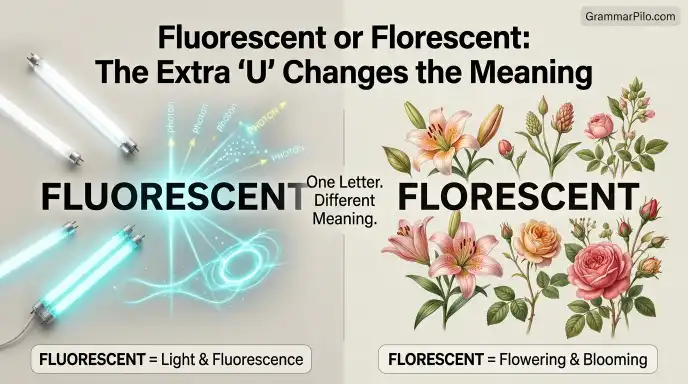
Fluorescent is the correct word when you mean something related to fluorescence, fluorescent lighting, or an extremely bright color, while florescent is a different word that means flowering or blooming.
The two words look almost identical, so it is easy to type “florescent light” when you actually mean “fluorescent light.”
The confusion comes from their similar spelling and pronunciation. Both words contain the familiar “ escent” ending, but they come from different word families.
Fluorescent is connected with fluorescence, a scientific term for light produced by certain substances after they absorb energy. Florescent, in contrast, is connected with Latin roots related to flowers and blooming.
This difference matters in everyday writing. You might describe a bright yellow safety vest as fluorescent, a tube light as fluorescent, or a marker as fluorescent. You would use florescent only when talking about something flowering or coming into bloom.
In this guide, you will learn the difference between fluorescent and florescent, their meanings, origins, spelling patterns, common mistakes, examples, and simple ways to remember which word fits your sentence.
Fluorescent or Florescent: Quick Answer
Correct for light and bright colors: Fluorescent
Correct for flowering or blooming: Florescent
Fluorescent meaning: Related to fluorescence, producing light through fluorescence, or extremely bright and vivid in appearance.
Florescent meaning: Flowering, blooming, or beginning to produce flowers.
So, if you are writing about fluorescent lights, use fluorescent with the extra “u.”
If you are describing a plant that is blooming, florescent can be the correct word.
The easiest distinction is:
Fluorescent: Light and vivid color
Florescent: Flowers and blooming
Definition and Meaning of Fluorescent or Florescent
What Does Fluorescent Mean?
Fluorescent is an adjective related to fluorescence. It can describe a substance that produces light through fluorescence or something that has an exceptionally bright, vivid appearance.
Cambridge defines fluorescent in relation to producing light through fluorescence and also uses it for very bright colors.
Common phrases with Fluorescent include:
Light: A type of electric light that produces bright illumination.
Bulb: A bulb that uses fluorescent technology.
Paint: Paint designed to appear extremely bright under suitable lighting.
Marker: A bright marker used to highlight text.
Color: A very bright or vivid color.
For example:
Correct: The office has fluorescent lighting.
Correct: She wore a fluorescent yellow jacket.
What Does Florescent Mean?
Florescent is also a real English word, but its meaning is completely different.
It means flowering, blooming, or beginning to produce flowers. Collins defines florescent as “flowering” or “bursting into flower.”
For example:
Correct: The garden looked florescent in early spring.
Correct: The florescent plants added color to the landscape.
This word is much less common in everyday English than fluorescent, which is one reason the two words can cause confusion.
Fluorescent and Florescent at a Glance
| Word | Meaning | Common Context |
| Fluorescent | Related to fluorescence or very bright | Lights, colors, dyes, markers |
| Florescent | Flowering or blooming | Plants, flowers, botanical writing |
The extra u is not just a spelling detail. It helps separate two different word families and meanings.
The Origin of Fluorescent and Florescent
Origin of Fluorescent
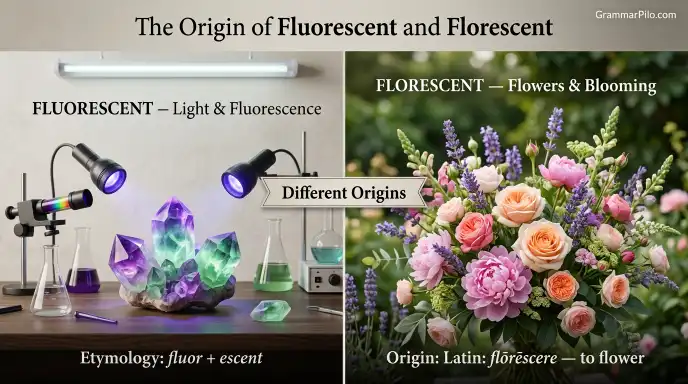
The word fluorescent dates from the nineteenth century. Etymonline records fluorescent from 1853 and connects it with fluor and the suffix escent. The related noun fluorescence was coined in 1852 by English mathematician and physicist Sir George G. Stokes.
Stokes used the term in connection with the glowing behavior he observed in fluor spar, now commonly called fluorite. The word therefore developed within the scientific vocabulary of light and materials.
The related word fluorescence refers to the production of light by a substance after it absorbs energy. Cambridge and Collins both describe the scientific process in terms of absorbed energy or radiation and emitted light.
This explains why the spelling contains fluor:
Fluor + escent = fluorescent
Remembering this connection can make the spelling easier.
Origin of Florescent
Florescent comes from a completely different Latin word family related to flowers and blooming.
American Heritage traces florescence to Latin flōrēscēns, from flōrēscere, meaning to flower or bloom.
That gives us a useful memory connection:
Florescent: flower related
Fluorescent: fluorescence and light related
The two words happen to look similar, but their histories are separate.
British English vs American English Spelling
There is no standard British vs. American spelling difference between fluorescent and florescent.
Both British and American English use:
Fluorescent
for words related to fluorescence, fluorescent lighting, and vivid fluorescent colors.
Collins lists fluorescent in both British and American English with the same spelling, although pronunciation differs slightly between varieties.
Comparison Table
| Variety | Correct for light | Correct for flowering |
| American English | fluorescent | florescent |
| British English | fluorescent | florescent |
| Canadian English | fluorescent | florescent |
| Australian English | fluorescent | florescent |
| International English | fluorescent | florescent |
The spelling does not change simply because you are writing for a US or UK audience.
For example:
American: The fluorescent lights are bright.
British: The fluorescent lights are bright.
The word stays the same.
Which Spelling Should You Use?
Your choice depends on the meaning of the sentence.
Use Fluorescent for Light
Use fluorescent when discussing fluorescent lighting, substances that show fluorescence, scientific applications, or objects with a very bright fluorescent appearance.
Example: The laboratory uses fluorescent lighting.
Example: The researchers examined the sample with a fluorescent microscope.
Use Fluorescent for Bright Colors
The word can also describe colors that are exceptionally bright or vivid.
Example: He bought a fluorescent green backpack.
Example: The warning sign has a fluorescent orange background.
Use Florescent for Flowering
Use florescent when you specifically mean flowering or blooming.
Example: The garden was florescent in the spring.
Example: The landscape became florescent after the rainy season.
Because florescent is relatively uncommon, writers often use simpler words such as flowering, blooming, or in bloom.
A Simple Rule
If it involves light, remember fluorescent.
If it involves flowers, remember florescent.
Common Mistakes with Fluorescent or Florescent
Mistake 1: Writing “Florescent Light”
A common error is removing the u from fluorescent.
Incorrect: The room has florescent lights.
Correct: The room has fluorescent lights.
The phrase fluorescent light refers to a type of electric light and uses the spelling with fluor. Cambridge and Collins both list fluorescent light as a standard term.
Mistake 2: Treating Florescent as a Misspelling Every Time
Florescent is not simply an invented spelling.
Florescent is a legitimate adjective meaning flowering or blooming.
The problem occurs when someone uses it in a sentence that needs fluorescent.
Mistake 3: Confusing Fluorescent With Fluorescence
These words are related, but they have different grammatical roles.
Fluorescence: The phenomenon or property.
Fluorescent: The adjective describing something related to that phenomenon.
Example: The material shows fluorescence.
Example: The material is fluorescent.
Mistake 4: Dropping the “U”
The spelling fluorescent contains the sequence fluor.
Correct: fluorescent
Incorrect: florescent when referring to light
A useful memory trick is to connect the word with fluorite and fluorescence.
Mistake 5: Confusing Fluorescent With Incandescent
These are different lighting technologies.
Fluorescent: Uses fluorescence to produce light.
Incandescent: Produces light from a heated filament.
So, a traditional filament bulb should not automatically be called a fluorescent bulb.
Fluorescent or Florescent in Everyday Examples
In Emails
Correct: The fluorescent lights in the conference room are not working.
Correct: Please replace the fluorescent bulbs in the hallway.
In News Writing
Correct: Workers were wearing fluorescent safety jackets near the construction site.
In Social Media
Correct: I bought a fluorescent green jacket for my evening run.
In Formal Writing
Correct: The laboratory uses fluorescent lighting for several procedures.
In Academic Writing
Correct: The researchers used a fluorescent marker to identify the cells.
In Workplace Communication
Correct: The fluorescent lights above the desks need to be replaced.
In Product Descriptions
Correct: This safety vest features a fluorescent orange fabric.
In Botanical Writing
Correct: The garden became florescent as the spring flowers began to bloom.
These examples show why fluorescent and florescent should not simply be treated as two alternative spellings. They can have different meanings.
Fluorescent vs. Florescent: Side by Side Comparison
| Feature | Fluorescent | Florescent |
| Standard word | Yes | Yes |
| Main meaning | Related to fluorescence | Flowering or blooming |
| Common with lights | Yes | No |
| Common with bright colors | Yes | No |
| Common with plants | No | Yes |
| Related noun | Fluorescence | Florescence |
| Root family | Fluor / fluor spar | Latin flower related root |
| British spelling | fluorescent | florescent |
| American spelling | fluorescent | florescent |
| Common in everyday English | Very common | Relatively uncommon |
Fluorescent or Florescent
The correct choice depends on your meaning, not simply on spelling preference.
Fluorescent and florescent are not interchangeable.
Fluorescent vs. florescent: Think light versus flowers.
Florescent vs. fluorescent: Think blooming versus fluorescence.
Fluorescent or Florescent: Google Trends & Usage Data
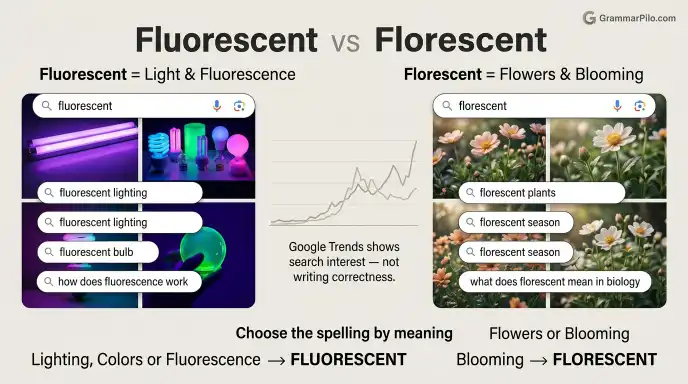
Google Trends can help show how often people search for fluorescent or florescent, but search interest should not be treated as a direct measurement of correct writing frequency.
When people search for fluorescent or florescent, they may be trying to check the spelling of a word used in phrases such as:
Fluorescent lighting
Fluorescent colors
Florescent plants
Florescent meaning
A search comparison can also reveal why confusion exists. The two spellings are visually similar, and the less common word florescent is still a legitimate English word. That means a searcher may encounter both forms and wonder if they are simply spelling variants.
For writing purposes, the meaning remains the better guide.
If your sentence is about lighting, vivid colors, markers, dyes, or fluorescence, use fluorescent.
If your sentence is about flowers blooming, florescent may fit.
This is also why spelling tools can sometimes create confusion. A real word such as florescent may not be flagged even when it is the wrong word for the intended meaning.
How to Remember Fluorescent vs. Florescent
A simple memory trick can make this distinction much easier.
Think “Fluor” for Light
Fluorescent → fluorescence → light
The word begins with fluor, connecting it with the scientific word family around fluorescence.
Think “Flor” for Flowers
Florescent → flower → blooming
Florescent comes from a Latin family connected with flowering.
The Fast Memory Test
Ask yourself what your sentence is describing.
Light or bright color: Fluorescent
Flowers or blooming: Florescent
For example:
Correct: fluorescent dye
Correct: florescent garden
This quick test can prevent many spelling and word choice mistakes.
Key Takeaways
- Fluorescent is the standard word for something related to fluorescence.
- Fluorescent is used for fluorescent lights, bulbs, dyes, markers, and vivid colors.
- Florescent is also a real English word.
- Florescent means flowering, blooming, or beginning to produce flowers.
- The two words come from different word families.
- British and American English use the same spelling for both words.
- Fluorescent or florescent is a meaning based choice, not simply a spelling variation.
- For light, remember fluorescent.
- For flowers, remember florescent.
Frequently Asked Questions
1. Is fluorescent or florescent correct?
Both are legitimate words, but they have different meanings. Fluorescent is correct for fluorescence, fluorescent lighting, and extremely bright colors, while florescent means flowering or blooming.
2. Is “florescent light” correct?
No, not when you mean a light related to fluorescence. The standard spelling is fluorescent light.
3. Is florescent a real word?
Yes. Florescent is a real adjective meaning flowering or blooming. It is much less common than fluorescent in everyday English.
4. What is the difference between fluorescent and florescent?
Fluorescent relates to fluorescence and light. Florescent relates to flowers and blooming.
5. Is fluorescent the same in British and American English?
Yes. The spelling fluorescent is used in both British and American English. Pronunciation can vary, but the spelling remains the same.
6. Why is fluorescent spelled with a “u”?
The spelling is connected to the word family around fluorescence, which was formed from fluor spar and the suffix escence.
7. How do you spell fluorescent correctly?
The correct spelling is:
F L U O R E S C E N T
A useful way to remember it is fluor + escent.
8. Can florescent describe a plant?
Yes. Florescent can describe something that is flowering or blooming.
Example: The florescent garden was filled with spring flowers.
9. Is fluorescent used for colors?
Yes. Fluorescent can describe colors that are exceptionally bright or vivid.
Example: She wore a fluorescent pink jacket.
Cambridge and Collins both give bright color uses for fluorescent.
10. Which should I use: fluorescent or florescent?
Use fluorescent for light, fluorescence, dyes, markers, and very bright colors. Use florescent when you mean flowering or blooming.
Conclusion
The difference between fluorescent or florescent becomes much easier once you connect each word with its meaning.
Fluorescent is the word you need for fluorescent lights, fluorescent lighting, bright fluorescent colors, scientific dyes, and anything related to fluorescence.
Florescent, on the other hand, is a legitimate but less common word that describes something flowering or blooming.
The extra u in fluorescent is important because it points to a completely different word family.
Fluorescence was named in the nineteenth century in connection with fluor spar, while florescent comes from a Latin family associated with flowers and blooming.
For everyday English, the most useful rule is simple: light means fluorescent, flowers mean florescent.
Once you remember that connection, phrases such as “fluorescent light” and “florescent flowers” become much easier to spell and use correctly.
So, when you are writing about lighting, safety clothing, bright markers, vivid colors, or scientific materials, choose fluorescent. When your sentence is about something coming into bloom, florescent may be the word you need.
Related Posts

I’m Sloane Mercer, a U.S.-based English language writer focused on grammar, spelling, vocabulary, and everyday English usage. Through GrammarPilo, I provide clear and practical explanations to help readers choose the right words and communicate with confidence.








2 thoughts on “Fluorescent or Florescent: The Extra “U” Changes the Meaning”