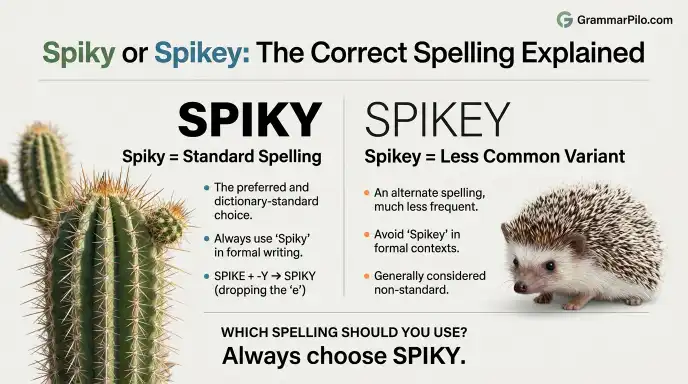
Spiky is the standard spelling, while spikey is a less common variant that appears in some dictionaries and usage contexts.
Both spiky and spikey are formed from the word spike, and both can describe something covered with spikes, having a sharp or pointed appearance, or behaving in a sharp or abrupt way.
The main spelling difference is the ending. Spiky uses y, while spikey uses ey. In modern standard English, spiky is the more common and widely preferred spelling, especially in general writing, edited content, and American English.
You may still encounter spikey in British English, dictionaries, informal writing, product descriptions, and names. This does not mean the spelling is always wrong. Instead, it is a less common variant of spiky.
If you are searching for spiky or spikey, the simple answer is: use spiky when you want the most widely recognized standard spelling.
Spiky or Spikey: Quick Answer
Standard and most common spelling: spiky
Less common variant: spikey
Example: The cactus has a spiky surface.
Also found: The cactus has a spikey surface.
For most standard writing, spiky is the safer choice. It is commonly used to describe hair, plants, objects, textures, and personalities.
The spelling spikey is also documented as a variant, so it should not automatically be treated as a meaningless spelling error. The main difference is usage frequency and preference.
Spiky or Spikey: Quick Comparison
| Version | Meaning | Correct? | Common Usage | Example |
| spiky | Having spikes or sharp points | Yes | Standard and common | The plant has spiky leaves. |
| spikey | Same basic meaning as spiky | Variant | Less common | The plant has a spikey appearance. |
The two spellings generally have the same meaning. Spiky is simply the more established and widely used form.
Definition and Meaning of Spiky or Spikey
What Does Spiky Mean?
Spiky is an adjective that describes something having spikes, sharp points, or a pointed appearance.
For example:
Example: The cactus has spiky leaves.
Here, spiky describes the sharp or pointed structure of the plant.
The word can also describe hair:
Example: He has short, spiky hair.
In this sentence, spiky describes hair that stands up in pointed sections.
Spiky Can Describe a Personality
The word can also have a figurative meaning.
Example: She can seem spiky when she first meets people.
Here, spiky does not describe physical spikes. It describes someone who seems sharp, unfriendly, defensive, or difficult to approach.
This figurative use is especially common in descriptions of people’s behavior or personalities.
What Does Spikey Mean?
Spikey generally has the same meaning as spiky.
It can describe something:
- Covered with spikes
- Having sharp points
- Looking pointed
- Having a prickly texture
- Having pointed hair
- Having a sharp or defensive personality
For example:
Example: The animal has a spikey coat.
However, spikey is less common than spiky, so spiky is usually the preferred spelling in general English.
The Origin of Spiky and Spikey
The Origin of Spike
Both forms come from the noun spike.
A spike is a pointed object or structure. The word has been used in English for many centuries.
The adjective spiky developed from spike by adding the adjective forming suffix y.
The basic formation is:
spike + y = spiky
The word spikey represents a spelling variant that keeps the e before the final y.
Why Is It Spiky Instead of Spikey?
English spelling often removes a final silent e before certain suffixes.
For example:
spike → spiky
The final e is removed before y.
Similar patterns occur in words such as:
noise → noisy
ice → icy
shine → shiny
This helps explain why spiky looks more natural as the standard form.
However, English has many spelling variants, and spikey has developed as an accepted less common form.
British English vs American English Spelling
There is not a major British versus American spelling distinction between spiky and spikey.
Both forms can be found in English language sources, but spiky is generally the more common form.
| English Variety | Preferred Form | Variant |
| American English | spiky | spikey |
| British English | spiky | spikey |
| Canadian English | spiky | spikey |
| Australian English | spiky | spikey |
| Formal writing | spiky | Less common |
| Informal writing | spiky | May appear |
The key point is that spikey is not simply the British spelling of spiky.
If you are writing for an international audience, spiky is the clearest choice.
Which Spelling Should You Use?
Use Spiky in American English
For American English writing, spiky is the best general choice.
Example: She styled her hair in a spiky look.
Example: The cactus has a spiky surface.
Use Spiky in British English
British English also uses spiky.
Example: The plant has very spiky leaves.
Example: He had short, spiky hair.
Although spikey can appear in British sources, it is not necessary to use it simply because your audience is British.
Use Spiky in Formal Writing
Choose spiky for:
- Academic writing
- Business writing
- School assignments
- Professional articles
- News writing
- Formal reports
When Can Spikey Be Used?
Spikey can appear in informal writing, regional usage, product names, usernames, titles, and other contexts where a variant spelling is intentionally used.
If a person’s name, brand, product, or official title uses Spikey, preserve that exact spelling.
Common Mistakes With Spiky or Spikey
Mistake 1: Assuming Spikey Is Always Wrong
Incorrect assumption: Spikey is never a real English spelling.
Better: Spikey is a less common variant of spiky.
The main standard choice is spiky, but spikey can be found in English usage.
Mistake 2: Assuming Spikey Is the British Spelling
Incorrect assumption: Americans write spiky, but British speakers write spikey.
Correct: Both British and American English commonly use spiky.
Spikey can occur in both varieties as a less common variant.
Mistake 3: Keeping the E Automatically
Some writers may think that because the noun is spike, the adjective must be spikey.
But standard English commonly forms the adjective as:
spike → spiky
The final e is removed.
Mistake 4: Confusing Spiky With Spiked
Spiky means having spikes or a pointed appearance.
Spiked usually means having been fitted with, containing, or formed into spikes.
Example: The cactus has spiky leaves.
Example: The fence is topped with spiked metal.
These words are related but do not always have the same grammatical function.
Mistake 5: Using Spikey When Spiky Is More Natural
Less common: She has spikey hair.
More common: She has spiky hair.
For general writing, spiky is usually the more natural choice.
Spiky or Spikey in Everyday Examples
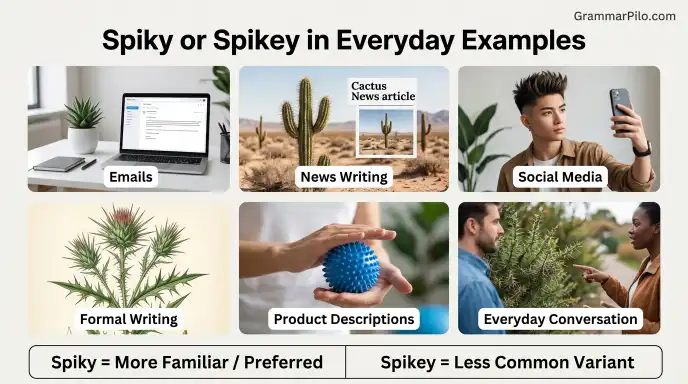
In Emails
Example: The plant in the office has very spiky leaves, so please be careful.
In News Writing
Example: The unusual cactus has a tall, spiky shape.
In Social Media
Example: I finally tried a spiky hairstyle!
In Formal Writing
Example: The species is characterized by spiky leaves and a thick stem.
In Product Descriptions
Example: This spiky massage ball is designed for textured pressure.
In Everyday Conversation
Example: That plant looks really spiky.
Using Spikey as a Variant
Example: The character has a spikey hairstyle.
This sentence can be understood, but spiky is generally the more familiar spelling.
Spiky and Spikey: Grammar and Word Formation
The word spiky is an adjective.
It describes a noun.
Example: a spiky plant
Example: a spiky texture
The word can also be used figuratively.
Example: a spiky personality
In this case, the adjective describes behavior rather than physical appearance.
The same general grammatical role applies to spikey when that variant spelling is used.
Spiky or Spikey: Why Are Both Forms Seen?
The difference comes from English spelling variation.
The base word is:
spike
When the adjective forming suffix y is added, the common spelling becomes:
spiky
The alternative spikey preserves the final e before adding y.
English contains many words where spelling conventions can produce variation. Some variants become much more common than others over time.
In this case, spiky has become the dominant general spelling, while spikey remains a less common variant.
This is why a search for spikey or spiky can produce examples of both forms.
Spiky vs. Spikey: Side by Side Examples
| Context | Preferred Example |
| Plant | The cactus has spiky leaves. |
| Hair | He has spiky hair. |
| Texture | The surface feels spiky. |
| Personality | He has a spiky personality. |
| Object | The ball has a spiky surface. |
| Informal variant | The character has a spikey hairstyle. |
In ordinary writing, the first form should normally be spiky.
Spiky or Spikey: Google Trends & Usage Data
Google Trends can be useful for comparing search interest for spiky or spikey, but search interest should not be confused with spelling correctness.
Google Trends displays relative search interest rather than a simple count of how many people use each word. Results can change depending on the country, time period, language, and search category selected.
For this spelling question, dictionary and corpus evidence are more useful than search popularity alone.
The main usage point is clear: spiky is the more common standard form, while spikey is a less common variant.
If you use Google Trends for this comparison, check:
- The same geographic region
- The same time period
- The same search category
- The exact search terms
- Related search variations
This avoids treating one isolated search result as proof of a spelling rule.
Key Takeaways
- Spiky is the standard and more common spelling.
- Spikey is a less common variant.
- Both forms generally have the same meaning.
- Spiky describes something with spikes, sharp points, or a pointed appearance.
- Spiky can also describe hair, behavior, or personality.
- The common word formation is spike → spiky.
- Spiky is used in both American and British English.
- Spikey should not automatically be called a random spelling error because it is documented as a variant.
- For formal and general writing, spiky is the safest choice.
Frequently Asked Questions
1. Is spiky or spikey correct?
Answer: Spiky is the standard and more common spelling. Spikey is also found as a less common variant. For school, professional, academic, and general writing, spiky is the preferred choice.
2. Is spikey a real word?
Answer: Yes. Spikey is found as a variant spelling of spiky. It can appear in dictionaries and real world usage, although it is much less common than spiky. Its presence does not make it the preferred spelling for standard writing.
3. What is the difference between spiky and spikey?
Answer: The main difference is spelling and frequency of use. Both words generally describe something that has spikes, sharp points, or a pointed appearance. Spiky is the more common standard form, while spikey is a less common variant.
4. Is spiky the British spelling?
Answer: Spiky is used in British English, but it is not exclusively British. American English also commonly uses spiky. Spikey can appear as a variant in English usage, so the difference is not a simple British versus American spelling rule.
5. Is spiky the American spelling?
Answer: Yes, spiky is the normal spelling used in American English. It is also common in British English and other varieties of English. American writers generally do not need to use spikey.
6. Why is it spelled spiky instead of spikey?
Answer: The common adjective is formed by adding y to spike, with the final silent e removed: spike → spiky. English commonly removes a final silent e before certain suffixes. This gives spiky its standard spelling.
7. Should I write spiky hair or spikey hair?
Answer: Use spiky hair in standard writing. Both expressions can be understood, but spiky is the more common spelling. For professional, academic, or general English, spiky hair is the better choice.
8. Can spiky describe a person?
Answer: Yes. Spiky can describe someone’s personality or behavior in a figurative way. For example, “She has a spiky personality” can suggest that she seems sharp, defensive, or difficult to approach. The word does not always describe physical spikes.
9. Is spikey a spelling mistake?
Answer: Not always. Spikey is a documented variant spelling, although it is much less common than spiky. If you are writing standard English, spiky is the preferred form. Spikey may also appear intentionally in names, brands, informal writing, or other specific contexts.
10. What should I remember about spiky or spikey?
Answer: Remember the common spelling spiky. The base word is spike, and the standard adjective is formed as spike → spiky. Spikey exists as a less common variant, but spiky is the clearest choice for normal English writing.
Conclusion
Spiky is the standard and more widely used spelling, while spikey is a less common variant. Both forms can describe something with spikes, sharp points, or a pointed appearance. They can also describe hair, textures, objects, and even a person’s personality.
The spelling spiky follows the common English pattern of dropping the final silent e from spike before adding y. This gives us spike → spiky.
The form spikey can still be found in real English usage, so it is not useful to assume that every appearance of it is simply an accidental typo. However, if your goal is clear, standard English, spiky is the form to choose.
So when comparing spiky or spikey, spikey or spiky, spiky vs. spikey, or spikey vs. spiky, remember one simple rule: use spiky for standard English writing, and recognize spikey as a less common variant.
Check This Out

I’m Claire Morgan, the author behind Grammarpilo.com, where I write about English grammar, sentence structure, punctuation, and everyday language. My goal is to make grammar simple, clear, and practical, helping readers understand the rules and apply them with confidence in real-world writing.







4 thoughts on “Spiky or Spikey: The Correct Spelling Explained”