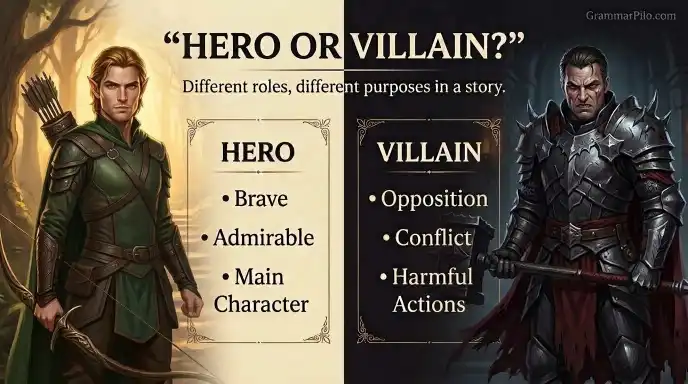
A hero is usually the main character or a character admired for bravery or good qualities, while a villain is a character who harms others or creates conflict in a story. These two words are often discussed together because stories commonly use heroes and villains to create opposing goals, challenges, and conflicts.
The terms can describe fictional characters, but they can also describe real people in everyday English. Someone who performs a brave act may be called a hero, while someone who causes serious harm may be described as a villain.
In literature, movies, television, comics, and games, the words often describe character roles rather than simple personality types.
This can make hero or villain confusing because a character does not always fit neatly into one category. Some protagonists have serious flaws, and some antagonists may have understandable motives.
A story can also include antiheroes, morally complex characters, or characters who change sides.Understanding hero and villain starts with their basic roles, meanings, origins, and use in everyday English.
Hero or Villain: Quick Answer
Hero: A main character or admired person who is usually associated with courage, good qualities, or actions that help others.
Villain: A person or fictional character who harms others, acts against the main character, or creates major conflict in a story.
In a simple story structure:
Hero: Faces a challenge and works toward a goal.
Villain: Creates opposition, danger, or conflict.
Cambridge defines a hero as a person admired for bravery or great achievement and also as the main character in a book or movie who is usually good. A villain can be a harmful person or a character in a book, play, or movie who harms others.
The key point is that hero or villain refers to different character roles, not two alternative spellings of the same word.
Definition and Meaning of Hero or Villain
What Does Hero Mean?
A hero is someone admired for bravery, achievement, or good qualities. In storytelling, the hero is often the main character whose experiences form the central part of the story.
For example:
Example: The hero saves the village from danger.
Example: She became a hero after helping the injured passengers.
The word can also describe someone who is greatly admired.
Example: My grandfather has always been my hero.
In literature and movies, the hero does not need to be perfect. A main character can make mistakes, face personal weaknesses, or struggle with difficult choices while still functioning as the story’s hero.
What Does Villain Mean?
A villain is a person who harms others or behaves in a seriously harmful way. In fiction, a villain is a character whose actions create conflict or work against other characters, often including the protagonist.
For example:
Example: The villain tries to take control of the kingdom.
Example: The detective spends the story trying to stop the villain.
A villain does not always appear as a simple character who is evil for no reason. Modern stories can give villains personal goals, beliefs, fears, or motives that explain their actions.
Hero and Villain as Story Roles
The words hero and villain are often used together because they describe contrasting roles.
Hero: Usually connected to the central character or admirable actions.
Villain: Usually connected to opposition, harm, or conflict.
However, these roles can become more complicated in modern storytelling. A hero can have flaws, and a villain can have qualities that make the character understandable or interesting.
The Origin of Hero and Villain
The Origin of Hero
The word hero entered English through Old French heroe, from Latin heros, which came from Greek hērōs, meaning a hero or demigod. Etymonline records the English word from the late 14th century.
The word originally had strong connections with legendary figures, warriors, and people of exceptional courage. Its English meaning expanded over time.
The sense of a person who demonstrates great bravery appeared in English in the 1660s. The meaning of the main male character in a play or story is recorded from the 1690s.
Today, hero can describe both real people and fictional characters.
The Origin of Villain
The history of villain is especially interesting because its original meaning was very different from its modern storytelling meaning.
Etymonline traces villain to Anglo French and Old French vilain, from Medieval Latin villanus, meaning a farm worker, with the Latin word villa referring to a country house or farm.
Over time, the word developed negative social meanings. By the mid 16th century, it had developed the sense of a scoundrel or person capable of serious wrongdoing. The storytelling sense of a character whose harmful motives or actions help drive a plot is recorded from 1822.
So, the modern meanings of hero and villain developed over centuries rather than appearing all at once.
British English vs American English Spelling
There is no standard British and American spelling difference between hero and villain.
Both varieties use:
American English: hero, villain
British English: hero, villain
The words are spelled the same in both forms of English.
Their pronunciations can vary slightly by accent, but the written forms remain the same.
Comparison Table
| Word | American English | British English | Meaning |
| Hero | hero | hero | Brave or admired person; main character |
| Villain | villain | villain | Harmful person; opposing story character |
The plural of hero is heroes, while the plural of villain is villains.
Singular: hero
Plural: heroes
Singular: villain
Plural: villains
Which Word Should You Use?
Use hero when you are describing a person who is admired for bravery, achievement, or positive actions, or the central character in a story who fills that role.
Use villain when you are describing a harmful person or a fictional character whose actions create serious opposition or conflict.
Hero for an Admired Person
Example: The firefighter became a local hero.
Use Hero for a Main Character
Example: The hero must find a way to protect the kingdom.
Use Villain for a Harmful Person
Example: The story presents him as a dangerous villain.
Use Villain for an Opposing Character
Example: The villain creates a major obstacle for the hero.
Remember the Basic Difference
Hero: The character we usually follow or admire.
Villain: The character who usually creates major opposition or harm.
This is a useful starting point, but stories can intentionally challenge these traditional roles.
Common Mistakes with Hero or Villain
Mistake 1: Assuming Every Main Character Is a Hero
A main character is not automatically a hero.
A protagonist can be morally complicated, selfish, flawed, or even harmful.
Incorrect assumption: The main character must always be the hero.
Better understanding: A protagonist is the central character, while a hero is a character associated with heroic or admirable qualities.
Mistake 2: Assuming Every Opposing Character Is a Villain
An opposing character is not automatically a villain.
A character may disagree with the protagonist without being cruel or harmful.
Example: Two characters can have different goals without one being a villain.
Mistake 3: Confusing Hero With Heroine
Hero: Traditionally refers to a male hero or, more broadly, a heroic main character.
Heroine: Traditionally refers to a female hero or main female character.
Modern English often uses hero more broadly for people of any gender.
Mistake 4: Thinking Heroes Must Be Perfect
Heroes can make mistakes.
A character can be brave while also being impatient, fearful, stubborn, or uncertain.
Many modern stories use these flaws to make characters more realistic.
Mistake 5: Assuming Villains Have No Motivation
A villain can have a detailed motivation.
The character may believe the goal is justified even when the actions cause harm to others.
This creates more complex storytelling than simply labeling a character “bad.”
Hero or Villain in Everyday Examples
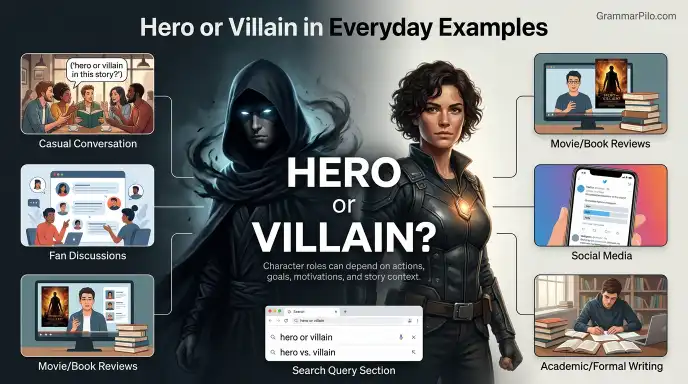
In Casual Conversation
Example: Who would you choose as the hero or villain in this story?
In Fan Discussions
Example: Fans often debate if the character is a hero or villain.
In Movie Reviews
Example: The movie presents its hero and villain with very different goals.
In Book Reviews
Example: The novel gradually reveals why the villain acts against the hero.
In Social Media
Example: Is this character a hero or villain in your opinion?
In Academic Writing
Example: The novel uses the hero and villain as opposing character roles.
In Formal Writing
Example: The story contrasts the hero’s goals with the villain’s actions.
In Search Queries
People may search:
Hero or villain
Villain or hero
Hero and villain
Villain and hero
Hero vs. villain
Villain vs. hero
These searches can refer to character identity, personality, morality, story roles, relationships, motivations, or specific events in a movie, book, game, or television series.
Hero vs. Villain: Side by Side Comparison
| Feature | Hero | Villain |
| Basic role | Admirable or central character | Harmful or opposing character |
| Typical goal | Protect, solve, rescue, achieve | Control, harm, obstruct, or pursue a conflicting goal |
| Story position | Often protagonist | Often antagonist |
| Character traits | Courage, determination, helpfulness | Harmful actions, opposition, manipulation |
| Can be flawed? | Yes | Yes |
| Can change? | Yes | Yes |
| Always morally perfect? | No | No |
| Used in fiction? | Yes | Yes |
| Used for real people? | Yes | Yes |
A hero and villain can have completely different goals, but their roles can also change during a story.
Hero or Villain: Google Trends & Usage Data
Google Trends can show relative search interest for hero or villain, but search interest should not be treated as a direct measurement of how often people use either word correctly.
Searches may come from many different contexts. People might search hero or villain when discussing a movie, book, comic, video game, television series, or a specific fictional character.
Common search variations include:
Hero or villain
Villain or hero
Hero and villain
Villain and hero
Hero vs. villain
Villain vs. hero
The phrase can also appear in searches about character analysis, storytelling, personality, morality, and plot structure.
Because search interest changes over time and can be influenced by newly released movies, shows, games, books, and viral discussions, Google Trends should be viewed as a measure of search behavior rather than a dictionary of correct usage.
For language learners, the definitions remain more useful:
Hero: An admired or heroic person, or a central heroic character.
Villain: A harmful person or an opposing fictional character.
Hero and Villain in Storytelling
The Hero’s Role
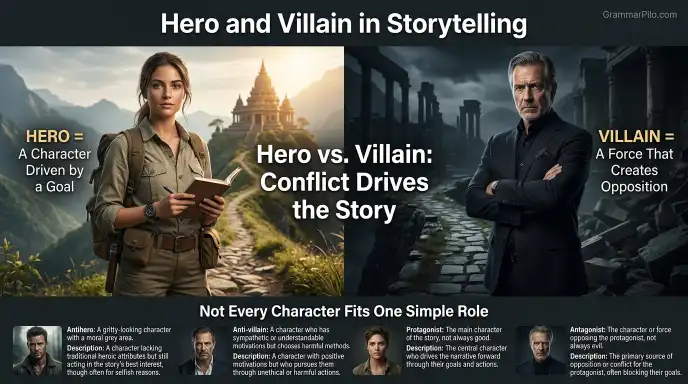
The hero often has a goal that drives the story forward.
The character may need to solve a problem, protect someone, overcome an obstacle, discover something important, or change during the story.
The hero can also begin as an ordinary person and develop through challenges.
The Villain’s Role
The villain often creates an obstacle for the hero.
The villain may have a competing goal that makes it difficult for the hero to succeed. This conflict can provide the central tension of the story.
A villain can also reveal important qualities of the hero because difficult opposition forces the hero to make choices.
MasterClass describes the villain as a force that antagonizes the hero and creates crisis, while also noting that villains can have believable motivations and moral complexity.
Hero and Villain Are Not Always Simple Opposites
A story does not need to divide every character into two perfect groups.
Some stories include:
Antihero: A central character who lacks some traditional heroic qualities.
Anti villain: An opposing character whose motives or qualities may be more sympathetic than those of a traditional villain.
Protagonist: The central character in a story.
Antagonist: A character or force that opposes the protagonist.
These terms can overlap, but they describe different aspects of storytelling.
Key Takeaways
- Hero describes an admired person or a heroic main character.
- Villain describes a harmful person or an opposing fictional character.
- Hero and villain are different words with different meanings.
- Both words have the same standard spelling in British and American English.
- A hero does not have to be perfect.
- A villain can have complex motivations.
- A protagonist is not automatically a hero.
- An antagonist is not automatically a villain.
- Hero or villain is commonly used when discussing fictional character roles.
- Hero vs. villain often refers to the conflict between opposing character goals.
Frequently Asked Questions
1. What is the difference between a hero and a villain?
A hero is generally an admired or heroic character, often the central character in a story. A villain is generally a harmful or opposing character who creates conflict.
2. Is the hero always the main character?
Not always, but a hero is often the main character in traditional stories. A protagonist is the central character, while the term hero also carries a sense of admirable or heroic qualities.
3. Is the villain always the antagonist?
No. A villain is typically an opposing or harmful character, while an antagonist is the character or force that opposes the protagonist. The two roles often overlap, but they are not identical.
4. Can a hero become a villain?
Yes. Some stories intentionally show characters changing roles because of new choices, circumstances, or conflicts.
5. Can a villain become a hero?
Yes. A character can change sides or take actions that place the character in a heroic role later in the story.
6. Is hero or villain the correct phrase?
Yes. Hero or villain is a natural phrase when discussing two possible character roles or asking how a character should be understood.
7. What is the difference between hero and heroine?
Traditionally, hero refers to a male heroic character and heroine to a female heroic character. Modern usage also commonly uses hero more broadly for a heroic person of any gender.
8. What is the plural of hero?
The plural is heroes.
Singular: hero
Plural: heroes
9. What is the plural of villain?
The plural is villains.
Singular: villain
Plural: villains
10. Can a story have more than one hero or villain?
Yes. A story can contain several heroes, villains, supporting characters, and opposing forces.
Conclusion
The difference between hero or villain becomes clearer when you focus on the role each word describes. A hero is generally an admired person or a central character associated with courage, good qualities, or heroic actions.
A villain is generally a harmful person or a fictional character whose actions create opposition and conflict. Cambridge gives these core meanings for both words, while storytelling sources also recognize that fictional characters can be more complex than simple good versus bad roles.
The history of the two words is also different. Hero entered English through Old French, Latin, and Greek, while villain developed from Old French and Medieval Latin terms connected to farm workers before taking on its modern negative meaning.
In everyday writing, use hero for an admired or heroic person and villain for a harmful or opposing character.
Remember that a protagonist is not always a hero and an antagonist is not always a villain. Modern stories often use complex characters who can challenge these traditional roles.
Compare More Words

I’m Claire Morgan, the author behind Grammarpilo.com, where I write about English grammar, sentence structure, punctuation, and everyday language. My goal is to make grammar simple, clear, and practical, helping readers understand the rules and apply them with confidence in real-world writing.



1 thought on “Hero or Villain: Understanding the Roles That Drive a Story”