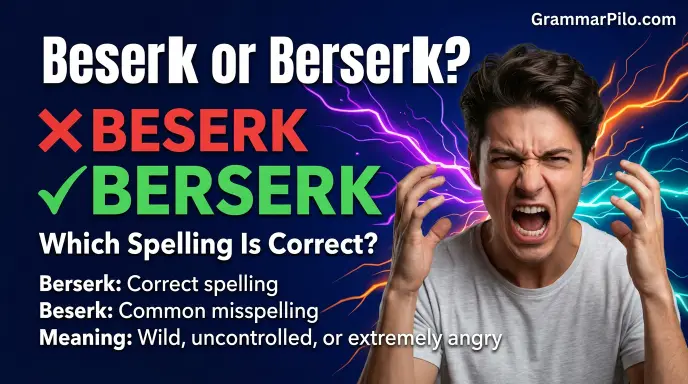
Berserk is the correct spelling in standard English, while beserk is a common misspelling. If you are writing about someone losing control, becoming extremely angry, or acting wildly, use berserk with an r after the first “be.”
The confusion is understandable because the word is often spoken quickly, and its pronunciation can make the middle letters less clear.
People may hear or remember it as “beserk,” then use that spelling in messages, schoolwork, or online searches. However, standard dictionaries recognize berserk, not beserk, as the correct form.
You may see the word in phrases such as “go berserk,” “run berserk,” or “the crowd went berserk.”
It can describe intense anger, excitement, or uncontrolled behavior. It is also used in informal writing to describe something that is behaving unpredictably, such as a computer or a machine.
This guide explains the difference between beserk and berserk, shows how to use the correct spelling, and provides practical examples to help you avoid this common mistake.
Beserk or Berserk: Quick Answer
Berserk is the correct spelling. Beserk is a misspelling and should generally be avoided in standard writing.
Use berserk when describing someone or something acting in an uncontrolled, wild, or extremely excited way.
Correct: The fans went berserk when their team scored.
Incorrect: The fans went beserk when their team scored.
The key difference is the letter r after “be.” The correct spelling is b-e-r-s-e-r-k.
Definition and Meaning of Berserk
Berserk is an adjective that describes someone who has lost control and is behaving in a wild, violent, or highly excited way. It can also describe something that seems to be operating wildly or unpredictably.
What Does Berserk Mean?
When a person goes berserk, they may become extremely angry, excited, or difficult to control.
Examples:
- The customer went berserk after receiving the wrong order.
- The children went berserk when the school bell rang.
- The crowd went berserk after the final goal.
- My laptop went berserk and opened several windows at once.
The word does not always describe anger. It can also express extreme excitement or enthusiasm.
Is Berserk Positive or Negative?
The meaning depends on the situation.
In a negative context, berserk may describe anger, aggression, or loss of control.
Example: The man went berserk and started shouting.
In a more playful context, it can describe excitement or enthusiastic behavior.
Example: The audience went berserk when the singer appeared.
The word is informal in many everyday situations, so a more neutral expression may be better in formal writing.
Is Berserk a Verb?
Berserk is mainly used as an adjective, not as a standard verb.
The common expression is go berserk. In this phrase, “go” is the verb and “berserk” describes the resulting state.
Example: The crowd went berserk.
Here, “went” is the past-tense verb, and “berserk” is an adjective.
The Origin and History of Berserk
The word berserk comes from Old Norse, an early North Germanic language. It is connected to the Old Norse word berserkr, which referred to a warrior associated with fierce or uncontrolled fighting.
The historical word is often explained through two elements: ber, meaning “bear,” and serkr, meaning “shirt” or “coat.” This has led to the interpretation “bear shirt,” possibly referring to warriors who wore bear skins.
The exact historical explanation has been discussed by scholars, so it is best to treat this as a traditional interpretation rather than a certain fact.
The word entered English through historical and literary use. Over time, its meaning broadened. Today, berserk is commonly used to describe someone acting wildly or losing control, even when no fighting is involved.
Why Do People Spell It Beserk?
The spelling beserk may occur because people remember the sound of the word but leave out the first “r” in the middle.
English spelling can be difficult because pronunciation does not always make every letter obvious. In this case, remembering the word’s spelling as ber-serk can help.
Memory tip: Think of ber + serk. The first part contains an r, so the correct spelling is berserk.
British English vs American English Spelling
There is no standard British American spelling difference between berserk and beserk.
Both American and British English use berserk. The spelling does not change based on the country, and beserk remains a misspelling in standard English.
| Form | American English | British English | Status |
| Berserk | Correct | Correct | Standard spelling |
| Beserk | Incorrect | Incorrect | Common misspelling |
Does Berserk Have Different Spellings in Other English Varieties?
No. The standard spelling is berserk in American, British, Canadian, Australian, and other major varieties of English.
Some words have regional spelling differences, such as “color” and “colour.” Berserk is not one of them.
Examples:
- American English: The crowd went berserk.
- British English: The crowd went berserk.
- Australian English: The fans went berserk.
The spelling stays the same across these examples.
Which Spelling Should You Use?
Use berserk in all standard English writing, regardless of your audience or location.
For American Readers
Choose berserk in school assignments, workplace communication, articles, and everyday writing.
Example: The dog went berserk when it heard the fireworks.
For British and Commonwealth Readers
The spelling is also berserk in British English and other Commonwealth varieties.
Example: The supporters went berserk after the match.
For International Readers
If you are writing for an international audience, use berserk. It is the recognized standard spelling across English varieties.
For Formal Writing
Although berserk is a valid English word, it can sound informal or dramatic. In formal or professional writing, consider alternatives such as:
- lost control
- became extremely agitated
- reacted violently
- behaved unpredictably
- became extremely excited
Example:
Informal: The machine went berserk.
More formal: The machine began operating unpredictably.
Choose the alternative that best matches the meaning and tone of your sentence.
Common Mistakes with Beserk or Berserk
Mistake 1: Leaving Out the First R
A common error is writing beserk instead of berserk.
Incorrect: The crowd went beserk after the announcement.
Correct: The crowd went berserk after the announcement.
Remember that the correct spelling has an r after the first “be.”
Mistake 2: Assuming Beserk Is a British Spelling
Some writers may think beserk is a British spelling and berserk is American.
That is not correct. Both British and American English use berserk.
Correct in both varieties: The fans went berserk.
Mistake 3: Using Berserk as a Verb
Berserk is not normally used as a verb by itself.
Incorrect: The children berserk when the music started.
Correct: The children went berserk when the music started.
Use a verb such as “go,” “went,” or “become” before the adjective.
Mistake 4: Using Berserk When You Only Mean Angry
Berserk usually suggests more than ordinary anger. It describes an intense or uncontrolled reaction.
Less precise: I was berserk because I missed the bus.
More natural: I was furious because I missed the bus.
Use berserk when the behavior or reaction is unusually wild, uncontrolled, or extreme.
Mistake 5: Confusing Berserk With a Simple Spelling Variant
Unlike words that have accepted regional spellings, beserk is not a standard alternative.
Correct: The computer went berserk.
Incorrect: The computer went beserk.
Berserk in Everyday Examples
Seeing berserk in different situations can make its meaning and spelling easier to remember.

In Emails
Example: The office printer went berserk this morning, so I could not print the reports.
This use describes a machine behaving unpredictably.
In News Writing
Example: The crowd went berserk after the team secured its place in the final.
Here, berserk describes an intense public reaction.
In Social Media
Example: My cat went berserk when I brought home a new toy.
This is a casual way to describe excited or energetic behavior.
In Formal Writing
Example: The system began operating unpredictably after the software update.
In formal writing, “operating unpredictably” may be more precise than “went berserk.”
In Everyday Conversation
Example: My little brother went berserk when he saw the birthday cake.
The sentence describes a very excited reaction.
In Entertainment and Pop Culture
Example: The character went berserk during the final scene.
The word can describe a character who loses control or acts with extreme intensity.
Beserk vs Berserk – Side-by-Side Comparison
The difference between beserk and berserk is spelling, not meaning. Only berserk is the standard form.
| Point | Beserk | Berserk |
| Spelling | Missing the first “r” | Includes the first “r” |
| Standard English | No | Yes |
| Dictionary form | Misspelling | Correct spelling |
| Meaning | No standard meaning | Wild, uncontrolled, or extremely excited |
| American English | Incorrect | Correct |
| British English | Incorrect | Correct |
| Example | The crowd went beserk. | The crowd went berserk. |
Beserk or Berserk: Which One Is Correct?
Berserk is correct. The word has two “r” letters: one after “be” and another after “se.”
A simple way to remember it is to break the word into two parts: ber + serk.
Google Trends and Usage Data for Berserk
People search for beserk or berserk because the two spellings look and sound similar. The missing “r” can make the incorrect form seem plausible, especially when someone is writing quickly or relying on memory.
Search interest can also come from different uses of the word. Some people look up its spelling and meaning, while others encounter it in books, entertainment, gaming, or everyday conversation.
Google Trends can help compare search interest for beserk and berserk over a selected time period and region. However, Trends data represents relative search interest, not the total number of searches or proof that a spelling is correct.
For spelling decisions, standard dictionaries and established writing references are more useful than search popularity. Even if people search for beserk, that does not make it an accepted spelling.
Practical takeaway: Use berserk in your writing, and treat beserk as a spelling mistake.
Frequently Asked Questions
1. Is it beserk or berserk?
Berserk is the correct spelling. Beserk is a common misspelling because it leaves out the first “r.”
2. Is beserk ever correct?
No. Beserk is not the standard spelling in modern English. Use berserk in formal, academic, professional, and everyday writing.
3. Is berserk British or American?
Berserk is used in both British and American English. There is no regional spelling difference between these varieties.
4. What does going berserk mean?
Going berserk means losing control or behaving in a wild, extremely angry, or highly excited way.
Example: The children went berserk when the concert began.
5. Is berserk a bad word?
No. Berserk is not a swear word or profanity. It is a standard English adjective, although it can sound dramatic or informal in some contexts.
6. How do you remember the spelling of berserk?
Remember that berserk begins with ber, not be. The correct spelling contains two “r” letters: b-e-r-s-e-r-k.
7. Can I say “I went berserk”?
Yes. I went berserk is a grammatically correct expression. It means you lost control or became extremely excited or angry.
Example: I went berserk when I realized I had lost my keys.
Conclusion: Remember the R in Berserk
When choosing between beserk or berserk, always use berserk. It is the standard spelling in American, British, and international English. The spelling beserk is a common error caused by leaving out the first “r.”
The word berserk describes someone or something acting wildly, losing control, or showing extreme excitement.
It often appears in the phrase “go berserk,” as in “The crowd went berserk after the goal.” It can also describe machines or systems that behave unpredictably.
For formal writing, consider alternatives such as “lost control,” “became agitated,” or “operated unpredictably” when they express your meaning more precisely. For everyday conversation, berserk is natural and widely understood.
The easiest way to remember the correct form is to think of ber + serk. Keep the first “r,” and you will spell the word correctly.
Must-Read Guide

I’m Sloane Mercer, a U.S.-based English language writer focused on grammar, spelling, vocabulary, and everyday English usage. Through GrammarPilo, I provide clear and practical explanations to help readers choose the right words and communicate with confidence.