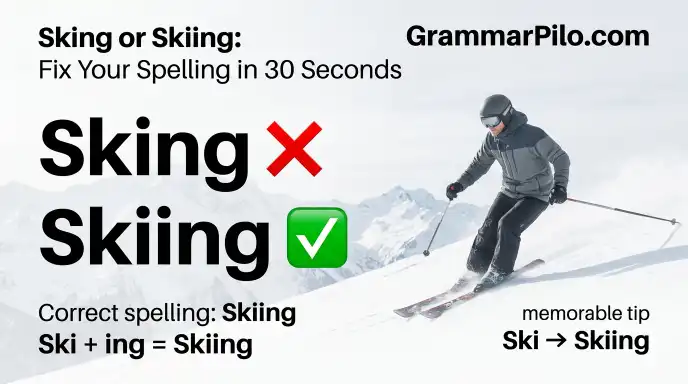
Skiing is the correct spelling, while sking is an incorrect spelling in standard English. The word skiing comes from the verb ski and means the activity or sport of moving over snow on skis.
The spelling can be confusing because English often drops a final silent e before adding -ing, as in make → making and write → writing. However, ski does not end with a silent e, so its spelling stays ski when -ing is added.
The correct form is therefore ski + ing = skiing.
If you search for sking or skiing, you may see sking because people sometimes leave out the second i when typing quickly or assume that the word should follow another familiar spelling pattern.
In standard English, however, dictionaries list skiing, not sking. Cambridge Dictionary defines skiing as the activity or sport of moving on skis and gives the pronunciation /ˈskiː.ɪŋ/.
This article explains the difference between sking and skiing, the spelling rule behind the extra i, common mistakes, British and American usage, everyday examples, and an easy way to remember the correct form.
Sking or Skiing: Quick Answer
Correct spelling: skiing
Incorrect spelling: sking
Example: I enjoy skiing in the mountains.
Incorrect: I enjoy sking in the mountains.
The word skiing is formed by adding -ing to the verb ski:
ski + ing = skiing
The important point is that ski already ends with the letter i. Adding -ing gives us another i, producing skiing.
Cambridge Dictionary lists skiing as a noun meaning the activity or sport of moving on skis. It also gives skiing as the present participle of ski.
Sking or Skiing: Quick Comparison
| Version | Meaning | Correct? | Region | Example |
| skiing | The activity or sport of moving on skis | Yes | British, American, and international English | We went skiing last winter. |
| sking | Intended as a form of skiing | No | Not a standard regional spelling | I enjoy skiing. |
The difference is simply the spelling. Skiing is the standard form used in English dictionaries and standard writing. Sking is a spelling error.
Definition and Meaning of Skiing
What Does Skiing Mean?
Skiing is the activity or sport of traveling over snow while wearing skis.
For example:
Example: We are going skiing this weekend.
Example: Skiing is popular in mountainous regions.
Cambridge defines skiing as the activity or sport of moving on skis.
What Does Ski Mean?
Ski can be both a noun and a verb.
As a noun, a ski is one of a pair of long, narrow pieces of material attached to boots for moving over snow.
As a verb, ski means to move over snow using skis.
Example: He likes to ski.
Example: She skis every winter.
Cambridge lists ski as both a noun and a verb.
Ski, Skied, and Skiing
The verb ski has several common forms:
| Verb Form | Example |
| Base form | ski |
| Third-person singular | skis |
| Present participle | skiing |
| Past tense | skied |
| Past participle | skied |
For example:
Present: I ski every winter.
Present participle: I am skiing today.
Past: I skied last weekend.
Past participle: I have skied in several countries.
Cambridge gives skiing as the present participle and skied as the past tense and past participle.
The Origin of Skiing
The word ski has Scandinavian roots and entered English from Norwegian. Its history is connected with the Scandinavian tradition of traveling over snow using skis.
The modern English word ski is therefore different from many native English verbs in its spelling and structure. Because ski already ends in i, adding -ing produces the sequence ii:
ski + ing = skiing
This spelling may look unusual, but it is completely standard.
The word skiing is not formed by changing ski to sk before adding -ing. That is why sking is not the standard spelling.
The modern dictionary form confirms this pattern. Cambridge lists skiing as the present participle of ski.
Why Is Skiing Spelled With Two I’s?
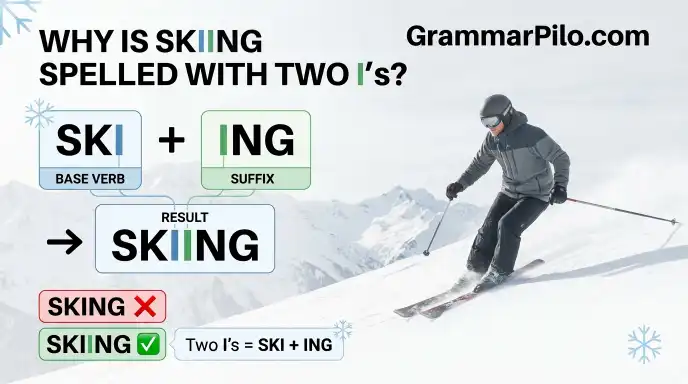
The two i’s in skiing come from the two parts of the word:
ski + ing
The first i belongs to the original word ski.
The second i belongs to the ending -ing.
Put them together:
ski + ing → skiing
This is why removing one i creates the incorrect form sking.
A useful way to remember it is:
ski + ing = skiing
Think of the word as two visible parts rather than trying to memorize the whole spelling.
British English vs American English Spelling
There is no British-American spelling difference between skiing and sking.
Both British English and American English use:
skiing
The incorrect form sking is not a standard alternative spelling in either variety.
| English Variety | Correct Form | Incorrect Form |
| American English | skiing | sking |
| British English | skiing | sking |
| Canadian English | skiing | sking |
| Australian English | skiing | sking |
| International English | skiing | sking |
Cambridge provides both UK and US dictionary entries for skiing, with the same spelling and pronunciation.
So you should not treat sking as an American or British variant. It is simply a misspelling.
Which Spelling Should You Use?
Use skiing in all standard English situations.
Use Skiing in Academic Writing
Correct: The study examines the physical benefits of skiing.
Incorrect: The study examines the physical benefits of sking.
Academic writing should use the standard spelling skiing.
Use Skiing in Professional Writing
Correct: Our company is organizing a skiing trip for employees.
Incorrect: Our company is organizing a sking trip for employees.
Use skiing in emails, reports, business documents, and workplace communication.
Use Skiing in Everyday Writing
Correct: I love skiing.
Correct: We are going skiing next month.
These are all standard examples.
Use Skiing in Online Content
Websites, blogs, social media posts, travel guides, and online articles should also use skiing.
Example: The resort offers excellent skiing conditions during the winter.
Common Mistakes With Sking or Skiing
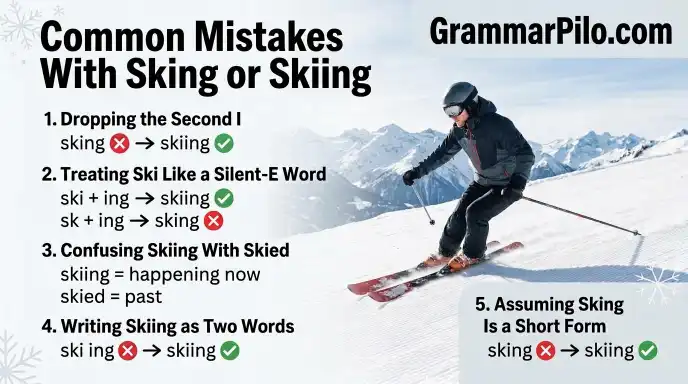
Mistake 1: Dropping the Second I
Incorrect: I went sking last year.
Correct: I went skiing last year.
The word is formed from ski + ing, so both i’s remain.
Mistake 2: Treating Ski Like a Silent-E Word
Some people may apply a spelling rule used with words such as make.
For example:
make + ing = making
The final e is removed.
But ski does not end in a silent e.
Therefore:
ski + ing = skiing
Not:
sk + ing = sking
Mistake 3: Confusing Skiing With Skied
The forms skiing and skied are both correct, but they are used in different grammatical situations.
Correct: We are skiing today.
Correct: We skied yesterday.
Cambridge confirms skied as the past tense and past participle of ski.
Mistake 4: Writing Skiing as Ski Ing
The word skiing is normally written as one word.
Correct: skiing
Incorrect: ski ing
The -ing ending is attached directly to the verb.
Mistake 5: Assuming Sking Is a Short Form
Sking is not a standard shortened version of skiing.
In standard writing, always use skiing.
Skiing in Everyday Examples
In Emails
Correct: I will be away next week because I am going skiing.
In News Writing
Correct: Heavy snowfall created excellent conditions for skiing.
In Social Media
Correct: We are going skiing this weekend!
In Travel Writing
Correct: The region is famous for skiing and winter sports.
In Academic Writing
Correct: Skiing requires balance, coordination, and controlled movement.
In Conversation
Correct: Do you enjoy skiing?
Correct: I have never tried skiing.
In Formal Writing
Correct: The resort provides facilities for skiing, snowboarding, and other winter activities.
Sking or Skiing: Easy Spelling Rule
The easiest rule is:
Remember: ski + ing = skiing
The original verb is:
ski
Add:
-ing
Result:
skiing
The extra i is not an accidental letter. It comes from the -ing ending.
Compare these forms:
| Base Word | + ing | Correct Form |
| ski | ski + ing | skiing |
| see | see + ing | seeing |
| agree | agree + ing | agreeing |
| flee | flee + ing | fleeing |
| free | free + ing | freeing |
The spelling pattern can look unusual, but keeping the letters from both parts helps you remember the correct form.
Sking vs. Skiing: Grammar and Word Formation
The word skiing can function as a noun or as a present participle.
Skiing as a Noun
Example: Skiing is an exciting winter sport.
Here, skiing refers to the activity itself.
Cambridge classifies skiing as a noun meaning the activity or sport of moving on skis.
Skiing as a Present Participle
Example: They are skiing down the mountain.
Here, skiing is part of the verb phrase are skiing.
Skiing After “Go”
English commonly uses go + -ing to talk about recreational activities.
Example: We went skiing.
Example: They are going skiing tomorrow.
This is why skiing frequently appears after go and going.
Sking or Skiing: Google Trends & Usage Data
People may search for both sking or skiing because spelling questions often arise when a word contains an unusual letter pattern.
However, search interest does not determine the correct spelling. Google Trends shows relative search interest, not grammatical correctness.
For this word, dictionary evidence provides a clear answer. Cambridge lists skiing as the standard noun and as the present participle of ski. It does not list sking as the standard spelling.
The important distinction is:
Search query: sking or skiing
Standard word: skiing
Spelling error: sking
So if you see people searching for sking, that does not mean sking is an accepted alternative spelling.
Sking and Skiing Side-by-Side
| Feature | Skiing | Sking |
| Standard English | Yes | No |
| Spelling | Correct | Incorrect |
| Meaning | Activity or sport involving skis | Intended spelling of skiing |
| Base word | ski | ski |
| Formation | ski + ing | Incorrectly shortened |
| British English | Correct | Incorrect |
| American English | Correct | Incorrect |
| Formal writing | Use | Avoid |
| Academic writing | Use | Avoid |
| Professional writing | Use | Avoid |
Key Takeaways
- Skiing is the correct spelling.
- Sking is an incorrect spelling in standard English.
- Skiing means the activity or sport of moving on skis.
- The word comes from ski + ing.
- The first i belongs to ski.
- The second i comes from -ing.
- British and American English both use skiing.
- Skied is the correct past tense and past participle of ski.
- Use skiing in formal, academic, professional, and everyday writing.
- A simple memory trick is ski + ing = skiing.
Frequently Asked Questions About Sking or Skiing
1. Is sking or skiing correct?
Answer: Skiing is correct. Sking is an incorrect spelling in standard English. The word is formed by adding -ing to ski, producing skiing. Cambridge Dictionary lists skiing as both a noun for the winter sport and the present participle of the verb ski.
2. Why does skiing have two i’s?
Answer: Skiing has two i’s because it is formed by combining ski and -ing. The first i is part of the original word ski, while the second i belongs to the ending -ing. Therefore, ski + ing = skiing. Removing one i creates the incorrect spelling sking.
3. Is sking a word?
Answer: Sking is not the standard spelling of the word. People may type or write it when they accidentally leave out the second i in skiing, but standard English uses skiing. For formal writing, schoolwork, professional communication, and published content, use skiing.
4. Is skiing the same in British and American English?
Answer: Yes. Both British English and American English use skiing. There is no standard spelling difference between the two varieties. Cambridge’s UK and US dictionary entries both give skiing as the standard form.
5. What is the past tense of ski?
Answer: The past tense of ski is skied. For example, “We skied down the mountain yesterday.” Skied is also the past participle, as in “They have skied in several countries.” Cambridge lists skied as the past simple and past participle of ski.
6. What is the difference between ski and skiing?
Answer: Ski can be a noun referring to the equipment or a verb meaning to move over snow using skis. Skiing refers to the activity or sport and is also the present participle of the verb ski. For example, “I ski every winter” uses the verb, while “I enjoy skiing” uses the activity noun.
7. How do you remember the spelling of skiing?
Answer: Break the word into two parts: ski + ing. The base word already contains an i, and the -ing ending adds another i. This gives skiing. Remembering ski + ing = skiing is easier than trying to remember the spelling as one long word.
8. Can I write sking in informal messages?
Answer: You may see sking in quick messages or online posts as a spelling mistake, but it is not the standard spelling. If you want your writing to follow standard English, use skiing even in informal communication. The correct form is the same in casual and formal English.
9. Is skiing a noun or a verb?
Answer: Skiing can have different grammatical roles. It is a noun when it refers to the activity, as in “Skiing is popular.” It is also the present participle of ski, as in “They are skiing.” Cambridge lists skiing as a noun and gives it as the present participle of ski.
10. What is the easiest way to choose between sking and skiing?
Answer: Always choose skiing in standard English. Remember the word formation: ski + ing = skiing. The two i’s come from the base word and the ending. If you see sking, treat it as a misspelling and change it to skiing.
Conclusion
Skiing is the correct spelling, and sking is an incorrect spelling in standard English. The confusion usually comes from the unusual appearance of two consecutive i’s. However, the spelling becomes easy to understand when you break the word into its parts: ski + ing = skiing.
The first i belongs to the base verb ski, while the second i is part of the -ing ending. This gives us skiing, the standard word for the activity or sport of moving over snow on skis. Cambridge Dictionary confirms skiing as the standard noun and as the present participle of ski.
There is no British or American spelling difference here. Both varieties use skiing, and sking is not a standard alternative.
So, if you are choosing between sking or skiing, the answer is simple: use skiing.
Remember the formula:
ski + ing = skiing
You Might Like
- Spiky or Spikey: The Correct Spelling Explained
- Customer or Costumer: Which Spelling Is Correct?
- Tried or Tryed: Which Spelling Is Correct?

I’m Sloane Mercer, a U.S.-based English language writer focused on grammar, spelling, vocabulary, and everyday English usage. Through GrammarPilo, I provide clear and practical explanations to help readers choose the right words and communicate with confidence.






2 thoughts on “Sking or Skiing: Fix Your Spelling in 30 Seconds”