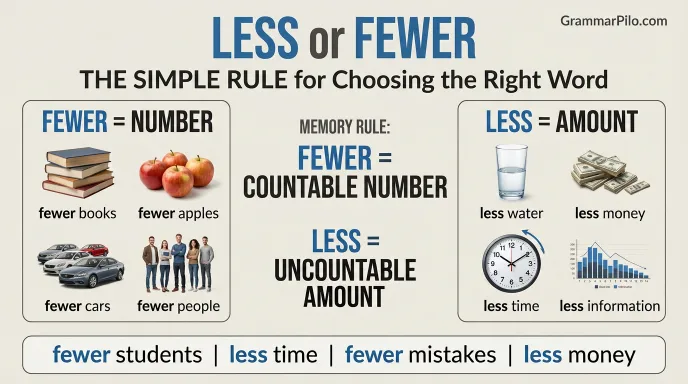
Less and fewer are both correct words, but the main difference is simple: use fewer with plural countable nouns and less with uncountable nouns.
This small grammar rule causes a lot of confusion because both words describe a smaller quantity or amount. For example, you can have fewer books, but you have less time. You can have fewer students, but less information.
The confusion becomes stronger because people often hear phrases such as “less people,” “less cars,” or “less items” in everyday speech.
These forms are common in modern English, but traditional grammar guidance generally recommends fewer people, fewer cars, and fewer items because these nouns can be counted individually.
The good news is that the difference between fewer or less becomes much easier once you understand countable and uncountable nouns.
This guide explains less and fewer, fewer and less, and the common question of less vs. fewer with clear rules, examples, common mistakes, and practical usage tips.
Less or Fewer: Quick Answer
Use fewer with plural countable nouns and less with uncountable nouns.
| Use | Example |
| Fewer + plural countable noun | fewer books |
| Fewer + plural countable noun | fewer students |
| Fewer + plural countable noun | fewer cars |
| Less + uncountable noun | less water |
| Less + uncountable noun | less time |
| Less + uncountable noun | less money |
A useful memory rule is:
Fewer = number. Less = amount.
If you can count the individual things, fewer is usually the traditional choice.
Example: I have fewer emails today.
If the noun describes something that is measured as a general amount, less is usually the right choice.
Example: I have less work today.
Cambridge Dictionary and Oxford Learner’s Dictionaries both explain the basic distinction in terms of countable and uncountable nouns.
Definition and Meaning of Less and Fewer
What Does Less Mean?
Less is a comparative word used to describe a smaller amount, quantity, degree, or extent.
It commonly appears with uncountable nouns.
Examples include:
- less water
- less money
- less time
- less information
- less traffic
- less work
- less noise
- less patience
- less food
Example: We need less water for this recipe.
Water cannot normally be counted as individual waters in this meaning. It is treated as an amount.
Less can also be used without a noun when the meaning is already clear.
Example: I used to drink more coffee, but now I drink less.
Here, “less” means less coffee.
What Does Fewer Mean?
Fewer is the comparative form associated with few. It is normally used with plural countable nouns.
Examples include:
- fewer books
- fewer people
- fewer cars
- fewer mistakes
- fewer questions
- fewer emails
- fewer problems
- fewer students
- fewer accidents
Example: This year, fewer students joined the club.
Students can be counted individually, so fewer students is the traditional standard form.
Fewer vs. Less in Simple Terms
The easiest distinction is:
Less = a smaller amount.
Fewer = a smaller number.
Compare:
She has less money than I do.
She has fewer dollars than I do.
Money is normally treated as uncountable, while dollars can be counted.
The Origin and History of fewer and Less
The difference between less or fewer has deep roots in the history of English.
The Origin of Less
Less comes from Old English forms such as læs and læssa, meaning “less,” “smaller,” or “fewer.” The word can be traced through Proto Germanic and an older Indo European root associated with the idea of being small.
Over time, less developed into the modern comparative word used for smaller amounts or degrees.
The word is closely connected with older forms such as least, although modern English uses these words in different grammatical roles.
The Origin of Fewer
Fewer comes from the word few, which traces back to Old English feawe, meaning “not many” or “a small number.”
The history of few goes back through Proto Germanic to an older Indo European root associated with the idea of “few” or “little.”
The relationship is easy to remember:
few → fewer → fewest
For example:
few books → fewer books → the fewest books
Likewise:
little → less → least
For example:
little time → less time → the least time
The historical development helps explain why fewer is associated with things that can be counted, while less is associated with amounts and degrees.
British English vs American English Spelling
There is no spelling difference between British and American English for less or fewer.
Both varieties use:
- less
- fewer
The main difference is not spelling. It is usage and style.
Traditional grammar guidance in both British and American English generally follows the same basic rule:
Fewer is used with plural countable nouns.
Less is used with uncountable nouns.
Examples:
| British English | American English |
| fewer cars | fewer cars |
| fewer people | fewer people |
| fewer mistakes | fewer mistakes |
| less money | less money |
| less time | less time |
| less information | less information |
However, less is frequently heard before plural countable nouns in everyday English, especially in informal speech.
For example:
There were less people at the event.
Many speakers use this naturally. Traditional edited English generally prefers:
There were fewer people at the event.
Oxford Learner’s Dictionaries notes that people often use less with countable nouns, while some speakers and editors still prefer fewer in these cases.
This means the distinction is useful, but actual modern usage is not completely rigid.
Which Spelling Should You Use?
For standard writing, the safest rule is simple:
Use fewer for plural countable nouns and less for uncountable nouns.
Choose fewer in sentences such as:
- We received fewer applications this year.
- There are fewer students in the class.
- She made fewer mistakes this time.
- The new road has fewer traffic accidents.
- I bought fewer books than last month.
Choose less in sentences such as:
- I have less time today.
- We need less information.
- She drinks less coffee now.
- The machine produces less noise.
- He spent less money than expected.
When Less Is Used With Numbers and Measurements
There is an important exception that often causes confusion.
We commonly use less with expressions involving measurements, time, money, distance, weight, and age.
Examples:
The trip took less than two hours.
The store is less than five miles away.
The product costs less than $20.
The child is less than six years old.
Here, the phrase is treated as a measurement or amount rather than a group of separate countable objects.
One Less
Another common expression is one less.
We need one less chair.
That is one less problem to solve.
Even though chairs and problems are countable nouns, one less is a standard and very common construction.
Common Mistakes With Less or Fewer
Mistake 1: Using Less With Every Plural Noun
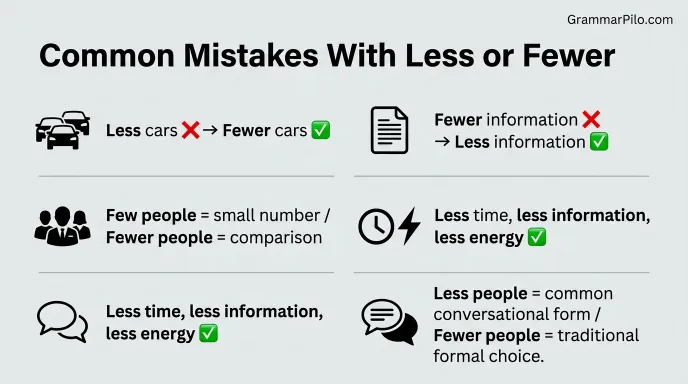
A common mistake is using less before every plural countable noun.
Incorrect in traditional standard usage: There are less cars on the road.
Better: There are fewer cars on the road.
Cars can be counted, so fewer is the traditional choice.
Mistake 2: Using Fewer With Uncountable Nouns
The opposite mistake is using fewer with an uncountable noun.
Incorrect: I need fewer information.
Correct: I need less information.
Information is normally uncountable in English.
Other examples include:
less advice
less furniture
Mistake 3: Confusing Less With Few
Few and fewer are related, but they do different jobs.
Few describes a small number.
Fewer compares one number with another.
Compare:
Few people attended the meeting.
Fewer people attended the meeting this year than last year.
Mistake 4: Thinking Less Is Always Informal
Less is not an informal replacement for fewer in every situation.
It is the correct word with many uncountable nouns.
Correct:
We have less time.
She needs less information.
The machine uses less energy.
The issue is not that less is informal. The issue is choosing it with the right type of noun.
Mistake 5: Treating “Less People” and “Fewer People” as Identical in Formal Writing
You may hear less people frequently in everyday English. Modern speakers often use it.
However, in formal writing, academic work, edited content, and situations where you want to follow the traditional countability rule, fewer people is the safer choice.
Formal choice: Fewer people attended the conference.
Common conversational form: Less people attended the conference.
Less and Fewer in Everyday Examples
In Emails
Example: We have fewer appointments available this week.
Example: I have less time for meetings today.
In News Writing
Example: Fewer residents reported problems after the changes.
Example: The city recorded less traffic during the holiday.
In Social Media
Example: I am trying to spend less money this month.
Example: I made fewer mistakes on my second attempt.
In Formal Writing
Example: The revised process resulted in fewer errors.
Example: The project required less funding than expected.
In Academic Writing
Example: The study included fewer participants than the previous trial.
Example: The revised method required less equipment.
In Everyday Conversation
Example: I have less work today.
Example: There are fewer people here tonight.
Less and Fewer: Special Cases
The basic rule is useful, but English has several constructions that deserve extra attention.
Less Than
Less than is very common with measurements.
Examples:
- less than five minutes
- less than ten dollars
- less than two miles
- less than three years
- less than 50 pounds
Example: The store is less than two miles from my house.
Fewer Than
Fewer than is used when the following noun is a plural countable noun.
Examples:
- fewer than ten people
- fewer than five mistakes
- fewer than 20 students
- fewer than 100 applications
Example: Fewer than ten people attended the meeting.
Less of
Use less of before certain noun phrases, pronouns, and determiners.
For example:
- We need less of this material.
- I want less of the sauce.
- She sees less of them now.
Fewer of
Use fewer of with plural countable groups.
Example: Fewer of the students completed the assignment.
Example: Fewer of them arrived on time.
The structure is:
less of + singular or uncountable reference
fewer of + plural countable reference
Less vs. Fewer Comparison Table
| Feature | Less | Fewer |
| Main idea | Smaller amount | Smaller number |
| Typical noun | Uncountable noun | Plural countable noun |
| Example | less water | fewer bottles |
| Example | less time | fewer hours |
| Example | less money | fewer dollars |
| Example | less information | fewer facts |
| Comparative form | Related to little | Related to few |
| Common phrase | less than two hours | fewer than ten people |
| Can appear without a noun? | Yes | Yes |
| British spelling | less | fewer |
| American spelling | less | fewer |
Less or Fewer: Google Trends & Usage Data
Search interest can help explain why people search for less or fewer, but search frequency does not decide the grammar rule.
Google Trends can be used to compare search interest for phrases such as less or fewer, fewer or less, and related grammar questions. However, search interest can change because of school assignments, grammar lessons, social media discussions, or individual writing questions.
For broader historical written usage, corpus resources can also help show how language patterns have changed over time. These resources are useful for studying usage, but they should not be treated as a simple vote for one grammatical form.
Modern dictionary guidance remains clear about the basic distinction:
Less is normally used with uncountable nouns.
Fewer is normally used with plural countable nouns.
At the same time, modern English contains many examples of less before plural countable nouns, especially in informal speech. Cambridge Dictionary notes this usage and explains that some speakers still consider it incorrect or unsuitable in formal contexts.
This is why you may see both less people and fewer people in real world English.
For careful standard writing, the traditional distinction remains useful:
fewer people
less time
fewer cars
less money
fewer mistakes
less information
The goal is not to treat every real world variation as a spelling error. It is to understand the standard pattern and recognize how actual English is used.
A Simple Memory Trick for Less and Fewer
Think of fewer as a word connected to figures.
If you can count the things, think fewer.
fewer books
fewer students
Think of less as a word connected to an amount.
If you measure it rather than count individual units, think less.
less water
less time
A quick question can help:
“Can I count these as separate things?”
If the answer is yes, fewer is usually the traditional choice.
If the answer is no, less is usually the right choice.
Key Takeaways
- Less normally goes with uncountable nouns.
- Fewer normally goes with plural countable nouns.
- Less = smaller amount.
- Fewer = smaller number.
- Use fewer people, fewer cars, and fewer mistakes in careful standard writing.
- Use less time, less money, and less information.
- Less than is common with measurements such as time, distance, money, and age.
- Fewer than normally introduces a plural countable noun.
- Less people occurs in everyday English, but fewer people remains the traditional standard choice.
- British and American English use the same spellings, less and fewer.
Frequently Asked Questions
1. Is it less or fewer people?
Fewer people is the traditional standard form because people are countable.
Example:
Fewer people attended the event this year.
Less people is also heard frequently in everyday English, but fewer is the safer choice for formal writing.
2. Is it less or fewer time?
Less time is correct.
Time is normally treated as an uncountable noun when referring to an amount or duration.
Example: I need less time to finish the task.
3. Is it less or fewer money?
Less money is correct.
Money is normally uncountable.
Example: We spent less money this month.
4. Is it fewer or less mistakes?
Fewer mistakes is the traditional standard form.
Mistakes can be counted individually.
Example: She made fewer mistakes on her second test.
5. Is it less or fewer than ten?
Both forms can be correct depending on the noun that follows or the meaning of the measurement.
Use fewer than ten people because people are countable.
Use less than ten minutes because time is treated as a measurement.
6. Is “10 items or less” grammatically correct?
10 items or fewer follows the traditional countability rule because items can be counted.
However, 10 items or less is very common in real world English, especially on signs and checkout lanes. The choice between the two can depend on the style being followed.
7. Can less be used with plural nouns?
Yes, less is frequently used with plural countable nouns in modern English, especially in informal speech.
For traditional standard writing, fewer is generally preferred with plural countable nouns.
Example: fewer books
Example: fewer people
8. What is the easiest way to remember Fewer vs. less?
Remember:
Fewer = number.
Less = amount.
Think fewer books but less water.
Conclusion
Less and fewer are both correct words, but they normally work with different types of nouns. Use fewer with plural countable nouns when you are talking about a smaller number. Use less with uncountable nouns when you are talking about a smaller amount.
For example, say fewer students, fewer cars, and fewer mistakes, but say less time, less money, and less information.
The distinction becomes less clear in everyday English because many speakers use less before plural countable nouns, especially in informal situations.
You may hear phrases such as “less people” or “less items,” but fewer people and fewer items remain the traditional choices for careful standard writing.
It is also important to remember that less works naturally with measurements such as time, distance, money, weight, and age. That is why we say less than two hours, less than five miles, and less than $20.
Once you connect fewer with number and less with amount, choosing between the two becomes much easier.
Explore Here!
- And vs Or: The Simple Rule for Choosing Between Them
- Right or Wright: The Simple Difference Between These Two Words
- Her’s or Hers: Why “Hers” Is the Correct Possessive Form

I’m Claire Morgan, the author behind Grammarpilo.com, where I write about English grammar, sentence structure, punctuation, and everyday language. My goal is to make grammar simple, clear, and practical, helping readers understand the rules and apply them with confidence in real-world writing.






3 thoughts on “Less or Fewer: The Simple Rule for Choosing the Right Word”