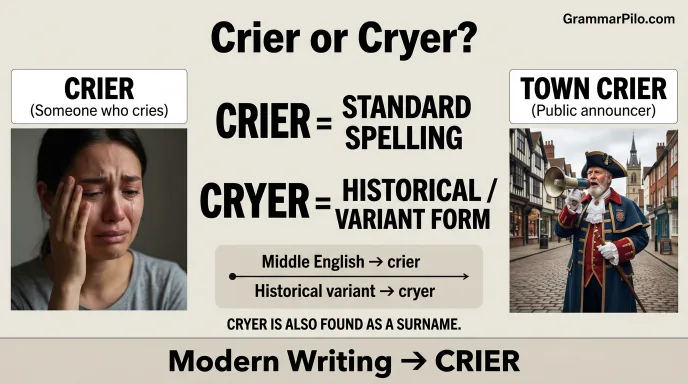
Crier is the standard spelling in modern English, while cryer is a much less common historical or variant form.
Use crier when you mean someone who cries, especially someone who cries easily or often. The same spelling is used in the familiar expression town crier, referring to a person who publicly announces news or proclamations.
Cambridge Dictionary defines crier as someone who cries and also recognizes the traditional town crier meaning.
Cryer does appear in English, but it is not normally the spelling to choose for an ordinary modern sentence. Historical sources document cryer as an older or alternative form of crier, and the spelling also survives in established surnames.
The confusion is easy to understand because both words sound the same or almost the same. The spelling cryer also looks like a straightforward combination of cry + er.
For standard modern writing, the simple rule is:
Crier = normal modern spelling
Cryer = uncommon variant, historical form, or proper name
Definition and Meaning of Cryer and Crier
What Does Crier Mean?
Crier is a noun with two established meanings.
First, it can describe a person who cries, especially someone who cries easily or frequently.
She is a crier during emotional movies.
The baby has always been a frequent crier.
Cambridge Dictionary lists this meaning directly.
Second, crier can refer to someone who publicly calls out news, announcements, or official information.
The most familiar example is:
town crier
Historically, a town crier announced public information aloud, often in a town square or other public place. The word also had legal and official uses for people who proclaimed court orders or public notices. Etymonline dates the noun crier to the late 13th century and records the town crier sense from the late 14th century.
What Does Cryer Mean?
Cryer is found as an alternative or archaic form of crier. Historical sources document the spelling, including its use for people who cried out or made public announcements.
This means it is too broad to say that cryer never existed.
However, in contemporary standard writing, crier is the form readers normally expect.
You may encounter Cryer as a surname as well. In that situation, the spelling is part of a person’s proper name and should be preserved.
Crier vs. Cryer: The Main Difference
The practical distinction is mainly one of modern standard usage versus historical or variant usage.
| Word | Status | Typical Use | Example |
| Crier | Standard modern form | Someone who cries | She is a frequent crier. |
| Crier | Standard modern form | Public announcer | The town crier made the announcement. |
| Cryer | Uncommon variant | Historical or older usage | An old document used the spelling cryer. |
| Cryer | Proper name | Surname | The person’s surname is Cryer. |
For an essay, article, email, school assignment, or general website content, crier is normally the appropriate choice.
Why Do People Confuse Crier and Cryer?
The confusion comes largely from pronunciation and spelling patterns.
When people hear crier, they may naturally think the word is formed directly from:
cry + er
That makes cryer look logical.
English spelling, however, does not always produce the most obvious looking form when suffixes are added.
The standard spelling is:
cry → crier
rather than:
cry → cryer
The spelling crier has a long history in English and is firmly established as the modern standard form. Historical evidence also shows that cryer has existed, so the confusion is not entirely caused by random misspelling.
The Pronunciation Adds to the Confusion
Crier and cryer are normally pronounced alike or very similarly in modern English.
Cambridge gives the British pronunciation of crier as /ˈkraɪ.ə(r)/ and the American pronunciation as /ˈkraɪ.ɚ/.
Because the difference cannot normally be heard in conversation, a person who has learned the word mainly through speech may choose cryer when writing it for the first time.
The Origin of Crier
The word crier has a long history connected with the verb cry.
Etymonline dates the noun crier to the late 13th century, originally referring to an officer who made public pronouncements in a court of justice. The later town crier meaning developed from the same idea of calling information out publicly.
The verb cry itself entered Middle English from Old French crier. Etymonline traces the Old French form through Vulgar Latin to Latin quiritare, meaning “to wail” or “shriek.” The modern verb developed several related meanings, including shouting, calling out, and shedding tears.
This history helps explain why crier can describe both:
Someone who cries emotionally
and:
Someone who cries out information publicly
The two meanings developed from the broader idea of producing a loud or expressive cry.
The Origin and History of Cryer
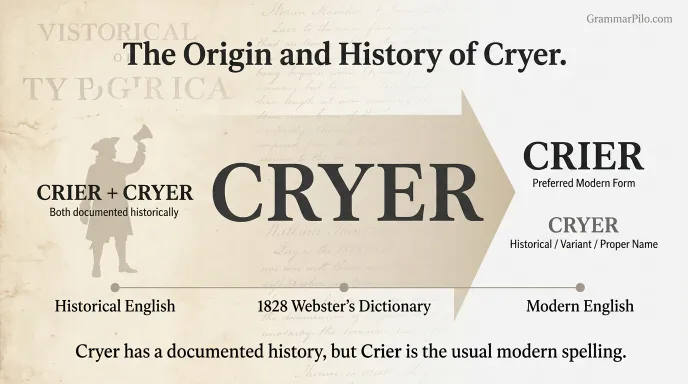
Cryer has also appeared in English historical usage.
Older English spelling was not standardized in the same way modern spelling is. Historical sources contain forms related to crier, including cryer.
Wiktionary records cryer as an archaic form of crier and gives historical examples involving town and court announcers.
An 1828 edition of Noah Webster’s American Dictionary of the English Language also listed crier and cryer together in its entry, showing that the variant was recognized historically.
The important point is that cryer has a documented history, but that does not make it the usual modern spelling.
The Cambridge Guide to English Usage notes that crier is overwhelmingly preferred in both American and British databases, while cryer is now mostly encountered as a proper name.
British English vs American English Spelling
There is no major British versus American spelling difference between these forms.
Modern British and American English both use crier as the normal spelling for the common noun.
| Variety | Standard Modern Form | Less Common Historical Form |
| American English | crier | cryer |
| British English | crier | cryer |
| Canadian English | crier | cryer |
| Australian English | crier | cryer |
The main difference is not regional spelling. Instead, it concerns modern standard usage, historical usage, and proper names.
So you do not need to write cryer simply because you are writing for an American audience.
Which Spelling Should You Use?
For ordinary modern writing, use crier.
Use Crier for Someone Who Cries
I am a crier when I watch emotional movies.
My sister is a natural crier.
The baby was a frequent crier.
These sentences use the standard modern noun.
Use Crier in Town Crier
The traditional expression is:
town crier
For example:
The town crier announced the news in the village square.
The phrase is well established in English and refers to a public announcer who historically called out important information.
Preserve Cryer as a Surname
If Cryer is someone’s family name, keep the spelling exactly as it is.
For example:
The author is named Cryer.
A surname does not need to follow the spelling pattern used for the common noun.
This is an important distinction because Cryer appears as an established surname.
Preserve Cryer in Historical Material
If you are quoting an old document that uses cryer, preserve the original spelling when accuracy to the source matters.
Do not automatically change a historical spelling simply because modern English normally uses crier.
Common Mistakes with Cryer or Crier
Mistake 1: Writing Cryer Because It Matches the Sound
Incorrect for normal modern usage: She is a frequent cryer.
Better: She is a frequent crier.
The two forms sound alike, but crier is the standard modern spelling.
Mistake 2: Writing Town Cryer
The traditional expression is:
Correct: town crier
Less appropriate in modern standard writing: town cryer
Historical sources may contain town cryer, but modern readers generally expect town crier.
Mistake 3: Assuming Cryer Never Existed
It is too simple to call cryer an invented spelling.
Historical dictionaries and texts document the form, and modern references recognize it as a variant or archaic form.
The better rule is:
Crier is standard today; cryer is an uncommon historical or variant form.
Mistake 4: Changing Someone’s Surname
If a person’s surname is Cryer, do not change it to Crier.
Correct: Jon Cryer
A proper name keeps its established spelling.
Mistake 5: Thinking Crier Only Means Someone Who Cries
Crier also has a historical public announcer meaning.
For example:
The town crier announced the royal proclamation.
The meaning comes from the older sense of crying out information publicly.
Crier or Cryer in Everyday Examples
In Emails
I am a bit of a crier at retirement celebrations.
In News Writing
A town crier announced the opening of the historical festival.
In Social Media
That movie turned me into a total crier.
In Formal Writing
Historical town criers played a role in communicating public announcements.
In Academic Writing
The study examined how children develop different patterns of emotional expression.
In Historical Writing
The document refers to a crier responsible for making public proclamations.
In Everyday Conversation
I’m definitely a crier when I watch sad movies.
These examples show that crier works naturally in both the emotional and public announcement senses.
Crier or Cryer: Google Trends & Usage Data
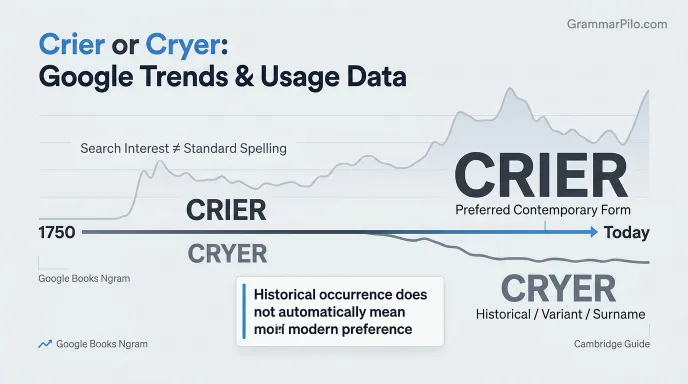
Search interest can help explain why people encounter both crier and cryer, but search frequency does not determine which spelling is standard.
For historical usage, Google Books Ngram Viewer provides a useful corpus comparison between crier and cryer across books published from 1750 onward.
The available Ngram comparison shows that both forms have appeared in published material, while modern usage references consistently identify crier as the preferred contemporary form.
The Cambridge Guide to English Usage likewise reports that crier is overwhelmingly preferred in both American and British databases.
This gives us an important distinction:
Historical occurrence does not automatically mean modern preference.
Crier is the form to choose for normal contemporary writing.
Cryer can still appear in historical sources, variant discussions, and surnames.
Cryer vs. Crier Comparison Table
| Feature | Crier | Cryer |
| Modern standard spelling | Yes | Uncommon |
| Person who cries | Yes | Historical or variant use |
| Town announcer | Yes | Historical variant |
| British English | Standard | Uncommon |
| American English | Standard | Uncommon |
| Historical texts | Yes | Yes |
| Surname | Possible | Established surname form |
| Plural | criers | cryers when the variant is used |
| Best choice for modern writing | Crier | Usually avoid |
| Pronunciation | Usually /ˈkraɪər/ | Usually similar |
How to Remember Crier or Cryer
A simple memory trick is:
Cry + person = crier
Think of the related form:
cries → crier
The spelling crier is the form you will normally see in modern English.
You can also remember the familiar phrase:
town crier
If you remember town crier, it becomes easier to remember the spelling for someone who cries.
Another useful reminder is:
Crier = modern standard
Cryer = historical, variant, or surname
This is more accurate than simply memorizing cryer = wrong, because historical English really did use the spelling.
Key Takeaways
- Crier is the standard modern spelling.
- Crier can mean someone who cries.
- Crier can also mean a public announcer, especially a town crier.
- Cryer is a documented historical or variant spelling.
- Cryer is also found as a surname.
- British and American English both normally use crier.
- The two forms are generally pronounced the same or very similarly.
- The confusion comes partly from the natural looking combination cry + er.
- Historical sources contain cryer, so it should not automatically be treated as nonexistent.
- For modern school, professional, and general writing, crier is the normal choice.
Frequently Asked Questions About Crier or Cryer
1. Is it crier or cryer?
Crier is the standard spelling in modern English.
Use crier for someone who cries or for the traditional term town crier.
2. Is cryer a real word?
Cryer is a documented English form, but it is uncommon in modern standard usage.
It appears in historical material and can also occur as a surname. Historical sources record it as an alternative form of crier.
3. Is a person who cries called a crier?
Yes.
Crier can describe someone who cries easily or frequently.
She is a frequent crier during emotional movies.
Cambridge Dictionary lists this meaning.
4. Is it town crier or town cryer?
Town crier is the standard modern expression.
Historical sources may contain the spelling town cryer, but modern writing normally uses town crier.
5. Why is crier spelled with an i?
The standard form developed historically as crier, and modern English established this spelling as the normal noun form. The spelling also fits broader patterns in English involving changes to a final y when suffixes are added.
6. Do crier and cryer sound the same?
They are normally pronounced the same or very similarly in modern English. Cambridge gives crier as /ˈkraɪ.ə(r)/ in British English and /ˈkraɪ.ɚ/ in American English.
7. Is Cryer a correct surname?
Yes.
Cryer is an established surname, so it should be preserved when it is someone’s family name.
8. What is the plural of crier?
The plural is criers.
Several criers gathered for the historical ceremony.
9. Should I use crier or cryer in formal writing?
Use crier for normal modern formal writing.
Use cryer only when the context specifically calls for a historical, variant, or proper name spelling.
10. Is crier only used for someone who cries?
No.
It can also describe a person who makes public announcements. The traditional expression town crier is the clearest example.
Conclusion
Crier is the standard modern spelling, while cryer is a much less common historical or variant form. If you are writing about someone who cries, the normal choice is crier.
The same spelling appears in the established expression town crier, referring to a person who publicly announces news or proclamations.
The confusion is understandable because crier and cryer sound alike, and cryer looks like a straightforward spelling of cry + er.
Historical English also used the spelling cryer, so it is not accurate to describe it as a completely invented form. Dictionaries and historical sources document its existence.
For modern writing, however, the practical rule is simple:
Crier = standard modern English
Cryer = uncommon variant, historical form, or surname
If you are writing an article, school assignment, professional email, or general English sentence, choose crier. If you encounter Cryer in a person’s name or an old document, preserve the spelling because the context gives it a legitimate role.
Explore More Articles

I’m Claire Morgan, the author behind Grammarpilo.com, where I write about English grammar, sentence structure, punctuation, and everyday language. My goal is to make grammar simple, clear, and practical, helping readers understand the rules and apply them with confidence in real-world writing.