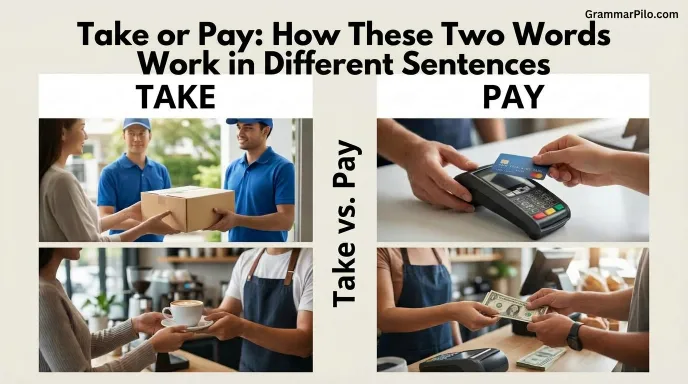
“Take” and “pay” are both correct English words, but they have different meanings and grammatical uses, so the right choice depends on the sentence. Take usually means to get, carry, accept, or move something, while pay means to give money for something or to settle a cost.
People may search for pay or take because the two words can appear in similar everyday situations, especially when talking about shopping, money, services, transportation, or instructions.
The word take has many meanings and can work in several grammatical patterns. Pay is more closely connected with money, bills, prices, debts, and financial transactions.
Understanding the difference helps you choose the correct word in emails, conversations, business writing, and everyday English.
The simple rule is easy to remember: take generally involves receiving, carrying, choosing, or moving something, while pay involves giving money for something.
Quick Answer
Pay and Take are both correct words, but they do different jobs.
Take can mean to receive, carry, accept, choose, or move something.
Example: Please take this package.
It means to give money for something or to settle a financial obligation.
Example: Please pay the bill.
The two words can appear together in some expressions.
Example: You can take the product now and pay later.
Here is the basic difference:
| Word | Main meaning | Example |
| take | Receive, carry, accept, choose, or move | Take this bag. |
| pay | Give money for something | Pay the bill. |
| take payment | Receive money from someone | The store will take payment by card. |
| pay for | Give money in exchange for something | I will pay for dinner. |
| take or pay | Accept something or make the required payment, depending on context | The contract uses a take or pay arrangement. |
The important point is that they are not alternative spellings of the same word. They have different meanings.
Definition and Meaning
What does “take” mean?
Take is a common English verb with many meanings.
It can mean to receive something:
Please take this letter.
It can mean to carry something:
I will take the bags upstairs.
It can mean to move someone or something:
The bus takes passengers to the city center.
It can mean to choose or accept something:
I will take the blue shirt.
It can also describe consuming or using something:
I take two tablets every day.
Because take has many meanings, its exact meaning depends strongly on context.
What does “pay” mean?
It generally means to give money to someone in exchange for goods or services or to settle an amount that is owed.
Examples:
- I need to pay the bill.
- She paid for the meal.
- He paid the company yesterday.
The verb can also have meanings that are not directly related to buying something.
Example: The investment paid off.
However, money and financial obligations are the most common contexts for pay.
Take and pay in shopping
The two words can occur in the same situation but describe different actions.
Example: You can take the shirt after you pay for it.
Here, take describes receiving or carrying the shirt.
Pay describes giving money for the shirt.
Another example is:
I will take the shoes, but I need to pay first.
The words have clearly different functions.
Take payment vs. pay
These expressions are also easy to confuse.
Take payment means to receive money from a customer.
Example: The store takes payment by credit card.
It means to give money.
Example: The customer paid by credit card.
The person or business receiving the money can take payment, while the customer can pay.
The Origin and History
The history of “take”
Take is an old English verb. It developed from Old Norse taka, which entered English during the Middle English period.
The verb became extremely common and developed many different meanings over time. Modern English now uses take in a wide range of expressions.
Examples include:
- take a seat
- take a break
This large number of meanings explains why take can sometimes be difficult for English learners.
The history of “pay”
Pay also has a long history. It came into English through Old French and ultimately developed from Latin pacare, associated with settling or satisfying an obligation.
Over time, it became strongly connected with financial transactions and the settlement of debts or costs.
Modern English uses pay in expressions such as:
- pay rent
- pay for food
Why are “take” and “pay” so different?
The words come from different historical roots and developed different meanings.
Take became a highly flexible verb used for receiving, carrying, choosing, moving, experiencing, and many other actions.
Pay became closely associated with money, costs, debts, and obligations.
That is why pay and take is not a spelling question in the same way as pairs such as began or begun. Instead, it is mainly a question of meaning and context.
British English vs American English Spelling
There is no major British American spelling difference between take and pay.
Both British and American English use the same spellings:
take
pay
Their past forms are also different in the same way:
take → took → taken
pay → paid → paid
| Form | British English | American English |
| Present | take | take |
| Past | took | took |
| Past participle | taken | taken |
| Present | pay | pay |
| Past | paid | paid |
| Past participle | paid | paid |
British and American English examples
Please take your seat.
Please pay the bill.
The spellings remain the same in both varieties.
Some expressions may have different preferences across regions, but take and pay themselves do not have a British American spelling difference.
Which Spelling Should You Use?
For American English
Use take when the meaning involves receiving, carrying, accepting, choosing, or moving something.
Example: I will take the package home.
Use pay when money is being given or an amount is being settled.
Example: I will pay for the package.
For British English
The same basic distinction applies.
Example: Please take this document.
Example: Please pay the invoice.
For Commonwealth English
The same spellings and basic meanings apply in countries such as Canada, Australia, and New Zealand.
Take remains take.
Pay remains pay.
For international English
Use the word that matches the action you want to describe.
If someone is receiving, carrying, choosing, or accepting something, take may be appropriate.
If someone is giving money or settling a financial obligation, pay is usually appropriate.
A useful memory rule is:
Take = receive or carry
Pay = give money
Common Mistakes
Mistake 1: Using “take” when you mean give money
Incorrect: I need to take the bill.
If you mean giving money to settle the bill, use pay.
Correct: I need to pay the bill.
However, take the bill can have another meaning. A waiter might say:
I will take the bill to the table.
Here, take means carry or bring something.
Mistake 2: Using “pay” when you mean receive something
Incorrect: I will pay the package home.
Correct: I will take the package home.
Here, take describes carrying or moving the package.
Mistake 3: Confusing “pay” and “pay for”
Pay can take a person or organization as its object.
Example: I paid the company.
When talking about something purchased, use pay for.
Example: I paid for the shoes.
Correct: She paid for dinner.
Mistake 4: Confusing “take payment” with “pay”
A business can take payment from a customer.
Example: The restaurant takes payment by card.
The customer pays the restaurant.
Example: The customer paid by card.
The direction of the money helps determine the expression.
Mistake 5: Using “pay” instead of “take” in transportation
We often use take for transportation.
Correct: I take the bus to work.
Correct: She takes a taxi home.
Pay may also appear in the same situation, but it describes the cost.
Example: I pay for the bus ride.
Mistake 6: Assuming “take” has only one meaning
Take is one of the most flexible verbs in English.
It can mean:
- Receive
- Carry
- Choose
- Accept
- Move
- Consume
- Use
- Experience
The surrounding words usually tell you which meaning is intended.
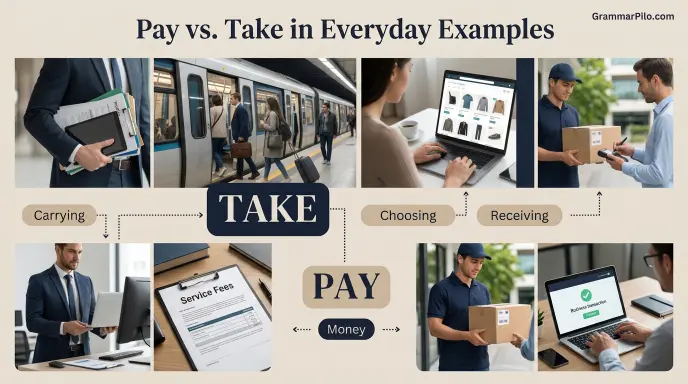
Pay vs. Take in Everyday Examples
In Emails
Example: Please take the documents to the office before noon.
Here, take means carry or deliver.
Example: Please pay the outstanding invoice by Friday.
Here, pay refers to settling a financial obligation.
In News Writing
Example: Passengers can take the new train service from Monday.
Example: Passengers will pay a reduced fare during the first week.
The first sentence describes transportation.
The second describes the cost.
In Social Media
Example: I think I will take the black one!
Here, take means choose or buy.
Example: I still need to pay for my order.
Here, pay refers to completing the purchase.
In Formal Writing
Example: Customers may take possession of the equipment after approval.
Example: Customers must pay all applicable fees before delivery.
The two words describe different actions in a formal transaction.
In Everyday Conversation
Examples:
- I will take the smaller one.
- How much do I need to pay?
These examples show how naturally the words can appear in the same conversation.
In Business English
Business writing often uses both words.
Example: The customer may take delivery after making the required payment.
Example: The company must pay the supplier within 30 days.
The first sentence focuses on receiving delivery. The second focuses on the financial obligation.
Google Trends & Usage Data
Google Trends can help show how often people search for take or pay, but search frequency does not determine the meaning or correctness of either word.
The phrase take or pay can also have several different search intentions. Some people may be looking for ordinary English meanings, while others may be searching for the business or contractual expression take or pay.
This distinction matters because take or pay can be used as a general phrase, while take or pay can describe a specific commercial agreement.
What is a take or pay agreement?
A take or pay agreement is a contractual arrangement in which a buyer agrees to either take a specified amount of a product or service or pay an agreed amount for the unused portion.
This expression is especially associated with industries such as energy, natural gas, electricity, and other long term supply arrangements.
In this context, take or pay is not simply a question about choosing between the verbs take and pay.
The hyphenated phrase has a specialized business meaning.
Search context matters
A search for:
take or pay
may involve general English.
A search for:
take or pay agreement
is more likely to involve commercial or legal terminology.
Search data can show what people are looking for, but context and dictionary definitions provide the clearer explanation of usage.
Take vs. Pay: Comparison Table
| Feature | Take | Pay |
| Main idea | Receive, carry, accept, choose, or move | Give money or settle a cost |
| Simple past | took | paid |
| Past participle | taken | paid |
| Common phrase | take a book | pay a bill |
| Money related use | take payment | pay for something |
| Transportation | take a bus | pay the fare |
| Shopping | take the item | pay for the item |
| Example | I will take it. | I will pay for it. |
They can describe opposite sides of one transaction
Consider this example:
The customer pays for the product and takes it home.
The customer pays because money is given to the seller.
Another example is:
The store takes payment, and the customer pays the bill.
The store takes payment.
The customer pays.
Frequently Asked Questions
1. What is the difference between take and pay?
Take commonly means receive, carry, accept, choose, or move something.
It means give money for something or settle a financial obligation.
2. Is it “pay for” or “take for”?
For the cost of something, use pay for.
Correct: I will pay for the meal.
Take for has different meanings and is not normally used to mean paying for something.
3. What does “take payment” mean?
Take payment means to receive money from someone.
Example: The store takes payment by credit card.
4. Is “take or pay” a business term?
Yes. Take or pay is also a specialized commercial term used in certain supply contracts. It can require a buyer to take a specified amount of a product or service or pay an agreed amount for the unused amount.
5. Is “take” related to buying something?
It can be. In shopping contexts, take can mean choose or accept something.
Example: I will take the blue jacket.
The exact meaning depends on context.
6. Is “pay” always about money?
No. It has other uses.
For example:
Pay respect or attention.
However, its most familiar meaning involves money, costs, or financial obligations.
7. Can take and pay be used in the same sentence?
Yes.
Example: I will take the product after I pay for it.
The words describe two different actions.
Final Thoughts
The difference between take or pay is mainly about meaning and context. Take is a flexible verb that can mean receive, carry, accept, choose, move, or use something. Pay usually relates to giving money, settling a bill, or meeting a financial obligation.
The easiest way to remember the difference is:
Take = receive, carry, accept, or choose
Pay = give money or settle a cost
For example, you can take a package and pay for the package. A customer can take an item from a store, while the customer must pay for that item. A business can take payment, while the customer pays the business.
There is no British American spelling difference between take and pay. Both words are spelled the same in major varieties of English.
For everyday English, focus on the action being described. If something is being received, carried, accepted, or chosen, take may fit. If money is being given or a cost is being settled, pay is usually the right word.
Continue Reading

I’m Claire Morgan, the author behind Grammarpilo.com, where I write about English grammar, sentence structure, punctuation, and everyday language. My goal is to make grammar simple, clear, and practical, helping readers understand the rules and apply them with confidence in real-world writing.



1 thought on “Take or Pay: How These Two Words Work in Different Sentences”