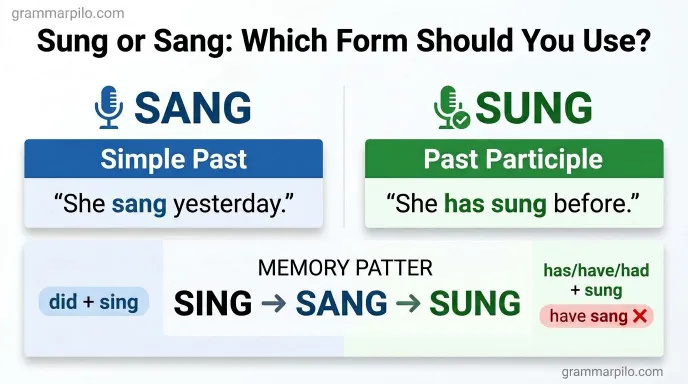
When you talk about singing in the past, should you write sung or sang? The answer depends on the grammar of your sentence. Sang is the simple past form of sing, while sung is the past participle.
For example, “She sang at the concert last night” is correct, while “She has sung at several concerts” uses the past participle correctly.
This confusion is common because sang and sung both describe the same basic action. The difference is not their core meaning. It is the role they play in a sentence.
English learners often mix them up in phrases such as have sang or have sung, I sang or I sung, and did sing or did sang. The pattern becomes much easier once you learn the three main forms together: sing, sang, sung.
This guide explains the difference between sung or sang, shows how each form works, covers British and American English, and gives practical examples for everyday and formal writing.
Sung or Sang: Featured Snippet Answer
Sang is the simple past form of sing, while sung is the past participle. Use sang for a completed past action, such as “She sang yesterday.”
Use sung after has, have, or had, such as “She has sung before.” The basic pattern is sing → sang → sung.
Sung or Sang: Quick Answer
The simplest way to remember the difference is:
- Sing = base or present form
- Sang = simple past
- Sung = past participle
Consider these examples:
I sing in the choir every week.
I have sung in the choir for several years.
The form changes because the grammar changes.
Use Sang
Use sang when you are describing a completed action in the simple past.
She sang at the wedding.
We sang together last night.
Use Sung
Use sung when it is the past participle.
She has sung at the wedding before.
We have sung that song many times.
You will often see sung after have, has, or had. It can also appear in passive constructions.
The song was sung by the school choir.
What Does Sung or Sang Mean?
Sang and sung are forms of the irregular verb sing.
The verb sing means to produce musical sounds with the voice, often by following a melody or using words. Dictionaries list sang as the past simple form and sung as the past participle.
Sang
Sang is the simple past form.
Daniel sang at the concert.
The action happened in the past.
Sung
Sung is the past participle.
Daniel has sung at several concerts.
Here, has is the helping verb, and sung completes the verb phrase.
Why They Are Confusing
The two forms refer to the same basic action, but they cannot normally be exchanged freely.
Compare:
She sang yesterday.
She has sung before.
The first sentence uses simple past. The second uses the present perfect.
A useful formula is:
Simple past = sang
Past participle = sung
The Origin of Sing, Sang, and Sung
The verb sing is an old English word with Germanic roots. Historical records trace it to Old English singan, meaning to chant or sing. Its older strong verb pattern included past forms related to modern sang and sung.
Modern English kept this irregular pattern instead of changing the verb to a regular ed form.
That is why English does not use singed as the ordinary past tense of sing. The correct forms developed through the older vowel changing pattern.
The same type of pattern appears in several other common English verbs:
| Base form | Simple past | Past participle |
| sing | sang | sung |
| ring | rang | rung |
| drink | drank | drunk |
| begin | began | begun |
| swim | swam | swum |
The exact historical development differs from verb to verb, but these examples show why English learners often find irregular verbs harder than regular verbs.
The past participle sung has also been used as an adjective in English, especially in expressions connected with music. Historical records show this use developing from the participle of sing.
British English vs American English
There is no major British American difference in the forms sang and sung. Both varieties use sang as the simple past and sung as the past participle.
| British English | American English | Example |
| sang | sang | She sang yesterday. |
| sung | sung | She has sung before. |
| sing | sing | She likes to sing. |
| singing | singing | She is singing now. |
Cambridge lists the same basic forms for British and American English: sang as the past tense and sung as the past participle.
This means writers do not need to change sang to another regional spelling when moving between American and British English.
The main issue is grammar, not geography.
Which Version Should You Use?
The correct choice depends on the sentence structure rather than the country in which you are writing.
United States
American English uses:
She sang at the event.
She has sung at the event before.
United Kingdom
British English uses the same forms:
She sang at the event.
She has sung at the event before.
Canada
Standard Canadian English also uses sang as the simple past and sung as the past participle.
Australia
Australian English follows the same standard verb pattern.
International Writing
For international readers, sing → sang → sung is clear and standard.
Academic Writing
In academic writing, choose the form that fits the tense and sentence structure.
The participants sang during the exercise.
Several traditional songs have been sung during the ceremony.
Business Writing
Professional writing follows the same rule.
The team sang during the company celebration.
The national anthem was sung before the event began.
There is no special professional version of sang or sung. Accuracy comes from using the correct grammatical form.
Common Mistakes With Sung and Sang
Mistake 1: Using Sang After Have
Incorrect: I have sang this song before.
Correct: I have sung this song before.
Explanation: Have requires the past participle, so use sung.
Memory tip: Have, has, or had → sung.
Mistake 2: Using Sung as Simple Past
Incorrect: She sung at the concert last night.
Correct: She sang at the concert last night.
Explanation: A straightforward completed action in the simple past uses sang.
Memory tip: Yesterday, last night, and last year often point you toward sang.
Mistake 3: Using Sang After Did
Incorrect: Did she sang at the concert?
Correct: Did she sing at the concert?
Explanation: After did, the main verb returns to its base form.
Memory tip: Did + sing, not did + sang.
Mistake 4: Treating Sing as a Regular Verb
Incorrect: He singed at the wedding.
Correct: He sang at the wedding.
Explanation: Sing is an irregular verb. Its simple past is sang, not singed.
There is a separate word singed, which means slightly burned.
The edge of the paper was singed.
Mistake 5: Using Sang After Had
Incorrect: They had sang three songs before dinner.
Correct: They had sung three songs before dinner.
Explanation: Had is followed by the past participle in the past perfect.
Memory tip: Had + sung.
Sung or Sang in Everyday Examples
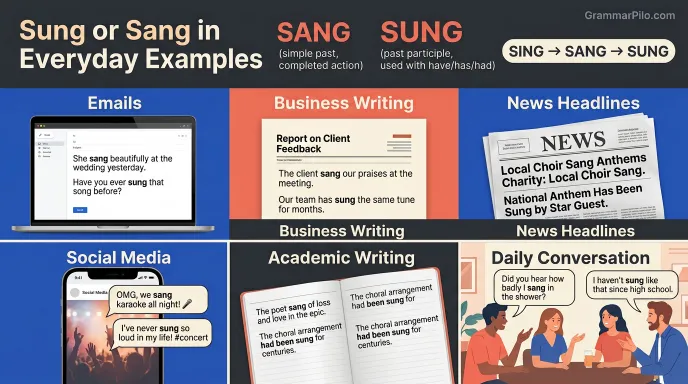
The best way to understand the difference is to see it in real writing situations.
Emails
I sang at the charity event last Friday.
I have sung at this event several times.
The first sentence refers to a specific past occasion. The second describes past experience connected to the present.
Business Writing
The employees sang during the annual celebration.
The opening song was sung by the company choir.
The second example uses the passive voice.
News Headlines
News writing often uses simple past forms when reporting completed events.
Local Choir Sang at Annual Festival
In a longer report, you might see:
The choir has sung at the festival for five consecutive years.
Blogs
Last weekend, I sang in front of a large audience for the first time.
I have never sung in front of so many people before.
Social Media
I finally sang on stage!
I have sung this song a hundred times in my room.
The choice depends on the sentence, not the casual nature of the platform.
Academic Writing
The participants sang a series of traditional songs.
Several songs were sung during the study session.
Academic writing still follows the same standard verb forms.
Daily Conversation
We sang all the way home.
Have you ever sung in public?
Did you sing at the party?
These three examples show all three forms in natural conversation.
Google Trends & Modern Usage
Search interest for sung or sang usually reflects a grammar question rather than a debate over two different words.
People commonly search phrases such as:
- sung or sang
- sang or sung
- sang vs. sung
- sung vs. sang
- have sang or have sung
- has sang or has sung
- I sang or I sung
- did sing or did sang
- had sang or had sung
These searches make sense because English learners often know that sing changes in the past but are unsure which form belongs in a particular sentence.
Exact Google Trends results can vary by country, time period, search type, and selected category. Without a specific Trends dataset, it is not appropriate to claim that one form has a particular search volume or is universally more popular.
Modern standard English keeps the distinction clear:
Sing → sang → sung
The important point is that sang and sung are not competing spellings. They are different grammatical forms of the same irregular verb.
Quick Comparison Table
| Version | Meaning | Correct? | Region | Example |
| sing | Base form | Yes | Standard English | I like to sing. |
| sang | Simple past | Yes | US, UK, international | I sang yesterday. |
| sung | Past participle | Yes | US, UK, international | I have sung before. |
| singed | Slightly burned | Yes, but different word | Standard English | The paper was singed. |
| sung after did | Incorrect structure | No | Standard English | Did she sing? |
| sang after have | Incorrect structure | No | Standard English | She has sung. |
Key Takeaways
- Sang is the simple past form of sing.
- Sung is the past participle of sing.
- The basic pattern is sing → sang → sung.
- Use sang for a simple past action.
- Use sung after has, have, or had.
- Use sing after did.
- Sang and sung are standard in both British and American English.
- Singed is a different word meaning slightly burned.
FAQs About Sung or Sang
Is it “I sang” or “I sung”?
Use I sang when you are describing a simple past action.
I sang at the concert last night.
Use I have sung when the sentence uses the present perfect.
I have sung at several concerts.
The form depends on the tense and helping verb.
Is it “have sang” or “have sung”?
The standard form is have sung.
I have sung this song before.
After have, the verb should use its past participle form. Since sung is the past participle of sing, it is the correct choice.
Is “sung” the past tense of sing?
Sung is a past form of sing, but more precisely, it is the past participle. The simple past is sang.
She sang yesterday.
She has sung before.
Is “sang” the past tense of sing?
Yes. Sang is the simple past form of sing.
I sing every day.
I sang yesterday.
These three forms create the standard pattern sing, sang, sung.
Should I say “did sing” or “did sang”?
Use did sing.
Did you sing at the party?
Do not use did sang in standard English. The auxiliary did already marks the past tense, so the main verb stays in its base form.
Is it “has sang” or “has sung”?
Use has sung.
She has sung this song many times.
The word has is followed by the past participle. The past participle of sing is sung.
Is “had sang” correct?
In standard English, use had sung.
They had sung three songs before the show ended.
The pattern is had + past participle, so sung is required.
Is “singed” the past tense of sing?
No. The simple past of sing is sang.
Singed is a separate word that means slightly burned.
She sang beautifully.
The flame singed the edge of the paper.
The similar spelling can cause additional confusion.
Do British people say “sang” or “sung”?
British English uses both forms, but they have different grammatical functions. Sang is the simple past, while sung is the past participle. American English follows the same standard distinction.
Which is correct, “sung or sang”?
Both are correct forms, but they are not interchangeable.
Use sang as the simple past:
She sang yesterday.
Use sung as the past participle:
She has sung before.
The right choice depends on the grammar of the sentence.
Conclusion
The difference between sung or sang is simple once you learn the complete verb pattern: sing → sang → sung.
Use sang for the simple past. For example, “He sang at the wedding.” Use sung as the past participle, usually after has, have, or had, as in “He has sung at many weddings.”
Remember that did takes the base form sing, so “Did she sing?” is correct. Also, singed is a separate word that means slightly burned.
There is no major British American difference in this verb pattern. Writers in both varieties use sang for the simple past and sung for the past participle.
The easiest memory rule is short and reliable:
Sing now, sang before, sung with a helping verb.
Once this pattern becomes familiar, choosing between sung vs. sang becomes much easier in conversation, schoolwork, business writing, and everyday English.
Boost Your English!
- Sewed or Sewn: Which Form of Sew Should You Use?
- Less or Fewer: The Simple Rule for Choosing the Right Word
- Take or Pay: How These Two Words Work in Different Sentences

I’m Claire Morgan, the author behind Grammarpilo.com, where I write about English grammar, sentence structure, punctuation, and everyday language. My goal is to make grammar simple, clear, and practical, helping readers understand the rules and apply them with confidence in real-world writing.








2 thoughts on “Sung or Sang: Which Form Should You Use?”