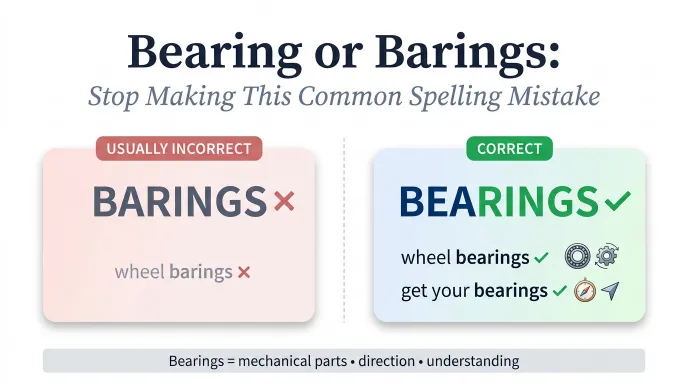
Bearings is the correct standard English spelling when you mean mechanical parts, direction, or someone’s understanding of a situation; barings is usually a misspelling.
The word bearings has several meanings, but barings is not normally an alternative spelling. People often search for barings and bearings because the two words can sound similar in casual speech.
This can make the spelling difficult to remember, especially when the word is used in technical terms such as wheel bearings or ball bearings.
The confusion can also occur with the expression find your bearings, where bearings means an understanding of your position or situation.
For example, you would write, “The mechanic replaced the wheel bearings,” not “wheel barings.” You would also say, “I am still trying to get my bearings,” when you mean that you are trying to understand where you are or what is happening.
This guide explains the difference between bearings and barings, their meanings, origins, common mistakes, and how to use the correct spelling in everyday, technical, academic, and professional writing.
Barings and Bearings: The Quick Answer
Bearings is the correct spelling in standard English. Barings is generally incorrect when you mean bearings.
Examples:
- The mechanic replaced the wheel bearings. ✓
- I need a moment to get my bearings. ✓
- The machine has damaged bearings. ✓
- The mechanic replaced the wheel barings. ✗
- I need to get my barings. ✗
Quick rule
Bearings = correct standard spelling
Barings = usually a misspelling
The word bearings can refer to mechanical components, directions, position, or an understanding of a situation.
What Does Bearings Mean?
The word bearings is the plural of bearing, but it has several important meanings.
Bearings as Mechanical Parts
In engineering and mechanics, a bearing is a component that helps one part of a machine move smoothly relative to another.
For example:
The car needs new wheel bearings.
The technician inspected the engine bearings.
The bicycle’s bearings need to be cleaned.
This is one of the most common technical uses of the word.
You may see terms such as:
- wheel bearings
- ball bearings
- roller bearings
- bearing assembly
- bearing housing
- bearing failure
In all of these expressions, the correct spelling is bearing or bearings.
Bearings as Direction
Bearings can also describe directions, especially in navigation.
For example:
The ship changed its bearing.
The pilot checked the aircraft’s bearings.
In navigation, a bearing is a direction measured from a reference point, often expressed in degrees.
Bearings as Understanding
The expression get your bearings has a figurative meaning.
It means to understand where you are, what is happening, or what you should do.
For example:
I walked around the new building to get my bearings.
Give me a few minutes to get my bearings.
Here, bearings does not refer to mechanical parts. It means a person’s sense of position, direction, or understanding.
What Does Barings Mean?
Barings is generally not the standard English spelling when you mean bearings.
For example:
The car needs new barings.
This is incorrect.
The correct sentence is:
The car needs new bearings.
However, Barings can appear as a proper name. For example, Barings is the name associated with a financial institution. That is completely different from the ordinary English noun bearings.
So context matters.
If you are talking about:
- machines
- wheels
- mechanics
- navigation
- direction
- understanding your situation
you almost certainly need bearings.
The Origin of Bearings
The word bearing is connected to the verb bear, which has a long history in English.
The verb bear can mean to carry, support, endure, or carry a load. The mechanical sense of bearing developed from the idea of something that supports or carries a load.
This connection makes sense in engineering.
A mechanical bearing supports moving parts and helps them move with reduced friction.
The word also developed other meanings related to position, direction, manner, and conduct.
This is why modern English has several meanings of bearing.
For example:
The machine’s bearing supports the rotating shaft.
and:
His calm bearing impressed everyone.
These meanings are related historically, even though they are used differently today.
The spelling bearing has remained standard across major varieties of English.
British English vs American English
There is no major British American spelling difference between bearings and barings.
| Meaning | British English | American English | Example |
| Mechanical components | bearings | bearings | The wheel bearings need replacement. |
| Direction | bearings | bearings | Check your bearings. |
| Sense of position | bearings | bearings | I am getting my bearings. |
| Incorrect spelling | barings | barings | Usually incorrect. |
Both British and American English use bearings.
You do not need to change the spelling based on your audience.
If you are writing for readers in the United States, United Kingdom, Canada, Australia, or an international audience, bearings is the standard spelling.
Which Version Should You Use?
United States
Use bearings.
The mechanic replaced the front wheel bearings.
United Kingdom
Use bearings.
The engineer inspected the machine’s bearings.
Canada
Use bearings in Canadian English.
The vehicle’s bearings were damaged.
Australia
Use bearings.
The technician checked the wheel bearings.
International Writing
Use bearings whenever you mean the standard English word.
Avoid barings unless you are referring to a proper name.
Technical Writing
In engineering, automotive, manufacturing, and mechanical writing, spelling accuracy is especially important.
Write:
bearing failure
bearing replacement
ball bearings
wheel bearings
Never use barings as an alternative spelling.
Business Writing
Use bearings when discussing equipment, manufacturing, transportation, or figurative understanding.
The maintenance team replaced the damaged bearings.
For the figurative expression:
The new manager needed some time to get her bearings.
Common Mistakes With Bearings or Barings
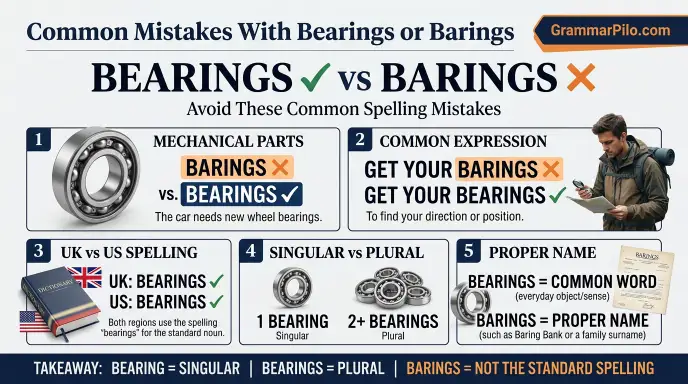
Mistake 1: Writing Barings for Mechanical Parts
Incorrect:
The car needs new wheel barings.
Correct:
The car needs new wheel bearings.
Explanation: The standard spelling of the mechanical component is bearing, plural bearings.
Memory tip: Think of the word bear inside bearing.
Mistake 2: Writing “Get Your Barings”
Incorrect:
I need some time to get my barings.
Correct:
I need some time to get my bearings.
Explanation: The established expression is get your bearings.
It means to understand your surroundings or situation.
Mistake 3: Assuming Barings Is a Spelling Variant
Incorrect assumption:
British English uses barings while American English uses bearings.
Correct:
Both British and American English use bearings.
There is no standard regional spelling difference here.
Mistake 4: Confusing Bearings With Bearing
Remember that bearing is singular and bearings is plural.
The machine has one damaged bearing.
The machine has several damaged bearings.
The spelling stays the same except for the plural -s.
Mistake 5: Confusing Bearings With Barings as a Name
Bearings is an ordinary English word.
Barings may be a proper name.
Therefore, capitalization and context can matter.
For example:
The machine’s bearings were replaced.
This refers to mechanical parts.
A sentence containing Barings may refer to an organization or other proper noun instead.
Barings or Bearings in Everyday Examples
Emails
The maintenance team has ordered replacement bearings.
I am still getting my bearings after joining the new department.
The first example is technical. The second uses the word figuratively.
Business Writing
The factory replaced several worn bearings.
New employees may need time to get their bearings.
Both uses are common in professional writing.
News Headlines
Engineers Investigate Damaged Wheel Bearings
New Employees Take Time to Get Their Bearings
News headlines may use bearings in either its technical or figurative sense.
Blogs
How to Tell When Your Wheel Bearings Need Replacing
Five Tips to Help You Get Your Bearings in a New City
Both examples use the standard spelling.
Social Media
My car finally got new bearings!
First week at my new job, and I’m still getting my bearings.
Academic Writing
The researchers examined the effect of friction on mechanical bearings.
The study provides a framework for understanding spatial bearings.
In academic writing, the intended meaning should be clear from context.
Daily Conversation
My bike’s bearings are making a strange noise.
I just moved here, so I’m still getting my bearings.
These are natural everyday uses.
Bearings in Different Contexts
The word bearings is useful because it appears in several fields.
| Context | Meaning | Example |
| Automotive | Mechanical components | The wheel bearings need replacement. |
| Engineering | Parts supporting movement | The machine uses ball bearings. |
| Navigation | Directions or position | The navigator checked the bearings. |
| Everyday English | Sense of direction or understanding | I am getting my bearings. |
| Figurative English | Understanding a new situation | She quickly got her bearings. |
This variety can make the word appear in many different kinds of writing.
Bearings vs. Baring: Google Trends & Modern Usage
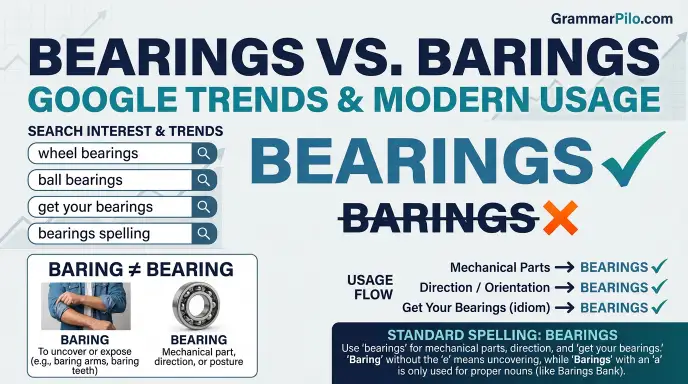
Searches for barings vs. bearings are likely to come from spelling uncertainty. The two forms are close in pronunciation, and people may hear the word before seeing it written.
The confusion is particularly common in searches involving phrases such as:
- wheel bearings or wheel barings
- ball bearings or ball barings
- get your bearings or get your barings
- bearing vs baring
- bearings spelling
- how to spell bearings
The standard spelling remains bearings.
There is also another English word, baring, which is related to the verb bare. For example:
She was baring her arms.
This is different from bearing.
That distinction can create additional confusion because baring, bearing, and bearings sound somewhat similar in certain contexts.
Exact Google Trends numbers should not be invented without checking current search data. However, the spelling rule itself is stable: when you mean mechanical parts, direction, or the expression get your bearings, use bearings.
Bearings vs Baring
One useful distinction is between bearings and baring.
| Word | Meaning | Example |
| bearings | Mechanical parts or direction/understanding | The wheel bearings are worn. |
| bearing | Supporting part, direction, or manner | The machine has a damaged bearing. |
| baring | Exposing or uncovering | She was baring her arms. |
| bare | Expose or uncover | Do not bare the wires. |
| barings | Usually not the intended standard form | Check the bearings. |
This is important because someone searching for barings and bearings may actually be confusing bearings with the verb form baring.
Quick Comparison Table
| Version | Meaning | Correct? | Region | Example |
| bearing | One mechanical component or direction | ✓ | All major varieties | The bearing is damaged. |
| bearings | Multiple components or sense of direction | ✓ | US, UK, International | The wheel bearings need replacing. |
| baring | Exposing or uncovering | ✓ | US, UK, International | He was baring his arms. |
| barings | Usually a misspelling in this context | ✗ | Standard English | Use bearings instead. |
| Barings | Possible proper name | Context dependent | Proper noun | Barings may refer to an organization. |
Key Takeaways
- Bearings is the correct standard spelling for the plural of bearing.
- Barings is usually a misspelling when you mean mechanical parts or direction.
- Wheel bearings and ball bearings are correct phrases.
- Get your bearings is the correct idiom.
- British and American English both use bearings.
- Baring is a different word meaning exposing or uncovering.
- Bearing is singular; bearings is plural.
- Barings can occur as a proper name, but it is not the normal spelling of the English word.
- When in doubt, remember: bear + ing = bearing.
FAQs About Bearings or Barings
Is it bearings or barings?
Bearings is the correct standard spelling when you mean mechanical parts, directions, or your sense of position or understanding.
For example, “The car needs new wheel bearings” and “I am trying to get my bearings.” Barings is generally incorrect in these contexts.
Are wheel barings or wheel bearings correct?
Wheel bearings is correct. A wheel bearing is a mechanical component that allows a wheel or related part to rotate smoothly.
Therefore, write “The mechanic replaced the wheel bearings,” not “The mechanic replaced the wheel barings.”
Is “get your bearings” correct?
Yes. Get your bearings is a standard English expression meaning to understand where you are, what is happening, or how to proceed. For example, “I need a few minutes to get my bearings in this new office.”
Is barings a word?
Barings is not normally the standard English spelling of bearings. However, a capitalized Barings may be used as a proper name, such as the name of an organization. If you mean mechanical components or direction, use bearings.
What is the singular of bearings?
The singular is bearing. For example, “The machine has one damaged bearing.” When referring to several components, use bearings: “The machine has several damaged bearings.”
What is the difference between bearing and bearings?
Bearing is singular, while bearings is plural. A bearing can be a mechanical component, a direction, or a person’s manner or position.
Bearings refers to multiple components or directions, or appears in expressions such as “get your bearings.”
Is bearings a mechanical term?
Yes. Bearing is an important mechanical and engineering term. Bearings support moving parts and help reduce friction between components. Common examples include ball bearings, roller bearings, and wheel bearings.
Is it “I lost my bearings” or “I lost my barings”?
The correct expression is “I lost my bearings.” It means that you became confused about your location, direction, or situation. Barings is not the standard spelling of this expression.
Is bearing British or American English?
Bearing and bearings are used in both British and American English. There is no major spelling difference between the two varieties. You can safely use bearings for an international audience.
What is the difference between bearing and baring?
Bearing has several meanings, including a mechanical component and a sense of direction or position. Baring comes from bare and means exposing or uncovering something.
For example, “The machine has damaged bearings” differs completely from “She was baring her arms.”
Conclusion
The correct choice between bearings or barings is usually straightforward: use bearings when you mean mechanical components, directions, or your sense of position and understanding. The spelling barings is generally incorrect in these contexts.
You will see bearings in technical phrases such as wheel bearings, ball bearings, and roller bearings. The word is also common in everyday expressions such as get your bearings and lose your bearings.
There is no British American spelling difference to remember. Both British and American English use bearings. The main source of confusion is pronunciation and the existence of the separate word baring, which means exposing or uncovering.
So, if you are writing a car repair guide, an engineering report, a business email, or a casual message, choose bearings when that is the meaning you intend.
Remember: machines have bearings, and people get their bearings.
Explore More Articles

I’m Sloane Mercer, a U.S.-based English language writer focused on grammar, spelling, vocabulary, and everyday English usage. Through GrammarPilo, I provide clear and practical explanations to help readers choose the right words and communicate with confidence.







4 thoughts on “Bearings or Barings: Stop Making This Common Spelling Mistake”