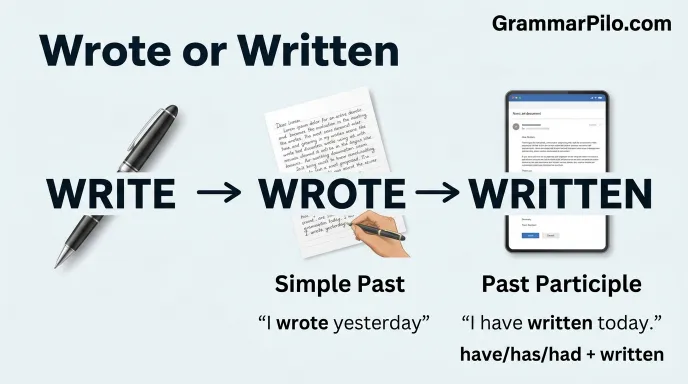
Wrote and written are both correct forms of the verb write, but they are used in different grammatical situations.
Wrote is the simple past form, while written is the past participle and usually appears with an auxiliary verb such as has, have, had, is, or was. This difference is the main reason people search for wrote or written, written or wrote, and written vs. wrote.
For example, you can say, “I wrote a letter yesterday,” but you would say, “I have written three letters this week.” The first sentence describes a completed action in the simple past. The second uses the present perfect tense, which requires the past participle written.
The confusion is easy to understand because write, wrote, and written do not follow the regular pattern used by verbs such as walk, walked, walked. The forms must be learned as an irregular verb pattern.
In this guide, you will learn the difference between wrote and written, how each form works, common mistakes, everyday examples, and an easy way to remember which one to use.
Wrote or Written Quick Answer
Wrote is the simple past form of write, while written is the past participle.
| Form | Grammar role | Example |
| Write | Present/base form | I write every day. |
| Wrote | Simple past | I wrote yesterday. |
| Written | Past participle | I have written before. |
Use wrote when the sentence is in the simple past.
Example: I wrote an email last night.
Use written with an auxiliary verb in perfect constructions.
Example: I have written an email.
Written can also appear in passive constructions.
Example: The letter was written by Sarah.
The easiest rule is simple:
Wrote = past action
Written = past participle
Cambridge identifies wrote as the past simple of write and written as the past participle.
Definition and Meaning of Written and Wrote
What Does Wrote Mean?
Wrote is the simple past form of write.
It describes an action that happened in the past.
Examples include:
- I wrote a letter yesterday.
- She wrote a short story last night.
- They wrote their names on the form.
- He wrote to his friend last week.
The word wrote can be used without another auxiliary verb.
Example: She wrote a book in 2022.
The past action is expressed directly by wrote.
What Does Written Mean?
Written is the past participle of write.
It normally needs an auxiliary verb when it functions as part of a perfect tense.
Examples include:
- I have written the report.
- She has written three articles.
- They had written the instructions before the meeting.
- He will have written the letter by Friday.
Written is also used in passive constructions.
Example: The report was written by the manager.
Cambridge also lists written as an adjective meaning expressed in writing or involving writing, as in “written instructions” or “a written test.”
Wrote and Written Are Not Interchangeable
Although both words come from write, they do not perform the same grammatical job.
Correct: I wrote the email yesterday.
Correct: I have written the email.
Incorrect: I have wrote the email.
Incorrect: I written the email yesterday.
The auxiliary verb is an important clue.
The Origin of Wrote and Written
The forms wrote and written come from the irregular English verb write.
The verb goes back to Old English writan, which originally had meanings connected with scoring, scratching, or drawing marks. It later developed the meaning of putting words into writing. Its historical forms included an older past tense and past participle that eventually developed into the modern forms wrote and written.
This history helps explain why write does not form its past tense by simply adding ed.
Compare:
- walk → walked
- work → worked
- play → played
But:
- write → wrote → written
This is an example of an irregular verb.
The modern forms have been shaped by centuries of English language development. Written is also an old form, with the word recorded in English as a past participle and later developing additional adjective uses.
The basic pattern remains unchanged in modern English:
Write → Wrote → Written
British English vs American English
There is no spelling difference between British and American English for these forms.
Both varieties use:
| Form | British English | American English |
| Present | write | write |
| Simple past | wrote | wrote |
| Past participle | written | written |
Examples are the same in both varieties.
British English: She wrote a letter yesterday.
American English: She wrote a letter yesterday.
British English: She has written a letter.
American English: She has written a letter.
Pronunciation can vary slightly between speakers, but the written forms remain the same.
So the choice between wrote and written is a matter of grammar, not British versus American spelling.
Which Form Should You Use?
Choose the form based on the tense and structure of your sentence.
Use Wrote for Simple Past
Use wrote when describing a completed action in the past.
Example: I wrote the report yesterday.
Example: She wrote to me last month.
The simple past does not require have, has, or had before wrote.
Use Written With Have, Has, or Had
Use written after have, has, or had in perfect constructions.
Example: I have written the report.
Example: They had written the letter before the meeting.
This is one of the easiest ways to distinguish wrote vs. written.
Use Written in Passive Sentences
Written can also follow forms of be in passive constructions.
Example: The letter was written in English.
Example: The instructions were written clearly.
Here, written is not replacing wrote. It is functioning as the past participle in a passive construction.
A Quick Grammar Test
Look at the words before the verb.
If you have a simple past sentence with no auxiliary verb, wrote may be correct.
If you have have, has, or had, use written.
I wrote the message.
I have written the message.
This simple comparison solves many wrote or written questions.
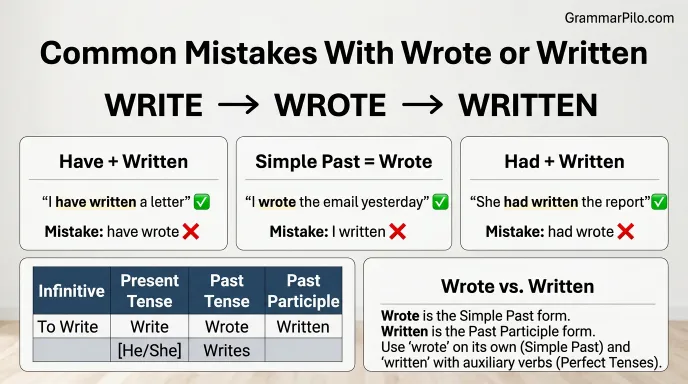
Common Mistakes With Wrote or Written
Mistake 1 Using Wrote After Have
Incorrect: I have wrote a letter.
Correct: I have written a letter.
After have, use the past participle written.
Mistake 2 Using Written as the Simple Past
Incorrect: I written the email yesterday.
Correct: I wrote the email yesterday.
A simple past sentence normally uses wrote.
Mistake 3 Using Wrote After Had
Incorrect: She had wrote the report before lunch.
Correct: She had written the report before lunch.
The auxiliary had requires the past participle written.
Mistake 4 Confusing Write, Wrote, and Written
These three forms have different roles.
Present: I write emails every day.
Past: I wrote an email yesterday.
Perfect: I have written several emails today.
Learning the complete pattern is more useful than memorizing only two words.
Mistake 5 Treating Written as a Regular Past Form
Some learners may think written is simply another past form that can replace wrote.
It cannot.
Wrote is the simple past.
Written is the past participle.
Wrote or Written in Everyday Examples
In Emails
Simple past: I wrote to the customer yesterday.
Present perfect: I have written to the customer already.
In School
Simple past: Maria wrote her essay last night.
Present perfect: Maria has written five essays this semester.
In Workplace Writing
Simple past: The manager wrote the report on Monday.
Present perfect: The manager has written the final report.
In News Writing
Simple past: The journalist wrote about the event last year.
Present perfect: The journalist has written several reports about the issue.
In Social Media
Simple past: I wrote a post about it yesterday.
Present perfect: I have written a few posts this week.
In Formal Writing
Simple past: The researcher wrote the paper in 2020.
Present perfect: The researcher has written extensively on the subject.
In Passive Sentences
The book was written by a famous author.
The instructions were written in simple English.
The message was written by hand.
Wrote vs Written Comparison
| Feature | Wrote | Written |
| Base verb | Write | Write |
| Verb form | Simple past | Past participle |
| Main use | Completed past action | Perfect and passive structures |
| Auxiliary needed | Usually no | Usually yes |
| Example | I wrote a letter. | I have written a letter. |
| Common clue | Yesterday, last week, in 2020 | Have, has, had, was, were |
| British spelling | Wrote | Written |
| American spelling | Wrote | Written |
The key difference is grammatical form, not meaning.
Both refer to the act of putting words into writing, but they work differently inside a sentence.
Wrote or Written Google Trends and Usage Data
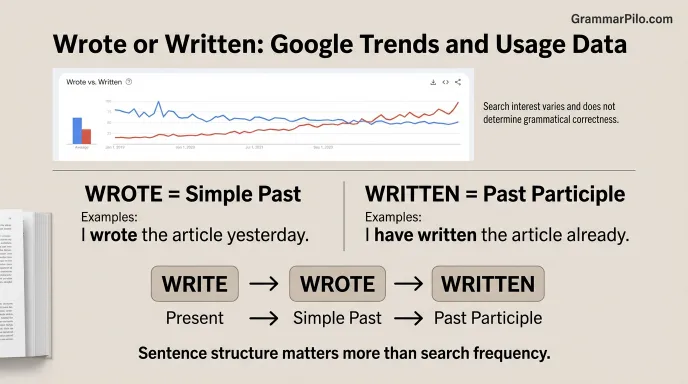
Google Trends can be useful for observing search interest in wrote or written, but search frequency should not be treated as a grammar rule.
A Google Trends comparison can change depending on the selected country, time period, search category, and type of search. For that reason, a single chart does not establish that one word is grammatically correct and the other is incorrect.
For language usage, dictionary and grammar evidence is more useful for identifying the role of each form.
The consistent grammatical distinction is clear:
Wrote = simple past
Written = past participle
Corpus and dictionary examples also show both forms in normal modern English because they serve different grammatical functions. Cambridge lists wrote as the past simple of write and written as its past participle.
This means the important question is not simply which word appears more often.
Instead, look at the sentence structure.
I wrote the article yesterday.
I have written the article already.
Both sentences are correct because the forms match their grammatical roles.
Wrote and Written Memory Trick
Use this simple three step pattern:
Write → Wrote → Written
Think of it as:
Today → Yesterday → Have/Has/Had
Today: I write.
Yesterday: I wrote.
Have/has/had: I have written.
Another useful trick is to remember:
Wrote stands alone. Written usually needs help.
For example:
I wrote the letter.
But:
I have written the letter.
This is not an absolute rule for every grammatical use because written can also work as an adjective, but it is a useful shortcut for choosing between the two verb forms.
Key Takeaways
- Wrote is the simple past form of write.
- Written is the past participle of write.
- Use wrote for a completed action in the simple past.
- Use written with have, has, or had in perfect constructions.
- Use written in passive structures such as “was written.”
- Wrote and written have the same spelling in British and American English.
- The correct form depends on sentence structure.
- I wrote is correct for simple past.
- I have written is correct for the present perfect.
- The basic pattern is write → wrote → written.
Frequently Asked Questions About Wrote or Written
1. Is wrote or written correct?
Both wrote and written are correct, but they have different grammatical uses. Wrote is the simple past form of write, while written is the past participle. For example, “I wrote a letter yesterday” uses wrote, while “I have written a letter” uses written.
2. Is it correct to say I have wrote?
No. In standard English, the correct form is I have written. The word have is followed by the past participle, so the correct sequence is have written, not have wrote.
3. Is I wrote correct?
Yes. I wrote is correct when you are using the simple past tense. For example, “I wrote the email yesterday” describes a completed action in the past. Wrote does not normally need an auxiliary verb in a simple past sentence.
4. When should I use written?
Use written as the past participle of write. It commonly appears after have, has, or had, as in “She has written a book.” It can also appear in passive constructions, such as “The book was written by an experienced author.”
5. What is the difference between wrote and written?
The main difference is grammatical form. Wrote is the simple past, while written is the past participle. Compare “He wrote the report yesterday” with “He has written the report.” The first uses simple past, while the second uses the present perfect.
6. Is written the past tense of write?
Written is a past form of write, but it is specifically the past participle, not the simple past. The simple past is wrote. The complete pattern is write, wrote, written.
7. Is wrote or written used in British English?
Both forms are used in British English. British English uses wrote as the simple past and written as the past participle. The same forms are used in American English, so there is no British versus American spelling difference here.
8. Can written be used without have or has?
Yes. Written can appear without have or has when it functions as an adjective or as part of a passive construction. For example, “The written instructions were clear” uses written as an adjective, while “The letter was written yesterday” uses it as a past participle in a passive structure.
9. What is the easiest way to remember wrote and written?
Remember the sequence write → wrote → written. Use wrote for a simple past action, such as “I wrote yesterday.” Use written after an auxiliary in perfect structures, such as “I have written.” This pattern will solve most wrote or written questions.
10. Is written or wrote correct after had?
Written is correct after had when forming the past perfect. Say “She had written the letter before dinner,” not “She had wrote the letter.” The structure is had + past participle, and the past participle of write is written.
Conclusion
Wrote and written are both correct English words, but they have different grammatical jobs.
Wrote is the simple past form of write, so it is used for completed actions in the past. Written is the past participle, so it commonly follows have, has, or had and also appears in passive constructions.
The easiest pattern to remember is write → wrote → written. For example, “I write every day,” “I wrote yesterday,” and “I have written several pages today.” Once you understand this pattern, the difference between wrote or written becomes much easier.
There is also no British versus American spelling issue here. Both varieties use wrote and written in the same grammatical roles.
When you are unsure, check the sentence structure. A simple past sentence normally calls for wrote, while a perfect construction or passive structure often requires written.
Learning the role of each form is more reliable than trying to choose based on how the words sound.
Discover More Posts

I’m Sloane Mercer, a U.S.-based English language writer focused on grammar, spelling, vocabulary, and everyday English usage. Through GrammarPilo, I provide clear and practical explanations to help readers choose the right words and communicate with confidence.








2 thoughts on “Wrote or Written: The Simple Guide to Choosing the Right Form”