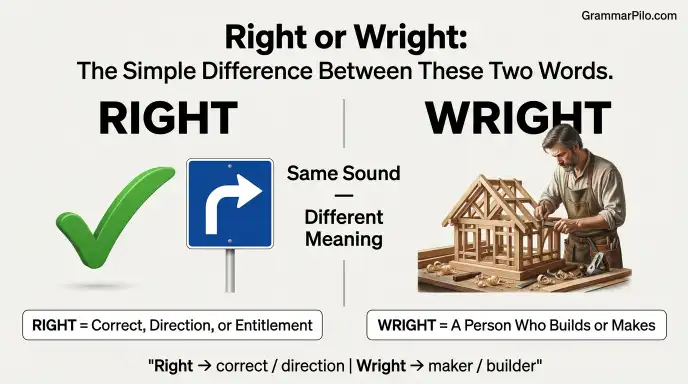
Right is the common English word used for correctness, direction, entitlement, or something proper, while wright is a much less common noun referring to a person who makes or builds things, especially traditionally from wood. The two words are pronounced the same, but their meanings and spellings are completely different.
The confusion between right or wright usually comes from their pronunciation. Both words are pronounced approximately like “rite,” so hearing the word alone does not tell you which spelling to use. The context of the sentence gives you the answer.
For example, “You are right” can be used when someone has given a correct answer. When giving directions, you might say, “Turn right at the corner.” The word right can also describe something that belongs to someone or something that is morally or legally justified.
Wright, on the other hand, appears mainly in historical, occupational, or compound word contexts. Words such as wheelwright, shipwright, and wright preserve an old English word connected with making or building.
Understanding the difference between right and wright becomes easy once you connect right with correctness and direction, and wright with making or building.
Right or Wright: Quick Answer
Right: The common word meaning correct, proper, opposite of left, or a legal or moral entitlement.
Wright: A person who makes or builds things, especially traditionally from wood.
The easiest memory rule is:
Right = correct or opposite of left
Wright = maker or builder
For example:
You are right.
Turn right at the next street.
The wheelwright repaired the wooden wheel.
The old wright was known for his craftsmanship.
The words right or wright sound alike, but they cannot normally be exchanged.
Definition and Meaning of Right or Wright
What Does Right Mean?
Right is one of the most flexible words in English. It can work as an adjective, adverb, noun, and verb.
As an adjective, right can mean correct, proper, suitable, or morally correct.
Example: Your answer is right.
Example: We made the right choice for the project.
It can also refer to direction.
Example: Turn right after the bridge.
As a noun, right can refer to something a person is legally or morally entitled to.
Example: Everyone has the right to speak.
As an adverb, right can mean correctly, directly, or exactly.
Example: You did the calculation right.
Cambridge also distinguishes uses of right as an adverb, including the meaning “correctly” or “well.”
What Does Wright Mean?
Wright is a noun for a person who makes or builds things, especially out of wood. Cambridge labels this use as old fashioned or historical.
The word survives more clearly in compound words.
Common examples include:
Wheelwright: A person who traditionally makes or repairs wheels.
Shipwright: A person who builds or repairs ships.
Cartwright: A person who traditionally makes carts.
Playwright: A person who writes plays.
So, if you see wright in a modern word, it often carries the old idea of someone who makes something.
Right and Wright at a Glance
| Word | Main Meaning | Common Use |
| Right | Correct, proper, opposite of left, entitlement | Everyday English |
| Wright | Maker or builder | Historical terms and compound words |
The biggest difference is simple: right is a very common everyday word, while wright is specialized and much less common.
The Origin of Right and Wright
The Origin of Right
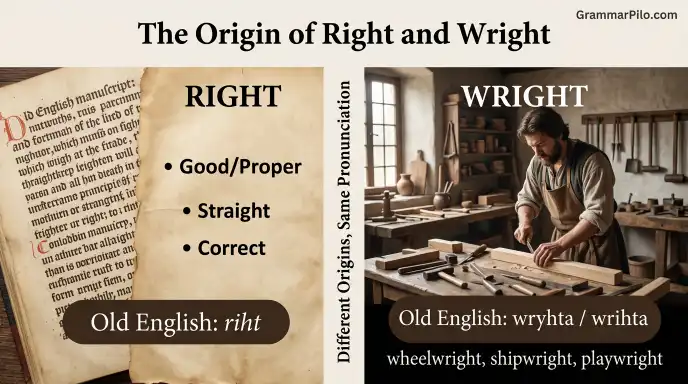
The word right has a very old history in English. Etymonline traces the adjective to Old English riht, with meanings including “good,” “proper,” “fitting,” “straight,” and “correct.” It is connected to the Proto Germanic form rehtan.
The meaning related to being opposite the left side developed from the older meanings connected with being straight, proper, or correct. Etymonline dates the “opposite of left” sense to the early 12th century.
Over time, right developed many meanings.
These include:
Right answer: A correct answer.
Right side: The side opposite the left.
Human right: Something a person is entitled to.
Right away: Immediately.
Right now: At this moment.
This explains why right appears so frequently in everyday English.
The Origin of Wright
Wright comes from Old English forms such as wryhta and wrihta, meaning a worker or maker. Etymonline connects it with the Old English verb wyrcan, meaning “to work.”
Historically, wright referred to an artisan or craftsperson. The word was especially associated with people who worked with wood and built useful objects.
The word later became preserved mainly in compounds and surnames.
Examples include:
Wheelwright
Wainwright
Cartwright
Shipwright
Playwright
The spelling wright therefore carries an old connection with work, craftsmanship, and making things.
British English vs American English Spelling
There is no standard British and American spelling difference between right and wright.
Both varieties use:
American English: right / wright
British English: right / wright
The difference is based on meaning, not regional spelling.
Comparison Table
| Word | American English | British English | Meaning |
| Right | right | right | Correct, proper, direction, entitlement |
| Wright | wright | wright | Maker or builder |
For example:
American: Turn right at the corner.
British: Turn right at the corner.
The spelling remains unchanged.
Which Word Should You Use?
Use right in almost all ordinary situations involving correctness, direction, suitability, morality, or entitlement.
Wright used only when you mean a traditional maker or builder, or when it appears as part of a recognized compound word.
Use Right for Correctness
Example: You are right about the answer.
Use Right for Direction
Example: Turn right after the traffic light.
Use Right for Entitlement
Example: Every citizen has certain legal rights.
Use Right for Something Proper or Suitable
Example: This is the right tool for the job.
Use Wright for a Traditional Maker
Example: The old village wright was known for making wooden tools.
Use Wright in Compound Words
Example: The wheelwright repaired the wagon wheel.
A simple test can help:
If you mean correct or the opposite of left, use right.
If you mean a maker or builder, use wright.
Common Mistakes with Right or Wright
Mistake 1: Writing “Wright” for “Correct”
Because the two words sound the same, some writers may accidentally choose wright.
Incorrect: You are wright.
Correct: You are right.
The meaning here is “correct,” so right is required.
Mistake 2: Writing “Wright” for Direction
Incorrect: Turn wright at the corner.
Correct: Turn right at the corner.
The direction opposite left is spelled right.
Mistake 3: Assuming Wright Is Simply an Alternative Spelling
Wright is not an alternative spelling of right.
They are separate words with separate meanings.
Right: correct, proper, direction, entitlement
Wright: maker or builder
Mistake 4: Forgetting Wright in Compound Words
Some familiar words contain wright.
Playwright
Wheelwright
Shipwright
These words preserve the historical meaning of wright as a maker or craftsperson.
Mistake 5: Confusing Right With Rite
There is another homophone to remember.
Right: correct or opposite of left
Wright: maker or builder
Rite: a formal or religious ceremony
For example:
She was right about the answer.
The wheelwright repaired the wheel.
The ceremony included an ancient rite.
Right or Wright in Everyday Examples
In Emails
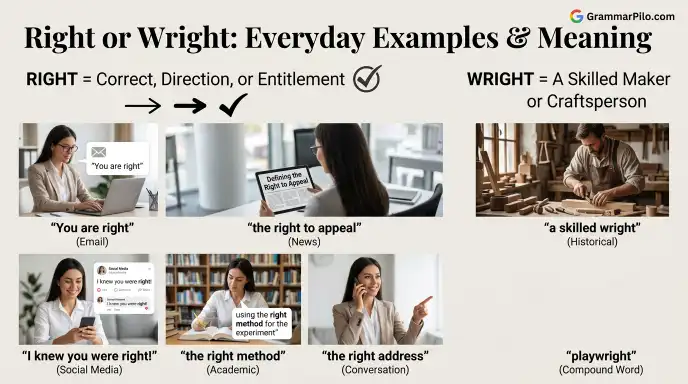
Correct: You are right about the meeting time.
Correct: Please turn right after the main entrance.
In News Writing
Correct: The court ruled that the workers had the right to appeal.
In Social Media
Correct: I knew you were right!
In Formal Writing
Correct: Every person has the right to express an opinion within the applicable rules.
In Academic Writing
Correct: The researchers selected the right method for the study.
In Conversation
Correct: Are you sure this is the right address?
In Workplace Communication
Correct: Please take the right hallway after the reception desk.
In Historical Writing
Correct: The village once employed a skilled wright to make wooden tools.
In Compound Words
Correct: The playwright created a new drama for the theater.
Right vs. Wright: Side by Side Comparison
| Feature | Right | Wright |
| Pronunciation | /raɪt/ | /raɪt/ |
| Common everyday word | Yes | No |
| Means correct | Yes | No |
| Means opposite of left | Yes | No |
| Can mean entitlement | Yes | No |
| Refers to a maker | No | Yes |
| Common in compound words | Sometimes | Yes |
| Historical origin | Old English riht | Old English wryhta / wrihta |
| British spelling | right | wright |
| American spelling | right | wright |
The pronunciation is the same, but the spelling tells you which meaning you intend.
Right or Wright: Google Trends & Usage Data
Google Trends can show search interest for right or wright, but search activity should not be treated as a direct measurement of correct word usage.
The two spellings may appear in searches for very different reasons.
People may search:
Right or wright
Wright or right
Right and wright
Wright and right
Right vs. wright
Wright vs. right
These searches can involve spelling checks, homophones, surnames, occupations, historical terms, or compound words.
Search behavior can also be affected by searches for famous surnames such as Wright, historical occupations, or words such as playwright and wheelwright.
For everyday English, right is the word you will encounter far more often because it has many meanings and grammatical uses.
Wright has a narrower meaning and is mainly found in historical contexts, surnames, and compound words.
How to Remember Right or Wright
A simple memory trick can help.
Think “Right = Correct”
If someone gives the correct answer, they are right.
Example: Your answer is right.
Think “Right = Direction”
The opposite of left is right.
Example: Turn right.
Think “Wright = Worker”
Connect wright with the old idea of a worker or maker.
Wright → Worker → Maker
This connection also helps with:
Wheelwright: Wheel maker
Shipwright: Ship builder
Cartwright: Cart maker
Playwright: Play maker in the sense of a person who writes plays
The Fast Memory Test
Ask yourself what the sentence means.
Correct or opposite of left: Right
Maker or builder: Wright
This makes the spelling much easier to remember.
Right and Wright in Compound Words
One of the best ways to recognize wright is to look at compound words.
Wheelwright
A wheelwright traditionally makes or repairs wheels.
Shipwright
A shipwright builds or repairs ships.
Cartwright
A cartwright traditionally makes carts.
Wainwright
A wainwright historically made or repaired wagons.
Playwright
A playwright writes plays.
These words preserve the historical wright spelling even though the word is not common as an independent noun in modern everyday English.
Key Takeaways
- Right is the common everyday English word.
- Right can mean correct, proper, opposite of left, or an entitlement.
- Wright means a maker or builder, especially in older usage.
- Both words are pronounced the same.
- Right is used in ordinary sentences such as “You are right.”
- Wright appears frequently in compounds such as playwright and wheelwright.
- British and American English use the same spellings.
- Right or wright is a homophone spelling question, not a regional spelling difference.
- Remember right = correct/direction.
- Remember wright = worker/maker.
Frequently Asked Questions
1. Is right or wright the correct spelling?
Both are correct words, but they have different meanings. Right is used for correctness, direction, suitability, and entitlement, while wright refers to a maker or builder, especially in historical usage.
2. Is wright a real word?
Yes. Wright is a real English noun meaning a person who makes or builds things, especially out of wood. Cambridge identifies it as an old use word.
3. Is “You are wright” correct?
No. The correct sentence is “You are right.” Here, right means correct.
4. Is “turn wright” correct?
No. The correct phrase is “turn right.” Right is the direction opposite left.
5. What does wright mean?
Wright means a maker or builder, especially in older English. It survives in words such as wheelwright, shipwright, and playwright.
6. Why are right and wright pronounced the same?
They developed from different historical word families, but their modern pronunciations became the same. This makes them homophones even though their spellings and meanings differ.
7. What is the difference between right and wright?
Right usually means correct, proper, opposite of left, or an entitlement. Wright means a maker or builder and is now mainly found in historical terms and compound words.
8. Is wright used in British English?
Yes. Wright exists in British English as well as American English. The spelling and basic meaning do not change between the two varieties.
9. Is playwright spelled with wright?
Yes. The correct spelling is playwright. The word preserves the historical wright element associated with a maker or worker.
10. What is an easy way to remember right and wright?
Remember right = correct or direction and wright = maker or builder. Compound words such as wheelwright and shipwright can help you remember the second spelling.
Conclusion
The difference between right or wright is mainly a difference in meaning and word history. Right is one of the most common words in English and can describe correctness, direction, suitability, morality, or a person’s legal or moral entitlement.
Wright is much less common and refers to a maker or builder, especially in older English. Today, it survives clearly in compound words such as wheelwright, shipwright, cartwright, and playwright.
The two words are pronounced the same, which explains why right or wright can be confusing when you hear them in conversation. The spelling must come from the meaning of the sentence.
For everyday writing, use right when you mean correct, proper, or the opposite of left. Use wright when you are referring to the traditional maker or builder meaning, or when it appears in a recognized compound word.
The easiest memory trick is simple: right means correct or direction, while wright connects with worker and maker. Once you remember that distinction, choosing between right and wright becomes much easier.
Explore Similar Words

I’m Claire Morgan, the author behind Grammarpilo.com, where I write about English grammar, sentence structure, punctuation, and everyday language. My goal is to make grammar simple, clear, and practical, helping readers understand the rules and apply them with confidence in real-world writing.




3 thoughts on “Right or Wright: The Simple Difference Between These Two Words”