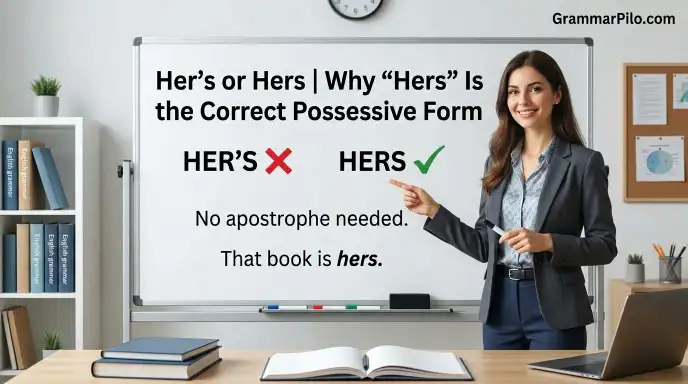
Hers is the correct standard English form, while her’s is not the standard spelling when you mean possession.
This small difference causes frequent confusion because an apostrophe often appears in possessive words, such as Sarah’s, the dog’s, or the teacher’s. However, possessive pronouns follow a different rule.
The word hers is a possessive pronoun. It shows that something belongs to a female person or is associated with her, and it can stand alone without a noun immediately after it. For example, “That jacket is hers” is correct.
The spelling her’s looks logical because many learners expect possession to require ‘s. However, possessive pronouns such as hers, ours, yours, theirs, and his do not take an apostrophe.
The British Council specifically lists hers among possessive pronouns and warns against forms such as her’s.So, when deciding between her’s or hers, use hers for possession.
Her’s or Hers: Quick Answer
Correct: hers
Incorrect for standard possessive use: her’s
Correct example: That blue car is hers.
Incorrect example: That blue car is her’s.
Simple rule: Possessive pronouns do not use apostrophes.
The same rule applies to several common possessive pronouns:
| Correct | Incorrect |
| hers | her’s |
| yours | your’s |
| ours | our’s |
| theirs | their’s |
| his | his’s |
The British Council explains that possessive pronouns do not have apostrophes and gives hers, ours, and theirs as examples.
Her’s and Hers: Quick Comparison
| Form | Meaning | Standard? | Example |
| hers | Belonging to her | Yes | The red bag is hers. |
| her’s | Intended as the possessive form of her | No in modern standard English | The red bag is hers. |
The key difference is not pronunciation. It is spelling and grammatical function.
Hers is the standard possessive pronoun. Her’s is commonly treated as a spelling error when the intended meaning is possession. Scribbr likewise explains that hers is the correct third person singular feminine possessive pronoun and that her’s is not correct for this use.
Definition and Meaning of Hers
What Does Hers Mean?
Hers is a third person singular feminine possessive pronoun. It indicates that something belongs to or is associated with a female person.
Example: The laptop is hers.
Here, hers means “her laptop.”
Another example:
Example: My coat is black, but hers is blue.
Here, hers replaces her coat.
This is an important feature of possessive pronouns. Hers can stand by itself instead of being followed by a noun.
Hers vs. Her
Her and hers are related, but they do different jobs.
Example: This is her book.
Here, her comes before the noun book.
Example: This book is hers.
Here, hers stands alone.
A simple comparison is:
| Word | Function | Example |
| her | Possessive determiner | This is her phone. |
| hers | Possessive pronoun | This phone is hers. |
Can Hers Stand Alone?
Yes. In fact, this is one of the main grammatical features that separates hers from her.
Correct: The blue umbrella is hers.
Correct: I found my keys, but she cannot find hers.
In the second example, hers replaces her keys.
The Origin of Hers and Her’s
The history of hers helps explain why its spelling does not follow the modern pattern many learners expect.
Origin of Hers
Reference sources trace hers to Middle English forms such as hires and heres. Wiktionary records the word as being attested from the Middle English period and explains its development into the modern possessive pronoun hers.
The modern form developed over time rather than simply being created by taking her and adding an apostrophe plus s.
This is why the standard spelling is:
her → hers
not:
her → her’s
Historical Use of Her’s
The form her’s has appeared in older English texts. Historical examples can be found in literature, including works from the eighteenth and nineteenth centuries. Wiktionary records her’s as an obsolete form of hers.
This historical use is important because it explains why her’s may sometimes appear in older books or historical quotations.
Modern standard English, however, uses hers for the possessive pronoun.
British English vs American English Spelling
There is no standard British American spelling difference between hers and her’s.
Both British English and American English use:
hers
Both varieties generally reject her’s as the standard possessive pronoun spelling.
| English Variety | Standard Form | Nonstandard Form |
| American English | hers | her’s |
| British English | hers | her’s |
| Canadian English | hers | her’s |
| Australian English | hers | her’s |
| International English | hers | her’s |
The British Council’s possessive pronoun guidance applies the no apostrophe rule to hers, along with other possessive pronouns.
So her’s vs. hers is not a British English versus American English issue. The standard form is hers in both.
Which Form Should You Use?
Use hers when you need a possessive pronoun.
Use Hers in Formal Writing
Correct: The final decision was hers.
Incorrect: The final decision was her’s.
Academic and formal writing should use the standard spelling hers.
Use Hers in Professional Emails
Correct: The blue folder is hers, so please return it to her desk.
Incorrect: The blue folder is her’s, so please return it to her desk.
Use Hers in Everyday Writing
Correct: That phone is hers.
Correct: The smaller apartment is hers.
Use Her Before a Noun
When a noun comes immediately after the possessive word, use her, not hers.
Correct: This is her car.
Incorrect: This is hers car.
The difference is easy to remember:
her + noun
hers without the noun
Common Mistakes With Her’s or Hers
Mistake 1: Adding an Apostrophe to Hers
Incorrect: That jacket is her’s.
Correct: That jacket is hers.
The apostrophe is unnecessary because hers is already a possessive pronoun.
Mistake 2: Writing Hers Before a Noun
Incorrect: Hers car is outside.
Correct: Her car is outside.
Hers normally replaces a noun phrase rather than modifying a noun directly.
Mistake 3: Assuming Every Possessive Needs ‘s
This is a common English spelling trap.
Possessive nouns can use ‘s:
Example: Maria’s phone
But possessive pronouns do not:
Example: The phone is hers.
The British Council specifically notes that possessive pronouns do not use apostrophes.
Mistake 4: Confusing Hers With Here’s
Here’s is completely different from hers.
Here’s is a contraction of here is or here has.
Example: Here’s your book.
Hers indicates possession.
Example: The book is hers.
A useful test is to expand here’s. If here is or here has works, you probably need here’s, not hers.
Mistake 5: Using Hers’ With an Apostrophe at the End
Incorrect: That responsibility is hers’.
Correct: That responsibility is hers.
The word hers does not need an apostrophe at either end.
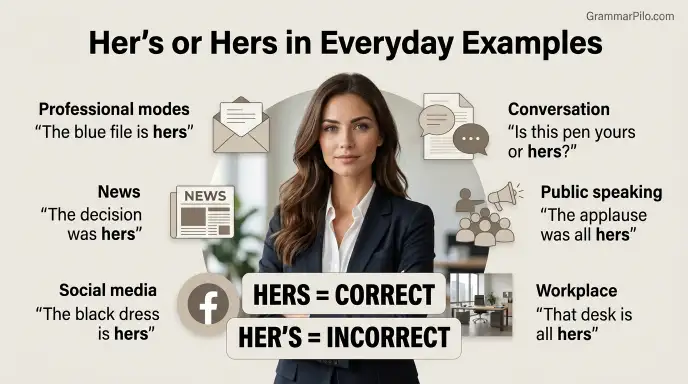
Her’s or Hers in Everyday Examples
In Emails
Correct: The blue file is hers.
Correct: I believe this notebook is hers.
In News Writing
Correct: The decision was ultimately hers.
In Social Media
Correct: The black dress is hers, and the white one is mine.
In Formal Writing
Correct: The responsibility for the final decision was hers.
In Academic Writing
Correct: The interpretation was hers rather than her colleague’s.
In Conversation
Correct: Is this pen yours or hers?
In Workplace Communication
Correct: That desk is hers, so please leave the documents there.
Her and Hers: The Grammar Rule
The easiest way to understand her vs. hers is to look at what comes next.
Her + Noun
Use her before a noun.
Example: Her computer is new.
Example: I borrowed her book.
Hers Without a Noun
Use hers when the noun is understood and does not need to be repeated.
Example: My computer is old, but hers is new.
Example: I borrowed my book, not hers.
This gives you a simple formula:
her + noun
hers = her + noun understood
Her’s vs. Hers in Different Sentences
Here are some side by side examples:
| Incorrect | Correct |
| The car is her’s. | The car is hers. |
| That phone is her’s. | That phone is hers. |
| The red bag is her’s. | The red bag is hers. |
| This is hers book. | This is her book. |
| I like her’s better. | I like hers better. |
The main issue is understanding the grammatical role of her and hers.
Her’s or Hers: Google Trends & Usage Data
People search for her’s or hers because the apostrophe pattern can seem natural. English commonly uses apostrophes to show possession with nouns, so learners may apply the same pattern to possessive pronouns.
Search interest alone does not determine the correct form. Dictionary and grammar references provide stronger evidence for standard usage.
The British Council explicitly lists hers as the possessive pronoun corresponding to she and warns that possessive pronouns do not take apostrophes.
Scribbr similarly identifies hers as the correct form and explains that her’s is a common mistake.
Historical sources do show her’s in older texts, but modern standard English uses hers.
So, when comparing her’s vs. hers in modern writing, the standard choice is clear.
Her’s and Hers Side by Side
| Feature | Hers | Her’s |
| Standard modern English | Yes | No |
| Possessive pronoun | Yes | No |
| Shows possession | Yes | Intended meaning |
| Takes an apostrophe | No | Not in standard modern use |
| Used before a noun | No | No |
| Can stand alone | Yes | No |
| Formal writing | Use | Avoid |
| Academic writing | Use | Avoid |
| Professional writing | Use | Avoid |
| Historical texts | Yes | May appear |
Key Takeaways
- Hers is the correct standard possessive pronoun.
- Her’s is not the standard modern spelling for possession.
- Possessive pronouns do not use apostrophes.
- Use her before a noun.
- Use hers when the noun is understood or omitted.
- Here’s is different from hers.
- Hers’ is also incorrect in standard English.
- British and American English both use hers.
- Historical texts may contain her’s, but modern standard writing uses hers.
- Remember: her car, but the car is hers.
Frequently Asked Questions About Her’s or Hers
1. Is her’s or hers correct?
Answer: Hers is the correct standard English form when you are showing possession. Her’s is not the standard spelling of the possessive pronoun. For example, “That bag is hers” is correct.
The British Council lists hers as the possessive pronoun corresponding to she and states that possessive pronouns do not use apostrophes.
2. Why is hers spelled without an apostrophe?
Answer: Hers is a possessive pronoun, and possessive pronouns have their own forms. They do not follow the same apostrophe pattern as possessive nouns. For example, Sarah’s book uses an apostrophe because Sarah is a noun, but the book is hers uses the possessive pronoun hers without an apostrophe.
3. Is her’s ever correct?
Answer: In modern standard English, her’s is not the correct spelling for the possessive pronoun. Historical English texts contain examples of her’s, and reference sources record it as an obsolete form. Modern writing should use hers.
4. What is the difference between her and hers?
Answer: Her is normally used before a noun, while hers replaces a noun phrase. For example, “This is her jacket” uses her before jacket. “This jacket is hers” uses hers without repeating the noun. A simple rule is her + noun and hers without the noun.
5. Is hers a possessive pronoun?
Answer: Yes. Hers is a third person singular feminine possessive pronoun. It shows that something belongs to or is associated with a female person and can stand without a following noun. For example, “The red bicycle is hers” means that the red bicycle belongs to her.
6. Is her’s a possessive pronoun?
Answer: Her’s is not the standard modern possessive pronoun. The standard form is hers. Although her’s appears in historical writing and has been recorded as an obsolete form, it should not be used in modern standard English to show possession.
7. Is hers or her’s used in American English?
Answer: American English uses hers as the standard possessive pronoun. Her’s is not a standard American spelling for possession. The same rule applies in standard British English, so this is not a difference between American and British spelling.
8. Can you say “hers book”?
Answer: No. Use her before a noun. The correct sentence is “That is her book.” Use hers when the noun does not follow it, as in “That book is hers.” This distinction is one of the easiest ways to remember the difference between her and hers.
9. What is the difference between here’s and hers?
Answer: Here’s is a contraction, usually meaning here is or here has. Hers is a possessive pronoun. For example, “Here’s your coat” means “Here is your coat,” while “The coat is hers” means the coat belongs to her. The apostrophe in here’s signals the contraction.
10. How do I remember her’s or hers?
Answer: Remember that possessive pronouns do not need apostrophes. Think of the pair her car and the car is hers. If a noun comes after the word, use her. If the word stands alone to show possession, use hers. Never add an apostrophe to hers in standard modern English.
Conclusion: Her’s or Hers?
Hers is the correct standard English form, while her’s is not the standard modern spelling for possession. The main reason people confuse her’s and hers is that apostrophes are commonly used with possessive nouns. For example, we write Sarah’s phone, so it can seem logical to write her’s phone. English possessive pronouns do not work that way.
The easiest rule is simple: use her before a noun and hers when the noun is understood or omitted. For example, “This is her jacket” is correct, while “This jacket is hers” is also correct.
The British Council confirms that possessive pronouns such as hers, ours, yours, and theirs do not take apostrophes. Historical sources show that her’s has appeared in older English, but modern standard English uses hers.
So, when you see her’s or hers, hers and her’s, or her’s vs. hers, remember one simple rule: hers is the standard form.
Similar Words Explained

I’m Sloane Mercer, a U.S.-based English language writer focused on grammar, spelling, vocabulary, and everyday English usage. Through GrammarPilo, I provide clear and practical explanations to help readers choose the right words and communicate with confidence.






1 thought on “Her’s or Hers: Why “Hers” Is the Correct Possessive Form”