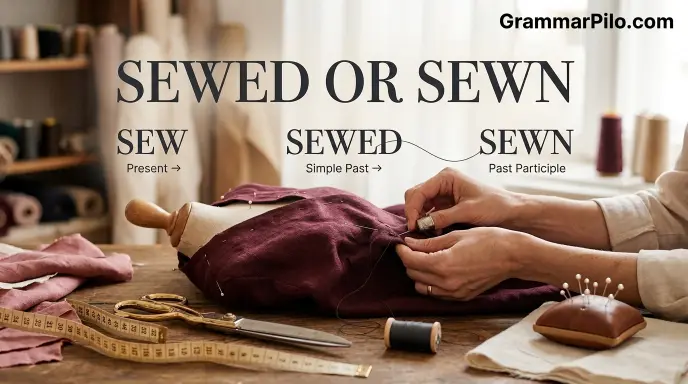
Sewed is the simple past form of sew, while sewn is a past participle commonly used with have, has, had, and in passive sentences. Both sewed and sewn are correct forms of the verb, but they do not always work in the same sentence.
People often search for sewed or sewn because the verb sew has an unusual set of forms. Unlike many regular verbs, it can appear as sew, sewed, and sewn, which makes the past forms easy to mix up. For example, we say, “I sewed the dress yesterday,” but “I have sewn the dress.”
Dictionaries also record sewed as an alternative past participle, so the issue is more flexible than it may first appear. The key is understanding how each form works in a sentence.
If you remember one basic pattern, make it sew → sewed → sewn. Use sewed for a simple past action, and use sewn most often with helping verbs or in passive constructions.
Sewed or Sewn: Quick Answer
Sewed is the simple past form of sew.
Example: I sewed a button onto my shirt yesterday.
Sewn is a past participle.
Example: I have sewn a button onto my shirt.
You can also use sewn in passive sentences.
Example: The button was sewn onto the shirt.
The basic verb forms are:
Sew → sewed → sewn
| Form | Use | Example |
| sew | Present/base form | I sew clothes. |
| sewed | Simple past | I sewed the dress. |
| sewn | Past participle | I have sewn the dress. |
| sewing | ing form | I am sewing the dress. |
There is one important detail: sewed can also be used as a past participle. Major dictionaries recognize both sewn and sewed in this role. However, sewn is very common after have, has, and had and in passive constructions.
Definition and Meaning of Sewed or Sewn
What does “sew” mean?
Sew means to join pieces of material using a needle and thread. It can also mean attaching something to fabric with stitches or repairing clothing.
Examples:
- I sew my own clothes.
- She sewed the torn sleeve.
- He is sewing a button onto his jacket.
The verb can describe both hand sewing and machine sewing.
What does “sewed” mean?
Sewed is normally the simple past form of sew.
It describes an action that happened in the past.
Examples:
- She sewed a new dress.
- I sewed the patch onto my jeans.
- They sewed the costumes last week.
The action is presented as a completed past event.
What does “sewn” mean?
Sewn is a past participle of sew.
It is commonly used with have, has, or had.
Examples:
- I have sewn the button back on.
- She has sewn three dresses.
- They had sewn the costumes before the performance.
It is also common in passive constructions.
Example: The dress was sewn by hand.
Can “sewed” be a past participle?
Yes. This is an important point.
Cambridge lists the past tense as sewed and gives sewn or sewed as past participles. Oxford also records both forms.
So I have sewed the dress can be found in standard English.
Still, I have sewn the dress is a very familiar and widely used form. For learners, the easiest pattern is:
Simple past → sewed
Past participle → sewn
The Origin of Sewed or Sewn
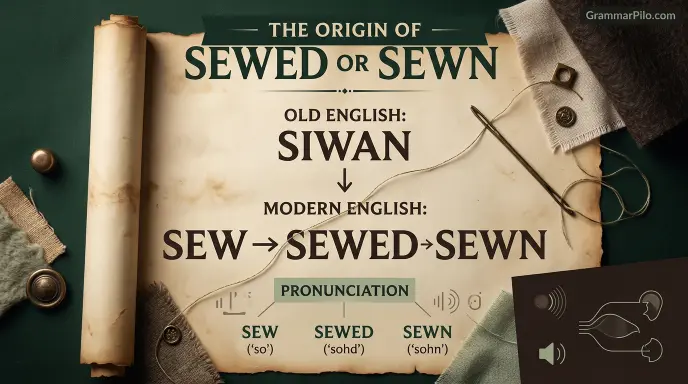
The verb sew has a very old history. It comes from Old English siwan, meaning to sew or stitch. It belongs to a wider Germanic word family connected with the idea of joining materials with thread.
The modern forms developed over many centuries.
English has retained different forms for the past tense and past participle:
sew → sewed → sewn
This pattern reflects older English verb formation. The form sewn has survived as a strong or irregular past participle, while sewed developed as the regular looking past form.
The spelling can be confusing because pronunciation does not closely follow the letters.
Sew is pronounced like “so.”
Sewed is pronounced approximately like “sohd.”
Sewn is pronounced approximately like “sohn.”
This unusual pronunciation is one reason learners may recognize the words when spoken but feel unsure about their spelling when writing.
The historical development also explains why English has more than one accepted past participle form. Modern dictionaries continue to recognize sewn and sewed as possible forms.
British English vs American English Spelling
There is no major British versus American spelling difference between sewed and sewn.
Both British and American English use sewed as the simple past form. Both also recognize sewn as a past participle. Sewed can also function as a past participle.
| English variety | Simple past | Past participle |
| British English | sewed | sewn / sewed |
| American English | sewed | sewn / sewed |
| Canadian English | sewed | sewn / sewed |
| Australian English | sewed | sewn / sewed |
| International English | sewed | sewn / sewed |
British English examples
I sewed the dress yesterday.
I have sewn the dress by hand.
American English examples
I sewed the dress yesterday.
I have sewn the dress by hand.
The difference is therefore mainly about verb form and sentence structure, not national spelling rules.
Which Spelling Should You Use?
For American English
Use sewed when describing a simple past action.
Example: I sewed the jacket last night.
Use sewn when forming the present perfect, past perfect, or passive voice.
Examples:
- I have sewn the jacket.
- She had sewn the lining.
- The jacket was sewn by hand.
For British and Commonwealth English
The same basic pattern works.
Example: She sewed the dress yesterday.
Example: She has sewn the dress already.
For international writing
If you want a form that is immediately familiar to a wide range of English readers, the pattern sewed for simple past and sewn for past participle is easy to understand.
This is especially useful for students, ESL learners, editors, and writers who want consistent usage.
The easiest rule
Remember:
Yesterday → sewed
Have/has/had → sewn
Was/were → sewn
For example:
Yesterday, I sewed the dress.
I have sewn the dress.
The dress was sewn by hand.
Common Mistakes with Sewed or Sewn
Mistake 1: Using “sewn” as the simple past
Incorrect: I sewn the dress yesterday.
Correct: I sewed the dress yesterday.
The sentence describes one completed action in the past, so sewed is the simple past form.
Mistake 2: Using “sewed” when “sewn” is expected
Less usual: I have sewed the dress.
Common choice: I have sewn the dress.
The first form is documented because sewed can also be a past participle. However, sewn is a very familiar choice in this construction.
Mistake 3: Forgetting the helping verb
Incorrect: She sewn the button yesterday.
Correct: She sewed the button yesterday.
Or:
Correct: She has sewn the button onto the shirt.
The form sewn normally needs a suitable auxiliary in this type of sentence.
Mistake 4: Confusing “sew” and “sewing”
Incorrect: I am sew a dress.
Correct: I am sewing a dress.
After am, is, or are for a continuous action, use the ing form.
Mistake 5: Assuming “sewed” is always incorrect
Incorrect idea: “Sewed” can never be used with have.
In fact, dictionaries recognize sewed as an alternative past participle.
However, sewn is a very common choice:
I have sewn the dress.
Sewn vs. Sewed in Everyday Examples
In Emails
Example: I sewed the missing button onto the uniform yesterday.
This uses sewed because the action happened in the past.
Example: I have sewn the loose button back onto the shirt.
This uses sewn with have.
In News Writing
Example: The costumes were sewn by local volunteers.
The passive construction naturally uses sewn.
Example: The designer sewed the costumes for the event.
Here, sewed is the simple past.
In Social Media
Example: I finally sewed my first dress!
Example: Look what I have sewn this weekend!
Both forms can appear naturally in casual online writing.
In Formal Writing
Example: The fabric was carefully sewn along the edges.
Example: The tailor sewed the individual pieces together.
The correct form depends on the grammatical structure rather than the level of formality.
In Everyday Conversation
Example: My grandmother sewed this blanket years ago.
Example: She has sewn blankets for the whole family.
These examples show the basic difference clearly.
Sewed or Sewn: Google Trends & Usage Data
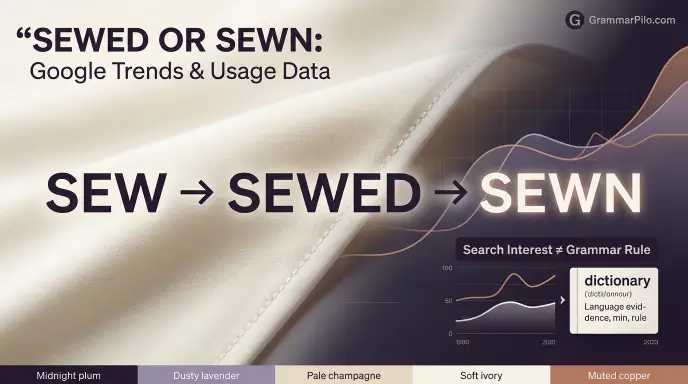
Google Trends can help show how often people search for sewed or sewn, but search popularity does not decide grammar.
Search interest can change based on:
- Country
- Time period
- Search category
- Search type
- Seasonal interest
- User intent
Someone searching for sewed or sewn may be looking for a grammar explanation, a spelling check, a definition, or help with a sentence.
For this reason, Google Trends should be treated as a measure of search interest, not proof that one form is grammatically better.
Dictionary evidence gives a clearer picture of actual usage. Cambridge identifies sewed as the past tense and recognizes sewn or sewed as past participles. Oxford also records the relevant verb forms.
Why “sewn” often attracts attention
The form sewn looks unusual because many English learners expect the past form to end in ed.
They may know:
sew → sewed
and then wonder why they also see:
sew → sewn
The answer is that English preserves both forms in modern usage, with sewn being especially common as a past participle.
Sewed vs. Sewn: Comparison Table
| Feature | Sewed | Sewn |
| Base verb | sew | sew |
| Simple present | No | No |
| Simple past | Yes | No |
| Past participle | Yes | Yes |
| Common with have/has/had | Possible | Very common |
| Common in passive voice | Possible | Very common |
| Meaning | Completed sewing action | Completed sewing action |
| Example | I sewed the dress. | I have sewn the dress. |
| Pronunciation | Like “sohd” | Like “sohn” |
The main pattern
Sew: I sew clothes.
Sewed: I sewed clothes yesterday.
Sewn: I have sewn clothes before.
Sewing: I am sewing clothes now.
Frequently Asked Questions
1. Is “sewed” correct?
Yes. Sewed is the standard simple past form of sew. Dictionaries also recognize sewed as a possible past participle.
2. Is “sewn” correct?
Yes. Sewn is a standard past participle of sew.
Example: She has sewn the dress.
3. Is it “I sewed” or “I sewn”?
Use I sewed for the simple past.
Correct: I sewed the dress yesterday.
Use I have sewn when using the present perfect.
Correct: I have sewn the dress.
4. What is the past tense of “sew”?
The simple past is sewed.
Example: She sewed a new skirt last week.
5. What is the past participle of “sew”?
The past participle can be sewn or sewed. Sewn is a very common choice, especially after have, has, and had.
6. Can I say “I have sewed”?
Yes. Sewed is documented as an alternative past participle.
However, I have sewn is also standard and is a very common construction.
7. Should I say “was sewed” or “was sewn”?
Was sewn is the familiar choice.
Example: The dress was sewn by hand.
Sewed is also documented as a past participle, but was sewn is the clearer choice for most learners and general writing.
Final Thoughts
The difference between sewed or sewn becomes simple once you focus on sentence structure. Sewed is the simple past form of sew, so it works naturally for a completed action in the past. For example, “I sewed the dress yesterday.”
Sewn is a past participle and is especially common with have, has, had, and in passive constructions. For example, “I have sewn the dress” and “The dress was sewn by hand.”
There is also an important point for advanced learners: sewed can function as a past participle too. Major dictionaries recognize both sewn and sewed in this role.
For everyday writing, the easiest pattern to remember is sew → sewed → sewn. Use sewed for the simple past and sewn as the usual past participle. This rule will help you write naturally in American English, British English, and international English.
Don’t Miss!

I’m Claire Morgan, the author behind Grammarpilo.com, where I write about English grammar, sentence structure, punctuation, and everyday language. My goal is to make grammar simple, clear, and practical, helping readers understand the rules and apply them with confidence in real-world writing.





2 thoughts on “Sewed or Sewn: Which Form of Sew Should You Use?”