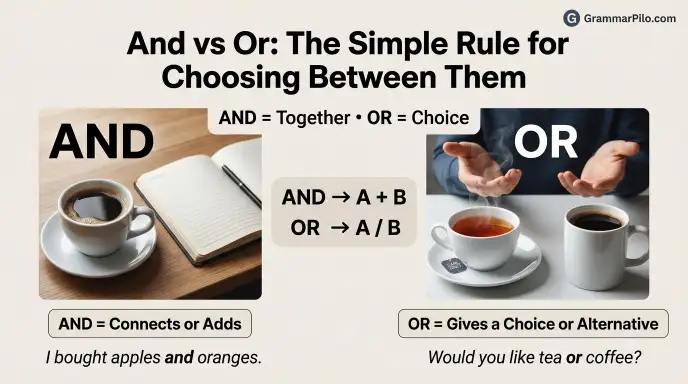
And connects things that are added together, while or presents alternatives or choices. The basic difference is simple: use and when two or more things are included together, and use or when you are presenting one possibility, another possibility, or a choice.
Both are coordinating conjunctions that can connect words, phrases, and clauses of the same grammatical type.
The confusion around and vs or usually happens because both words connect ideas. However, they create different relationships between those ideas.
If someone says, “I bought apples and oranges,” the sentence means the person bought both. If someone says, “Would you like apples or oranges?” the sentence presents two alternatives.
Understanding and and or is important because changing one word can change the meaning of an entire sentence.
The difference also becomes especially important in questions, lists, negative sentences, instructions, conditions, and formal writing.
This guide explains and or, or and, and vs. or, and or vs. and with simple rules, examples, common mistakes, and practical usage tips.
And vs Or: Quick Answer
And: Use and to add or combine two or more things.
Or: Use or to present alternatives, possibilities, or choices.
Example with and: I bought a notebook and a pen.
Example with or: You can choose a notebook or a pen.
In the first sentence, both items are included. In the second sentence, the speaker presents alternatives.
Cambridge identifies and as a common coordinating conjunction used for adding words, phrases, and clauses. It describes or as a conjunction that connects two or more possibilities or alternatives.
The Basic Memory Rule
And = together
Or = alternatives
This simple rule works in most everyday situations.
Definition and Meaning of And or
What Does And Mean?
And is a coordinating conjunction used to connect words, phrases, clauses, or ideas that are being added together.
Example: Sarah bought bread and milk.
The sentence tells us that Sarah bought both items.
Example: Tom opened the door and walked inside.
Here, and connects two actions.
Example: The report is clear and detailed.
Here, and connects two descriptions.
Cambridge explains that coordinating conjunctions such as and and or can connect items of the same grammatical type, including words, phrases, and clauses.
What Does Or Mean?
Or is a coordinating conjunction used to connect alternatives or possibilities.
Example: Would you like tea or coffee?
The speaker is presenting a choice.
Example: We can leave now or wait until later.
Two possible actions are presented.
Example: You can contact us by phone or email.
The sentence gives two possible methods of communication.
Cambridge specifically describes or as connecting two or more possibilities or alternatives.
And and Or at a Glance
| Word | Main Function | Basic Idea | Example |
| And | Adds or combines | Together | I need tea and coffee. |
| Or | Presents alternatives | Choice | Do you want tea or coffee? |
The Origin of And and Or
The Origin of And
And is one of the oldest and most frequently used connecting words in English.
The modern word developed from Old English forms including and and ond. It has continued to serve its basic connecting function throughout the history of English.
Its role has remained remarkably stable: it joins things together.
That basic idea can still be seen in modern sentences:
Bread and butter.
Jack and Jill.
Read and write.
The Origin of Or
Or also has a long history in English. It developed from Old English or, meaning an alternative or otherwise.
Its central function has remained connected with alternatives and choices.
Modern examples continue this basic meaning:
Example: Tea or coffee?
Example: Today or tomorrow?
The historical development of both words helps explain why they perform different grammatical jobs today.
British English vs American English Usage
There is no major British versus American spelling difference for and or or.
Both varieties use the same words:
British English: and / or
American English: and / or
The main differences can sometimes appear in punctuation and style rather than in the conjunctions themselves.
The Oxford Comma
One noticeable difference concerns lists containing and.
British English can use:
Example: We bought apples, oranges and bananas.
American English often uses:
Example: We bought apples, oranges, and bananas.
The extra comma before and is often called the Oxford comma or serial comma. Cambridge notes that the comma is optional before and in British English lists, while American English commonly uses it.
This does not change the meaning of and itself.
Comparison Table
| Feature | British English | American English |
| Word for addition | and | and |
| Word for alternatives | or | or |
| Spelling difference | None | None |
| Oxford comma | Often optional | Commonly used |
| Main meaning of and | Addition | Addition |
| Main meaning of or | Alternative | Alternative |
When Should You Use And?
Use and when you want to add information or show that two or more things belong together.
Adding Two Nouns
Example: I bought a shirt and a jacket.
Both items were bought.
Connecting Adjectives
Example: The room was clean and comfortable.
Both descriptions apply.
Connecting Verbs
Example: She opened the window and turned on the fan.
Two actions happened.
Connecting Clauses
Example: I finished my work and I went home.
Two clauses are connected.
Cambridge gives and as the common conjunction for adding words, phrases, clauses, and other elements.
When Should You Use Or?
Use or when you want to show alternatives, choices, or possibilities.
Giving a Choice
Example: Would you like tea or coffee?
The listener can choose between the two.
Giving Alternative Actions
Example: You can stay here or come with us.
Two possibilities are presented.
Showing Alternative Times
Example: Call me today or tomorrow.
The speaker offers two possible times.
Showing Alternative Methods
Example: You can pay online or by phone.
Two methods are available.
Cambridge explains that or connects two or more possibilities or alternatives.
And vs Or in Negative Sentences
This is one of the most important differences to understand.
In negative sentences, English commonly uses or instead of and when listing things that are not included.
Example: I don’t like tea or coffee.
This normally means that the speaker does not like tea and does not like coffee.
Compare:
Positive: I like tea and coffee.
Negative: I don’t like tea or coffee.
Cambridge specifically notes that or is used after the negative form of a verb instead of and in this type of sentence.
More Examples
Example: She doesn’t eat meat or fish.
Example: We don’t have time for lunch or dinner.
This pattern can feel confusing because the meaning may involve both things being excluded.
Either … Or and Both … And
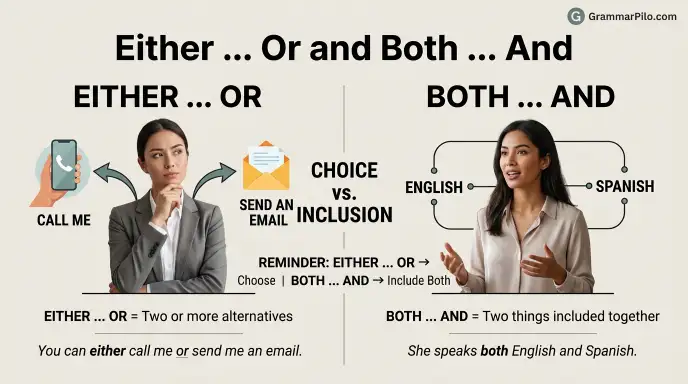
English also uses paired conjunctions to make relationships clearer.
Either … Or
Either … or presents two or more alternatives.
Example: You can either call me or send me an email.
The sentence presents two choices.
Both … And
Both … and emphasizes that two things are included.
Example: She speaks both English and Spanish.
The sentence tells us that she speaks both languages.
Cambridge lists either … or, neither … nor, and both … and among common two part coordinating conjunctions.
Comparison
| Structure | Meaning | Example |
| and | Addition | I want tea and coffee. |
| or | Alternative | I want tea or coffee. |
| both … and | Two things included | I want both tea and coffee. |
| either … or | One of two alternatives | I want either tea or coffee. |
| neither … nor | None of two alternatives | I want neither tea nor coffee. |
Common Mistakes With And vs Or
Mistake 1: Using And for a Choice
Incorrect: Would you like tea and coffee?
This asks for both unless the context gives another meaning.
Better: Would you like tea or coffee?
Use or when presenting a choice.
Mistake 2: Using Or When Both Things Are Included
Incorrect: I bought bread or milk.
If the speaker means both items were purchased, and is needed.
Correct: I bought bread and milk.
Mistake 3: Using And in a Negative List
Less natural: I don’t eat meat and fish.
Standard choice: I don’t eat meat or fish.
When a negative verb applies to both alternatives, or is commonly used.
Mistake 4: Confusing Either … Or With Both … And
Example: You can choose either red or blue.
This means the choices are alternatives.
Example: You can choose both red and blue.
This means both can be selected.
The conjunction changes the relationship between the choices.
Mistake 5: Connecting Unequal Grammatical Structures
Coordinating conjunctions normally connect elements of the same grammatical type.
Example: She likes reading and writing.
Both connected elements are gerunds.
Example: We can travel by train or by bus.
Both connected elements are prepositional phrases.
Cambridge notes that coordinating conjunctions connect items of the same grammatical type.
And or Or in Everyday Examples
In Emails
Example: Please review the document and send me your comments.
Here, two actions are requested.
Example: Please reply by email or phone the office.
Here, two communication options are provided.
In News Writing
Example: Officials announced new rules and additional safety measures.
Both things are included.
Example: Residents can report the issue online or by telephone.
Two reporting options are presented.
In Social Media
Example: Coffee and a good book make the perfect weekend.
Both things are combined.
Example: Movie night or game night?
The post presents alternatives.
In Formal Writing
Example: The study examined age and language ability.
Both factors were examined.
Example: Participants could respond online or in writing.
Two response methods were available.
In Workplace Communication
Example: Please complete the form and send it to your manager.
Both actions are required.
Example: You can contact the support team by email or phone.
Either method can be used.
In Instructions
Example: Turn off the computer and unplug the cable.
Both actions should be completed.
Example: Save the file or you may lose your changes.
Here, or introduces an alternative consequence.
And vs Or in Questions
Questions are another place where the distinction matters.
Questions With And
Use and when you are asking about things together.
Example: Did you buy bread and milk?
This can ask if both items were purchased.
Example: Do you speak English and Spanish?
This asks about both languages.
Questions With Or
Use or when presenting alternatives.
Example: Did you buy bread or milk?
This asks which item was purchased, although context can affect the exact interpretation.
Example: Do you want tea or coffee?
This presents a clear choice.
The difference is:
And = both or together
Or = one possibility or another
And vs Or in Lists
Using And in a List
Example: I packed shirts, shoes, socks, and a jacket.
The items are being added together.
The final and connects the last item to the rest of the list. Cambridge notes that and is normally used before the final item in a list.
Using Or in a List
Example: You can choose tea, coffee, or juice.
The items are alternatives.
Comparison
And: We need pens, paper, and folders.
Or: You can bring pens, paper, or folders.
The first sentence describes a collection of things needed. The second gives a set of alternatives.
And vs Or: Side by Side Comparison
| Feature | And | Or |
| Main function | Adds information | Presents alternatives |
| Basic meaning | Together | Choice or possibility |
| Connects words | Yes | Yes |
| Connects phrases | Yes | Yes |
| Connects clauses | Yes | Yes |
| Positive lists | Common | Common when alternatives are intended |
| Negative lists | Less commonly used | Common |
| Choice questions | Usually not | Common |
| Paired form | both … and | either … or |
| Example | Tea and coffee | Tea or coffee |
Both and and or are coordinating conjunctions, but they create different logical relationships between the connected elements.
And or Or: Google Trends and Usage Data
Search interest for and or or, and vs. or, and or vs. and can reflect people looking for help with conjunctions and sentence meaning. However, Google Trends measures relative search interest, not grammatical correctness.
Searches can also come from specific contexts such as:
and vs. or in logic
or and meaning
and or grammar
or and grammar
and or in English
and vs. or examples
This matters because and and or are used in several fields, including everyday English, mathematics, computer programming, formal logic, and technical writing.
For ordinary English grammar, the basic distinction remains:
And = addition or combination
Or = alternative or choice
Cambridge’s grammar guidance supports this distinction, describing and as the common conjunction for adding and or as the conjunction for alternatives.
And vs Or in Logic and Technical Contexts
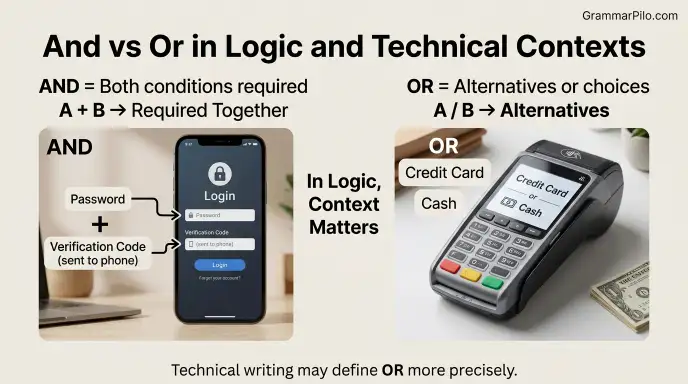
The words and and or also have special importance in logic and technical fields.
In everyday language, and usually means that multiple conditions or items are included together.
Example: You need a password and a verification code.
The sentence suggests that both are required.
Or generally introduces alternatives.
Example: You can pay by card or cash.
The exact meaning of or can depend on context in technical or logical writing. Sometimes it means one option, the other option, or potentially either or both. For that reason, formal technical documents often define conditions carefully.
For ordinary English writing, however, the practical distinction remains straightforward.
How to Remember And vs Or
Use this simple memory trick:
AND = ADD
Both words begin with the same idea:
And = add another thing
Or = offer another option
For example:
I want pizza and salad.
Add both foods.
I want pizza or salad.
Choose between alternatives.
Another useful test is to ask:
Are both included?
If yes, and is usually appropriate.
Is there a choice or alternative?
If yes, or is usually appropriate.
Key Takeaways
- And adds or combines things.
- Or presents alternatives or possibilities.
- And often means two or more things are included together.
- Or commonly presents a choice.
- Both are coordinating conjunctions.
- Both can connect words, phrases, and clauses of the same grammatical type.
- After a negative verb, or is commonly used instead of and when listing things that are not included.
- Both … and emphasizes inclusion.
- Either … or emphasizes alternatives.
- British and American English use the same spellings and and or.
- The main British American difference can involve punctuation, such as the Oxford comma.
- The easiest memory rule is and = together and or = choice.
Frequently Asked Questions
1. What is the difference between and vs or?
And adds or combines things, while or presents alternatives or possibilities.
Example: I want tea and coffee.
Example: I want tea or coffee.
2. Should I use and or or for a choice?
Or is normally used when you are presenting a choice.
Example: Would you like tea or coffee?
The word and normally indicates that both things are included.
3. What does and mean in grammar?
And is a coordinating conjunction used to connect words, phrases, clauses, and ideas that are being added together.
4. What does or mean in grammar?
Or is a coordinating conjunction used to connect alternatives or possibilities.
5. Can and and or connect clauses?
Yes. Both can connect clauses.
Example: I finished my work and I went home.
Example: We can stay here or we can leave now.
Coordinating conjunctions can connect clauses of equal grammatical status.
6. Should I use and or or after a negative verb?
Or is commonly used after a negative verb when listing alternatives or things that are not included.
Example: I don’t eat meat or fish.
Cambridge specifically gives this as a standard usage pattern.
7. What is the difference between both and and either or?
Both … and means two things are included.
Example: She speaks both English and Spanish.
Either … or presents alternatives.
Example: She speaks either English or Spanish.
8. Is and or correct in British and American English?
Yes. Both British and American English use and and or with the same basic meanings.
9. Is “and” a conjunction?
Yes. And is a coordinating conjunction that connects words, phrases, clauses, and other grammatical elements.
10. Is “or” a conjunction?
Yes. Or is a coordinating conjunction used mainly to connect alternatives and possibilities.
Conclusion
Understanding and vs or becomes much easier when you focus on the relationship between the ideas being connected. And is used mainly for addition and combination, while or is used mainly for alternatives, choices, and possibilities. These two small words can create a significant difference in sentence meaning.
Think of and as bringing things together. If you say, “I bought a notebook and a pen,” you are saying that both items were included. If you say, “I bought a notebook or a pen,” you are presenting alternatives.
The same principle works in questions, instructions, lists, workplace communication, formal writing, and everyday conversation. Negative sentences also have an important pattern, with or commonly used after a negative verb when multiple things are excluded.
The simplest memory rule is and = together and or = choice. Once you understand that basic distinction, choosing between and or, or and, and vs. or, and or vs. and becomes much more straightforward.
See the Difference

I’m Claire Morgan, the author behind Grammarpilo.com, where I write about English grammar, sentence structure, punctuation, and everyday language. My goal is to make grammar simple, clear, and practical, helping readers understand the rules and apply them with confidence in real-world writing.






2 thoughts on “And vs Or: The Simple Rule for Choosing Between Them”