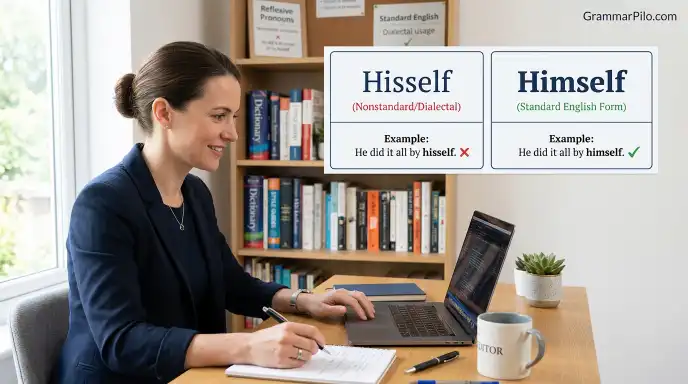
Himself is the correct standard English form, while hisself is a nonstandard or dialectal form of the same reflexive pronoun.
The confusion comes from the way English reflexive pronouns are formed. Words such as myself, yourself, and herself can make hisself look logical, but standard English uses himself, not hisself.
If you have seen hisself or himself in conversation, social media, older writing, or regional speech, the two forms may appear to be int
erchangeable. They are not interchangeable in standard written English. Himself is the form used in formal writing, academic work, professional communication, edited publications, and standard English.
At the same time, hisself is a real documented form. Dictionaries record it as nonstandard or dialectal, and it can appear in particular regional varieties of English or in dialogue intended to represent a speaker’s natural speech.
American Heritage, for example, identifies hisself as a chiefly Southern and South Midland U.S. form of himself, while Collins labels it “not standard.”
So, if you are deciding between hisself and himself for normal English writing, choose himself.
Hisself or Himself: Quick Answer
Correct standard form: himself
Nonstandard or dialectal form: hisself
Example:
Correct: He taught himself how to play the guitar.
Nonstandard: He taught hisself how to play the guitar.
Simple rule: Use himself in standard English. Use hisself only when intentionally representing a dialect or informal speech pattern.
Cambridge defines himself as the reflexive form used for a male person or animal and also as an emphatic form. Its grammar guidance lists he → himself among standard reflexive pronoun forms.
Hisself or Himself: Quick Comparison
| Form | Meaning | Standard? | Typical Use | Example |
| himself | Reflexive form of he/him | Yes | Standard English | He introduced himself. |
| hisself | Dialectal/nonstandard form of himself | No | Regional or informal speech | He did it hisself. |
The two forms can communicate the same basic meaning, but their grammatical status is different. Himself is the standard form. Hisself is recorded as a nonstandard or dialectal variant.
Definition and Meaning of Hisself and Himself
What Does Himself Mean?
Himself is a reflexive pronoun that refers back to a male person or animal represented by he or him.
For example:
Correct: John blamed himself for the mistake.
Here, himself refers back to John.
Correct: David introduced himself to the new team.
Here, himself shows that David introduced David.
Cambridge explains that reflexive pronouns are used when the subject and object refer to the same person or thing.
Himself for Emphasis
Himself can also emphasize a particular person.
Example: The manager himself approved the request.
This means the manager personally approved it.
Another example is:
Example: The author himself answered the question.
The word himself adds emphasis to the fact that the author personally did the action.
Himself With “By”
Himself can appear with by to mean alone or without help.
Example: He fixed the computer by himself.
Example: Michael traveled by himself.
This is another common standard use of the word.
What Does Hisself Mean?
Hisself has essentially the same basic meaning as himself, but it is not the standard English reflexive form.
American Heritage describes hisself as a chiefly Southern and South Midland U.S. form of himself. Dictionary.com labels it nonstandard, while Collins also marks it as not standard.
For example, you may encounter:
Dialectal: He hurt hisself while working.
Standard English would use:
Standard: He hurt himself while working.
The meaning is understandable in both sentences, but the standard form is himself.
The Origin of Himself and Hisself
The difference between himself and hisself has a long history.
The Origin of Himself
The word himself comes from Old English him selfum. The first part developed from the pronoun him, while self supplied the reflexive or emphatic element. Etymonline traces modern himself to this Old English construction.
The development can be simplified as:
he → him → himself
The modern standard form therefore does not come from his + self.
This is important because his is a possessive form, while him is the object form used in the standard reflexive construction.
The Origin of Hisself
Hisself is much older than many people realize. Etymonline dates the form to around the 14th century and explains that a shift in how the first element of himself was understood contributed to the development of hisself.
Dictionary.com also gives a Middle English origin dating to approximately 1350–1400.
American Heritage offers another useful explanation. It notes that forms such as hisself can result from regularizing an irregular pattern in the standard reflexive pronoun system.
In other words, speakers may naturally see forms such as:
my + self = myself
your + self = yourself
his + self = hisself
That pattern looks logical, but standard English preserves himself instead.
British English vs American English Spelling
There is no standard British-versus-American spelling difference between himself and hisself.
| Variety | Standard Form | Hisself |
| American English | himself | Nonstandard/dialectal |
| British English | himself | Nonstandard/dialectal |
| Academic English | himself | Avoid |
| Professional English | himself | Avoid |
| Formal writing | himself | Avoid |
| Regional dialect | himself | May occur |
American Heritage specifically records hisself as a chiefly Southern and South Midland U.S. form, but that does not make it the standard American English spelling.
Collins similarly labels hisself as “not standard.”
So it is inaccurate to say that hisself is the American spelling and himself is the British spelling. Both standard British and standard American English use himself.
Which Spelling Should You Use?
For almost all standard English writing, use himself.
Use Himself in Academic Writing
Use himself in:
- School assignments
- University papers
- Research writing
- Essays
- Exams
- Formal reports
Example: The researcher conducted the experiment himself.
Use Himself in Professional Writing
Use himself in:
- Emails
- Business reports
- Resumes
- Applications
- Workplace documents
- Professional websites
Example: The director himself reviewed the proposal.
Use Himself in Everyday Standard English
Himself is also the normal choice in everyday standard conversation and writing.
Example: He made dinner himself.
Example: He taught himself Spanish.
When Can Hisself Appear?
Hisself can appear when a writer intentionally represents a dialect, regional speech, historical speech, or a character’s informal voice.
For example, a novelist might write:
Dialectal dialogue: He done it hisself.
This does not mean the writer believes hisself is the standard spelling. It can be a deliberate representation of how a character speaks.
Dictionary sources document this kind of regional and nonstandard usage.
Common Mistakes With Hisself or Himself
Mistake 1: Using Hisself in Standard Writing
Incorrect in standard English: He taught hisself to cook.
Correct: He taught himself to cook.
The standard reflexive pronoun is himself.
Mistake 2: Thinking His + Self Must Equal Hisself
This is one of the easiest reasons to understand the confusion.
English has:
my + self = myself
your + self = yourself
her + self = herself
It may therefore seem logical to write:
his + self = hisself
However, standard English uses:
him + self = himself
The standard form must simply be learned as himself.
Mistake 3: Treating Hisself as an American Spelling
Hisself is not the standard American alternative to himself.
Some American regional dialects use hisself, particularly varieties associated with the Southern and South Midland United States. That is a dialect distinction, not a standard spelling difference.
Mistake 4: Changing Himself to Hisself in Formal Speech
A person may hear hisself in casual or regional speech and assume it should be copied into formal writing.
For standard writing, replace it with himself.
Mistake 5: Confusing Himself With His
These words perform different grammatical jobs.
Correct: That is his car.
Correct: He fixed the car himself.
His shows possession. Himself is reflexive or emphatic.
Hisself and Himself in Everyday Examples
In Emails
Correct: James will handle the presentation himself.
Incorrect: James will handle the presentation hisself.
For a professional email, himself is the appropriate standard form.
In News Writing
Correct: The president himself attended the ceremony.
News writing generally uses standard English, so himself is appropriate.
In Social Media
In ordinary social media writing, himself remains the standard form.
Example: He built the entire table himself.
A user might intentionally write hisself to reproduce a regional voice or informal dialect, but that is a stylistic choice rather than standard grammar.
In Formal Writing
Correct: The author himself explained the decision.
Correct: He completed the project himself.
In Everyday Conversation
Example: He made it himself.
Example: He went there by himself.
These are natural standard English sentences.
In Fictional Dialogue
A writer may use hisself to represent a character’s dialect.
Example: “He fixed it hisself.”
In this setting, the form can be intentional. The important distinction is between representing a dialect and using standard English.
Hisself vs. Himself: Grammar Rule
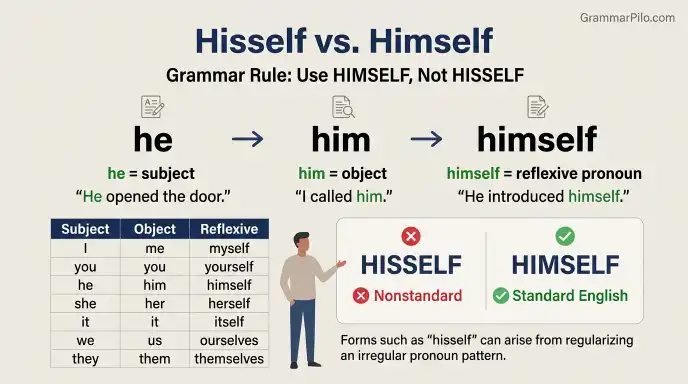
The easiest grammar rule is:
Standard reflexive form: he → him → himself
The pronoun he is the subject form.
Example: He opened the door.
The pronoun him is the object form.
Example: I called him.
The reflexive form is himself.
Example: He introduced himself.
This gives you a useful pattern:
| Subject | Object | Reflexive |
| I | me | myself |
| you | you | yourself |
| he | him | himself |
| she | her | herself |
| it | it | itself |
| we | us | ourselves |
| they | them | themselves |
Cambridge’s grammar guidance lists these standard reflexive forms and explains that reflexive pronouns commonly refer back to the subject.
The unusual part is that English does not form every reflexive pronoun with exactly the same pattern. Himself and themselves use object forms rather than possessive forms. American Heritage notes that forms such as hisself and theirselves can arise when speakers regularize this irregularity.
Hisself or Himself: Google Trends & Usage Data
Search interest can help show that people encounter both hisself and himself, but search frequency does not determine grammatical correctness.
Google Trends measures relative search interest over a selected period and location. A higher search interest for one spelling does not automatically mean that spelling is the standard form.
For this comparison, dictionary evidence is more useful for determining standard usage:
- Cambridge identifies himself as the standard reflexive pronoun.
- Dictionary.com labels hisself nonstandard.
- Collins labels hisself not standard.
- American Heritage documents hisself as a regional form, particularly in Southern and South Midland U.S. speech.
So, if you see hisself or himself in searches, books, comments, or conversations, the presence of both forms does not mean they have equal status in standard English.
Hisself and Himself Side-by-Side
| Feature | Himself | Hisself |
| Standard English | Yes | No |
| Reflexive pronoun | Yes | Dialectal/nonstandard variant |
| Meaning | Refers back to a male subject | Same basic meaning |
| Formal writing | Appropriate | Avoid |
| Academic writing | Appropriate | Avoid |
| Professional writing | Appropriate | Avoid |
| Regional speech | Common | May occur |
| Historical/dialect writing | Common | May occur |
| U.S. Southern dialect | Standard form | Documented regional form |
| British standard English | Standard | Nonstandard/dialectal |
Key Takeaways
- Himself is the correct standard English form.
- Hisself is a documented nonstandard or dialectal form.
- Use himself in school, academic, professional, and formal writing.
- Himself is the reflexive form connected to he/him.
- The spelling hisself may appear in regional or informal speech.
- Hisself has a long history and is not simply a modern spelling mistake.
- American Heritage records hisself especially in Southern and South Midland U.S. usage.
- If you are unsure, choose himself.
Frequently Asked Questions
1. Is hisself a correct word?
Answer: Hisself is a documented English word form, but it is not the standard reflexive pronoun used in formal English.
Dictionaries such as Dictionary.com and Collins label it nonstandard, while American Heritage records it as a regional form.
2. Is himself or hisself correct?
Answer: Himself is the correct choice in standard English. Use it in formal writing, academic work, business communication, and general standard English.
Hisself can occur in regional or dialectal speech but should not normally replace himself in standard writing.
3. Why do people say hisself instead of himself?
Answer: The form can result from applying a more regular pattern to English reflexive pronouns. Words such as myself, yourself, and herself may make his + self seem logical.
Some regional varieties therefore use hisself. American Heritage describes this as a regularization of an irregular pattern.
4. Is hisself an American word?
Answer: Hisself is documented in American English, particularly in Southern and South Midland varieties, but it is not the standard American English form.
Standard American English uses himself. The form is also documented historically and in dialects outside the United States.
5. Can I use hisself in formal writing?
Answer: No, himself is the better choice for formal standard English. Hisself may be appropriate in a quotation, fictional dialogue, dialect study, or other context where the writer intentionally represents a particular speech variety.
For normal essays, reports, emails, and professional writing, use himself.
6. What is the difference between his and himself?
Answer: His is a possessive word, while himself is a reflexive or emphatic pronoun. For example, “That is his jacket” uses his to show possession.
“He washed himself” uses himself because the action refers back to the subject he.
7. Is hisself a misspelling of himself?
Answer: In standard English writing, hisself should be treated as a nonstandard form rather than the normal spelling of himself.
However, calling it simply a random spelling mistake misses its dialect history. It is a documented regional and historical form with the same basic meaning as himself.
8. Is himself always used for males?
Answer: In modern standard English, himself normally refers to a male person or animal.
Cambridge also notes an older use in which himself could refer to a person of unknown or unspecified gender, although many people now prefer singular they and themselves for that purpose.
9. Can hisself appear in books?
Answer: Yes. Hisself can appear in literature, especially when a writer represents a character’s regional or informal speech.
Its appearance in a book does not make it the standard form. Writers may use nonstandard forms intentionally to preserve a character’s voice or dialect.
10. What should I remember about hisself or himself?
Answer: Remember the standard sequence he → him → himself. Although hisself may sound logical because of words such as myself and yourself, standard English uses himself. Use hisself only when a dialectal or historical form is intentionally required.
Conclusion
Himself is the correct standard English form, while hisself is a documented nonstandard and dialectal form. If you are writing an essay, email, report, article, application, or other standard English text, use himself.
The confusion is understandable because English reflexive pronouns do not follow one perfectly regular pattern. We have myself, yourself, and herself, so hisself can appear logical.
However, the standard form developed from him + self, giving us himself. Historical evidence also shows that hisself has existed for centuries, so it is more than a random modern spelling error.
The most useful rule is simple: he → him → himself.
If you encounter hisself, it may represent a regional dialect, informal speech, historical language, or fictional character voice. In standard English, however, himself is the form to choose.
Similar Words Explained

I’m Claire Morgan, the author behind Grammarpilo.com, where I write about English grammar, sentence structure, punctuation, and everyday language. My goal is to make grammar simple, clear, and practical, helping readers understand the rules and apply them with confidence in real-world writing.



3 thoughts on “Hisself or Himself: Clear Up the Confusion Now”