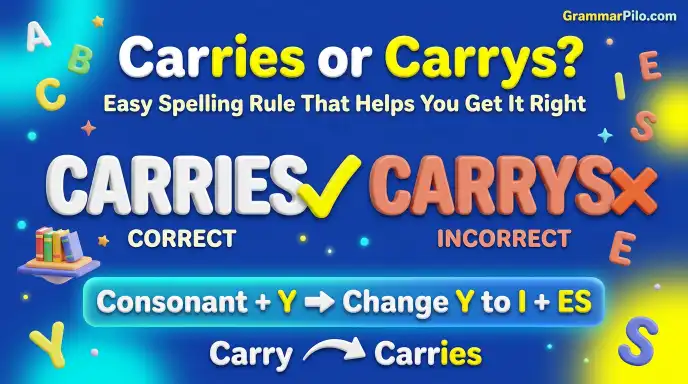
The correct spelling is carries, not carrys, when you want to describe someone or something transporting, holding, or taking something from one place to another.
The word carries is the third person singular form of the verb carry, used with subjects such as he, she, it, or a singular noun. The spelling carrys is a common mistake because English spelling rules can make verb endings confusing.
For example, you would write, “She carries her books to school,” rather than “She carrys her books to school.” The reason is simple: when a verb ends in a consonant followed by y, the y usually changes to ies when the verb is used with he, she, or it in the simple present tense.
Understanding the difference between carries and carrys helps you write more accurately in school assignments, emails, professional documents, and everyday messages.
This guide explains the correct spelling, meaning, grammar rule, pronunciation, examples, common mistakes, and related words so you can confidently choose the right form every time.
Quick Answer: Carries or Carrys?
Carries is the correct spelling. It is the simple present tense form of carry used with a third person singular subject, such as he, she, it, or a singular noun. Carrys is not the standard spelling in this context.
Example: She carries her laptop to work every morning.
Remember the rule: Carry changes to carries because the verb ends in a consonant followed by y.
What Does Carries Mean?
Carries is a verb that can describe transporting something, holding or supporting something, containing something, or having responsibility for something. Its exact meaning depends on the sentence.
1. Carries as Transporting Something
The word carries often describes taking an object or person from one place to another.
Examples:
- The student carries her books to class.
- He carries groceries into the kitchen.
- The worker carries boxes into the warehouse.
- My brother carries his backpack everywhere.
In each sentence, someone transports or moves something.
2. Carries as Holding or Supporting
Carries can also describe supporting the weight of something.
Examples:
- This bridge carries heavy traffic.
- The shelf carries several large boxes.
- The athlete carries the team during difficult matches.
The word can describe physical support or, figuratively, someone taking responsibility for a group’s performance.
3. Carries as Containing or Including
Sometimes, carries describes something that contains, provides, or includes another thing.
Examples:
- This store carries several international brands.
- The newspaper carries an article about education.
- The medicine carries a warning about possible side effects.
4. Carries as Having or Communicating Something
The word can also describe having a quality, meaning, responsibility, or implication.
Examples:
- Her words carry a powerful message.
- The decision carries serious consequences.
- His voice carries across the room.
What Does Carrys Mean?
Carrys is generally a misspelling of carries when the intended word is the verb carry in the simple present tense.
English spelling rules require the y to change to ies when a verb ending in a consonant plus y is used with he, she, or it.
Incorrect: He carrys his lunch to work.
Correct: He carries his lunch to work.
Incorrect: The bus carrys many passengers.
Correct: The bus carries many passengers.
Although carrys may appear in informal messages, spelling errors, or usernames, it is not the standard form for this verb. In formal writing, schoolwork, business communication, and published content, use carries.
Carries vs. Carrys: The Main Difference
The primary difference is spelling and grammatical correctness. Carries follows the standard English rule for third person singular verbs, while carrys does not.
| Feature | Carries | Carrys |
| Standard spelling | Correct | Incorrect in the intended verb form |
| Base verb | Carry | Carry |
| Grammatical use | Third person singular present | Not standard for this use |
| Example | She carries a bag. | She carrys a bag. |
| Suitable for formal writing | Yes | No |
The key point: Use carries with he, she, it, or a singular noun in the simple present tense.
Why Does Carry Change to Carries?
The spelling change follows a common English grammar rule.
When a verb ends in a consonant + y, change the final y to ies for the third person singular form in the simple present tense.
The formula is:
Consonant + y → consonant + ies
For example:
| Base verb | Correct form | Example |
| Carry | Carries | She carries a purse. |
| Try | Tries | He tries again. |
| Study | Studies | She studies English. |
| Worry | Worries | He worries too much. |
| Apply | Applies | The student applies for a scholarship. |
| Hurry | Hurries | She hurries to class. |
| Reply | Replies | He replies to the email. |
| Copy | Copies | The assistant copies the document. |
The same spelling pattern explains why carries is correct and carrys is not.
What Happens When a Verb Ends in a Vowel + Y?
When a verb ends in a vowel followed by y, you normally add s without changing the y.
Examples:
| Base verb | Correct form | Example |
| Play | Plays | He plays football. |
| Enjoy | Enjoys | She enjoys reading. |
| Stay | Stays | It stays open late. |
| Buy | Buys | He buys fresh fruit. |
| Say | Says | She says hello. |
Compare carry → carries with play → plays. The difference is the letter immediately before the final y.
Carries and Carry in Different Tenses
The form you choose depends on the subject and the tense of the sentence. You should not use carries in every situation.
| Grammar situation | Correct form | Example |
| Simple present with I | Carry | I carry my own bag. |
| Simple present with you | Carry | You carry the equipment. |
| Simple present with he or she | Carries | She carries her notebook. |
| Simple present with we | Carry | We carry the supplies. |
| Simple present with they | Carry | They carry their luggage. |
| Simple past | Carried | He carried the box yesterday. |
| Present continuous | Carrying | She is carrying a basket. |
| Present perfect | Has carried | He has carried this responsibility for years. |
| Future tense | Will carry | She will carry the documents. |
Important: Carries is used with a third person singular subject in the simple present tense. Other subjects and tenses require different forms.
British English vs. American English: Carries or Carrys
There is no spelling difference between standard British English and American English for this word. Both varieties use carries.
| English variety | Correct spelling | Incorrect form |
| American English | Carries | Carrys |
| British English | Carries | Carrys |
| Canadian English | Carries | Carrys |
| Australian English | Carries | Carrys |
| International English | Carries | Carrys |
For example, an American writer might say, “She carries her lunch to work,” and a British writer would use exactly the same spelling.
Other English varieties also follow this standard spelling rule.
Common Mistakes When Using Carries
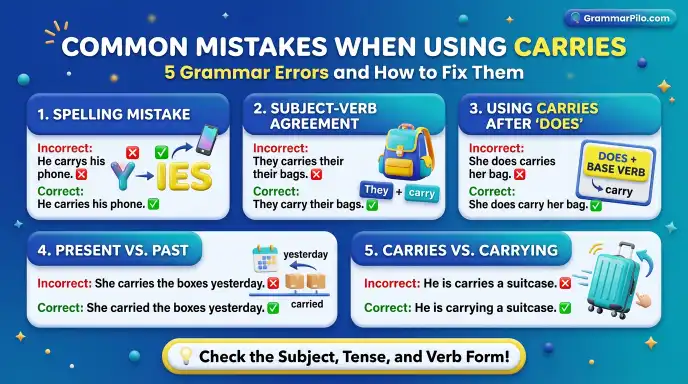
Writers sometimes make spelling and grammar errors because they apply the wrong verb pattern. Here are the most common mistakes and how to correct them.
Mistake 1: Writing Carrys Instead of Carries
Incorrect: He carrys his phone in his pocket.
Correct: He carries his phone in his pocket.
Why: A consonant followed by y changes to ies in this verb form.
Mistake 2: Using Carries With I or They
Incorrect: They carries their bags to school.
Correct: They carry their bags to school.
Why: I, you, we, and they use the base form carry in the simple present tense.
Mistake 3: Using Carries After Does
Incorrect: She does carries her own bag.
Correct: She does carry her own bag.
Why: After does, use the base form of the verb. The auxiliary verb already marks the third person singular form.
A question follows the same pattern:
Incorrect: Does he carries the package?
Correct: Does he carry the package?
Mistake 4: Confusing Carries With Carried
Incorrect: She carries the boxes yesterday.
Correct: She carried the boxes yesterday.
Why: Use carried for a completed action in the past. Use carries for a habitual or generally true action in the simple present.
Mistake 5: Confusing Carries With Carrying
Incorrect: He is carries a suitcase.
Correct: He is carrying a suitcase.
Why: After is, use the -ing form for the present continuous tense.
Carries or Carrys in Everyday Examples
The following examples show how to use the correct spelling in different situations.
For Example in:
School
- The student carries her books to class every day.
- He carries a calculator in his backpack.
- The teacher carries extra worksheets for the students.
- This sentence carries an important message about responsibility.
Emails and Workplace Communication
- She carries out the assigned tasks before the deadline.
- Our delivery service carries packages across the city.
- The report carries details about the latest project.
- He carries responsibility for managing the department.
Everyday Conversation
- My father carries his keys in his pocket.
- She carries an umbrella when it rains.
- The little boy carries his favorite toy everywhere.
- This bag carries everything I need for the trip.
News and Formal Writing
- The new policy carries significant financial implications.
- The company carries several popular product lines.
- The article carries a detailed explanation of the issue.
- The bridge carries thousands of vehicles each day.
Social Media and Informal Messages
- She carries her camera everywhere.
- He carries the whole team during the competition.
- This song carries so much emotion.
- My backpack carries all my study essentials.
In all these examples, carries is the correct form because it agrees with a singular third person subject.
Carries vs. Carry vs. Carried: Quick Comparison
These three forms are related, but they serve different grammatical purposes.
| Word | Function | Example |
| Carry | Base form; used with I, you, we, and they in the simple present | They carry the boxes. |
| Carries | Third person singular simple present | She carries the boxes. |
| Carried | Simple past and past participle | She carried the boxes yesterday. |
| Carrying | Present participle and gerund | She is carrying the boxes. |
Remember that carrys is not the correct standard spelling for any of these usual verb forms.
Carries or Carrys: Google Trends and Modern Usage
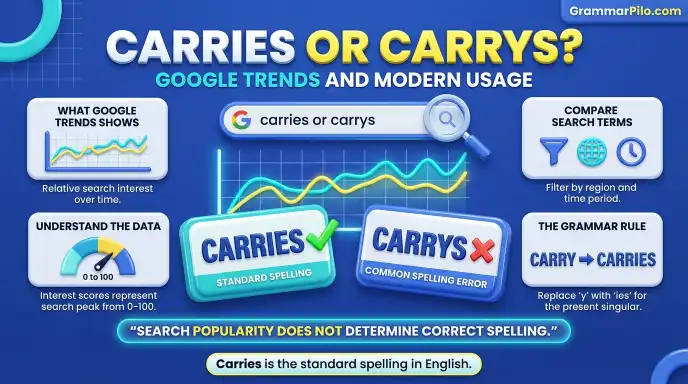
People may search for “carries or carrys” when they are unsure how to spell the third person singular form of carry. The confusion is understandable because some English verbs simply add s, while others change the final y to ies.
The standard written form is carries in American, British, Canadian, Australian, and other varieties of English. The incorrect form carrys can occur in typing mistakes, informal posts, or learner writing, but it should not be used as the standard spelling.
Google Trends can help compare search interest in the two spellings over a selected period and region. However, search interest is not the same as proof of correctness, and no specific search volume figures are provided here.
For reliable writing, grammar rules and reputable dictionaries provide a stronger basis for choosing the correct form than the frequency of a search query.
How to Remember Carries or Carrys
Use this simple memory trick:
Carry ends in consonant + y, so change y to ies: carry → carries.
You can also remember the pattern by comparing these verbs:
- Carry → Carries
- Try → Tries
- Study → Studies
- Reply → Replies
Then compare them with verbs ending in a vowel plus y:
- Play → Plays
- Enjoy → Enjoys
- Stay → Stays
Quick test: Complete this sentence: “She _____ her books to school.”
The correct answer is carries.
Frequently Asked Questions
1. Is carries or carrys correct?
Carries is correct. It is the third person singular present form of carry. Carrys is a misspelling in this context.
2. Why is carries spelled with ies?
The verb carry ends in a consonant followed by y. In the third person singular simple present, the y changes to ies, giving carries.
3. Is carrys ever correct in English?
Carrys is not the standard spelling of the verb carry in ordinary English writing. It may appear as a typo or as a deliberately chosen username or name, but those uses do not make it the correct verb form.
4. What is the plural form of carry?
The verb does not have a separate plural form in the simple present. You write I carry, we carry, and they carry. With he, she, or it, use carries.
5. Is carries American or British English?
Carries is correct in both American and British English. There is no regional spelling difference for this word.
6. What is the past tense of carry?
The past tense is carried.
Example: She carried the bag to the car yesterday.
7. Is it “the company carrys” or “the company carries”?
The correct phrase is “the company carries” because company is a singular noun.
Example: The company carries products from several well known brands.
8. Do you write “does carry” or “does carries”?
Use does carry.
Example: Does she carry her own luggage?
The auxiliary verb does takes the third person singular marking, so the main verb remains in its base form.
9. What is the difference between carries and carrying?
Carries is used for a simple present action with a singular third person subject. Carrying is the -ing form, used in continuous tenses and other grammatical constructions.
Examples:
- She carries a bag every day.
- She is carrying a bag right now.
10. What is an easy way to remember the correct spelling?
Remember the consonant + y rule. Change the final y to ies: carry → carries, try → tries, and study → studies.
Conclusion: Carries or Carrys?
The correct spelling is carries, while carrys is a common spelling mistake. Use carries when describing what he, she, it, or a singular noun does in the simple present tense. For example, “She carries her laptop to work” is correct, while “She carrys her laptop to work” is not.
The spelling becomes easy once you understand the rule. When a verb ends in a consonant followed by y, change the y to ies for the third person singular form. That is why carry becomes carries, just as try becomes tries and study becomes studies.
Keep in mind that the subject and tense also matter. You write they carry, she carries, and she carried when describing a past action. These forms follow different grammatical patterns, but each has a clear purpose.
Final reminder: Choose carries, not carrys, in standard English writing. A small spelling rule can make your emails, assignments, articles, and everyday messages clearer and more professional.
More Related Articles

I’m Sloane Mercer, a U.S.-based English language writer focused on grammar, spelling, vocabulary, and everyday English usage. Through GrammarPilo, I provide clear and practical explanations to help readers choose the right words and communicate with confidence.