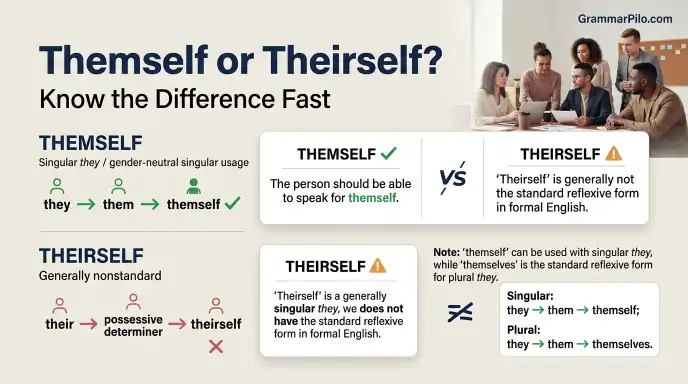
Themself is the preferred form when you need a singular reflexive pronoun for singular they, while theirself is a nonstandard or dialectal form that is generally avoided in standard writing.
However, there is an important detail: themselves is still widely used for both plural they and singular they, and many style guides consider it the safer choice in formal writing.
The confusion between themself or theirself comes from the way English builds reflexive pronouns.
We have myself, yourself, himself, herself, and ourselves, so it may seem logical to create theirself from their + self. But standard English uses them as the object form of they, which helps explain the formation of themself.
So, when you are comparing themself vs. theirself, the choice depends partly on the number and style of the sentence.
For one person using singular they, themself can be used. For several people, themselves is the normal form. Theirself is generally best avoided in standard formal English.
Themself or Theirself: Quick Answer
Quick answer: Themself is the appropriate singular form when a person is referred to with singular they, while theirself is generally considered nonstandard or dialectal.
For example:
Correct: Someone should be allowed to express themself.
Also widely used: Someone should be allowed to express themselves.
Generally avoided in standard writing: Someone should be allowed to express theirself.
Cambridge lists themself for situations where they refer to one person, although it labels the form “not standard.” Other style guidance recognizes singular they and permits themself in appropriate contexts. The MLA, for example, gives themselves and themself as options for a person who uses singular they.
Key point: Do not automatically replace themselves with themself. First determine if they refer to one person or several people.
Quick Comparison
| Version | Meaning | Standard? | Typical Use | Example |
| themself | Singular reflexive form of they | Accepted in some modern usage, but not universally considered standard | Singular they | Someone should trust themself. |
| theirself | Reflexive form based on their | Nonstandard or dialectal | Regional or nonstandard speech/writing | They did it theirself. |
| themselves | Reflexive form of they | Standard | Plural they and widely used with singular they | They prepared themselves. |
Definition and Meaning of Themself and Theirself
What Does Themself Mean?
Themself is a reflexive or emphatic pronoun used with singular they when the person referred to is one individual.
For example:
Someone should learn to accept themself.
Here, someone refers to one person, and themself refers back to that same person.
The word can also be used for emphasis:
The person themself explained the situation.
Cambridge specifically records themself for a singular person referred to with them. Its examples include sentences where someone or another singular person is followed by themself.
What Does Theirself Mean?
Theirself is a reflexive form that has developed from their + self. It is found in English, but dictionaries generally describe it as nonstandard or dialectal.
Dictionary.com defines theirself as a nonstandard pronoun meaning themselves and notes that it can be used as a singular, gender-neutral reflexive form.
Collins describes theirself as a dialect form of themselves in British English and as a nonstandard form in American English.
So, theirself is a real word found in English usage, but that does not make it the normal choice for standard edited writing.
What Does Themselves Mean?
Themselves is the established reflexive form of they.
For plural subjects:
The students prepared themselves for the exam.
For a group:
The employees introduced themselves.
The traditional standard pattern is:
- I → myself
- you → yourself
- he → himself
- she → herself
- it → itself
- we → ourselves
- they → themselves
Cambridge identifies themselves as the reflexive form of they and explains that it refers back to they when the subject and object refer to the same people or things.
Themself vs. Theirself: What Is the Difference?
The main difference is grammatical formation and standard usage.
Themself follows the object form them + self.
Theirself follows the possessive form their + self.
This creates a pattern that can look confusing because some English reflexive pronouns are related to possessive forms:
- my + self = myself
- your + self = yourself
- our + selves = ourselves
- their + self = theirself
However, English does not form every reflexive pronoun by simply adding self to the possessive form.
For example:
- him + self = himself, not hisself
- them + selves = themselves, not theirselves
- them + self = themself in singular-they usage
This is one reason theirself can look logical but still be considered nonstandard in standard English.
The Origin of Themself and Theirself
The Origin of Themself
Themself developed as a logical singular counterpart to themselves.
English has long used they, them, and their in contexts where the person is unknown, unspecified, or not identified by gender. Modern English also uses singular they for an individual who uses they/them pronouns.
As singular they became increasingly established, speakers and writers needed a reflexive form that clearly referred to one person.
That created greater use of themself.
The formation is straightforward:
They → them → themself
This resembles other reflexive patterns:
He → him → himself
She → her → herself
They → them → themself
Modern style guidance increasingly recognizes singular they. The MLA states that singular they is widely accepted and gives themselves or themself for a person who uses singular they.
The Origin of Theirself
Theirself is much older than its recent use with modern singular they might suggest.
Collins gives its origin as Middle English, formed by analogy with myself, with its first recorded use dating to approximately 1250–1300.
American Heritage explains that forms such as theirself and theirselves developed in vernacular dialects as speakers regularized the patterns of English reflexive pronouns.
This history is important because theirself is not simply a recent internet spelling mistake. It has documented historical and dialectal use. Still, its historical existence does not make it the preferred form in standard modern writing.
British English vs. American English Spelling
There is no major British-versus-American spelling difference between themself and theirself.
The main issue is standardness and usage, not regional spelling.
| Form | British English | American English | Standard Writing |
| themself | Used in modern singular-they contexts | Used in modern singular-they contexts | Accepted by some style guides, but not universally standard |
| theirself | Dialectal/nonstandard | Nonstandard/dialectal | Generally avoid |
| themselves | Standard | Standard | Widely accepted |
Collins lists theirself as a dialect form in British English and a nonstandard form in American English.
American Heritage also documents theirself and theirselves in vernacular English, including British and American dialect usage.
The important point is that this is not like center vs. centre or organize vs. organise. There is no normal US spelling and UK spelling split here.
Which Form Should You Use?
Your choice should depend on the meaning and the writing context.
For One Person Using Singular They
Themself can be appropriate:
Alex wanted to explain themself clearly.
If Alex uses they/them pronouns, themself can make the singular meaning especially clear.
For Several People
Use themselves:
The students prepared themselves for the presentation.
Here, they refers to multiple people, so themselves is the standard reflexive form.
For Formal or Academic Writing
Themselves is often the safest choice because it is the established standard form and is widely understood.
For example:
Every applicant should introduce themselves.
Some style guides and organizations allow themself for singular they, so the exact choice can depend on the style guide you are following. The MLA specifically recognizes themselves or themself for singular they.
For Someone’s Stated Pronoun Usage
If an individual uses themself, preserving that person’s preferred form can be appropriate.
For example:
Jordan said they prefer to describe themself in their own words.
The Associated Press has expanded its guidance on using they/them/their to accurately represent people who use those pronouns.
Common Mistakes with Themself or Theirself
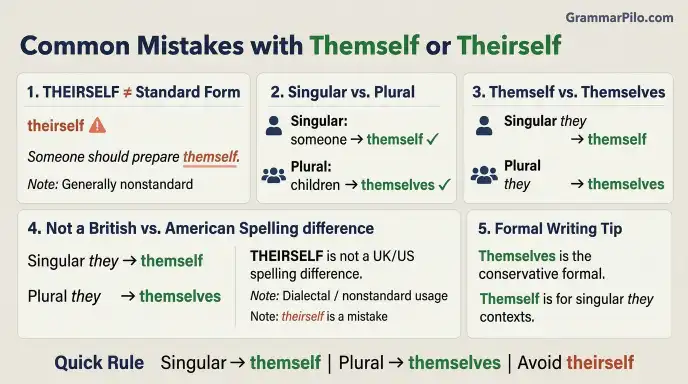
Mistake 1: Assuming Theirself Is the Standard Form
Incorrect in standard writing: Someone should prepare theirself.
Better: Someone should prepare themself.
Also widely accepted: Someone should prepare themselves.
The form theirself may occur in dialectal English, but it is generally not the best choice for standard edited writing.
Mistake 2: Using Themself for a Plural Group
Incorrect: The children taught themself how to play the game.
Correct: The children taught themselves how to play the game.
Here, the children refers to several people, so themselves is required.
Mistake 3: Thinking Themself and Themselves Always Mean the Same Thing
They can overlap when singular they is involved, but they have different forms.
Singular: Someone should trust themself.
Plural: The players should trust themselves.
The subject tells you which meaning is intended.
Mistake 4: Treating Theirself as a British or American Spelling
Theirself is not a normal regional spelling equivalent to themself.
It is documented as dialectal or nonstandard usage, not as the standard British version or standard American version.
Mistake 5: Assuming Themself Is Universally Standard
Themself is increasingly used and is recognized by major language resources, but its status is still not completely uniform.
Cambridge labels it “not standard,” while its dictionary definition explicitly describes its use with singular they. The MLA permits themselves or themself in relevant contexts.
For a conservative formal style, themselves may be the safer option.
Themself or Theirself in Everyday Examples
In Emails
Preferred:
Please ask the applicant to introduce themselves at the beginning of the meeting.
If the applicant specifically uses singular they and the style permits it:
Please ask the applicant to introduce themself at the beginning of the meeting.
In News Writing
Singular they is now widely used in professional writing for people whose gender is unknown or for people who use they/them pronouns. AP guidance recognizes the use of they/them/their to accurately represent people who use those pronouns.
Example:
The spokesperson said they would represent themselves at the hearing.
For an individual using singular they:
The artist said they wanted to express themself through their work.
On Social Media
Informal writing often contains themself:
Everyone should feel free to be themself.
This form can sound natural when the writer clearly means one person.
In Formal Writing
For a broad audience, themselves remains a familiar and widely accepted option:
Every employee should ask themselves if the decision is appropriate.
If you are writing specifically about a person who uses they/them and your style permits themself, you can write:
The employee wanted to explain themself clearly.
In Academic Writing
Check the style guide used by your institution.
The MLA recognizes both themselves and themself in singular-they contexts.
If you need a conservative construction, you can also rewrite the sentence:
Every student should review the instructions carefully.
This avoids the reflexive form entirely.
Themself and Theirself: Google Trends & Usage Data
Google Trends measures relative search interest, not the total number of times a word appears in English writing.
For a comparison such as themself or theirself, search interest can reflect several things:
- people checking grammar
- writers comparing two forms
- students learning singular they
- editors checking nonstandard forms
- readers encountering dialectal English
- people searching for the correct reflexive pronoun
A higher Google Trends result for one spelling does not automatically prove that it is grammatically correct.
For this topic, dictionary evidence is more useful for determining status. Cambridge documents themself as a form used with singular they, while Dictionary.com and Collins document theirself as nonstandard or dialectal.
Usage also continues to develop around singular they. The Associated Press expanded its guidance on singular they over time, and the MLA recognizes singular they as widely accepted.
Therefore, do not treat search volume alone as a grammar rule.
Themself vs. Theirself: Side-by-Side Comparison
| Feature | Themself | Theirself |
| Basic form | them + self | their + self |
| Main use | Singular reflexive with singular they | Nonstandard/dialectal reflexive |
| Refers to one person | Yes | Sometimes |
| Refers to several people | No | Sometimes dialectally |
| Formal standard use | Limited and style-dependent | Generally avoided |
| Modern usage | Increasing | Dialectal/nonstandard |
| Common alternative | themselves | themselves |
| Example | Someone should trust themself. | Someone should trust theirself. |
Simple Rule to Remember
Singular they + singular reflexive: themself
Plural they + plural reflexive: themselves
Theirself: generally avoid in standard writing.
Key Takeaways
- Themself is used as a singular reflexive form with singular they.
- Theirself exists in English but is generally considered nonstandard or dialectal.
- Themselves is the established standard reflexive form of they.
- Use themselves for a group of people.
- Themself can refer to one person who uses singular they.
- Some style guides accept themself, while others still prefer themselves.
- Theirself is not simply a British or American spelling variation of themself.
- For conservative formal writing, themselves is often the safest choice.
Frequently Asked Questions
1. Is themself or theirself correct?
Themself is the better choice when a singular person is referred to with they and a singular reflexive form is needed.
Theirself is documented in English but is generally considered nonstandard or dialectal. Themselves is also widely accepted for singular they, depending on the style guide.
2. Is themself a real word?
Yes. Themself is documented in major dictionaries and is used with singular they. Cambridge specifically defines it as a reflexive form used when they refers to one person.
Its status as a standard form is still developing, so some dictionaries and style guides treat it cautiously.
3. Is theirself a real word?
Yes, but it is nonstandard or dialectal. Dictionary.com defines theirself as a nonstandard pronoun, while Collins describes it as dialectal in British English and nonstandard in American English.
It can appear in regional speech and historical usage, but it is generally avoided in standard edited writing.
4. Should I say themself or themselves for one person?
Both can occur, depending on the style and context. Themself makes the singular meaning explicit, while themselves is the more established form and is widely used with singular they.
The MLA specifically recognizes themselves or themself for a singular person who uses they/them.
5. Is themself grammatically correct?
Themself can be grammatically appropriate with singular they, although its status varies among dictionaries and style guides.
Cambridge labels it “not standard” while explicitly documenting its singular use, and other guidance permits it. For conservative formal writing, themselves may be preferred.
6. Can I use theirself in formal writing?
It is better to avoid theirself in formal writing. Although the word has documented dialectal and historical use, major dictionaries identify it as nonstandard or dialectal. Use themselves, or themself when your chosen style guide permits it for singular they.
7. What is the difference between themself and themselves?
Themself can be used for one person referred to with singular they. Themselves is the established reflexive form for plural they and is also widely used with singular they.
For example, “Someone should trust themself” refers to one person, while “The students should trust themselves” refers to several people.
8. Why do people write theirself instead of themself?
Theirself seems logical because English uses possessive forms in words such as myself and yourself. However, standard English uses them as the object form of they, producing themself in singular-they usage.
Theirself also has a long history in dialectal English, which helps explain why some speakers still use it.
9. Is themself acceptable in American English?
Themself is used in American English, particularly in contexts involving singular they. However, its acceptance varies by dictionary and style guide.
For broad formal writing, themselves remains a familiar and established option. Theirself is generally treated as nonstandard in American English.
10. What is the easiest way to remember themself or theirself?
Remember “they → them → themself.” The object form of they is them, so the singular reflexive form can be built as them + self.
For several people, use themselves. Avoid theirself in standard writing unless you are intentionally preserving dialect or a person’s exact wording.
Conclusion: Themself or Theirself?
The choice between themself or theirself becomes easier once you separate standard usage from dialectal forms. Themself is used for a singular person referred to with singular they, while theirself is a documented but generally nonstandard or dialectal form.
Themselves remains the established reflexive form and is widely used for plural they as well as for singular they in many styles.
For example, you can write “Someone should be allowed to express themself” when using a singular reflexive form.
You can also write “Someone should be allowed to express themselves,” particularly when following a style guide that prefers the established form. For several people, “They should express themselves” is the standard choice.
If you are writing for school, work, publishing, or a broad audience, check the style guide you follow. The MLA accepts themself alongside themselves in relevant singular-they contexts, while dictionary treatment shows that the form is still developing.
The safest rule is simple: use themself for singular they when your style permits it, use themselves for plural they, and generally avoid theirself in standard writing.
Perfect Your Grammar
- Theirselves or Themselves: Which Is Correct?
- Their or They’re: How to Use Them Correctly?
- Hisself or Himself: Clear Up the Confusion Now

I’m Claire Morgan, the author behind Grammarpilo.com, where I write about English grammar, sentence structure, punctuation, and everyday language. My goal is to make grammar simple, clear, and practical, helping readers understand the rules and apply them with confidence in real-world writing.








1 thought on “Themself or Theirself: Know the Difference Fast”