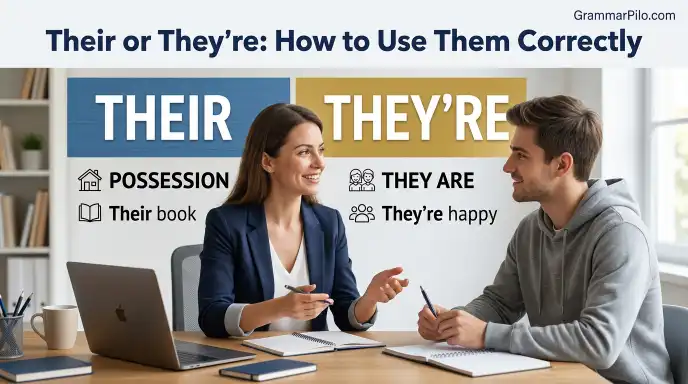
Their and they’re are both correct English words, but they have different meanings: “their” shows possession, while “they’re” is a contraction of “they are.” They sound the same when spoken, which makes their or they’re a common spelling and grammar problem.
For example, in “They’re going to their house,” both words are correct, but they do different jobs. They’re means “they are,” while their means that something belongs to them.
The confusion becomes even greater when there is added to the mix. There, their, and they’re are homophones, meaning they sound alike but have different meanings and spellings. Cambridge Dictionary identifies all three as commonly confused words.
The good news is that the difference between their and they’re is easy to remember once you know what each word means. A simple test is to replace they’re with they are. If the sentence still makes sense, they’re is correct. If you are showing ownership or connection, use their.
They’re and Their: Quick Answer
Their is a possessive determiner that shows something belongs to or is connected with them.
They’re is the contraction of they are.
Examples
- Their car is parked outside.
- They’re waiting outside.
- I like their new house.
- They’re moving to a new house.
- The students finished their work.
- They’re ready for the test.
Quick Trick
Replace they’re with they are.
They’re happy.
→ They are happy. ✓
But:
Their house is large.
→ They are house is large. ✗
Therefore, their is correct in the second sentence.
Their vs. They’re: Definition and Meaning
What Does “Their” Mean?
Their is a possessive determiner. It is used before a noun to show that something belongs to, relates to, or is associated with a group of people.
For example:
They sold their car.
Here, their tells us that the car belongs to them.
More examples:
The children packed their bags.
The employees returned to their offices.
The players celebrated their victory.
The students completed their assignments.
Cambridge Dictionary defines their as referring to something that belongs to or is connected with them. It can also refer to one person when the person’s gender is unknown or does not need to be specified.
What Does “They’re” Mean?
They’re is a contraction of they are.
The apostrophe shows that letters have been removed from the two-word form.
They are → They’re
For example:
They’re coming soon.
means:
They are coming soon.
Other examples include:
They’re very friendly.
They’re working today.
They are ready to leave.
They’re excited about the trip.
Cambridge Dictionary defines they’re as the short form of they are.
What Is the Difference Between Their and They’re?
The main difference is possession versus “they are.”
| Word | Meaning | Example |
| Their | Belonging to them | Their house is beautiful. |
| They’re | They are | They’re at home. |
Think of it this way:
Their = belonging to them
They’re = they are
This simple distinction solves most their or they’re questions.
Compare These Sentences
Their dog is very friendly.
Here, their tells us that the dog belongs to them.
They’re very friendly.
Here, they’re means they are.
The two words may sound identical, but their grammatical functions are completely different. Merriam-Webster also identifies their as the possessive form of they and they’re as the contraction of they are.
When to Use Their
Use their when you are showing possession, ownership, connection, or association.
1. Showing Ownership
They parked their car outside.
The students opened their books.
The family sold their house.
Here, their tells us who the car, books, or house belongs to.
2. Showing a Relationship
Their does not always mean literal ownership. It can also show a relationship or connection.
The company thanked their employees.
The team celebrated their victory.
The children called their parents.
In these examples, their connects the noun with the people represented by they.
3. With Singular “They”
Their can also be used when referring to one person whose gender is unknown or does not need to be specified.
Someone left their phone on the table.
Every student should bring their own notebook.
If anyone calls, ask for their name.
Cambridge Dictionary notes this use of their with singular reference, including after words such as someone and everyone.
When to Use They’re
Use they’re when you mean they are.
1. They’re + Adjective
They’re happy.
= They are happy.
They’re tired.
= They are tired.
They’re ready.
= They are ready.
2. They’re + Verb Ending in -ing
They’re working today.
= They are working today.
They’re studying for the exam.
= They are studying for the exam.
They’re waiting outside.
= They are waiting outside.
3. They’re + Noun
They’re teachers.
= They are teachers.
They’re my neighbors.
= They are my neighbors.
They’re good friends.
= They are good friends.
4. They’re + Prepositional Phrase
They’re at home.
= They are at home.
They’re in the office.
= They are in the office.
They’re on the bus.
= They are on the bus.
They’re or Their: How to Choose the Correct Word
When you are unsure about they’re or their, use the “they are” test.
Step 1: Replace “They’re” With “They Are”
Take the sentence:
They’re coming tomorrow.
Replace the contraction:
They are coming tomorrow.
The sentence still makes sense, so they’re is correct.
Now consider:
Their friends are coming tomorrow.
Replace their with they are:
They are friends are coming tomorrow.
That does not work.
Therefore, their is correct.
The Easy Rule
If you can replace the word with they are, use:
They’re
If you cannot, and the sentence shows possession or connection, use:
Their
Their and They’re in Everyday Examples
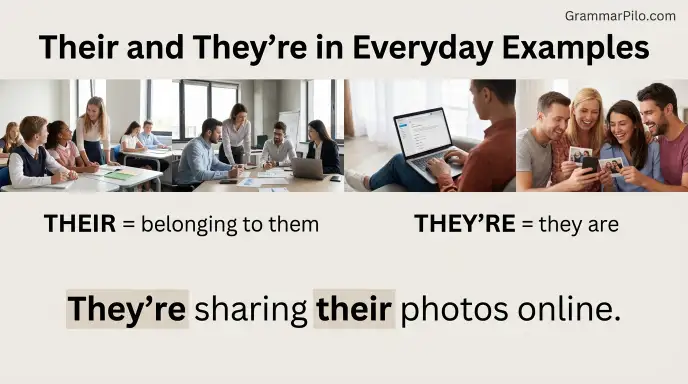
Understanding their and they’re becomes easier when you see both words in normal sentences.
At School
The students finished their homework.
They’re ready for the next lesson.
At Work
The employees submitted their reports.
They’re waiting for the manager.
In an Email
The customers received their confirmation emails.
They’re now ready to begin the process.
In Social Media
They’re sharing their travel photos.
Both words can appear in the same sentence:
They’re sharing their photos online.
Here:
- They’re = they are
- their = belonging to them
In News Writing
The players returned to their hotel after the match.
They’re expected to arrive early tomorrow.
In Formal Writing
Employees should complete their applications before Friday.
They’re responsible for providing accurate information.
They’re Vs. Their: Side-by-Side Examples
| Their | They’re |
| Their house is new. | They’re moving soon. |
| I like their idea. | They’re very creative. |
| The children lost their toys. | They’re looking for them. |
| The company changed their policy. | They’re announcing it today. |
| Everyone brought their own lunch. | They’re eating outside. |
A useful pattern is:
Their + noun
their house
their car
their friends
their idea
They’re + adjective/verb/noun/phrase
they’re happy
they’re working
they’re teachers
they’re at home
Common Mistakes With Their or They’re
Mistake 1: Using They’re for Possession
Incorrect:
They’re house is beautiful.
Correct:
Their house is beautiful.
Why? The house belongs to them.
Mistake 2: Using Their Instead of They’re
Incorrect:
Their going to the store.
Correct:
They’re going to the store.
Why? The intended meaning is:
They are going to the store.
Mistake 3: Forgetting the Apostrophe
Incorrect:
Theyre coming later.
Correct:
They’re coming later.
The apostrophe is part of the standard contraction they’re.
Mistake 4: Adding an Apostrophe to Their
Incorrect:
Their’ car is outside.
Correct:
Their car is outside.
Their does not need an apostrophe.
The British Council’s possessive pronoun reference also distinguishes their from contractions and explains possessive forms such as their and theirs.
Mistake 5: Confusing Their, They’re, and There
There is a third commonly confused word: there.
Compare:
Their house is over there, and they’re waiting outside.
All three words are different:
- Their = belonging to them
- There = a place or location
- They’re = they are
Cambridge Dictionary specifically groups there, their, and they’re together because they sound the same but have different meanings and grammatical roles.
Their, There, or They’re?
Although the main keyword is their or they’re, it is useful to understand there too.
Their
Shows possession:
Their car is red.
There
Refers to a place or is used in expressions about existence:
Put the box over there.
There is a problem.
They’re
Means they are:
They’re outside.
A simple memory trick is:
Their = possession
There = place
They’re = they are
Merriam-Webster recommends essentially the same distinction and notes that the three words are pronounced alike in standard English.
The Origin of Their and They’re
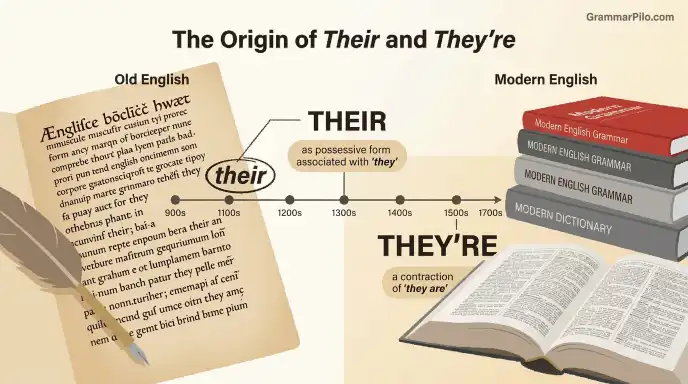
The two words have very different histories.
Origin of Their
Their dates back to Middle English and ultimately comes from Old Norse. Etymonline traces it to Old Norse þierra, meaning “of them.” It replaced the older Old English form hiera.
The broader pronoun family they, them, and their entered English from Scandinavian sources. The form they itself is recorded from around the 12th century and eventually replaced older native English forms.
Over time, their became the standard possessive determiner associated with they.
Origin of They’re
They’re is much simpler to explain. It is a contraction of:
they + are = they’re
Merriam-Webster records the first known use of they’re in its contraction sense around 1595.
The apostrophe marks the letters removed from the original phrase.
they are → they’re
This is similar to:
we are → we’re
you are → you’re
cannot → can’t
British English vs American English
There is no spelling difference between British English and American English for their or they’re.
Both varieties use:
| Meaning | British English | American English |
| Possession | their | their |
| They are | they’re | they’re |
| Place | there | there |
For example:
Their car is outside.
and:
They’re waiting outside.
are standard in both British and American English.
The pronunciation can vary slightly by accent, but the spellings remain the same.
The important distinction is therefore grammar and meaning, not regional spelling.
Which Spelling Should You Use?
The answer is simple: use the word that matches the meaning of your sentence.
Use “Their” If:
- something belongs to them
- something is connected with them
- you are referring to a person’s or group’s possessions
- you are using singular “they” to avoid specifying gender
Examples:
The students finished their work.
Someone left their bag here.
Use “They’re” If:
- you mean they are
Examples:
They’re coming soon.
They’re very busy.
This rule works in American English, British English, and other standard varieties of English.
Their or They’re in Professional Writing
Choosing the correct form is especially important in emails, reports, resumes, academic writing, and business communication.
Compare:
The employees should submit their forms.
This means the forms belong to or are associated with the employees.
But:
They’re required to submit the forms.
This means:
They are required to submit the forms.
A single apostrophe can completely change the grammatical function of the word.
Their vs. They’re: A Simple Memory Trick
Use this three-word memory system:
THEIR = THINGS
Think of their when talking about something that belongs to them.
Their house
Their car
Their books
THEY’RE = THEY ARE
Look at the apostrophe as a clue that two words have been shortened.
They’re happy.
= They are happy.
They’re working.
= They are working.
THERE = PLACE
Think of there when talking about a location.
The keys are over there.
This makes the three commonly confused words much easier to separate.
Google Trends & Usage Data
Searches for “their or they’re,” “they’re or their,” and “their vs. they’re” reflect a common English grammar and spelling confusion. The problem is understandable because their, they’re, and there have the same pronunciation in standard English but different meanings and spellings.
Google Trends measures relative search interest, not the total number of times a word is used. Search interest can also vary by country, education level, season, and current search behavior.
For that reason, a specific Trends number should not be presented as a measure of overall English usage without checking the actual Google Trends data for a defined time period and region.
For grammar guidance, established dictionaries and grammar references consistently make the same core distinction:
- their = possession or association
- they’re = they are
- there = place or existence
That distinction is more useful for everyday writing than trying to memorize search-volume numbers.
Their or They’re: Quick Comparison Table
| Feature | Their | They’re |
| Meaning | Belonging to them | They are |
| Word type | Possessive determiner | Contraction |
| Apostrophe | No | Yes |
| Used before a noun | Yes | No, not as a possessive determiner |
| Example | Their house is large. | They’re at home. |
| Easy replacement | Belonging to them | They are |
| British English | Their | They’re |
| American English | Their | They’re |
Frequently Asked Questions
Is “their or they’re” the correct form?
Both their and they’re are correct words, but they are used differently. Their shows possession, while they’re means they are.
What is the difference between their and they’re?
Their means belonging to or associated with them.
They’re is short for they are.
Their dog is friendly.
They’re friendly.
Which is correct: “their” or “they’re”?
Both can be correct depending on the sentence.
Use their for possession:
Their house is large.
Use they’re for they are:
They’re at home.
How do I remember their vs. they’re?
Use the they are test. If you can replace the word with they are, use they’re.
They’re coming.
= They are coming. ✓
If the sentence shows possession, use their.
Their car is new. ✓
Can “their” refer to one person?
Yes. Their can be used with singular they, especially when the person’s gender is unknown or does not need to be specified.
Someone forgot their phone.
Cambridge Dictionary recognizes this singular use of their.
Is “they’re” a possessive word?
No. They’re is not possessive. It is a contraction of they are.
The possessive form is their.
Is “their” always followed by a noun?
In its normal use as a possessive determiner, their appears before a noun or noun phrase:
their car
their best idea
The related possessive pronoun theirs can stand alone:
That car is theirs.
Cambridge distinguishes possessive determiners such as their from possessive pronouns such as theirs.
Are their and they’re pronounced the same?
Yes. In standard English pronunciation, their and they’re are homophones, meaning they have the same pronunciation but different meanings and spellings. There is also commonly pronounced the same way.
Conclusion
Their and they’re are both correct English words, but they cannot normally be used interchangeably. The easiest way to remember the difference is to focus on what each word means.
Their shows possession, connection, or association:
The students brought their books.
They’re is a contraction meaning they are:
They’re bringing their books.
When you are unsure about their or they’re, try replacing the word with they are. If the sentence still makes sense, they’re is the right choice. If the sentence is showing that something belongs to or is connected with them, use their.
It is also useful to remember there, which commonly refers to a place or is used to introduce statements about existence.
Their = belonging to them
They’re = they are
There = place/existence
Once you learn these three simple meanings, the difference between their vs. they’re becomes much easier to recognize. The spellings are the same in British and American English, so the real issue is meaning and grammar, not regional spelling.
See the Difference

I’m Sloane Mercer, a U.S.-based English language writer focused on grammar, spelling, vocabulary, and everyday English usage. Through GrammarPilo, I provide clear and practical explanations to help readers choose the right words and communicate with confidence.








2 thoughts on “Their or They’re: How to Use Them Correctly”