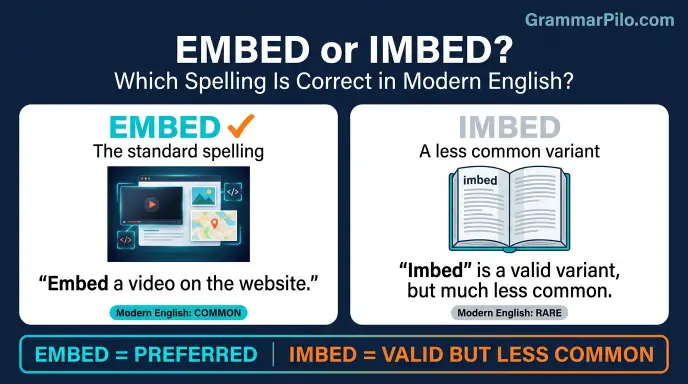
Embed is the preferred spelling in modern English, while imbed is also accepted but much less common.
Both words mean to place something firmly inside, into, or within another thing, which is why writers often wonder if imbed or embed is the correct choice.
This spelling question appears often in technology, writing, education, science, and everyday communication.
You may see instructions such as “embed a video,” “embed an image,” or “embed a link,” while older or less common sources may use “imbed.” That can make the two forms look like competing spellings.
The good news is simple: you can use embed confidently in almost all modern writing. It is the dominant form in American English, British English, technical writing, websites, software documentation, and digital publishing.
Imbed is not necessarily a spelling mistake. It is a recognized variant that has the same basic meaning, but modern usage strongly favors embed.
If you are writing an article, email, report, website, or academic paper, embed is usually the safest and most natural choice.
Embed or Imbed: Quick Answer
Embed is the preferred spelling. Imbed is a legitimate but less common variant.
Both words function as verbs and generally mean to place something deeply, firmly, or securely inside something else.
For example:
- You can embed a video in your blog post.
- The photographer embedded the image in the report.
- The software allows users to embed external content.
- The stone became imbedded in the wall.
In modern English, embed is far more common, especially when discussing websites, videos, images, links, documents, and software.
| Word | Correct? | Modern usage |
| Embed | Yes | Preferred and very common |
| Imbed | Yes | Correct but uncommon |
| Embedded | Yes | Standard form |
| Imbedded | Yes | Less common variant |
The easiest rule
If you are unsure, choose embed.
It is the form most readers expect, particularly in American English and digital or technical contexts.
Definition and Meaning of Imbed and Embed
The words embed and imbed have essentially the same meaning.
What Does Embed Mean?
Embed means to place something firmly or deeply inside another thing.
It can describe physical objects as well as information or digital content.
For example:
The scientist found a small piece of metal embedded in the rock.
Here, the metal is physically inside the rock.
The word is also common in technology:
The website allows you to embed a video.
In this case, the video is placed directly into a webpage.
What Does Imbed Mean?
Imbed has the same basic meaning as embed.
For example:
The object was imbedded in the surface.
However, imbed is considerably less common in current standard usage.
Because embed is more familiar to modern readers, it is usually the better choice.
Embed in Technology
The word is especially common in digital writing.
You can:
- embed a YouTube video
- embed an image
- embed a map
- embed a social media post
- embed a link
- embed a document
- embed a widget
- embed code
For example:
We embedded the video directly into the article.
This is the form most websites and software guides use.
Embed as a Noun
Embed can also appear as a noun in technical contexts.
For example:
The article includes an embed of the original video.
However, the verb embed is much more common in everyday writing.
The Origin of Embed or Imbed
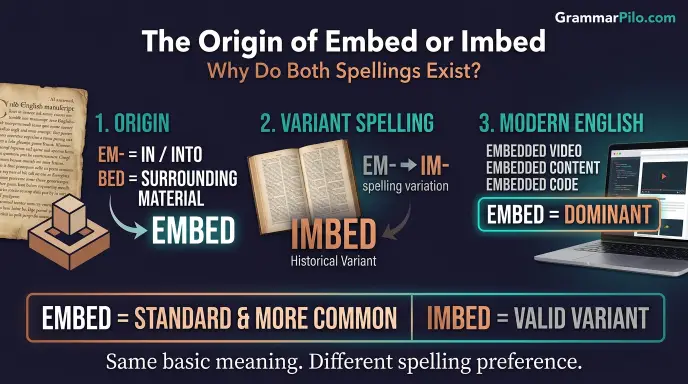
The history of embed helps explain why imbed also exists.
Embed developed from the idea of putting something into a bed or surrounding material. The word combines em-, meaning “in” or “into,” with bed.
The spelling eventually became embed, and this form became firmly established in English.
Imbed developed as a variant spelling. The initial im- can appear naturally before certain sounds in English, so writers sometimes used imbed instead of embed.
Both forms have appeared in English for a long time.
However, English usage has gradually favored embed.
This is especially clear in modern technology and digital communication. Terms such as embedded video, embedded content, embedded code, and embedded links are now extremely familiar.
Why Do Both Spellings Exist?
The difference is not really about two different meanings.
Instead, it is mainly a matter of spelling preference and historical usage.
Modern English has kept both forms, but they are not equally common.
Embed has become the dominant spelling.
That is why dictionaries may list imbed as a variant while giving embed as the main entry.
British English vs American English Spelling
Unlike pairs such as color/colour or center/centre, embed/imbed is not primarily a British versus American spelling difference.
Both forms can appear in British and American English.
However, embed is strongly preferred in both varieties.
| Form | American English | British English | Frequency |
| embed | Standard | Standard | Very common |
| imbed | Accepted variant | Accepted variant | Uncommon |
| embedded | Standard | Standard | Very common |
| imbedded | Accepted variant | Accepted variant | Uncommon |
American English
American writers overwhelmingly use embed.
Examples include:
Embed the video on your website.
The image is embedded in the document.
British English
British writers also commonly use embed.
For example:
The article contains an embedded video.
Therefore, you do not normally need to change embed to imbed when writing for a British audience.
Important Spelling Point
The past tense and participle are normally written:
embed → embedded
Notice the doubled d.
The same pattern appears in:
- embedding
- embedded
- embeds
For example:
The website is embedding the video automatically.
Which Spelling Should You Use?
For almost every modern writing situation, choose embed.
For American English
Use embed.
It is the normal spelling in American writing.
For British English
Use embed.
British English also commonly uses this spelling.
For International English
Embed is the safest choice because it is widely recognized around the world.
For Websites and Technology
Definitely use embed.
Digital terminology overwhelmingly favors forms such as:
- embedded video
- embedded content
- embedded media
- embedded code
- embedded player
For Academic Writing
Use embed unless you are quoting an original source that uses imbed.
For Professional Writing
Embed is usually more polished and familiar.
So, if you are writing an email, report, blog post, instruction guide, or business document, choose embed.
Common Mistakes With Embed or Imbed
Mistake 1: Thinking Imbed Is Always Wrong
Imbed is not necessarily incorrect.
It is a recognized variant of embed.
However, it is much less common, so replacing it with embed will usually make your writing more natural.
Less common: Imbed the video.
Preferred: Embed the video.
Mistake 2: Using Imbed in Technical Writing
Technical writing strongly favors embed.
For example:
Preferred: Embed the HTML code into the page.
Less common: Imbed the HTML code into the page.
The first version sounds more natural to modern readers.
Mistake 3: Misspelling Embedded
A common mistake is writing embeded with only one d.
Incorrect: The video is embeded.
Correct: The video is embedded.
The word doubles the final d before adding -ed.
Mistake 4: Misspelling Embedding
The correct form is:
embedding
Not:
embeddding
For example:
We are embedding the video into the article.
Mistake 5: Treating Embed and Imbed as Different Meanings
They generally have the same meaning.
The main difference is frequency and modern preference, not definition.
Embed or Imbed in Everyday Examples
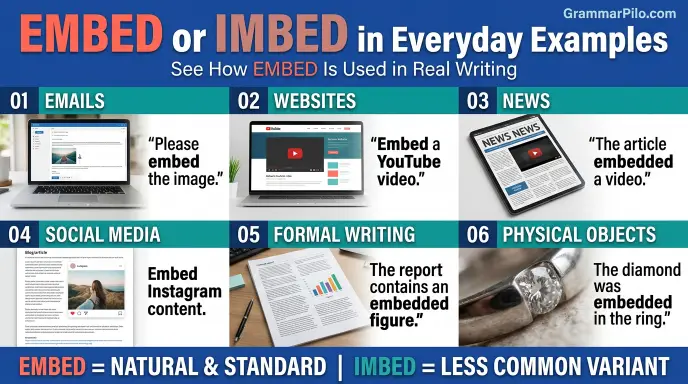
Seeing the words in real situations makes the difference easier to understand.
Emails
A professional email might say:
I have embedded the presentation below for easy access.
Another example:
Please embed the image before sending the final document.
Embed is the natural choice in modern business communication.
Websites and Blogs
This is one of the most common uses.
You can embed a YouTube video directly into the article.
The website automatically embeds social media posts.
The video is already embedded on the page.
In digital publishing, embed is clearly preferred.
News Writing
A news website might write:
The article embedded a video showing the event.
Or:
The report includes an embedded social media post.
Again, embed sounds natural and professional.
Social Media
People may say:
I embedded the post in my article.
Or:
The website lets you embed Instagram content.
The term is especially common when discussing websites that display content from another platform.
Formal Writing
In a formal report, you might write:
The researcher embedded the chart within the final report.
Or:
The document contains an embedded figure.
This usage is clear and standard.
Physical Objects
The word does not only describe digital content.
For example:
A piece of glass was embedded in the wood.
The diamond was embedded in the ring.
Here, embed has its literal physical meaning.
Imbed vs. Embed: Google Trends & Usage Data
Search interest for embed or imbed usually comes from people checking if imbed is an acceptable spelling or trying to understand why they see both forms.
Modern usage strongly favors embed, especially in technology related contexts.
The growth of the internet has made embed even more common because websites frequently allow users to insert external content into pages.
Common searches include:
- embed or imbed
- is imbed a word
- is imbed correct
- embed meaning
- embedded meaning
- embed a video
- embed code
- embed HTML
The context also matters.
In technology, embed is overwhelmingly the natural choice.
In general English, embed remains much more familiar.
Imbed may still appear in older books, specialized writing, or sources that prefer the variant form, but it is not the spelling most modern readers expect.
Usage Comparison
| Context | Preferred Form |
| Websites | Embed |
| Software | Embed |
| HTML | Embed |
| Videos | Embed |
| Images | Embed |
| Business writing | Embed |
| Academic writing | Embed |
| General English | Embed |
| Older texts | Imbed may appear |
| Variant spelling | Imbed |
For current professional communication, embed is the clear practical choice.
Embed vs. Imbed: Side by Side Comparison
| Feature | Embed | Imbed |
| Correct spelling | Yes | Yes |
| Meaning | Place firmly inside | Place firmly inside |
| Standard modern usage | Yes | Less common |
| Common in technology | Very common | Rare |
| Common in websites | Very common | Rare |
| American English | Preferred | Variant |
| British English | Preferred | Variant |
| International English | Preferred | Less common |
| Past tense | Embedded | Imbedded |
| Present participle | Embedding | Imbedding |
| Recommended for new writing | Yes | Usually no |
The key takeaway is simple:
Embed and imbed have the same basic meaning, but embed is the standard choice for modern writing.
Frequently Asked Questions About Embed or Imbed
1. Is embed or imbed correct?
Both embed and imbed are accepted English spellings. However, embed is much more common and is the preferred choice in modern writing.
2. Is imbed a real word?
Yes. Imbed is a recognized variant of embed. It means to place something firmly or deeply inside another thing.
3. Is embed the American spelling?
Embed is the standard spelling in American English, but it is also standard and widely used in British English.
4. Is imbed British English?
No. Imbed is not simply the British spelling of embed. It is a less common variant that can appear in both British and American English.
5. Should I use embed in a website article?
Yes. Embed is the better choice for website content, especially when discussing videos, images, maps, social media posts, or code.
6. What is the past tense of embed?
The past tense is embedded.
For example:
She embedded the video in the article.
7. What is the difference between embed and imbed?
There is usually no meaningful difference in definition. Both mean to place something firmly or deeply inside something else. Embed is simply much more common in modern English.
Conclusion: Embed Is the Better Modern Choice
When choosing between embed or imbed, the safest answer is embed. Both forms are recognized in English and share the same basic meaning, but embed is much more common in modern usage.
This difference is especially noticeable in technology and digital publishing. Writers routinely embed videos, images, links, maps, social media posts, documents, and code into websites and other digital content. The forms embedded and embedding are also standard and widely recognized.
You may still encounter imbed, particularly in older sources or less common writing. Seeing it does not automatically mean that the writer made a spelling mistake. It is a legitimate variant. However, using imbed in modern professional or technical writing can look unusual simply because most readers are more familiar with embed.
For American English, British English, international English, academic writing, business communication, and website content, embed is the strongest choice.
So if you are wondering “embed or imbed?”, remember the simple rule: both are acceptable, but embed is preferred.
More Related Post

I’m Sloane Mercer, a U.S.-based English language writer focused on grammar, spelling, vocabulary, and everyday English usage. Through GrammarPilo, I provide clear and practical explanations to help readers choose the right words and communicate with confidence.






3 thoughts on “Embed or Imbed: Which Spelling Is Correct in Modern English?”