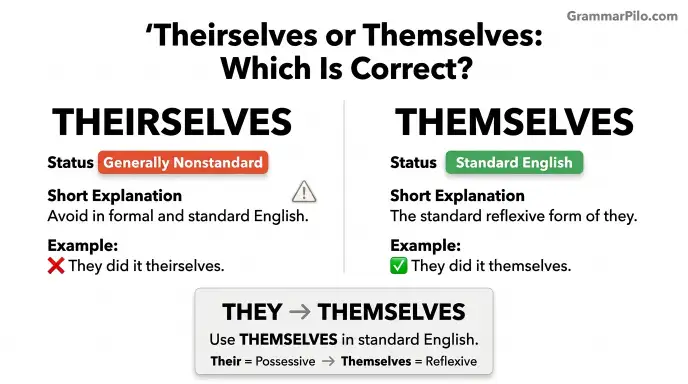
Are you confused about theirselves or themselves? The correct standard English form is themselves. The word theirselves is generally considered nonstandard and should be avoided in formal, academic, and professional writing.
Themselves is the standard reflexive pronoun used with they. For example, we say, “They prepared themselves for the meeting” and “The students completed the project themselves.”
Cambridge Dictionary defines themselves as the reflexive form used when they or a group of people is both the subject and the object.
The confusion often comes from the word their. Because their is already associated with they, some speakers may form theirselves by analogy. However, standard English uses themselves, not theirselves, as the plural reflexive form.
In this guide, you will learn the difference between theirselves and themselves, why theirselves is considered nonstandard, how to use themselves correctly, common mistakes, British and American usage, and everyday examples.
Theirselves or Themselves: Quick Answer
Themselves is the correct standard English reflexive pronoun for they. Theirselves is generally considered nonstandard and should not be used in formal or standard English writing.
Use themselves when the subject is they or a plural group and the same people are receiving the action. For example: “They introduced themselves.”
The correct choice is themselves.
- ❌ Theirselves: generally nonstandard
- ✅ Themselves: standard English
Examples:
They taught themselves how to play guitar.
The children dressed themselves.
The employees introduced themselves.
The players organized the event themselves.
A simple rule to remember is:
They → themselves
Not:
They → theirselves
Cambridge Grammar lists the standard reflexive pronouns as myself, yourself, himself, herself, itself, ourselves, yourselves, and themselves.
What Does Themselves or Theirselves Mean?
What Does “Themselves” Mean?
Themselves is a plural reflexive pronoun. It refers back to they or to a plural group of people when the subject and object refer to the same people.
For example:
They blamed themselves for the mistake.
Here:
- They = subject
- themselves = reflexive object
The same people who performed the action are also affected by it.
Another example:
The students prepared themselves for the exam.
The students prepared the same people who are represented by themselves.
What Does “Theirselves” Mean?
Theirselves is a form that you may encounter in some speech or informal usage, but it is not the standard reflexive form in modern standard English.
For formal writing, academic work, business communication, websites, reports, and professional documents, use themselves.
For example:
❌ The workers completed the task theirselves.
✅ The workers completed the task themselves.
The second sentence uses the standard English reflexive pronoun.
Why Do People Say “Theirselves”?
The form theirselves is understandable because English learners and speakers may associate their with they and create theirselves by analogy.
Compare:
- they → them
- their → theirs
- they → themselves
The reflexive form, however, is not formed from their. It is themselves.
This is why:
They → themselves
is the correct pattern.
The Difference Between Theirselves and Themselves
The main difference is standardness and grammatical function.
| Word | Standard English? | Function | Example |
| themselves | Yes | Plural reflexive pronoun | They introduced themselves. |
| theirselves | Generally no | Nonstandard variant | Avoid in formal writing. |
Theirselves vs. Themselves in a Sentence
Compare:
❌ They bought the tickets theirselves.
✅ They bought the tickets themselves.
The meaning is understandable in both, but themselves is the standard form.
Another example:
❌ The children cleaned the room theirselves.
✅ The children cleaned the room themselves.
Again, themselves is the form you should use in standard English.
The Origin of Theirselves or Themselves
The standard word themselves developed from the pronoun them combined with selves.
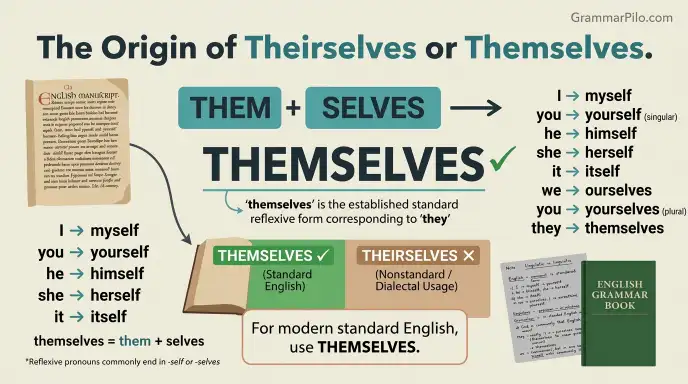
The form follows the broader English pattern of reflexive pronouns:
- I → myself
- you → yourself
- he → himself
- she → herself
- it → itself
- we → ourselves
- you → yourselves
- they → themselves
Cambridge Grammar describes reflexive pronouns as forms ending in -self or -selves that refer back to the subject forms of personal pronouns.
The important historical and grammatical point for modern learners is that themselves is the established standard reflexive form corresponding to they.
The form theirselves can appear in nonstandard or dialectal usage, but it is not the standard form recommended for formal English.
British English vs American English
There is no standard British-versus-American spelling difference between themselves and theirselves.
Both British and American standard English use themselves as the normal plural reflexive pronoun.
| Feature | British English | American English |
| Standard form | themselves | themselves |
| Nonstandard form | theirselves | theirselves |
| Reflexive form of “they” | themselves | themselves |
| Formal writing | themselves | themselves |
| Academic writing | themselves | themselves |
| Business writing | themselves | themselves |
For example:
British English:
The students completed the work themselves.
American English:
The students completed the work themselves.
The correct form does not change based on if you are writing for a British or American audience.
What About “Themself”?
There is an important related form worth knowing.
Themself can be used with singular they in certain contexts. Cambridge Dictionary labels themself as nonstandard in its dictionary entry, while also documenting its use with singular they for a single person of unspecified or nonbinary gender.
This is different from theirselves.
For plural they:
They introduced themselves.
For singular they, some contemporary usage uses:
Someone should be able to express themself.
The choice can depend on the style guide, variety of English, and context.
Which Version Should You Use?
For US English
Use themselves in standard English.
The employees introduced themselves.
Avoid theirselves in formal writing.
For UK English
The same standard form applies:
The children enjoyed themselves.
Not:
The children enjoyed theirselves.
For Canadian English
Use themselves as the standard plural reflexive pronoun.
For Australian English
Use themselves in standard English.
For International English
If you are writing for an international audience, themselves is the safest and clearest choice.
For Academic Writing
Always use themselves when a plural group needs a reflexive pronoun.
The researchers examined the results themselves.
Avoid:
The researchers examined the results theirselves.
For Business Writing
Use the standard form:
The managers will introduce themselves at the meeting.
The employees can complete the forms themselves.
For Formal Documents
Use themselves, especially in reports, applications, contracts, official communications, and professional documents.
Common Mistakes With Theirselves and Themselves
Mistake 1: Using “Theirselves” as the Reflexive Form of “They”
❌ They prepared theirselves for the presentation.
✅ They prepared themselves for the presentation.
Memory tip:
They → themselves
Mistake 2: Confusing “Their” With “Themselves”
Their is a possessive determiner.
Their car is outside.
Themselves is a reflexive pronoun.
They washed themselves.
They have completely different grammatical functions.
Mistake 3: Using “Theirselves” in Formal Writing
You may hear or encounter theirselves, but that does not make it the standard choice.
For formal writing:
❌ The students organized theirselves into groups.
✅ The students organized themselves into groups.
Mistake 4: Confusing “Themselves” With “Them”
Compare:
I gave the books to them.
They bought the books themselves.
Them is an object pronoun.
Themselves is a reflexive pronoun.
Mistake 5: Assuming “Theirselves” Is the Plural Form of “Themself”
The standard plural form is:
themselves
Not:
theirselves
If you are using themself in a singular-they construction, that is a separate grammatical issue.
Theirselves or Themselves in Everyday Examples
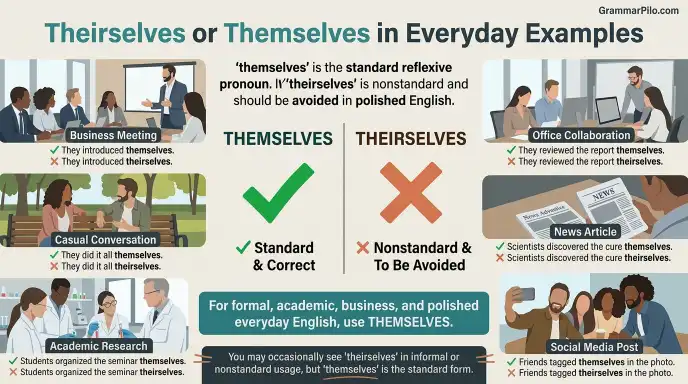
In Emails
Correct:
The team members introduced themselves during the meeting.
Incorrect:
The team members introduced theirselves during the meeting.
In Business Writing
Correct:
The employees can complete the training themselves.
Incorrect:
The employees can complete the training theirselves.
In News Writing
Correct:
The officials defended themselves against the criticism.
Incorrect:
The officials defended theirselves against the criticism.
In Blogs
Correct:
Many readers can teach themselves basic grammar.
Incorrect:
Many readers can teach theirselves basic grammar.
In Social Media
In casual online writing, you may occasionally see theirselves, but it remains nonstandard.
For polished content, use:
They can do it themselves.
In Academic Writing
Correct:
The researchers conducted the experiment themselves.
Correct:
The students evaluated themselves after the activity.
Academic writing should favor the standard form themselves.
In Daily Conversation
Correct:
They can take care of themselves.
Correct:
The kids made the food themselves.
These are natural uses of the standard reflexive pronoun.
Google Trends & Modern Usage
The search phrase “theirselves or themselves” reflects a common English-usage question: if theirselves can be used as the reflexive form of they.
In standard modern English, themselves is the established form. Cambridge Dictionary identifies themselves as the reflexive form of they and provides examples such as “They asked themselves” and “Did the children enjoy themselves?”
The form theirselves can appear in nonstandard speech, dialectal usage, or informal writing, but its appearance does not make it the preferred form for standard English.
For GrammarPilo readers, the practical rule is simple:
Use “themselves” in standard English.
There is no need to use numerical Google Trends statistics unless current, verifiable trend data is available.
Quick Comparison Table
| Theirselves | Themselves |
| Generally nonstandard | Standard English |
| Avoid in formal writing | Recommended |
| Sometimes heard in informal/dialectal usage | Used widely in standard English |
| Not the standard reflexive form of “they” | Reflexive form of “they” |
| ❌ They did it theirselves. | ✅ They did it themselves. |
| ❌ The children blamed theirselves. | ✅ The children blamed themselves. |
The Simple Pattern
| Subject | Reflexive Pronoun |
| I | myself |
| You | yourself |
| He | himself |
| She | herself |
| It | itself |
| We | ourselves |
| You | yourselves |
| They | themselves |
This makes the answer easy to remember:
They → themselves
Key Takeaways
- Themselves is the correct standard English form.
- Theirselves is generally considered nonstandard.
- Use themselves in academic, professional, formal, and polished writing.
- Themselves is the plural reflexive form of they.
- Do not form the reflexive pronoun from their.
- Their shows possession: “their house.”
- Them is an object pronoun: “I called them.”
- Themselves is reflexive: “They called themselves.”
- British and American standard English both use themselves.
- Themself is a separate form associated with some uses of singular they and should not be confused with theirselves.
FAQs About Theirselves or Themselves
Is “theirselves” a correct word?
“Theirselves” can be found in some informal, dialectal, or nonstandard English, but it is not the standard reflexive form of they. In formal, academic, professional, and edited writing, use themselves instead.
Which is correct: theirselves or themselves?
Themselves is the correct standard English form. For example, “They introduced themselves” is standard. “They introduced theirselves” is nonstandard and should be avoided in formal writing.
Why do people say “theirselves”?
People may use theirselves because they associate their with they and create a reflexive form by analogy. However, standard English does not form the plural reflexive pronoun that way. The established form is themselves.
Is “theirselves” grammatically correct?
In standard English, theirselves is generally not considered grammatically correct. It may occur in some dialects or informal speech, but writers who want standard English should use themselves.
Is “themselves” the reflexive form of “they”?
Yes. Themselves is the standard plural reflexive pronoun corresponding to they. For example, “They blamed themselves” means that the people represented by they also received the action of the verb.
Can I use “theirselves” in formal writing?
It is best not to. Use themselves in formal emails, academic assignments, business documents, reports, articles, and professional communication. This keeps your writing aligned with standard English usage.
What is the difference between their and themselves?
Their is a possessive determiner, as in “their house.” Themselves is a reflexive pronoun, as in “They built the house themselves.” The two words have different grammatical functions.
Is “themself” the same as “theirselves”?
No. Themself is a separate form that can occur with singular they in certain contemporary English contexts. Theirselves is a nonstandard plural form. Do not treat them as interchangeable. Cambridge documents themself in connection with singular they.
Is “themselves” used in British and American English?
Yes. Themselves is standard in both British and American English. There is no British-American spelling choice between themselves and theirselves. Use themselves in both varieties.
Conclusion
When choosing between theirselves or themselves, the answer is clear: use themselves in standard English.
Themselves is the established plural reflexive pronoun for they. It is used when the subject and object refer to the same people, as in “They introduced themselves” or “The children dressed themselves.” It can also be used for emphasis, as in “The managers themselves approved the decision.”
The form theirselves may appear in some informal or dialectal speech, but it is generally considered nonstandard. It should therefore be avoided in academic writing, business communication, formal documents, and polished online content.
Remember the simple pattern:
They → them → their → themselves
Do not let the possessive word their lead you to create theirselves. The standard reflexive form is themselves.
So if you search for “theirselves or themselves,” “theirselves vs. themselves,” “themselves vs. theirselves,” or “theirselves and themselves,” the standard answer remains the same: themselves is the correct choice for standard English.
Continue Reading
- Among or Between: What’s the Real Difference?
- Their or They’re: How to Use Them Correctly
- Might or May: What’s the Difference? (With Examples)

I’m Claire Morgan, the author behind Grammarpilo.com, where I write about English grammar, sentence structure, punctuation, and everyday language. My goal is to make grammar simple, clear, and practical, helping readers understand the rules and apply them with confidence in real-world writing.






4 thoughts on “Theirselves or Themselves: Which Is Correct?”