
Might and may are both modal verbs used to talk about possibility, but “may” is often more formal, while “might” commonly suggests a weaker or less certain possibility. Both words are correct, and in many everyday sentences they can be used interchangeably.
English learners often wonder if they should say “It may rain” or “It might rain.” The difference can seem small because both sentences mean that rain is possible. However, there are some useful differences in meaning, formality, and common usage.
Understanding might or may help you choose the right word in conversations, emails, academic writing, and professional communication.
The good news is that the basic rule is simple: use may and might when something is possible but not certain. Use may when you want a more formal tone or when asking for permission. Use might when the possibility sounds more uncertain or when making a polite suggestion.
Might or May: Quick Answer
May and might are both used to express possibility.
- May often sounds more formal and can express a possible present or future event.
- Might often expresses a weaker or more uncertain possibility.
- May is commonly used to ask for or give permission.
- Might can be used as the past form of may in reported speech.
- Both can be followed by a base verb without to.
Examples
- It may rain tonight.
- It might rain tonight.
- She may be at home.
- She might be at home.
- May I come in?
- He said I might leave early.
In many situations, may and might have almost the same meaning. Cambridge notes that native speakers do not always agree about exactly how much certainty each word expresses.
Definition and Meaning of Might and May
What Does “May” Mean?
May is a modal verb used to express possibility, permission, and sometimes a general possibility or formal statement.
For example:
She may arrive later.
This means it is possible that she will arrive later.
May can also be used to ask for permission:
May I use your phone?
This sounds polite and formal.
It can also give permission:
You may leave now.
The British Council explains that may is used for uncertain present or future situations and for formal permission.
What Does “Might” Mean?
Might is also a modal verb. It commonly expresses possibility, especially when the speaker is not very certain.
For example:
She might arrive later.
This means that her arrival is possible, but the speaker is not sure.
Might is also used for polite suggestions:
You might try restarting your computer.
It can also appear in reported speech:
He said he might come later.
Cambridge describes might as the past form of may in certain reported situations and also notes its use for weak possibility and suggestions.
Might vs May: The Main Difference
The easiest way to understand the difference is to think about certainty and formality.
| Word | Common use | Tone |
| May | Possibility, permission | More formal |
| Might | Possibility, uncertainty, suggestions | Less formal / more tentative |
Compare these sentences:
It may snow tonight.
It might snow tonight.
Both are correct. Both say that snow is possible.
However, might can make the possibility sound more uncertain:
I might go to the party.
This suggests that going is only one possibility and the speaker has not decided.
The British Council explains that may, might, and could can all express possibility when the speaker is unsure. It also notes that may is more formal than might and could in this use.
When to Use May
Use may when talking about possibility, especially in formal or neutral English.
1. To Express Possibility
The package may arrive tomorrow.
She may be busy right now.
We may need more time.
These sentences say that something is possible.
2. To Ask for Permission
It is commonly used for formal or polite requests for permission.
May I ask a question?
May we come inside?
Cambridge describes may as a formal and polite way to ask for permission.
In casual conversation, can or could may be more common:
Can I leave early?
Could I leave early?
But may remains perfectly correct.
3. To Give Permission
May can also give permission:
You may begin the test.
Visitors may enter through this door.
You may use my laptop.
This use is usually more formal than everyday speech.
4. In Formal Writing
May is common in academic, professional, and formal writing.
For example:
This change may affect future results.
The new policy may improve workplace communication.
These results may indicate a larger problem.
When to Use Might
Use might when you want to express possibility, especially when the outcome is uncertain.
1. To Express a Possible Future
I might visit New York next month.
We might go out tonight.
She might call you later.
The speaker is not certain that these things will happen.
2. To Show More Uncertainty
Compare:
He may come to the meeting.
He might come to the meeting.
Both are possible. The second sentence can sound more tentative.
However, this is not an absolute rule. Cambridge points out that native speakers do not always use may and might according to a strict scale of certainty. Context, stress, and intonation can also affect the meaning.
3. To Make a Suggestion
Might is often used for gentle suggestions.
You might want to check your email.
You might try restarting the computer.
This can sound softer than giving a direct command.
4. In Reported Speech
Might can be used when reporting something that was originally said using may.
Direct speech:
“I may come later.”
Reported speech:
He said that he might come later.
Cambridge identifies might as the past form of may in this type of reported context.
Might or May in Everyday Examples
Here are some common examples to show how the two words work.
At Home
We may order pizza tonight.
We might order pizza tonight.
Both are natural. The second can sound slightly more tentative.
At Work
The meeting may be delayed.
This sounds neutral and professional.
The meeting might be delayed.
This sounds slightly more uncertain.
In an Email
The manager may contact you tomorrow.
This is a natural formal sentence.
The manager might contact you tomorrow.
This emphasizes uncertainty.
Talking About Plans
I may travel this weekend.
I might travel this weekend.
Both are correct. Might is especially common when the plan is not definite.
Making a Suggestion
You might want to review the report again.
This is a polite and indirect suggestion.
May vs Might for Past Possibility

Both may have and might have can describe something that possibly happened in the past.
Examples:
She may have forgotten the appointment.
She might have forgotten the appointment.
Both mean that forgetting is a possible explanation.
The British Council states that may have and might have can be used when we think something possibly happened in the past. It also notes that may have can sound more formal than might have.
More Examples
He may have missed the train.
He might have missed the train.
They may have left already.
They might have left already.
I may have made a mistake.
I might have made a mistake.
British English vs American English
There is no British vs American spelling difference between may and might.
Both varieties of English use the same spellings:
| Meaning | British English | American English |
| Present possibility | may / might | may / might |
| Future possibility | may / might | may / might |
| Past possibility | may have / might have | may have / might have |
| Formal permission | may | may |
| Polite suggestion | might | might |
The main difference is not spelling. It is often related to formality, context, and individual speaker preference.
For example:
It may be difficult.
and
It might be difficult.
are both acceptable in both British and American English.
Which One Should You Use?
The choice depends on what you want to say.
Use “May” When:
- You are talking about possibility in a neutral or formal way.
- You are writing formally.
- You are asking for permission.
- You are giving formal permission.
- You want your sentence to sound professional.
Example:
The company may change its policy next year.
Use “Might” When:
- You want to emphasize uncertainty.
- You are talking about a possibility that is not definite.
- You are making a gentle suggestion.
- You are reporting something that was previously expressed with may.
- You want a softer or more tentative tone.
Example:
You might want to check the information again.
Simple Memory Trick
Think:
May = possible / formal
Might = possible / more tentative
This is not a strict rule for every sentence, but it works well for everyday English.
Common Mistakes with May and Might
Mistake 1: Adding “to” After May or Might
Modal verbs are followed by the base form of the verb, without to.
Incorrect:
She may to come tomorrow.
Correct:
She may come tomorrow.
Incorrect:
He might to call later.
Correct:
He might call later.
Cambridge confirms that both may and might are followed by an infinitive without to.
Mistake 2: Using “Does” or “Do” With May
Do not use do, does, or did to form questions with may.
Incorrect:
Do I may leave?
Correct:
May I leave?
Cambridge specifically notes that questions with may are formed by moving the subject after the modal verb.
Mistake 3: Using “May” and “Might” as Regular Verbs
Do not add -s to may or might.
Incorrect:
She mays come later.
Correct:
She may come later.
Incorrect:
He mights arrive soon.
Correct:
He might arrive soon.
Mistake 4: Thinking Might Always Means Past Time
Might is sometimes used as the past form of may in reported speech, but it does not always refer to the past.
For example:
It might rain tomorrow.
This sentence refers to the future.
So, might does not automatically mean past tense.
Might or May: Side-by-Side Comparison
| Feature | May | Might |
| Part of speech | Modal verb | Modal verb |
| Possibility | Yes | Yes |
| Present possibility | Yes | Yes |
| Future possibility | Yes | Yes |
| Past possibility | May have | Might have |
| Permission | Common | Rare/formal |
| Formality | Often more formal | Often more tentative |
| Suggestions | Less common | Common |
| Followed by “to”? | No | No |
| British spelling | May | Might |
| American spelling | May | Might |
Google Trends & Usage Data
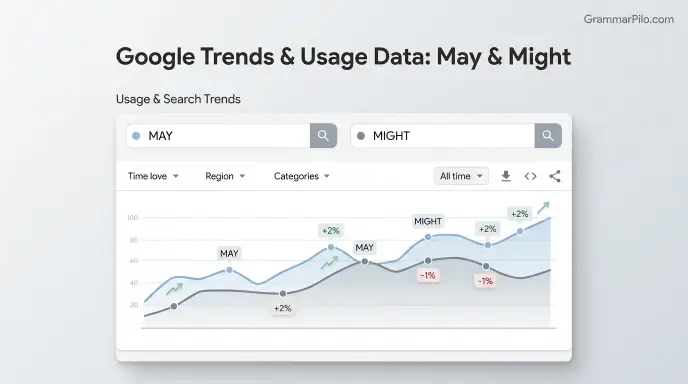
Search interest in “might or may” reflects a common grammar question because both words can express possibility and often appear in similar sentences.
However, Google Trends measures relative search interest, not the total number of times a word or phrase is used in English. Search interest can also change depending on education, grammar lessons, location, and current search behavior.
For practical English usage, major grammar references consistently recognize both may and might as modal verbs used to express possibility. The British Council also describes both as ways to show that something is possible but uncertain.
Rather than treating one word as always “more correct,” it is better to consider the context, certainty, and tone of the sentence.
Frequently Asked Questions
Is “might” more uncertain than “may”?
Often, yes. Might can suggest a weaker or more uncertain possibility than may. However, the difference is not absolute. Native speakers often use the two words interchangeably.
Is “may” more formal than “might”?
Generally, may can sound more formal, especially when expressing permission or possibility in professional writing. The British Council specifically notes that may is more formal than might in possibility contexts.
Can I use “may” and “might” interchangeably?
In many sentences, yes.
It may rain tomorrow.
It might rain tomorrow.
Both are correct. The second may sound a little more uncertain.
Which is correct: “It may rain” or “It might rain”?
Both are correct.
“It may rain” expresses possibility.
“It might rain” also expresses possibility and can sound slightly more tentative.
Is “might” the past tense of “may”?
Sometimes. In reported speech, might can function as the past form of may:
She said, “I may go.”
She said that she might go.
But might is also commonly used for present and future possibilities:
It might rain tomorrow.
Can I say “May I” to ask permission?
Yes. It is a correct and polite way to ask for permission, especially in formal situations.
May I come in?
May I ask a question?
Should I use “may” or “might” in formal writing?
Both can be correct. May is often a good choice for formal statements about possibility, while might is useful when the possibility is more tentative. Choose based on the meaning you want to express.
Conclusion
Might and may are both correct modal verbs used to express possibility. The main difference is usually one of tone and context rather than a strict grammar rule.
May is often more formal and is commonly used to ask for or give permission. It can also express a possible present or future event:
The package may arrive tomorrow.
Might often expresses a more tentative possibility and is common when the speaker is not sure:
The package might arrive tomorrow.
Both words can also be used for past possibilities with have + past participle:
She may have forgotten.
She might have forgotten.
Remember that native speakers do not always make a sharp distinction between the certainty levels of may and might. Context, tone, and emphasis can affect the meaning.
For everyday English, a simple rule works well: use may for possibility and formal permission, and use might for possibility that sounds more uncertain or tentative. Both are standard in British and American English.
Continue Reading

I’m Sloane Mercer, a U.S.-based English language writer focused on grammar, spelling, vocabulary, and everyday English usage. Through GrammarPilo, I provide clear and practical explanations to help readers choose the right words and communicate with confidence.








2 thoughts on “Might or May: What’s the Difference? (With Examples)”