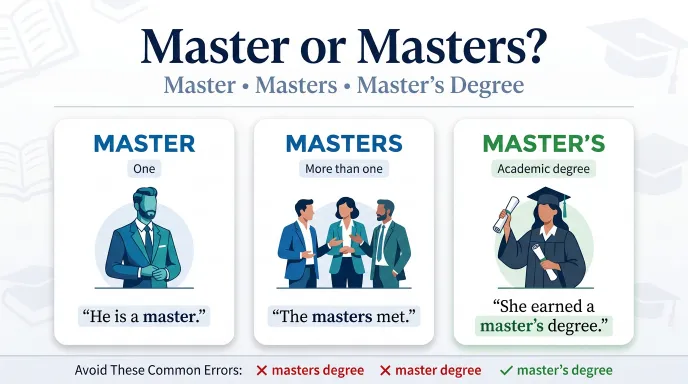
The correct choice between master or masters depends on what you mean. Master is the singular form, while masters can be the plural of master or part of a phrase such as master’s degree. The right form changes with the meaning and sentence structure.
People often search for masters or master because English uses master in several different ways. It can describe a highly skilled person, a person in control, an academic degree, or a title.
The confusion becomes greater when discussing education, because master’s degree contains an apostrophe, while masters without an apostrophe can have a different grammatical role.
For example, you might write, “She has a master’s degree in English,” but “Several masters attended the ceremony” uses masters as a plural noun.
In academic writing, choosing the correct form also matters in phrases such as master degree, masters degree, and master’s program.
This guide explains the difference between master, masters, and master’s, with simple rules and examples for academic, professional, and everyday English.
Master vs. Masters: The Quick Answer
Use master for one person, one thing, or the base form of the word. Use masters for more than one master. And use master’s when showing possession, especially in “master’s degree” or “master’s program.”
Examples:
- He is a master of chess. ✓
- Several masters attended the competition. ✓
- She earned a master’s degree. ✓
- He is studying for a master’s degree. ✓
- She completed her master degree. ✗ in standard English
- She completed her masters degree. ✗ in standard English
The simplest memory rule is:
Master = one
Masters = more than one
Master’s = belonging to or associated with one master, especially in academic terms
Masters vs. Master: What Is the Difference?
The words look almost identical, but their grammatical functions can differ.
Master as a Singular Noun
Master is the singular form when referring to one person who has great skill, authority, or control.
Examples:
He is a master of photography.
The chef is a master of French cooking.
She became a master at solving difficult puzzles.
It can also refer to a person who has authority over something or someone.
The dog returned to its master.
In these examples, master refers to one person.
Masters as a Plural Noun
Masters is the regular plural of master when you mean more than one master.
The masters of several martial arts schools attended the event.
The painting was inspired by the great masters of European art.
Here, masters refers to multiple people.
Master’s for Possession
Master’s contains an apostrophe because it is a possessive form.
The most familiar example is:
master’s degree
The phrase historically means a degree associated with or awarded at the master’s level.
Examples:
She earned a master’s degree in education.
He is pursuing a master’s degree in computer science.
I applied to a master’s program.
This is why master’s degree is normally written with an apostrophe.
What Does Master Mean?
The word master has several meanings in modern English.
Master as an Expert
A master can be someone who has exceptional skill in a particular field.
She is a master of public speaking.
He became a master of classical guitar.
In this sense, master is close to words such as expert, specialist, or highly skilled person.
Master as a Person in Authority
Historically and in some contexts, master has also referred to a person who has authority over others.
The servant waited for his master.
This meaning is less common in many modern everyday contexts, but it still appears in historical writing, literature, and certain specialized expressions.
Master as a Title
Master can also appear as a title in particular contexts.
For example:
Master of the household
or historical and formal uses involving a person with a particular position.
The exact capitalization and usage depend on the title and context.
The Origin of Master and Masters
Master comes through Middle English and Old French from Latin magister, meaning a teacher, leader, or person of authority.
The word became established in English with meanings connected to authority, skill, teaching, and control.
Over time, master developed many uses. It could describe someone who had authority over others, someone highly skilled at a craft, or someone who taught or supervised others.
The plural developed normally:
master → masters
The possessive form developed separately:
master → master’s
This distinction explains why masters and master’s should not be treated as interchangeable spellings.
For example:
The masters met at the conference.
Here, masters is plural.
She completed a master’s degree.
Here, master’s is possessive.
The apostrophe changes the grammatical function.
Master or Masters in British English vs American English
The basic distinction between master, masters, and master’s is similar in British and American English.
| Usage | British English | American English | Example |
| One skilled person | master | master | He is a master of music. |
| More than one | masters | masters | The masters gathered together. |
| Academic degree | master’s degree | master’s degree | She earned a master’s degree. |
| Academic program | master’s program/course | master’s program | He entered a master’s program. |
| Multiple degrees | master’s degrees | master’s degrees | They hold two master’s degrees. |
The main difference is often not the spelling of master itself, but the terminology used by individual universities and institutions.
For example, a university may call a qualification a Master of Arts, Master of Science, or another formal degree title.
When writing a specific degree title, follow the institution’s official capitalization and naming style.
Which Version Should You Use?
Choosing the right form becomes simple when you identify what you are trying to say.
For One Person
Use master.
He is a master of chess.
For More Than One Person
Use masters.
The masters of several schools attended the meeting.
For an Academic Degree
Use master’s degree in ordinary sentence use.
She has a master’s degree in English.
For a Specific Degree Title
Use the official name.
She earned a Master of Arts in English.
He completed a Master of Science in Biology.
Notice that formal degree titles often do not use the possessive apostrophe in the same way as the generic phrase master’s degree.
For Academic Programs
Usually use:
master’s program
master’s course
However, always check the university’s official terminology if you are referring to a named program.
For International Writing
If your audience is international, master’s degree is usually the clearest general phrase.
If you are discussing a specific qualification, use its official title.
Common Mistakes With Master or Masters
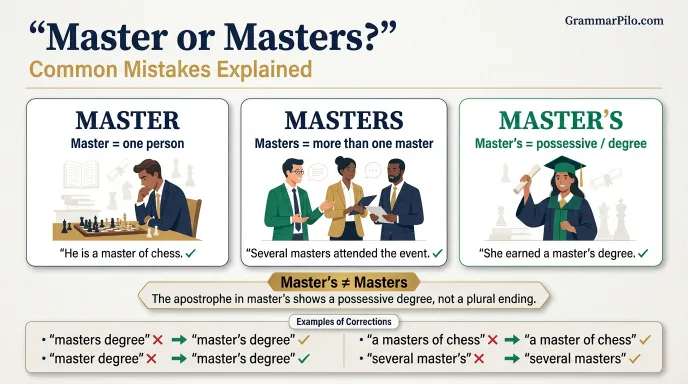
Mistake 1: Writing “Masters Degree”
Incorrect:
She has a masters degree in English.
Correct:
She has a master’s degree in English.
Explanation: The apostrophe shows the possessive form.
Memory tip: Think one master’s degree, not “many masters.”
Mistake 2: Writing “Master Degree”
Incorrect:
He completed his master degree.
Correct:
He completed his master’s degree.
In standard general English, master’s degree is the usual expression.
Mistake 3: Using “Masters” for One Person
Incorrect:
He is a masters of chess.
Correct:
He is a master of chess.
Explanation: One person is a master. The plural masters refers to more than one.
Mistake 4: Confusing Masters With Master’s
Compare:
The masters attended the event.
She earned a master’s degree.
The first word is plural. The second is possessive.
Mistake 5: Using “Master’s” as a Simple Plural
Incorrect:
Several master’s attended the ceremony.
Correct:
Several masters attended the ceremony.
The apostrophe should not be added to make a normal plural.
Masters or Master in Everyday Examples
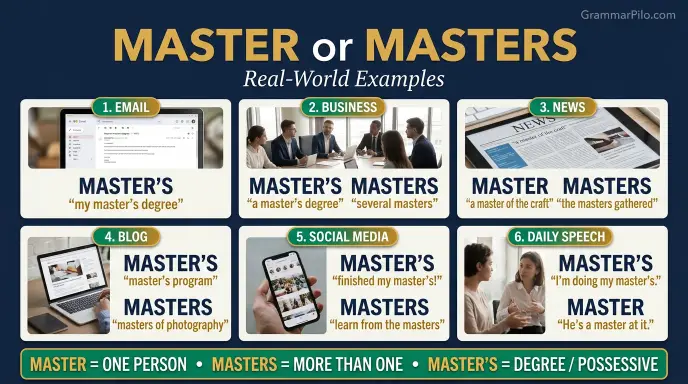
Emails
I am currently completing my master’s degree in English.
Several masters will speak at the conference.
For professional emails, use master’s degree when discussing education.
Business Writing
She holds a master’s degree in business administration.
The company invited several industry masters to the event.
The first sentence describes an academic qualification. The second describes multiple experts.
News Headlines
Local Expert Becomes Master of Traditional Craft
Masters Gather for Annual Competition
Headlines often shorten language, but the underlying grammatical distinction remains the same.
Blogs
How to Choose the Right Master’s Program
The Greatest Masters of Modern Photography
Both forms can appear naturally in blog writing.
Social Media
Finally finished my master’s degree!
Learning from the masters never gets old.
The apostrophe matters even in informal online writing.
Academic Writing
She completed a master’s degree in linguistics.
The work was influenced by several masters of modern literature.
Academic writing requires careful distinction between the academic degree and the plural noun.
Daily Conversation
I’m doing my master’s next year.
He’s a master at fixing old cars.
In informal speech, master’s can sometimes stand alone when the meaning is clearly “master’s degree.”
Master, Masters, or Master’s Degree?
This is one of the most common areas of confusion.
| Form | Function | Example |
| master | Singular noun | He is a master of chess. |
| masters | Plural noun | The masters taught the students. |
| master’s | Possessive singular | She earned a master’s degree. |
| master’s degree | Academic qualification | He has a master’s degree in history. |
| master’s degrees | More than one academic degree | They hold different master’s degrees. |
| Master of Arts | Formal degree title | She earned a Master of Arts. |
This table gives you a useful shortcut:
Master = one person or thing
Masters = multiple masters
Master’s = possessive form
Master’s degree = academic qualification
Google Trends & Modern Usage
Searches for master or masters often come from students and writers who are unsure about academic terminology.
Queries such as master degree or master’s degree, masters degree or master’s degree, and master’s or masters are especially common because the apostrophe is easy to overlook.
In modern academic and professional English, master’s degree is the standard general expression for the qualification. The plural form is master’s degrees when referring to more than one such qualification.
The word masters remains perfectly correct when it functions as a normal plural noun.
For example:
The great masters influenced later artists.
This is different from:
She earned a master’s degree in art history.
Exact Google search volume figures can change over time and should not be assumed without checking current search data.
The broader usage pattern is clear: most confusion comes from the difference between plural masters and possessive master’s.
Quick Comparison Table
| Version | Meaning | Correct? | Typical Context | Example |
| master | One person/expert | ✓ | General English | He is a master of the craft. |
| masters | More than one master | ✓ | General English | The masters shared their knowledge. |
| master’s | Possessive singular | ✓ | Grammar | She earned a master’s degree. |
| masters’ | Possessive plural | ✓ | Rare/specific contexts | The masters’ opinions differed. |
| master degree | Intended academic degree | Usually ✗ | Education | Use master’s degree instead. |
| masters degree | Intended academic degree | Usually ✗ | Education | Use master’s degree instead. |
| master’s degree | Graduate academic qualification | ✓ | Education | She earned a master’s degree. |
| master’s degrees | More than one graduate degree | ✓ | Education | They hold two master’s degrees. |
Key Takeaways
- Master is the singular form.
- Masters is the normal plural of master.
- Master’s is the possessive form.
- Master’s degree is the standard phrase for the academic qualification.
- Masters degree is normally missing the apostrophe.
- Master degree is not the usual standard form.
- Masters can correctly refer to multiple experts or people called masters.
- Master’s degrees is the correct plural for multiple master’s degrees.
- Always check the meaning before deciding if an apostrophe is needed.
FAQs About Master or Masters
Is it master or masters?
Use master for one person or thing and masters for more than one. For example, “He is a master of chess” refers to one person, while “The masters met at the event” refers to several.
If you mean the academic qualification, the usual phrase is master’s degree, with an apostrophe.
Is it master degree or master’s degree?
The standard expression is master’s degree. The apostrophe is important because master’s is the possessive form.
For example, “She earned a master’s degree in English.” In a formal degree title, however, you may see Master of Arts or Master of Science without an apostrophe.
Is masters degree correct?
In standard general English, masters degree is usually considered incorrect because it omits the apostrophe in master’s degree. Write “He is pursuing a master’s degree” rather than “He is pursuing a masters degree.”
What is the plural of master’s degree?
The plural is master’s degrees. The apostrophe remains because master’s is part of the established expression.
For example, “The university offers several master’s degrees in education, science, and business.”
Should I write Master’s degree with a capital M?
Usually, write master’s degree in lowercase when using it as a general description. However, formal degree names such as Master of Arts and Master of Science are capitalized according to standard title conventions and institutional style.
Is masters a plural word?
Yes. Masters can be the plural of master. For example, “The masters of the craft passed their knowledge to younger artists.” It can also appear in names or titles with special capitalization, so context matters.
What is the difference between masters and master’s?
Masters is normally a plural noun, meaning more than one master. Master’s is a possessive form and is commonly used in master’s degree. Compare “The masters met” with “She earned a master’s degree.”
Can I say “I am doing my masters”?
In informal English, especially in some regions, people may say “I’m doing my masters” to mean they are studying for a master’s degree.
In polished formal writing, “I am doing my master’s” or “I am pursuing a master’s degree” is clearer.
Is it Master or Masters in a degree title?
Formal degree titles are normally written as Master of Arts, Master of Science, Master of Business Administration, and similar forms. The exact title should follow the name used by the awarding institution.
Is “masters” correct for two master’s degrees?
Not by itself. If you mean two academic qualifications, write two master’s degrees. The word masters without an apostrophe normally functions as the plural of master, not as a shortened plural of master’s degree.
Conclusion
The difference between master or masters is straightforward once you identify the grammatical role of the word.
Master is singular, while masters is its regular plural. If you are referring to more than one expert, leader, or person described as a master, masters is correct.
Academic writing creates the most confusion because the standard phrase is master’s degree, not master degree or masters degree.
The apostrophe in master’s is important because it marks the possessive form. When you refer to more than one qualification, use master’s degrees.
For formal degree names, use the institution’s official title, such as Master of Arts or Master of Science.
A simple rule will help you remember the difference: master means one, masters means more than one, and master’s is the form commonly used in master’s degree.
If you are writing for school, university, work, or publication, taking one extra second to check the apostrophe can make your writing much clearer.
Remember: Master is one, masters are many, and master’s degree is the academic qualification.
Some More Differences are Here!
- Take or Pay: How These Two Words Work in Different Sentences
- Oriented or Orientated: Which Form Is Correct?
- Staffs or Staves: A Simple Guide to the Correct Usage

I’m Claire Morgan, the author behind Grammarpilo.com, where I write about English grammar, sentence structure, punctuation, and everyday language. My goal is to make grammar simple, clear, and practical, helping readers understand the rules and apply them with confidence in real-world writing.





1 thought on “Master or Masters: The Simple Guide to Using Them Correctly”