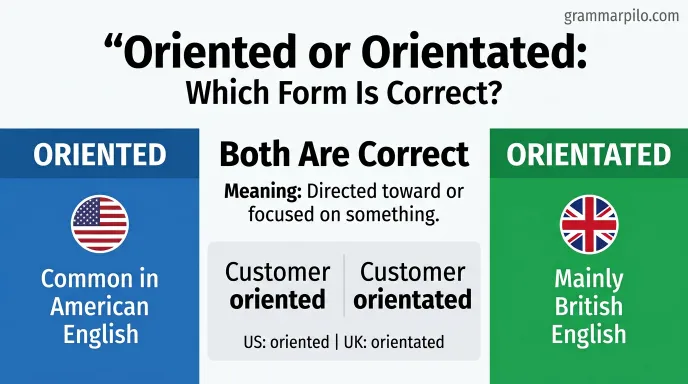
Oriented and orientated are both correct forms, but their regional preferences differ. Oriented is more common in American English, while orientated is mainly associated with British English.
Both can mean directed toward, focused on, or adapted for something. For example, customer oriented and customer orientated can both be used.
This difference often causes confusion because many writers learn oriented first and then encounter orientated in British books, websites, or professional writing. Others grow up using orientated and wonder if oriented is the only acceptable form.
The confusion becomes even greater with expressions such as customer oriented, customer orientated, goal oriented, and goal orientated. Both patterns can appear in standard English, although their regional preferences differ.
In this guide, you will learn the difference between oriented and orientated, how each form is used, which version is more natural in American and British English, common mistakes to avoid, and how to choose the right form for academic, business, and everyday writing.
orientated or Oriented : Quick Answer
Both oriented and orientated are legitimate English forms.
The main distinction is regional preference:
- Oriented is especially common in American English.
- Orientated is mainly used in British English.
- British English can also use oriented.
- American English can recognize orientate, but orient and oriented are generally preferred.
- Both forms can appear in compounds such as goal oriented and goal orientated.
Example 1: American English
The company is customer oriented.
Example 2: British English
The company is customer orientated.
Example 3: Either Variety
The course is career oriented.
The course is career orientated.
The choice often comes down to the variety of English being used and the style preferred by the organization or publication.
What Does Oriented or Orientated Mean?
Oriented and orientated are related to the verb orient or orientate.
The basic idea is directing something toward a particular point, purpose, group, or goal.
Oxford defines orient as directing someone or something toward something or making someone or something suitable for a particular purpose. Oxford also lists orientate as an alternative verb, with orientated as its past form and past participle.
Oriented
Oriented can describe something that is directed toward a particular purpose.
The program is oriented toward practical skills.
It can also describe a person who is focused on something.
She is highly oriented toward research.
The word frequently appears in compounds:
- customer oriented
- goal oriented
- results oriented
- family oriented
- career oriented
- service oriented
- detail oriented
- research oriented
Cambridge describes oriented as showing the direction in which something is aimed or indicating that something is directed toward or interested in something.
Orientated
Orientated carries essentially the same basic meaning.
The program is orientated towards practical skills.
It is particularly common in British English.
Cambridge labels orientated as mainly British and gives oriented as the mainly American counterpart.
It can also appear in compounds:
- customer orientated
- goal orientated
- results orientated
- family orientated
- career orientated
- service orientated
The Origin of Oriented and Orientated
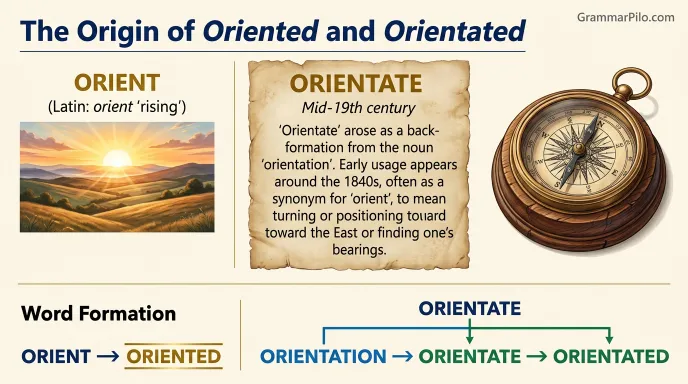
The history of these forms begins with orient.
Oxford traces orient to Late Middle English, through Old French, from Latin orient , meaning “rising” or “east,” from the Latin verb oriri, meaning “to rise.”
The original connection with the east is important because the rising sun was associated with the eastern direction. Over time, the meaning of orient developed beyond physical direction.
It came to mean finding one’s position, understanding one’s surroundings, and directing something toward a particular purpose.
The verb orientate developed later. Oxford dates it to the mid 19th century and describes it as probably a back formation from orientation.
This helps explain why English has both forms.
The two modern patterns can be summarized as:
orient → oriented
orientate → orientated
Both have established usage, but their regional preferences are different.
The noun orientation is also widely used in modern English. It can refer to a person’s aims or interests, the direction of something, or training provided to people starting a new job or course.
British English vs American English
The clearest difference between oriented and orientated is regional preference.
| British English | American English | Example |
| oriented | oriented | The course is oriented toward practical skills. |
| orientated | orientated can occur | The course is orientated towards practical skills. |
| customer oriented | customer oriented | The business is customer oriented. |
| customer orientated | Less common | The business is customer orientated. |
| goal oriented | goal oriented | She is goal oriented. |
| goal orientated | Less common | She is goal orientated. |
| orient | orient | He needed time to orient himself. |
| orientate | Mainly British preference | She needed time to orientate herself. |
Cambridge identifies oriented as mainly American in its general entry while also noting that British English uses it. It identifies orientated as mainly British and points readers toward oriented.
Oxford is broader in its treatment. It lists orient and orientate as alternatives and gives the corresponding verb forms oriented and orientated.
This means it is inaccurate to say that orientated is simply wrong. It is an established form, particularly in British English.
Which Version Should You Use?
Your choice should depend mainly on your audience and the variety of English you are writing.
United States
For American readers, oriented is usually the more natural choice.
The company is customer oriented.
The course is career oriented.
United Kingdom
British English allows both forms, but orientated is well established.
The company is customer orientated.
The course is career orientated.
British English also uses oriented, particularly in many professional and international contexts.
Canada
Canadian English can use both forms. If your publication follows American style usage, oriented may be the natural choice. If it follows British influenced conventions, orientated may also appear.
Consistency is more important than switching between forms without a reason.
Australia
Australian English uses both forms, with orientated appearing in British influenced usage. The appropriate choice can depend on the publication’s established style.
International Writing
For a broad international audience, oriented is often a straightforward choice, especially in global business, technology, and digital content.
However, orientated should not automatically be treated as an error.
Academic Writing
Academic writers should follow the style guide or institutional preference.
If the surrounding document uses American English, oriented is usually a natural choice:
The study used a community oriented approach.
For British English:
The study used a community orientated approach.
Business Writing
Business writing frequently uses compounds such as:
- customer oriented
- results oriented
- market oriented
- service oriented
- employee oriented
British business writing can also use:
- customer orientated
- results orientated
- market orientated
- service orientated
- employee orientated
Cambridge’s Business English material specifically recognizes oriented and notes orientated as a UK form.
Common Mistakes With Oriented or Orientated
Mistake 1: Calling Orientated Incorrect
Incorrect claim:
Orientated is always wrong.
Better understanding:
Orientated is a standard English form, especially in British English.
Explanation:
Cambridge labels it mainly UK and gives oriented as the mainly US counterpart. Oxford also lists orientate and its forms.
Memory tip:
Think British English → orientated can be natural.
Mistake 2: Assuming Oriented Is Only American
Incorrect claim:
British English never uses oriented.
Better understanding:
British English can use oriented as well.
Explanation:
The distinction is mainly about preference, not a strict grammatical rule.
Memory tip:
Oriented works across major English varieties.
Mistake 3: Mixing Forms in the Same Document
Less consistent:
The report uses customer oriented in one section and customer orientated in another without a style reason.
Better:
Choose one style and use it consistently.
Explanation:
Consistency makes professional writing easier to edit and read.
Memory tip:
Pick the form that matches your target variety.
Mistake 4: Assuming Every Compound Has Only One Correct Form
Incorrect claim:
Goal orientated is incorrect because only goal oriented is standard.
Better understanding:
Both goal oriented and goal orientated are established patterns.
Oxford lists oriented and orientated as alternative forms.
Memory tip:
The difference is usually regional preference, not a simple correct versus incorrect rule.
Mistake 5: Confusing Oriented With Orientation
Incorrect:
“The company is orientation toward customers.”
Correct:
“The company is oriented toward customers.”
Explanation:
Orientation is a noun, while oriented is an adjective or past participle.
For example:
The company has a strong customer orientation.
The company is customer oriented.
Everyday Examples of Oriented or Orientated
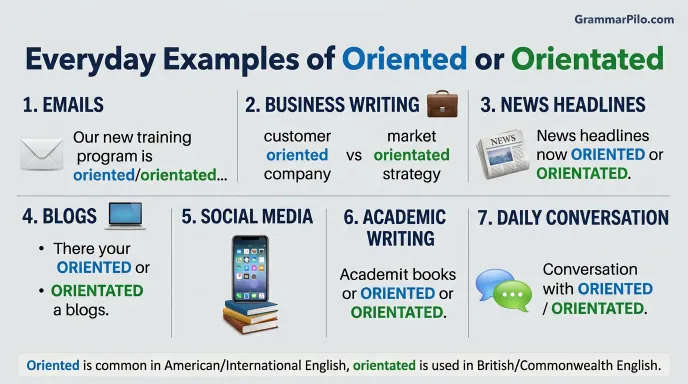
Emails
American style:
Our new training program is oriented toward practical workplace skills.
British style:
Our new training program is orientated towards practical workplace skills.
Business Writing
We are a customer oriented company.
The organization has developed a more market orientated strategy.
Both forms can work, depending on the chosen variety and house style.
News Headlines
New Program Takes a Student Oriented Approach
A British publication could use:
New Program Takes a Student Orientated Approach
Blogs
This guide is designed for readers who prefer practical, example oriented learning.
The course uses a learner orientated approach.
Social Media
Looking for a customer oriented business that puts service first?
We are building a community orientated project.
Academic Writing
The research adopted a data oriented approach.
The researchers developed a community orientated framework.
The preferred form should match the style of the academic publication.
Daily Conversation
She is very goal oriented.
He is more family oriented than career oriented.
In ordinary conversation, oriented is especially common in many international contexts.
Oriented or Orientated in Compound Words
One of the biggest reasons people search for oriented or orientated is that both forms appear in compound adjectives.
Common examples include:
| Oriented Form | Orientated Form | Meaning |
| customer oriented | customer orientated | focused on customers |
| goal oriented | goal orientated | focused on goals |
| results oriented | results orientated | focused on results |
| career oriented | career orientated | focused on career |
| family oriented | family orientated | focused on family |
| service oriented | service orientated | focused on service |
| market oriented | market orientated | focused on the market |
| detail oriented | detail orientated | focused on details |
| research oriented | research orientated | focused on research |
Oxford specifically lists oriented and orientated as alternative combining forms.
Cambridge likewise gives examples such as profit oriented and profit orientated, with the regional distinction reflected in its dictionary entries.
This is why you may encounter both spellings even within reputable publications.
Google Trends & Modern Usage
Searches for oriented or orientated often come from writers who have encountered different forms in different varieties of English.
Common searches include:
- oriented or orientated
- orientated or oriented
- oriented vs. orientated
- orientated vs. oriented
- customer oriented or customer orientated
- goal oriented or goal orientated
- is orientated correct
- is oriented British English
- orientated British or American
- oriented British English
These searches reflect a real regional usage difference.
Cambridge currently labels orientated as mainly UK and oriented as mainly US in its relevant entries, while also showing that British English uses oriented.
Exact Google Trends popularity can change based on country, date range, search category, and search type. Without a defined Trends dataset, specific search volume claims should not be made.
For modern writing, the safest approach is to consider your audience first.
If the document is primarily American, oriented will usually fit naturally.
If it follows British English, orientated can be a natural choice, although oriented is also accepted.
Quick Comparison Table
| Version | Meaning | Correct? | Region | Example |
| oriented | Directed toward or focused on something | Yes | US, UK, international | The program is oriented toward students. |
| orientated | Directed toward or focused on something | Yes | Mainly UK | The program is orientated towards students. |
| oriented | Focused on a particular goal or group | Yes | Especially common in US | It is customer oriented. |
| orientated | Focused on a particular goal or group | Yes | Especially common in UK | It is customer orientated. |
| orient | Direct or become familiar with surroundings | Yes | Broad English | He tried to orient himself. |
| orientate | Direct or become familiar with surroundings | Yes | Mainly UK | He tried to orientate himself. |
Key Takeaways
- Oriented and orientated are both established English forms.
- Oriented is especially common in American English.
- Orientated is mainly associated with British English.
- British English also uses oriented.
- Both forms can appear in compounds such as goal oriented and goal orientated.
- The difference is mainly regional preference and style.
- Use one form consistently within a document.
- Orient and orientate are the related verb forms.
- Check your publication’s style guide when writing for a specific institution or publisher.
- For broad international content, oriented is often a clear and familiar choice.
FAQs About Oriented or Orientated
Is oriented or orientated correct?
Both oriented and orientated are correct. Oriented is especially common in American English, while orientated is mainly used in British English. British English can also use oriented, so the difference is mainly one of regional preference rather than a strict grammar rule.
Is orientated British or American English?
Orientated is mainly associated with British English. Cambridge identifies it as mainly UK and gives oriented as the mainly US alternative. British writers can also use oriented, particularly in professional and international contexts.
Is oriented American English?
Oriented is especially common in American English, but it is not limited to the United States. British English also uses oriented. Oxford lists orient and orientate as alternative verbs, with oriented and orientated as their corresponding forms.
Should I write customer oriented or customer orientated?
Both are established forms. Customer oriented is particularly natural in American English, while customer orientated is common in British English. If you are writing for a specific organization, follow its established style. The most important point is to remain consistent throughout the document.
Is goal oriented or goal orientated correct?
Both forms are used. Goal oriented is especially common in American English, while goal orientated can be found in British English. Oxford recognizes oriented and orientated as alternative combining forms, so neither should automatically be treated as an error.
Can I use oriented in British English?
Yes. Oriented is used in British English as well as American English. Cambridge identifies orientated as mainly UK but also presents oriented as a British usage. Therefore, British writers do not have to replace every instance of oriented with orientated.
Can I use orientated in American English?
Orientated exists in English, but oriented is generally the more natural choice for American readers. If you are following American English conventions, especially in business or academic writing, oriented will usually provide the expected style.
Is orientate a real word?
Yes. Orientate is an established verb. Oxford lists it as an alternative to orient, and Cambridge labels it mainly UK. Its forms include orientated as the past simple and past participle.
What is the difference between orient and orientate?
The two verbs have closely related meanings. Both can mean directing someone or something toward a particular purpose or helping someone understand their position. Orientate is mainly associated with British English, while orient is particularly common in American English.
Which form is better for international writing?
For broad international writing, oriented is often a practical choice because it is widely recognized and common in international business and digital content. However, orientated is also a valid form and should not be treated as an error. Your audience and publication style should guide the final choice.
Conclusion
The difference between oriented and orientated is mainly about regional preference, not a simple correct versus incorrect rule.
Oriented is especially common in American English and is also used in British English. Orientated is mainly associated with British English and is a fully established form. Cambridge and Oxford both recognize the relationship between the two forms.
The same distinction appears in compound adjectives. You may see customer oriented and customer orientated, as well as goal oriented and goal orientated. Both patterns can be correct when they match the chosen variety and style.
For American English, oriented is generally the natural choice. For British English, orientated is available, although oriented is also accepted. And for international writing, choose a consistent style and avoid switching between the forms without a reason.
The easiest rule to remember is:
Oriented is especially common in American English; orientated is mainly British English. Both are correct.
Choose the form that fits your audience, keep your usage consistent, and your writing will remain clear and professional.
You Might Like
- Sang or Sung: Understanding Irregular Verb Forms
- Among or Between: Learn the Difference
- Transitive or Intransitive: A Simple Grammar Guide

I’m Sloane Mercer, a U.S.-based English language writer focused on grammar, spelling, vocabulary, and everyday English usage. Through GrammarPilo, I provide clear and practical explanations to help readers choose the right words and communicate with confidence.





1 thought on “Oriented or Orientated: Which Form Is Correct?”