
A transitive verb takes a direct object, while an intransitive verb does not need or take a direct object. This simple difference is one of the most common grammar questions for English learners.
People often search for “transitive or intransitive” because they want to know why some verbs need an object while others can stand alone.
For example:
- She opened the door. → “opened” is transitive because it has the object door.
- The door opened. → “opened” is intransitive because there is no direct object.
The confusion becomes greater because some English verbs can be used both transitively and intransitively. For example, we can say “She sings a song” and “She sings every day.” The first sentence has an object, while the second does not.
Cambridge Grammar explains that some verbs are normally transitive, some are normally intransitive, and others can be used in both ways.
Understanding this difference helps you build correct sentences, avoid unnecessary prepositions, and understand English verb patterns more easily.
Transitive or Intransitive: Quick Answer
A transitive verb needs or takes a direct object. An intransitive verb does not take a direct object.
Transitive verb
A transitive verb transfers an action from the subject to an object.
Maria opened the window.
- Maria = subject
- opened = verb
- the window = direct object
The verb opened is transitive because the action is directed toward the window.
Intransitive verb
An intransitive verb does not have a direct object.
The baby slept.
- The baby = subject
- slept = verb
There is no direct object after slept, so it is intransitive in this sentence.
Cambridge defines a transitive verb as one that has or needs an object, while an intransitive verb has or needs no object.
Quick rule
Transitive = verb + object
Intransitive = verb without a direct object
For example:
She bought a book. → Transitive
She laughed. → Intransitive
Definition and Meaning of Intransitive and Transitive
What Does “Transitive” Mean?
In grammar, transitive describes a verb that has or needs a direct object.
A direct object is the person or thing that receives the action of the verb.
Consider:
James kicked the ball.
The verb is kicked.
What did James kick?
The ball.
Therefore, kicked is transitive in this sentence.
More examples:
- She read the book.
- We watched the movie.
- They built a house.
- He opened the door.
- I answered the question.
In each example, the verb has a direct object.
What Does “Intransitive” Mean?
Intransitive describes a verb that does not have or need a direct object.
For example:
The children laughed.
The verb laughed does not act directly on an object.
Other examples include:
- The baby slept.
- We arrived early.
- She smiled.
- The bird flew away.
- They waited outside.
These verbs can form complete sentences without a direct object.
Cambridge gives verbs such as arrive, die, appear, come, fall, happen, rain, rise, wait, and work as common intransitive verbs.
What Is the Difference Between Transitive and Intransitive?
The main difference is the direct object.
| Type | Needs a direct object? | Example |
| Transitive | Yes | She opened the door. |
| Intransitive | No | The door opened. |
| Both | Depends on use | She sings a song / She sings. |
The important point is that a verb’s type can depend on how it is used in a particular sentence.
The Origin of Transitive or Intransitive Verb
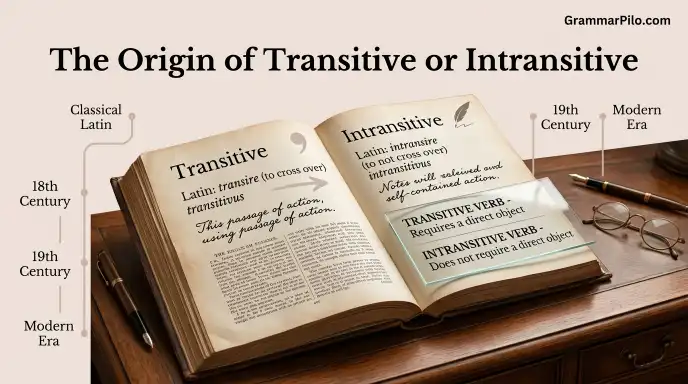
The terms transitive and intransitive come from Latin.
Origin of “Transitive”
Transitive comes from the Latin word transitivus, which is related to transire, meaning “to go across” or “to pass over.”
In grammar, the idea is that the action of the verb passes from the subject to an object.
For example:
The boy kicked the ball.
The action moves from the boy to the ball.
This helps explain why the term transitive is used for verbs that take an object.
Origin of “Intransitive”
Intransitive is formed with the prefix in-, meaning “not,” combined with the idea behind transitive.
So, the basic idea is:
- Transitive → action passes to an object.
- Intransitive → no direct object receives the action.
These terms describe grammar, not different spellings.
Why Are They Sometimes Confused?
The confusion usually comes from verbs that can work in both patterns.
For example:
She opened the door.
Here, opened is transitive.
The door opened.
Here, opened is intransitive.
The spelling of the verb has not changed. Its grammatical use has changed.
Cambridge Grammar confirms that some verbs can be used with an object or without one.
British English vs American English Spelling
There is no British-versus-American spelling difference between transitive and intransitive.
Both words are spelled the same in British and American English.
| Word | British English | American English |
| transitive | Correct | Correct |
| intransitive | Correct | Correct |
| transitive verb | Correct | Correct |
| intransitive verb | Correct | Correct |
| Spelling difference | None | None |
British English Examples
“Open” can be used as a transitive or intransitive verb.
“Arrive” is normally used as an intransitive verb.
American English Examples
“Open” can be transitive or intransitive.
“Arrive” does not normally take a direct object.
The grammar terms themselves do not change between the two varieties.
However, individual verbs can sometimes have different patterns or preferences in British and American English. Cambridge notes, for example, that the verb write can have different transitive and intransitive patterns in different varieties.
So, the key distinction is verb usage, not spelling.
Which Spelling Should You Use?
You do not need to choose between a British and American spelling here.
Use:
transitive
when describing a verb that takes a direct object.
Use:
intransitive
when describing a verb that does not take a direct object.
For American English
The terms are standard in American grammar teaching and writing.
Example:
“Hit” is a transitive verb in the sentence “The car hit the tree.”
Cambridge’s American Dictionary gives this same basic pattern: the object receives the action of the verb.
For British English
The same terms and rules apply.
Example:
“She opened the door” uses “opened” transitively.
“The door opened” uses “opened” intransitively.
For ESL Learners
If English is not your first language, focus on one simple question:
Does the verb have a direct object?
If yes, the verb is being used transitively.
If no, it is being used intransitively.
However, do not assume that every verb always belongs to only one group. Many verbs can change between the two patterns.
Common Mistakes with Intransitive or Transitive
Mistake 1: Thinking every verb is only transitive or only intransitive
This is not always true.
Some verbs can be used in both ways.
For example:
She opened the door. → Transitive
The door opened. → Intransitive
Mistake 2: Adding an unnecessary object
Some verbs do not need a direct object.
Incorrect:
We arrived the station.
Better:
We arrived at the station.
Arrive is normally intransitive, so it does not take the place directly as its object.
Mistake 3: Adding an unnecessary preposition after a transitive verb
Some verbs take a direct object without a preposition.
Correct:
We discussed the problem.
Not:
We discussed about the problem.
Cambridge specifically notes that verbs such as discuss do not need a preposition before their direct object.
Mistake 4: Thinking every sentence needs an object
An English sentence can be complete without a direct object.
For example:
The baby cried.
The children laughed.
She arrived early.
These are complete sentences.
Mistake 5: Confusing a prepositional phrase with a direct object
Consider:
She slept on the sofa.
The phrase on the sofa tells us where she slept. It is not a direct object.
The verb slept remains intransitive.
Mistake 6: Assuming the verb’s type never changes
Some verbs can be both transitive and intransitive.
For example:
He runs a business. → Transitive
He runs every morning. → Intransitive
The verb runs changes its grammatical pattern according to the sentence.
Intransitive vs. Transitive in Everyday Examples
In an Email
Please review the document before Friday.
Review is transitive because it has the direct object the document.
In News Writing
The storm damaged several buildings.
Damaged is transitive because several buildings receives the action.
In Social Media
My dog jumped when he heard the noise.
Jumped is intransitive because there is no direct object.
In Formal Writing
The study examined the effects of sleep deprivation.
Examined is transitive because it has the object the effects.
In Everyday Conversation
We ate dinner.
Here, ate is transitive.
But:
We ate at six.
Here, ate is used without a direct object and is intransitive.
More Examples
| Sentence | Verb | Type |
| She opened the window. | opened | Transitive |
| The window opened. | opened | Intransitive |
| He reads books. | reads | Transitive |
| He reads every night. | reads | Intransitive |
| They built a house. | built | Transitive |
| The house collapsed. | collapsed | Intransitive |
| She sings a song. | sings | Transitive |
| She sings beautifully. | sings | Intransitive |
Transitive or Intransitive : Google Trends & Usage Data
People searching for “transitive or intransitive” usually have strong educational or informational intent. They may be English learners, students, teachers, writers, or people checking how a particular verb works.
Google Trends measures relative search interest, not total language usage. It also does not tell us if one grammatical category is “better” than another. For this topic, dictionary and grammar references are more useful for explaining the actual rule.
Cambridge and the British Council both explain the basic distinction through the presence or absence of an object. The British Council gives examples such as “John wanted a new bicycle” for transitive use and “John smiled” for intransitive use. It also notes that some verbs can be used in both patterns.
Search interest is likely to be strongest in contexts where English grammar is studied, including:
| Context | Why people search |
| ESL learning | Understanding verb patterns |
| School grammar | Learning sentence structure |
| Academic writing | Checking correct verb usage |
| Teaching | Explaining objects and verbs |
| Editing | Correcting sentence structure |
| Grammar tests | Identifying verb types |
| Writing | Choosing the correct construction |
Transitive vs Intransitive: Comparison Table
| Feature | Transitive | Intransitive |
| Takes a direct object | Yes | No |
| Basic pattern | Subject + Verb + Object | Subject + Verb |
| Example | She opened the door. | The door opened. |
| Action reaches an object | Yes | No direct object |
| Can use a prepositional phrase? | Yes | Yes |
| Always one type? | No | No |
| Can some verbs use both patterns? | Yes | Yes |
| Main question | “Verb + what/whom?” | “No direct object?” |
Simple Test
To identify a transitive verb, ask:
Verb + what?
or
Verb + whom?
For example:
She bought a car.
She bought what?
A car.
So bought is transitive.
Now consider:
She laughed.
She laughed what?
There is no direct object.
So laughed is intransitive.
This test is useful, but it should be used with care because some verbs have special patterns and may require a preposition or another type of complement.
FAQs About Transitive or Intransitive
1. What is a transitive verb?
A transitive verb is a verb that has or needs a direct object.
Example:
She opened the door.
Door is the direct object.
2. What is an intransitive verb?
An intransitive verb does not have or need a direct object.
Example:
The baby slept.
There is no direct object after slept.
3. Can one verb be both transitive and intransitive?
Yes. Many verbs can be used both ways.
For example:
She opened the door. → Transitive
The door opened. → Intransitive
Cambridge Grammar gives several examples of verbs that can work with or without an object.
4. How can I tell if a verb is transitive?
Look for a direct object after the verb. You can often ask “what?” or “whom?”
Example:
He kicked the ball.
Kicked what?
The ball.
Therefore, kicked is transitive.
5. Does an intransitive verb never have anything after it?
No. An intransitive verb can be followed by other information, such as an adverb or prepositional phrase.
Example:
She arrived at noon.
“At noon” gives information about time, but it is not a direct object.
6. Is “arrive” transitive or intransitive?
Arrive is normally intransitive.
You can say:
We arrived at the station.
But not:
We arrived the station.
The phrase at the station is a prepositional phrase, not a direct object.
7. Is “eat” transitive or intransitive?
Eat can be both.
Transitive:
We ate dinner.
Intransitive:
We ate at six.
Cambridge includes eat among verbs that can be used either transitively or intransitively.
Conclusion
Transitive and intransitive describe how a verb works with an object. A transitive verb takes or needs a direct object, while an intransitive verb does not. This is the main rule to remember.
For example, “She opened the door” uses opened transitively because the door is the direct object. But in “The door opened,” there is no direct object, so opened is used intransitively.
Some verbs can work in both ways, which is why the same verb may be transitive in one sentence and intransitive in another.
There is no British-versus-American spelling difference between transitive and intransitive. The terms are used in both varieties of English. The important issue is understanding the verb pattern in the sentence.
When you are unsure, look for the direct object. Ask “what?” or “whom?” after the verb. If there is a direct object, the verb is transitive. If there is no direct object, it is usually intransitive.
Once you understand this simple pattern, transitive and intransitive verbs become much easier to identify and use correctly.
See More:

I’m Claire Morgan, the author behind Grammarpilo.com, where I write about English grammar, sentence structure, punctuation, and everyday language. My goal is to make grammar simple, clear, and practical, helping readers understand the rules and apply them with confidence in real-world writing.








3 thoughts on “Transitive or Intransitive: What’s the Difference?”